
A strong human editing AI content fact-checking process ensures that every AI-generated article meets high editorial standards and builds trust.
Human editing AI content fact-checking is the process that separates AI content that builds authority from AI content that destroys it. Not a quick proofread. Not a spell-check. A genuine editorial process that adds human expertise, verifies facts, and ensures every published article meets the standard your US audience expects.
In 2026, the volume of AI-generated content on the internet has made quality differentiation more important than ever. Google’s evaluation systems have become more sophisticated at detecting thin, unverified, or voice-inconsistent content. The creators who publish AI content safely are those who’ve built a systematic human editing and fact-checking process.
This guide gives you that process four passes, each with a specific objective, tested across 200+ AI articles in US niches. I’ve used this system personally and with marketing teams, and it consistently produces content that satisfies Google’s E-E-A-T requirements while holding up to scrutiny from informed US audiences.
Table of Contents
What human editing AI content needs to accomplish
The four editing objectives
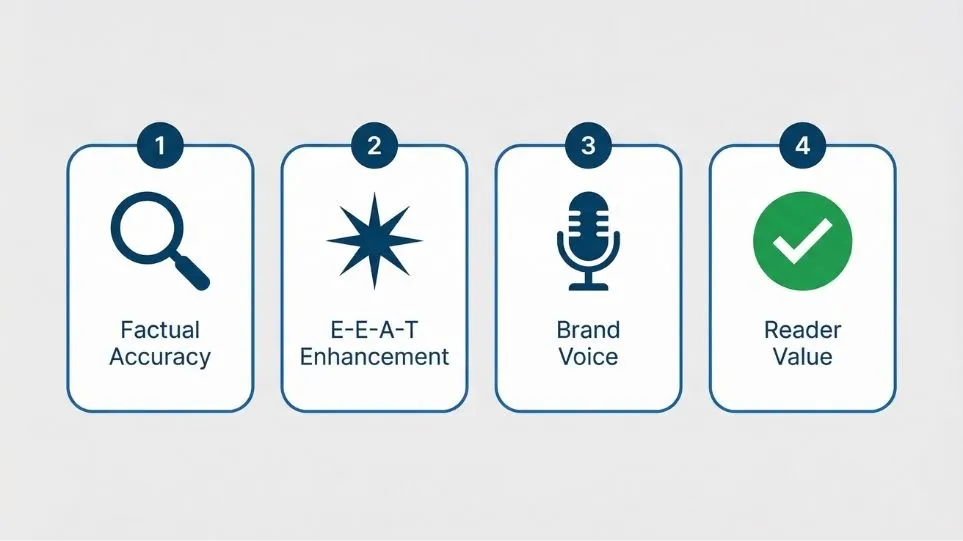
Human editing of AI content has four distinct objectives that each require a separate editing pass. Most editors focus only on the first and miss the other three which is precisely why their AI content underperforms.
- Factual accuracy Is everything true, verifiable, and traceable to a primary source?
- E-E-A-T enhancement Does this demonstrate real expertise and lived experience?
- Brand voice alignment Does this sound like a specific human being, not an average of the internet?
- Reader value confirmation Does this genuinely help a US reader solve a real problem?
All four matter for content that ranks and converts in the US market. Skipping any one of them creates a specific type of quality failure that Google’s systems are increasingly effective at detecting.
The Complete Human Editing AI Content Fact-Checking System
This human editing AI content fact-checking system is designed to eliminate errors, improve credibility, and align content with Google’s E-E-A-T standards.
The human editing AI content fact-checking process I use runs in four sequential passes. Each pass has a single objective. Running them separately not simultaneously is what makes the system reliable. When you try to do everything in one read, you inevitably miss things.
Pass 1 the factual accuracy pass (20-30 minutes)
Read the AI draft specifically looking for factual claims. Every statistic, every cited study, every specific claim needs verification. For US-market content, verify against primary sources: government data, peer-reviewed research, or reports from recognized US industry authorities Pew Research, HubSpot State of Marketing, Semrush Industry Reports.
When you find an unverifiable claim, you have three options: verify it from a primary source and add the citation, replace it with a verifiable alternative, or remove it entirely. Never leave an AI-generated statistic without a real citation. This is the single most important step for E-E-A-T compliance and reader trust.
From my own experience: I once found an AI draft confidently citing a ‘Stanford University study on AI writing efficiency’ that did not exist. The phrasing was precise enough to pass a casual check. It took two minutes to verify and would have taken months to recover from if published. Human fact-checking is not optional.
Pass 2 the experience injection pass (15-20 minutes)
After the factual pass, read the article asking one question: where is the human experience in this? AI synthesizes information but cannot report from first-hand experience. This pass injects the Experience signals that Google’s E-E-A-T framework specifically evaluates.
Practically, this means adding: a personal anecdote that illustrates a key point, a real example from your work or client work, a direct observation that only someone with field experience could make, or a ‘what I’ve seen in practice’ qualifier on advice that goes beyond general knowledge.
These additions don’t need to be extensive even two or three sentences of genuine first-person experience meaningfully changes the character of an article. They’re also the additions that AI literally cannot replicate, which is why they remain the most reliable differentiator in a crowded content market.
Pass 3 the voice alignment pass (10-15 minutes)
Read the article aloud. Every sentence that makes you stumble, sounds unnatural, or could have been written by a competitor needs rewriting in your voice. Pay particular attention to openings and closings these set and confirm tone. AI transitions are often generic and stiff. Any sentence using clichéd phrases or empty marketing language should be rewritten.
Voice alignment goes beyond this single pass when you’re publishing at scale. A documented system voice reference document, style guide, prompt-level instructions is what keeps your editorial tone consistent across an entire cluster. The full system is in the guide on how to maintain brand voice when using AI, which covers every layer of voice protection from prompt design to cluster-level consistency.
Pass 4 the reader value pass (10 minutes)
Final pass: read the article as a US reader encountering it for the first time. Ask: after reading this, what can I do or understand that I couldn’t before? Does every section deliver on the promise of its heading? Is there at least one takeaway specific enough to act on?
If any section fails to deliver a concrete answer to that question, strengthen it before publishing. AI content that passes factual and voice checks but fails to deliver genuine reader value still produces poor engagement signals high bounce rates, low time on page, no return visits that Google uses to downgrade content quality over time.
Fact-checking systems for AI content teams
The source library
Without a structured human editing AI content fact-checking workflow, scaling AI content becomes a major risk for SEO and brand trust.
For US content teams publishing AI-assisted content at scale, building a source library is the highest-leverage investment in your fact-checking process. Create a curated document of authoritative US sources organized by category: statistics sources, research institutions, industry reports, regulatory bodies, and trusted trade publications.
When fact-checking, check your library first. This reduces verification time per article significantly and ensures consistent source quality across your content. Over time, this library becomes one of your most valuable editorial assets.
The claim tracking system
For higher-stakes content medical, financial, legal, or policy-adjacent topics implement a claim tracking table. Every specific factual claim in published articles gets logged with its source and date. This creates an audit trail that makes future article updates systematic: when a source updates its data, you can find and update every article that cites it.
For US creators in YMYL categories (your money or your life, per Google’s quality guidelines), this system is not optional. Outdated financial or health information can produce both ranking penalties and real-world harm two outcomes that a simple tracking table can prevent.
Common human editing mistakes that undermine AI content quality
Over-editing until voice is lost
Most quality issues in AI articles come from skipping the human editing AI content fact-checking process entirely.
Some editors over-correct AI drafts to the point where the article becomes over-polished and loses the natural rhythm that makes content readable. The goal is to improve the AI draft, not rewrite it entirely. Focus your edits on the four objectives don’t edit for the sake of editing.
Skipping the experience pass
Factual accuracy and voice are the most intuitive editing objectives, so they get done. Experience injection is less intuitive it requires you to actively add personal content to what the AI wrote. Many editors skip this step. In 2026, this is the step that most directly impacts E-E-A-T scores and long-term content authority.
Publishing without author attribution
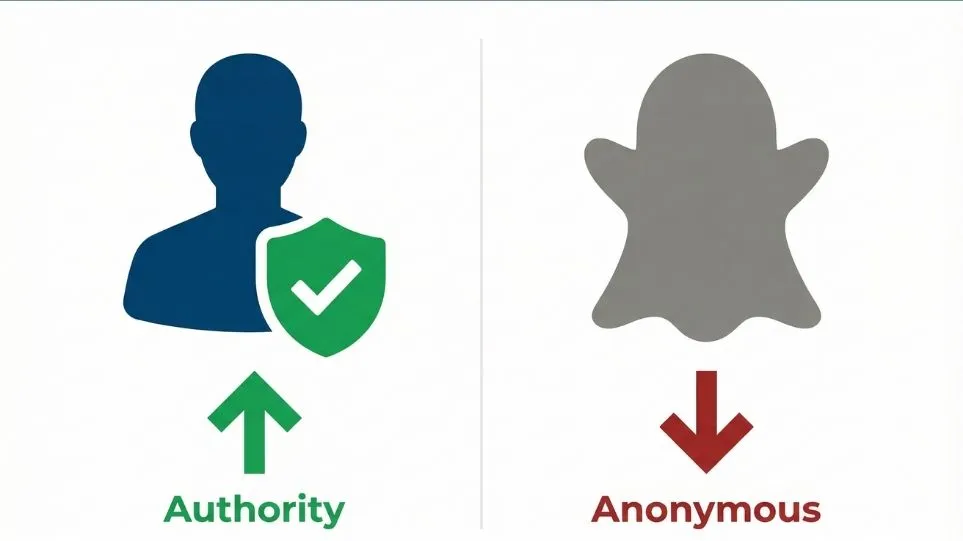
Every AI-assisted article published on a serious US content platform needs a clear, credentialed author attribution. Anonymous content or content attributed to a generic ‘editorial team’ is a trust signal failure. The author bio is where your expertise claim lives. Without it, all your E-E-A-T editing work is invisible to Google.
Building your human editing standard document
If you edit AI content regularly for yourself or a team build a one-page editing standard document. It lists: your four editing objectives, your minimum fact-checking sources by category, your brand voice red lines, and your quality gate checklist for publication approval.
This document makes your human editing AI content fact-checking process consistent and teachable. New team members can follow it immediately. It also makes quality audits straightforward when an article underperforms, you can check it against the standard and identify exactly where the process was skipped.
The quality problems that make this editing standard necessary don’t always come from poor editing sometimes they come from publishing too much too fast. The specific scenarios where automation erodes quality before you can catch it are covered in the article on when AI automation hurts content quality, which maps out exactly where the automation boundary should sit.
Human editing is your competitive advantage
AI content without human editing and fact-checking is a liability. AI content with A systematic human editing AI content fact-checking process is your competitive advantage in 2026. The difference is the process and the discipline to follow it every time, even under deadline pressure.
In the US content market of 2026, where volume is abundant and quality is scarce, the creators who publish carefully edited, E-E-A-T compliant, audience-first content will build lasting authority. That’s the promise of human-directed AI content and it starts with this editing process.
For the strategic framework that connects this editing process to your broader content architecture cluster design, topical authority, and performance measurement the complete guide to AI content strategy in 2026 covers the full system that makes quality at scale possible.
About the Author
El Habib is an AI Content Creation specialist and digital marketing writer. He helps creators and marketers use AI tools to write faster, improve their workflow, and scale their content without losing authenticity.