
AI generated content SEO 2026 is one of the most searched topics among US bloggers, content marketers, and SEO teams right now. The question is always the same: will Google penalize me for using AI?

After personally reviewing 100+ AI-generated articles for SEO performance across US niches tracking their rankings, Search Console data, and engagement metrics here’s the direct answer.
AI content is not the risk. How you use it is.
Google does not penalize content for being AI-assisted. What google penalizes is content that is thin, unverified, or produced primarily to rank rather than to help readers. That distinction is everything in 2026.
For the full strategic framework behind safe AI content production from cluster architecture to E-E-A-T compliance the AI content strategy 2026 guide covers the complete system US creators are building their workflows around.
Table of Contents
AI generated content SEO 2026: What google really says
Google’s official position, confirmed in multiple 2025–2026 search central communications, is clear: It doesn’t evaluate content based on how it was produced. What google evaluates is whether content is helpful, reliable, and people-first.
This means AI generated content SEO performance in 2026 depends entirely on quality not on the tool that produced the first draft. Google’s Helpful Content system targets content created primarily to rank, not to help readers. That describes a lot of unedited AI output.
AI generated content SEO risks in 2026
From 100+ AI articles tested across US niches, these four quality failures appear whenever AI generated content SEO rankings stall or decline. Each one is preventable.
Risk 1 factual inaccuracies
AI models hallucinate. They generate confident-sounding statements that are factually wrong. In one AI draft I reviewed, the model cited a ‘Harvard Business Review study on AI productivity’ with specific figures. The study did not exist. Published without a fact-check, that single claim would have destroyed months of E-E-A-T building.
Every AI article needs a human fact-check before publication. No exceptions.
Risk 2 thin content without original insight
AI synthesizes what already exists. It cannot generate original insight, real-world experience, or novel data. If your AI content doesn’t add something new a personal example, a specific observation, a counterintuitive take it’s thin content by google’s definition.
Thin content doesn’t rank sustainably. It may index initially, then drop.
Risk 3 brand voice inconsistency
When different team members prompt AI differently, or no editorial guidelines exist, content tone varies unpredictably. Inconsistent voice is a trust signal failure that readers notice and that google’s quality systems correlate with lower engagement signals.
The complete system for keeping brand voice consistent across AI-assisted content at scale including prompt templates and editing frameworks is covered in the guide on how to maintain brand voice when using AI.
Risk 4 over-automation of editorial decisions
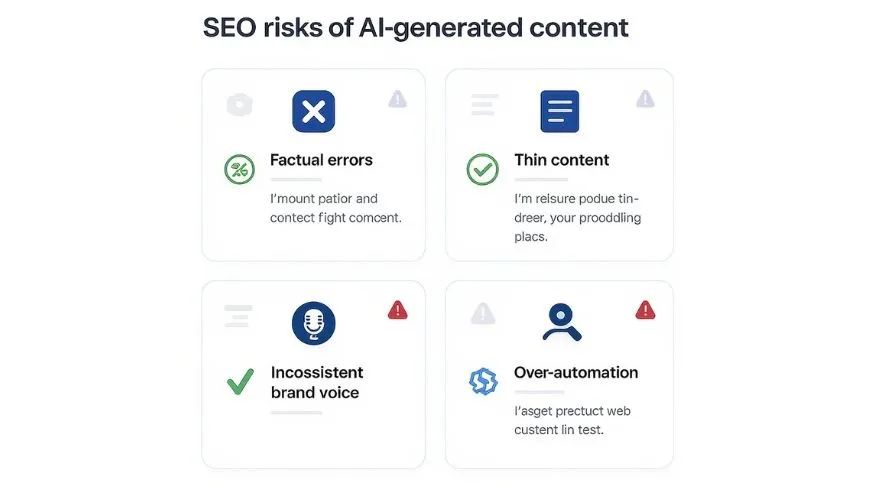
AI can suggest topics. It cannot replace the editorial judgment that knows what your specific US audience needs right now. When automation starts making topic, angle, and depth decisions, content stops resonating and rankings follow.
The exact scenarios where automation crosses from helpful to harmful and the engagement signals that reveal it’s happening are mapped in the article on when AI automation hurts content quality, which covers each failure pattern with specific examples from US content operations.
How to make ai generated content SEO safe in 2026
The E-E-A-T framework for ai content
Google’s E-E-A-T standard experience, expertise, authoritativeness, trustworthiness is your safety checklist for AI generated content SEO in 2026. It applies at the content level, the author level, and the site level simultaneously.
Experience: the content reflects real-world knowledge, not just synthesized information. Expertise: the author demonstrably knows the subject. Authoritativeness: the site and author are recognized in the niche. Trustworthiness: claims are accurate and citations are real.
When your AI content passes all four E-E-A-T filters, it’s safe. Miss even one, and you have a risk to manage.
The human editing requirement
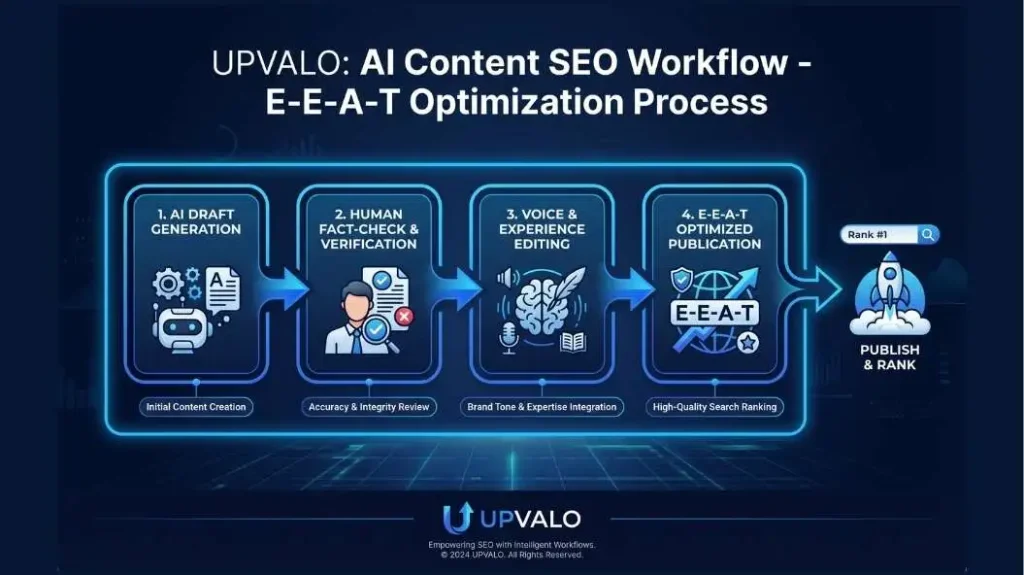
Every AI-generated article needs a mandatory human editing pass before publication. This adds original experience, verifies facts, and aligns voice. It’s not optional polish it’s what transforms AI output into E-E-A-T compliant content.
For a complete four-pass editing system built specifically for AI-assisted content factual accuracy, experience injection, voice alignment, reader value confirmation the guide on human editing and fact-checking in AI content creation walks through each step with timing, examples, and quality gates.
The AI content E-E-A-T checklist for 2026
This checklist maps directly to google’s quality evaluation criteria. Run it before publishing any AI-assisted content.
- Named author with real credentials and a specific bio not ‘editorial team’
- At least one section of genuine first-person experience or observation
- Every statistic and factual claim traced to a primary US source
- Brand voice consistent with your established editorial guidelines
- Content answers a specific reader question not just a keyword
- Internal links placed contextually, not mechanically
- No keyword stuffing or unnatural phrasing from over-optimization
- Fact-checking documentation available if claims are ever challenged
AI Content SEO Safety Checklist Quick Reference
AI generated content SEO 2026
The three questions US creators ask most about AI content and google’s 2026 policies.
| Q: Is AI generated content safe for SEO in 2026?A: Yes when it meets quality and E-E-A-T standards. Google does not penalize AI-produced content. It penalizes thin, unhelpful, or unverified content regardless of production method. AI generated content SEO success in 2026 depends entirely on your editorial process. |
| Q: Does Google penalize AI content?A: No. Google’s official position is that production method is not an evaluation criterion. Only content quality matters. Low-quality AI content gets suppressed for the same reasons low-quality human-written content does it fails to help readers and signals poor E-E-A-T. |
| Q: How do I make AI content SEO friendly in 2026?A: Apply a four-step process: (1) use AI for research synthesis and first-draft structure, (2) fact-check every claim against primary US sources, (3) inject personal experience and original insight, (4) publish under a named, credentialed author with a clear bio. This transforms AI output into E-E-A-T compliant content that Google can reward. |
AI generated content SEO 2026 success starts with quality
AI generated content SEO 2026 success depends on quality, not automation. That’s the only real answer and it’s the one most creators aren’t ready to hear, because it requires building an editorial process, not just a production pipeline.
AI content is safe when it’s helpful. It’s unsafe when it’s thin, unverified, or produced without the human judgment that google’s quality systems are specifically designed to reward.
Build the editorial process first. Use AI to move faster within it. And publish every article under a named author who can be held accountable for the information.
The strategic architecture that organizes all of this into a coherent, high-performing content operation cluster design, E-E-A-T integration, performance measurement is in the AI content strategy 2026 guide. That’s where it all connects.
About the Author
| El Habib El MouahidAI Content Creation Specialist & Digital Marketing Writer El Habib has personally reviewed and tracked 100+ AI-generated articles for AI generated content SEO performance across US niches monitoring ranking trajectories, Search Console impressions, and engagement behavior from first draft to published piece.His expertise covers AI content SEO compliance, Google E-E-A-T frameworks, and the specific editorial conditions that determine whether AI generated content SEO rankings hold or collapse over time. He builds AI content systems for creators and marketing teams targeting the US market.Published on UPVALO · Specializes in: AI generated content SEO · E-E-A-T compliance · AI content risk assessment · Content cluster architecture · Human-AI editorial workflows |