
The most common complaint I hear from US creators six months into an AI content workflow is some version of this: my content doesn’t sound like me anymore. The articles are correct, they’re structured, they’re readable but maintaining brand voice when using AI feels impossible at scale.
This is a real problem. And it’s a predictable one. AI language models are trained to produce an average of how people write functional, clear, and generic. Without specific guidance, every tool will produce content that sounds professionally anonymous. That’s what they’re optimized for.
Maintaining your brand voice while using AI is not about limiting how much AI you use. It’s about building the right inputs, the right prompts, and the right editing habits before you scale. This guide gives you the exact system one I’ve tested with creators and marketers across the US market.
Table of Contents
Why AI dilutes brand voice by Ddefault
Understanding the mechanism makes the solution clearer. AI tools generate text by predicting the most statistically probable continuation of a sequence. The ‘most probable’ text is, by definition, average it reflects the median of all writing on a given topic, not the distinctive voice of a specific creator.
Your voice is defined by the elements that make you non-average: the specific words you favor, the rhythm of your sentences, the way you handle transitions, the level of directness you bring to advice, the cultural references that resonate with your US audience. None of these are in the model’s default output. They have to be explicitly instructed and then reinforced in editing.
The good news is that AI tools respond remarkably well to specific voice guidance. The effort you invest in documenting your voice upfront pays compounding returns across every piece of content you produce.
Step 1 document your brand voice before you scale
The voice reference document
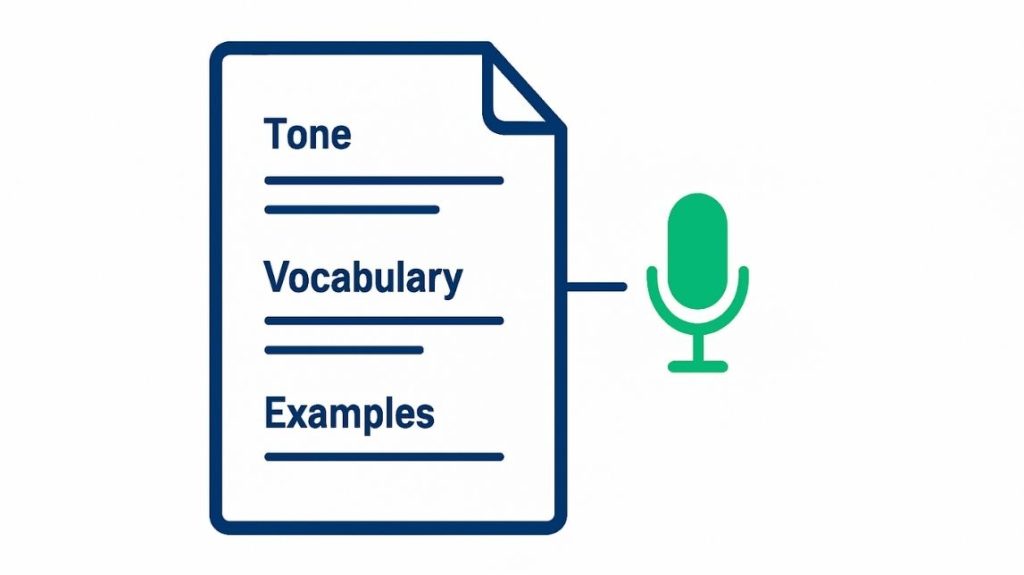
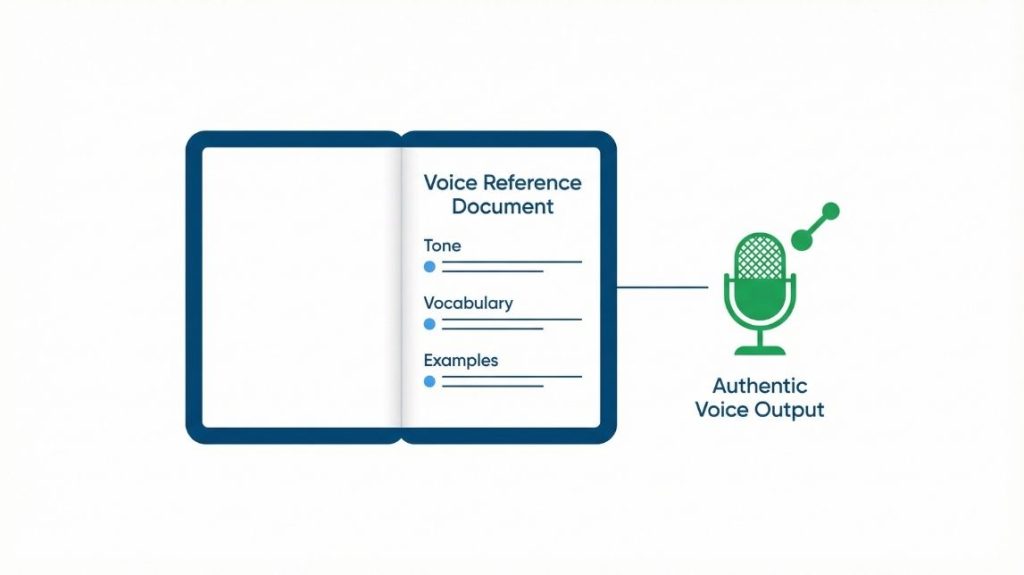
A voice reference document is a one to two page description of how your brand communicates. It should cover: your tone (direct, conversational, practical, empathetic pick the three or four words that genuinely describe you), your vocabulary preferences (the terms you use regularly and the ones you deliberately avoid), your sentence structure tendencies (short and punchy, longer and more developed, mixed), and your perspective on complexity (do you lean into nuance or simplify aggressively?).
The best source for this document is your own existing content. Read five of your best-performing articles and take notes on what makes them feel like you. The patterns you identify are your voice markers and they become the core of your reference document.
Include examples, not just descriptions
Voice descriptions are useful. Voice examples are essential. Include three to five sentences from your own writing that represent your voice at its best. When you instruct an AI tool to ‘match this style,’ give it those sentences alongside your description. A concrete example gives the model something to calibrate against that a description alone can’t provide.
Step 2 build brand voice into every ai prompt
The system prompt approach
Most AI writing tools allow you to set a system prompt a set of persistent instructions that apply to every response. This is where your voice reference document belongs. Paste your tone description, your vocabulary preferences, and your example sentences into the system prompt. Every draft the tool produces will be calibrated to those parameters from the start.
For creators using tools without a persistent system prompt option, include a ‘voice instructions’ section at the top of every prompt you write. It adds thirty seconds per prompt and meaningfully changes the output.
Give the model negative examples too
Alongside examples of what your voice sounds like, give the model examples of what it doesn’t sound like. If you find generic transition phrases, corporate marketing language, or overly formal academic framing particularly at odds with your style, say so explicitly: ‘Avoid phrases like…’ and list them. Negative instructions are often more effective than positive ones for voice calibration.
Step 3 edit with brand voice, not just accuracy
Read every draft aloud
The fastest and most reliable voice check is reading your draft aloud. Every sentence that makes you stumble, sounds unnatural, or you would never say in a conversation with your audience is a voice inconsistency that needs rewriting. This takes about five extra minutes per article and catches every major voice deviation that a reading-only review misses.
Add personal moments strategically
AI generates synthesized information. It cannot generate your personal experience. Every article you publish becomes more distinctively yours when you add at least one section drawn from your direct observations a specific client situation, a result you achieved or failed to achieve, a tool you’ve actually tested, a pattern you’ve noticed working with US creators in your niche.
These moments don’t need to be long. Two or three sentences of genuine first-person experience can anchor an entire article in your voice and simultaneously satisfy the Experience component of Google’s E-E-A-T evaluation. They’re the highest-value additions you make in the editing process.
The editing process goes deeper than voice alone. For a complete four-pass system that covers factual accuracy, experience injection, voice alignment, and reader value the full breakdown is in the guide on human editing and fact-checking in AI content creation, which walks through each step specifically for AI-assisted workflows.
Step 4 build brand voice consistency across your cluster
Treat your cluster as one editorial voice
Individual articles can maintain voice consistency while the overall cluster feels incoherent if each article was prompted and edited separately without reference to the others. Before you publish a satellite article, read your pillar article and the previous satellites together. The terminology should be consistent. The perspective should feel unified. The progression from one piece to the next should feel like one author thinking through a subject from multiple angles.
If you haven’t defined your cluster architecture yet, that’s the first thing to get right. The strategy behind how pillar and satellite articles work together and how each one reinforces the others is covered in detail in the complete guide to AI content strategy in 2026, which maps out the full system from authority zone to measurement.
Create a style guide
A style guide extends your voice reference document with specific editorial rules: how you format headers, whether you use contractions, how you handle statistics and citations, what level of specificity you bring to examples. For US content teams with more than one contributor, a style guide also clarifies how you handle cultural references, industry terminology, and the level of directness appropriate for your audience.
The style guide becomes your editorial quality standard. When a piece of content doesn’t feel right, you can trace the issue to a specific rule that was missed and fix it without relying on instinct alone.
The e-e-a-t dimension of brand voice
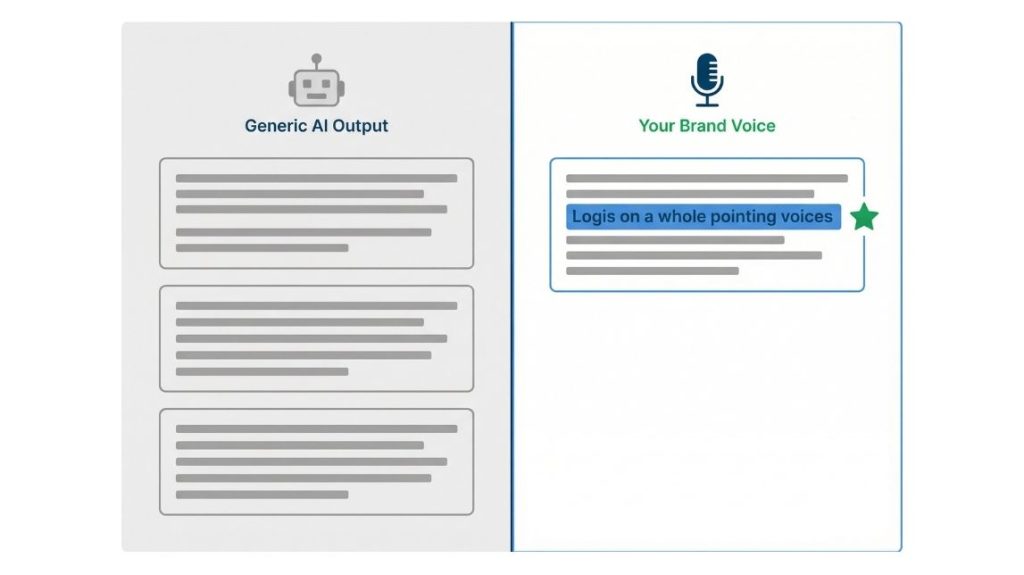
A consistent, recognizable brand voice is not just a creative asset. It’s a trust signal. Readers who encounter your content multiple times and find a coherent editorial perspective build an expectation of quality and reliability. That expectation produces the behavioral signals return visits, low bounce rates, sustained reading time that Google uses as proxies for content quality.
In competitive US content categories, where multiple sites are covering the same topics with similar AI-assisted production, a distinctive voice is often the primary differentiator. It’s what makes readers choose your take over the seven others that appear on the same search results page.
Protecting your brand voice at scale is, ultimately, protecting your ability to build authority. The tools are just the mechanism. The voice is the asset.
Common voice mistakes when using ai
Most voice problems are process problems. Here are the five mistakes I see most often from US creators who lose their voice after scaling with AI:
- Publishing AI drafts without reading them aloud the single fastest way to let generic phrasing slip through
- Using different voice instructions for different articles in the same cluster this breaks the editorial coherence readers are looking for
- Treating voice documentation as a one-time setup rather than a living reference that evolves with your writing
- Skipping the personal experience additions in the editing pass the one step that most directly impacts E-E-A-T signals
- Scaling content volume before voice consistency is established speed amplifies whatever habits you already have, good or bad
Voice inconsistency is closely related to a broader risk in AI content workflows: automating faster than your review process can handle. If you’re pushing volume without a solid editorial layer, the quality problems compound quietly before they show up in rankings. The article on when AI automation hurts content quality breaks down exactly where that line is and how to stay on the right side of it.
Your brand voice is your competitive edge
Your brand voice is what you bring to the collaboration with AI. The model provides structure and synthesis. You provide perspective, specificity, and the kind of human character that makes content memorable.
Document your voice before you scale. Build it into every prompt. Edit every draft with voice as a primary criterion, not an afterthought. And treat your cluster as a unified editorial voice, not a collection of individual articles.
The US creators who are building lasting authority in 2026 are not the ones publishing the most. They’re the ones whose content readers recognize after the first paragraph regardless of which article they land on.
About the Author
| El Habib El MouahidEl Habib is an AI Content Creation Specialist and digital marketing writer. He helps creators and marketers use AI tools to write faster, improve their workflow, and scale their content without losing authenticity. With a background in marketing and a deep interest in artificial intelligence, he writes guides, tutorials, and in-depth reviews that make AI accessible to everyone especially those who want real results, not technical jargon. |