
Most people start Monday with a content plan, then abandon it by Thursday.
The problem isn’t discipline. It’s that the system depends on having consistent energy, clear focus, and motivation that shows up on schedule.
Real weeks don’t work that way. Meetings run long. Priorities shift. Some days you wake up sharp, others you’re running on fumes.
A weekly AI content system only works when it’s built around those realities, not despite them. That’s the core principle behind any weekly AI content system that survives real life.
The goal isn’t to produce more content. It’s to build a weekly rhythm that holds up when life gets messy. That means deciding once how your week should flow, then following the same structure until it stops working.
When the system doesn’t require constant decision-making, consistency becomes automatic.

For most entrepreneurs and content creators in the US, a sustainable weekly AI content system comes down to this: two focused hours per week creating 3-5 pieces in one batch session, then scheduling everything and closing your tools until next week.
Not two scattered hours per day. Not “always-on” creation mode. Two focused sessions where AI handles the heavy lifting and you handle the decisions.
The rest of this guide breaks down exactly how to build that system so it actually sticks.
Table of Contents
Why most weekly AI content systems fail: The 3 design flaws
Flaw 1: Too much context switching kills your focus
Most creators bounce between idea to prompt to research to writing to editing to posting all day long.
That creates mental friction. Think of it like running errands across town during rush hour instead of batching them in one neighborhood.
My friend David in Austin told me he used to check his content tools 15-20 times per day. Every check meant reopening ChatGPT, remembering where he left off, finding the right tab, reloading his thought process. By the time he was ready to actually create something, half his energy was already gone.
When he switched to batching everything into two weekly sessions, he got the same output in 40% less time. Not because he worked faster, but because he stopped hemorrhaging focus.
Flaw 2: Building your weekly AI content system for ideal conditions
You design the system during a good week. Energy is high, the calendar is clear, everything clicks.
So you build around that version of your life- the one where you have two focused hours every morning and nothing urgent pops up.
Then reality returns. A client emergency hits. You get sick for three days. The kids stay home from school. The system, built for ideal conditions, can’t flex. It demands the same input you gave it during setup week.
When you can’t deliver, the whole thing stalls.
Sarah runs a marketing agency in Portland and learned this the hard way. She built an ambitious system in January that required her to draft content every Monday, Wednesday, and Friday at 7am. Worked great for two weeks. Then her biggest client had a crisis, her schedule exploded, and by week three the system was dead.
The system asked for discipline when it should have provided structure. That’s the second reason most weekly AI content systems collapse before the end of the month.
Flaw 3: No governance – who decides what’s good enough to publish
Without clear rules- what counts as done, what needs human approval, what you won’t say- you create a fragile system that breaks the moment your schedule gets busy.
If the AI drafts, edits, and publishes with no checkpoints, errors pile up. Wrong facts. Off-brand tone. Risky claims you’d never make in person.
You end up firefighting at the worst possible time, scrambling to delete posts or issue corrections while you’re supposed to be focused on actual work.
Jake in San Diego automated his LinkedIn posts completely for a month. No review, just scheduled. One post claimed a statistic he couldn’t verify. Someone called it out publicly. He spent three days managing the fallout instead of the three minutes it would have taken to fact-check before posting.
Automation without control isn’t a system. It’s a time bomb.

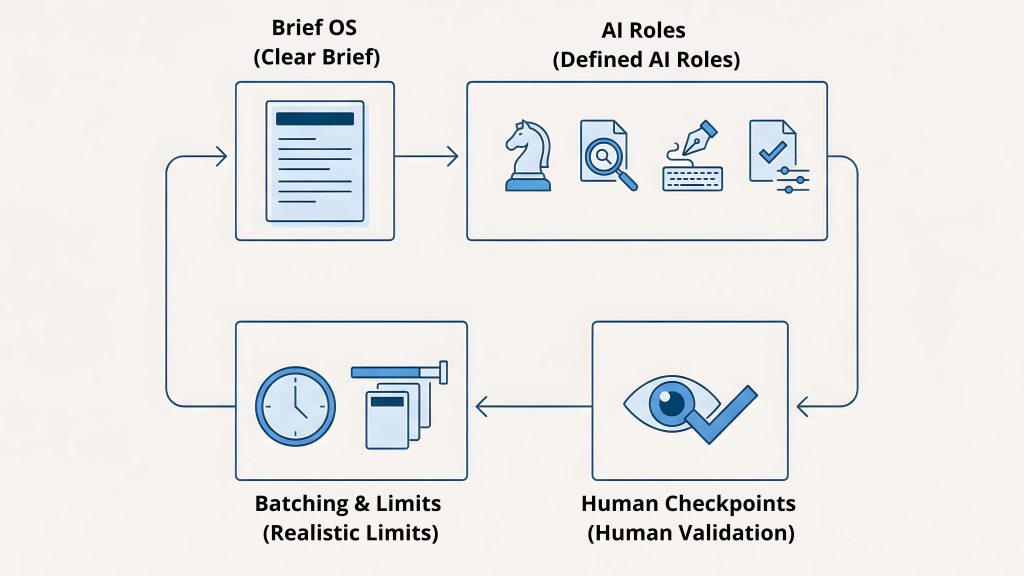
The 4 components of a sustainable weekly AI content system
Component 1: A one-page brief OS for every piece of content
Create a template the AI must use every time. This is the foundation of any reliable weekly AI content system.
Include: audience, promise, key belief to shift, proof points, tone, call to action, and boundaries- what you won’t claim.
This sounds like extra work. It’s not. It’s deciding once so you don’t decide 50 times.
My version lives in a Notion doc. Takes two minutes to fill out per piece. Tells the AI exactly who I’m talking to, what problem I’m solving, what I want them to believe afterward, and what tone to use.
Example tone note I use: “This should sound like a smart founder explaining it over coffee- clear, direct, no corporate fluff. Think operator energy, not academic lecture.”
That one sentence saves me from reviewing 800 words of AI output that sounds like a press release.
Component 2: A 4-role AI content workflow that runs itself
Instead of one magical prompt that does everything, assign roles so each step is simpler and more reliable.
| Role | What it does | Example output | Time required |
|---|---|---|---|
| Strategist | Turns business goals into topics and angles | “Top-of-funnel myth-busting post about AI automation fears” | 5 min |
| Researcher | Gathers evidence, counterpoints, examples, claims to verify | 3 case studies, 2 statistics, 1 counterargument to address | 10 min |
| Writer | Produces clean first draft following the brief | 800-word draft in your tone with structure | 15 min |
| Editor | Checks clarity, brand voice, risk, final polish | Publication-ready piece with no AI tell-tale signs | 10 min |
When I worked with a SaaS founder in Seattle, we mapped his content to the funnel this way. Strategist handled “top-of-funnel myth-busting.” Researcher pulled case studies for “middle-of-funnel proof.” Writer created the drafts. Editor made sure nothing sounded like AI wrote it.
Each role had one job. Made the whole process cleaner.
The key is running these roles sequentially, not simultaneously. One conversation with the AI per role. Copy the output into your workspace, then move to the next role.
Component 3: Human-in-the-loop checkpoints that prevent errors
Don’t review everything. Review the risk moments.
| Checkpoint | Question to Ask | If Yes | If No |
|---|---|---|---|
| Angle Approval | Is this worth saying this week? Does it serve the business? | Move to research phase | Discard, try new angle |
| Brief Approval | Is this aligned with brand and audience? Do I have proof for claims? | Green light for writing | Revise brief or kill piece |
| Final Approval | Are facts accurate? Tone on-brand? Any risky claims? | Schedule and publish | Edit or send back to writer role |
Treat it like sending an important email to a major client. You don’t automate-send without reading it once.
My friend in Denver reviews angles on Sunday, approves briefs Monday morning, and does final checks Thursday before scheduling. Takes her maybe 20 minutes total across the week. The rest runs on autopilot.
The approval doesn’t mean spending 30 minutes editing. It means a quick scan: “Is this safe to publish under my name?” If yes, schedule it. If no, note what’s wrong and rerun that specific role.
Component 4: Content batching strategy and hard limits
Batch work by type so your brain stays in one mode. This is what separates a weekly AI content system that sustains itself from one that burns you out.
One session for planning and research. One session for drafting. One session for editing and scheduling.
Add hard limits so the system stays realistic: one hero piece per week, then repurpose into smaller assets.
Think Sunday meal prep. Cook once, eat all week. Not making a new meal from scratch every night.
I create one long-form piece every Monday. Takes about 90 minutes with AI assistance. Then I break it into three LinkedIn posts, two tweets, and one email. The repurposing takes another 30 minutes on Tuesday. Rest of the week I don’t touch content tools.
That’s the whole system.
How to set up your AI content planning system in under 30 minutes
| Minutes | Task | What You’ll Have |
|---|---|---|
| 0-10 | Build your Brief OS template | One reusable template with 9 fields you fill out per piece |
| 10-20 | Create a simple pipeline board | Visual workflow showing what’s in progress and what’s stuck |
| 20-30 | Install checkpoints + decision log | Three approval gates and a simple doc tracking your decisions |
First 10 Minutes: Build your brief OS template
One page. Nothing fancy.
Fields you need:
- ICP (who you’re talking to)
- Goal (what you want them to do)
- Angle (your specific take)
- 3 proof points (why they should believe you)
- 1 story or example (makes it human)
- Objections (what they’ll push back on)
- CTA (next step)
- Tone notes (how it should sound)
- Forbidden claims (what you won’t say)
I keep mine in Notion. Google Doc works fine. Doesn’t matter where it lives as long as you can copy-paste it into your AI tool quickly.
Next 10 minutes: Create a simple pipeline board
Statuses: Strategize → Research → Draft → QA → Publish
Rule: every piece must always have a next action. No vague “in progress” status that means nothing.
When something sits in “Draft” for three days, you know exactly where the bottleneck is.
A friend in Chicago uses Trello. Takes him two minutes per week to move cards. That’s it. The board shows him what’s moving and what’s stuck without him having to remember everything in his head.
Last 10 minutes: Install the 3 checkpoints + decision log
Simple note per piece: angle chosen, key sources, final changes, what to improve next week.
Run it like a lightweight standup for your content. What’s moving, what’s blocked, what ships.
I keep a running doc titled “Content Decisions.” One line per piece. When I approve an angle, I write why. When I make a final edit, I note what I changed and why.
Takes 30 seconds per decision. Saves me from making the same mistakes twice.
What to do when your weekly AI content system breaks
When you miss a week: How to recover without breaking momentum
Don’t panic. Shrink the output, not the weekly AI content system. The structure stays intact – only the volume changes.
Keep the pipeline. Reduce volume. Publish one strong piece instead of forcing three rushed ones.
During a product launch last fall, I had zero time for content. Instead of abandoning the system, I published one piece that week instead of my usual three. The system stayed intact. The habit didn’t break.
The next week I was back to normal volume like nothing happened.
Use a hotfix week protocol to keep your system running
When things get chaotic:
Reduce scope to one hero piece only.
Repurpose something proven- update an older post, turn a popular idea into a new angle.
Increase QA temporarily. More human review until reliability returns.
My friend who runs a small business in Texas treats this like switching to minimum viable operations during tax season. The system doesn’t collapse. It flexes.
When AI output feels generic: How to fix it fast
You’re probably in production mode while still in understanding mode.
Fix: Generate content with zero intention to publish. Read it like you’re reviewing someone else’s work. Ask the AI to explain what it meant by specific sections.
Then create the real version.
Takes 10 extra minutes. Saves you from publishing something that sounds like every other AI-generated post on the internet. For a deeper approach, discover the editorial workflow that separates understanding from production.
When the whole weekly AI content system stops working
Take one week completely off. The system won’t collapse.
Ask yourself: what would I create if no one were watching?
Create one piece of that. If it feels better, that’s your new direction. Rebuild the system around that content.
A sustainable system at lower engagement beats a burnout system at higher engagement. You can’t build anything from a hospital bed.

The real test
A sustainable weekly AI content system should feel like relief when you open your tools, not dread.
Two focused hours per week, not two scattered hours per day.
The ability to take a week off without everything falling apart.
If your system doesn’t pass that test, you don’t have a system. You have a job you’re not getting paid enough for.
The difference between a system that works and one that burns you out isn’t the AI tools you use. It’s whether the structure serves you or demands things from you.
Build it once around how your actual weeks work – not how you wish they worked – and it’ll hold up when life gets messy.
Would you be ready to build a calm, predictable content engine?
- Complete guide to building a calm AI content system