
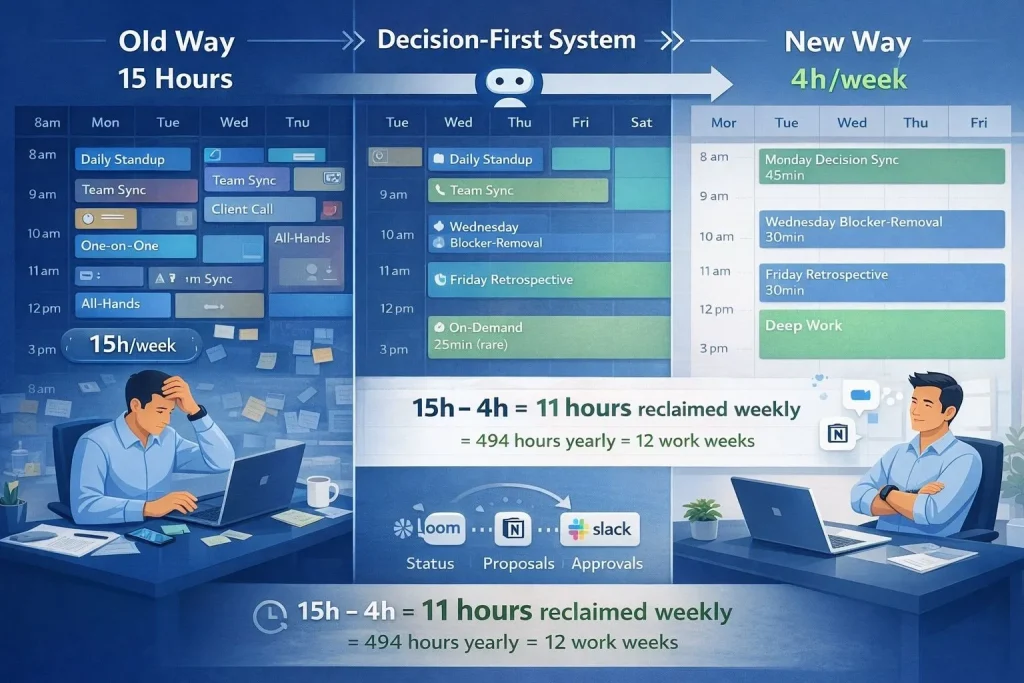
You spend 15 hours weekly in meetings. At least 60% of those could disappear tomorrow without impacting a single business outcome. The problem isn’t that your meetings are too long it’s that most shouldn’t exist at all. Most “meetings” are actually information transfer disguised as collaboration. True meetings exist for one purpose: making collective decisions that can’t happen asynchronously. This decision-first system gives you the exact framework to cut meeting time 60% while tripling decision velocity. Here’s the tactical playbook.
Building your lean meeting framework
The lean meeting philosophy
The foundation: default to async, meet only for decisions. Research shows 90% of what happens in typical meetings is information sharing status updates, announcements, proposals that works perfectly via Loom videos, Notion docs, or Slack messages.
True meetings exist exclusively for synchronous decision making when async fails complex negotiations requiring real-time tradeoff discussion. Conflict resolution where tone and body language matter. Brainstorming where ideas build momentum off each other. High-stakes commitments requiring immediate buy-in.
Everything else? Async by default.
The philosophy distills to one rule: “If no decision needs to be made, it’s not a meeting it’s information transfer.” Apply this ruthlessly. Status updates become five-minute Loom videos. Proposals become Notion docs with 48-hour async feedback windows. Approvals become decision documents with explicit deadlines.
Result: Teams running this system drop from 15 hours weekly meetings to 4 hours while improving decision velocity 3×. The time savings matter, but the bigger win is clarity. When every meeting exists to decide something specific, ambiguity disappears. Teams stop asking “what did we decide?” because decisions get locked in before meetings end.
This isn’t about hating meetings. It’s about respecting the organizational cost of synchronous time and reserving it exclusively for decisions that genuinely require real-time collective discussion.
The meeting necessity test (3 Questions)
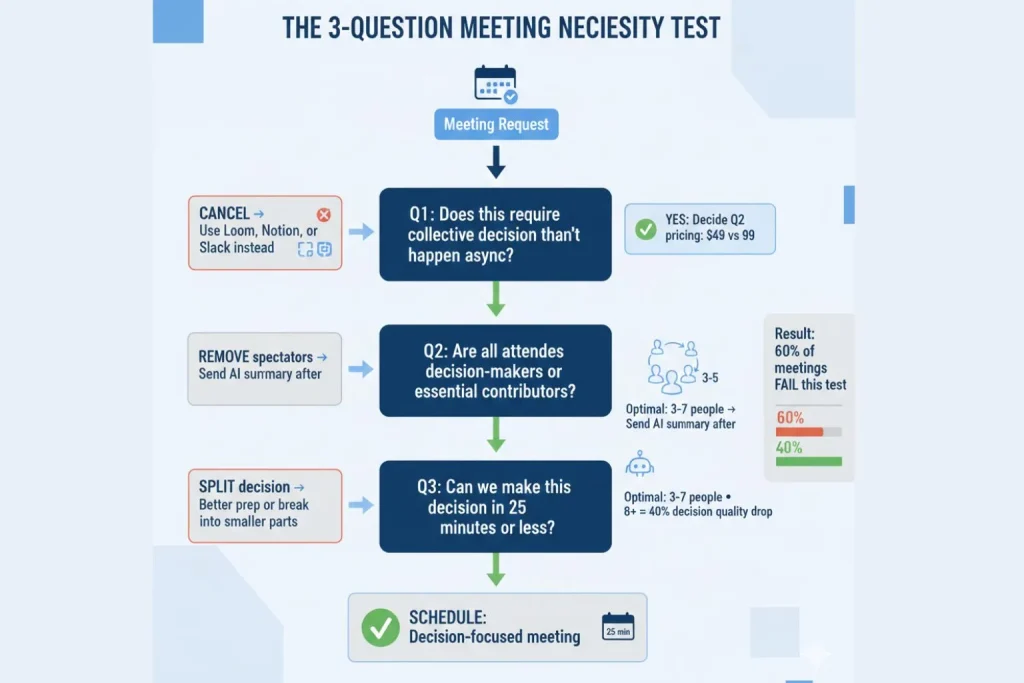
Before scheduling any meeting, run this three-question filter. If you answer “no” to even one question, cancel the meeting or convert it to async.
Question 1: Does this require a collective decision that can’t happen asynchronously?
YES example: “Decide Q2 pricing strategy $49/month vs $99/month, evaluating tradeoffs between customer acquisition cost and lifetime value.” This needs synchronous time because complex tradeoffs require real-time debate where people challenge assumptions dynamically.
NO example: “Weekly team check-in to align on priorities.” No specific decision to make—pure information sharing. Works better as async standup where people share updates on their schedule.
If no decision is needed, stop. Cancel the meeting. Convert to Loom video, Notion doc, or Slack update instead.
Question 2: Are all attendees decision-makers or essential contributors?
Remove spectators people attending “just to stay in the loop.” They don’t influence the decision. Send them an AI summary afterward. They get information in 2 minutes of reading instead of 60 minutes of passive listening.
Optimal meeting size: 3-7 people. Research shows 8+ people reduce decision quality by 40% through excessive input creating consensus paralysis. For each potential attendee, ask: “Will this person actively contribute to the decision or execution?” If no, remove them.
Example: Product roadmap meeting. Keep product lead (owner), engineering lead (feasibility), and CEO (strategic alignment). Remove marketing coordinator (can review afterward) and customer success rep (can provide input via pre-meeting doc). Reduced from 5 to 3 people = 40% cost reduction for identical decision quality.
Question 3: Can we make this decision in 25 minutes or less?
If no, one of two things is true: the meeting needs better prep (AI-generated agenda, pre-read materials) OR the decision is too big and should split into smaller component decisions.
Example: Bad “Decide entire Q2 product roadmap” requires 2+ hours. Good “Decide top 3 Q2 priorities” takes 25 minutes, then schedule separate meetings for each feature’s implementation details.
The 25-minute constraint creates a forcing function. Parkinson’s Law states work expands to fill available time. Constraining time forces clarity and prevents wandering discussion.
The 4-Meeting week template
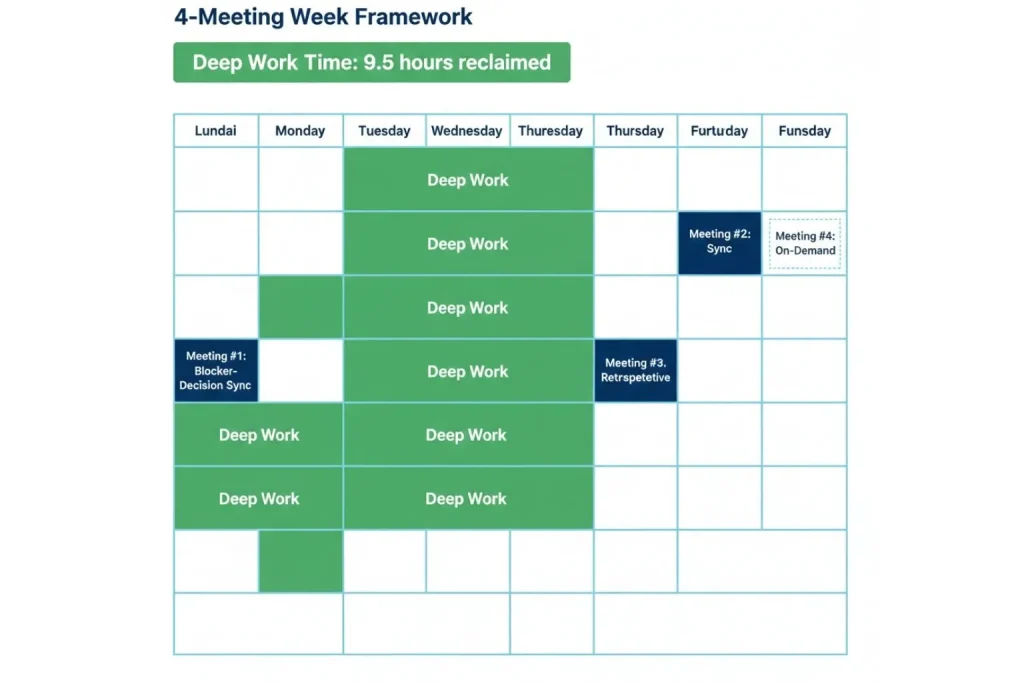
This is your default structure. Everything else must justify why it can’t wait for one of these four slots.
Meeting 1 : Monday Decision Sync (45 minutes)
Who: Core leadership or founders onlymaximum 3-5 people.
Purpose: Make strategic decisions for the week. NOT status updates.
Agenda structure: Minutes 0-10 cover last week’s lessons (what worked, what didn’t patterns, not details). Minutes 10-30 address this week’s top three priorities plus blockers requiring decisions. Minutes 30-45 focus exclusively on decisions—actual commitments with owners, not discussions for the sake of discussing.
Output : Every attendee leaves knowing exactly what was decided, who owns execution, and when it’s due. Example: “Launch beta February 15, Sarah owns launch, review progress February 8” or “Pause feature X, reallocate engineering to Y, John notifies stakeholders by end of day.”
Key rule: No status updates allowed. If someone starts “So last week we shipped X,” interrupt and redirect: “Great, that’s in the async update. What decision do you need made this week?”
Meeting 2 : Wednesday Blocker-Removal Session (30 minutes)
Who: Depends on blockers only relevant decision-makers attend, and attendance changes weekly.
Purpose: Unblock decisions that emerged mid-week and can’t wait until Friday.
Rule: If a blocker can wait until Friday retrospective, it waits. This protects Thursday for deep work blocks.
This is NOT a status update session exists only for decision bottlenecks.
Examples: “Client asked for custom feature need approval to proceed” or “Two team members disagree on technical approach need tiebreaker.”
If nothing is blocked, cancel the meeting. Some weeks you won’t need it.
Meeting 3 : Friday Retrospective (30 minutes)
Who : Full team for small orgs, or core team for larger companies (keep under 8 people).
Purpose: Decide one process improvement to test next week.
This is NOT a feelings session output must be concrete decision with owner. Bad retrospective: “Communication could be better, let’s try to improve.” Good retrospective: “Decision: Next week test async Loom standups instead of live Zoom. Sarah owns experiment. Review results next Friday.”
Meeting 4 : On-Demand Decision Calls (25 minutes each)
Who: Relevant decision-makers for specific urgent issues.
Frequency: Only when async decision-making fails should be rare if the system works.
Purpose: Resolve urgent decision that can’t wait for Monday/Wednesday/Friday slots. Examples: Major client escalation requiring immediate decision, breaking market change requiring strategic pivot, critical bug requiring resource reallocation.
These should feel like exceptions, not routine. If you’re scheduling 3+ on-demand calls weekly, your Monday planning or Wednesday blocker sessions aren’t working properly.
Total weekly meeting time: 2.5 hours (45 + 30 + 30 + occasional 25). Industry average: 12+ hours. Hours reclaimed: 9.5 hours weekly = 494 hours yearly = 12 full work weeks returned to deep work and execution.
Duration defaults that prevent waste
Meeting length expands to fill scheduled time. Book 60 minutes, people talk 60 minutes even if the decision could’ve been made in 20.
Use duration defaults that create forcing functions:
25-minute default for all decision meetings. Forces focus on deciding, not wandering discussion. Includes 5-minute buffer before next meeting preventing back-to-back exhaustion. Research shows most decisions can be made in 15-20 minutes with proper preparation.
45-minute maximum for complex strategic decisions only use when truly necessary negotiations, major strategic pivots. Still shorter than typical “1-hour meeting” default, maintaining urgency even for complex topics.
Never schedule meetings longer than 45 minutes. If a decision needs more than 45 minutes, it needs to split into multiple smaller decisions.
Exception: quarterly workshops or planning sessions, but these should be rare quarterly, not weekly.
Implementation tip: Change your calendar settings to default to 25-minute meetings make it harder to schedule 30-minute or 60-minute meetings by requiring manual override the friction helps enforce discipline.
Async alternatives for common meeting types
Most meetings can be eliminated entirely by converting to async. Here’s how:
Status Updates → Loom Video (5 minutes)
Instead of: 30-minute weekly standup with 6 people (3 organizational hours).
Do this: Everyone records 2-3 minute Loom video covering what shipped last week, top priority this week, any blockers. If blockers need decisions, flag for Wednesday session.
Total time: 15 minutes recording + 10 minutes watching everyone’s videos = 25 minutes per person versus 30 minutes in meeting.
Time saved: 2.5 organizational hours weekly = 130 hours yearly.
Proposals → Notion Doc + Async Feedback (48 hours)
Instead of: 60-minute meeting to discuss proposal (6 organizational hours).
Do this: Owner writes clear proposal in Notion with problem, proposed solution, tradeoffs, and recommendation share with stakeholders, 48-hour deadline for async comments. Owner synthesizes feedback, makes decision or escalates if conflict emerges.
Only schedule sync meeting if: Major disagreement emerges requiring real-time negotiation.
Time saved: 5 organizational hours per proposal.
Approvals → Decision Doc with Explicit Deadline
Instead of: Scheduling meeting to “review and approve.”
Do this: Share document or proposal, tag decision-maker, set explicit deadline: “Need approval by Thursday 5pm to stay on schedule.” Decision-maker approves via comment or Slack reaction.
Only schedule sync meeting if: Decision-maker has questions that can’t be resolved async.
Brainstorming → Async Idea Collection + Short Sync
Instead of: 60-minute open-ended brainstorm (6 organizational hours).
Do this: Create shared doc, everyone adds ideas asynchronously over 48 hours. Then 20-minute sync meeting to discuss top 3-5 ideas and decide which to pursue.
This works because: Async captures more diverse ideas (introverts contribute equally), written ideas are more thought-through, sync time focuses on decision not idea generation.
Time saved: 3-4 organizational hours.
Case study: SaaS founder cuts meetings 60%
Profile: Marcus Chen, founder of B2B scheduling platform in San Francisco with 12-person team generating $1.2M ARR.
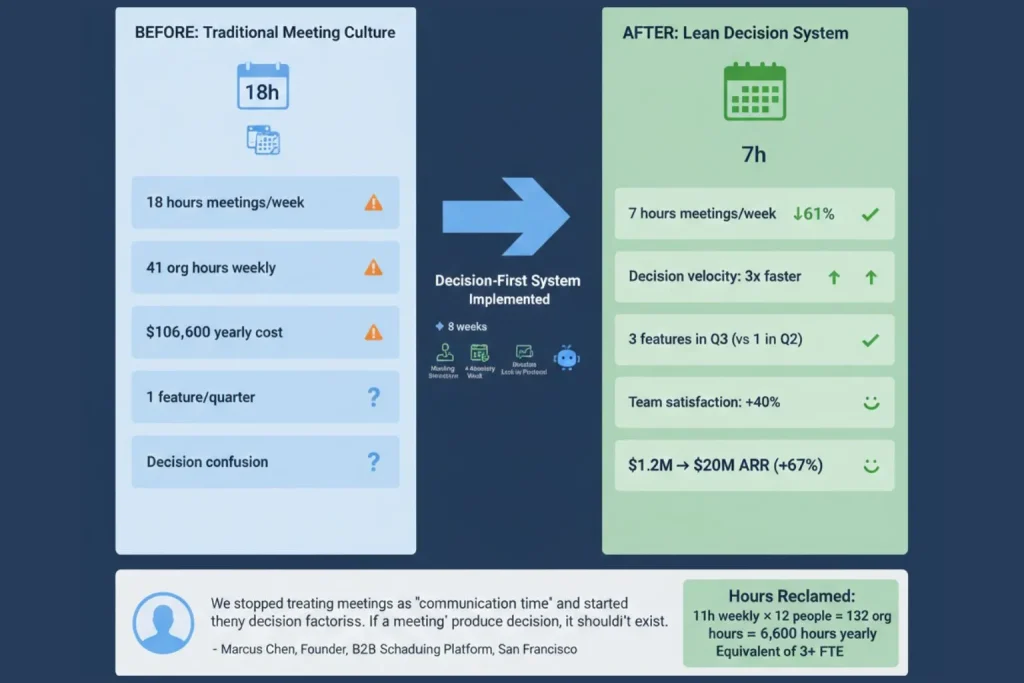
The Problem: Marcus ran 18 hours of meetings weekly: daily 30-minute standups with full team (15 org hours weekly), weekly 1-hour “strategy session” (12 org hours weekly), 6 individual one-on-ones at 30 minutes each (6 org hours weekly), random “quick syncs” as issues emerged (8+ org hours weekly). Total: 41+ organizational hours weekly = $2,050 at $50/hour average = $106,600 yearly.
Beyond calendar time: Decisions made in meetings then re-debated in Slack because outcomes were unclear. Team constantly confused about “what we decided.” Only 1 major feature shipped per quarter—slow execution velocity. Zero blocks of 3+ hours for deep work, all fragmented around meetings.
The Solution: Marcus implemented the Decision-First Meeting System over 4 weeks.
Week 1: Applied Meeting Necessity Test to all 14 recurring meetings. Result: Only 3 required collective decisions. Daily standups became async Loom videos (eliminated 15 org hours weekly). Strategy session became 45-minute Monday Decision Sync focused only on decisions. “Quick syncs” consolidated into 30-minute Wednesday Blocker-Removal (only when needed). One-on-ones cut to 25 minutes with decision-framed agendas.
Week 2: Implemented 4-Meeting Week structure: Monday 45-min Decision Sync for strategic decisions, Wednesday 30-min Blocker-Removal as needed, Friday 30-min Retrospective for process improvements, on-demand decision calls rare (maybe 1 per week).
Total: 7 organizational hours weekly versus previous 41 hours.
Week 3-4: Added decision lock-in protocol. New rule: Every meeting must output at least one concrete decision with owner plus deadline. Facilitator confirms verbally before ending. AI tool (Otter) captures decisions automatically.
Results After 8 Weeks:
Time saved: Meeting time dropped from 18 hours to 7 hours weekly per person. That’s 11 hours reclaimed × 12 people = 132 organizational hours weekly. Annually: 132 hours × 50 weeks = 6,600 hours yearly = equivalent of 3+ full-time employees.
Business impact: Decision velocity tripled measured from “we should do X” to “X is done.” Features shipped: 3 major features in Q3 versus 1 in Q2. ARR growth: $1.2M to $2M in 6 months (faster execution enabled faster growth). Team satisfaction increased 40% in exit surveys.
Marcus’s quote: “We stopped treating meetings as ‘communication time’ and started treating them as decision factories. If a meeting doesn’t produce a decision, it shouldn’t exist. The system came first AI tools just made it easier to execute.”
Key insight: The wins came from ruthless meeting elimination, not from making bad meetings slightly better. Most meetings didn’t need optimization they needed deletion.
Implementation roadmap (4 Weeks)
Here’s exactly how to implement this framework in your business:
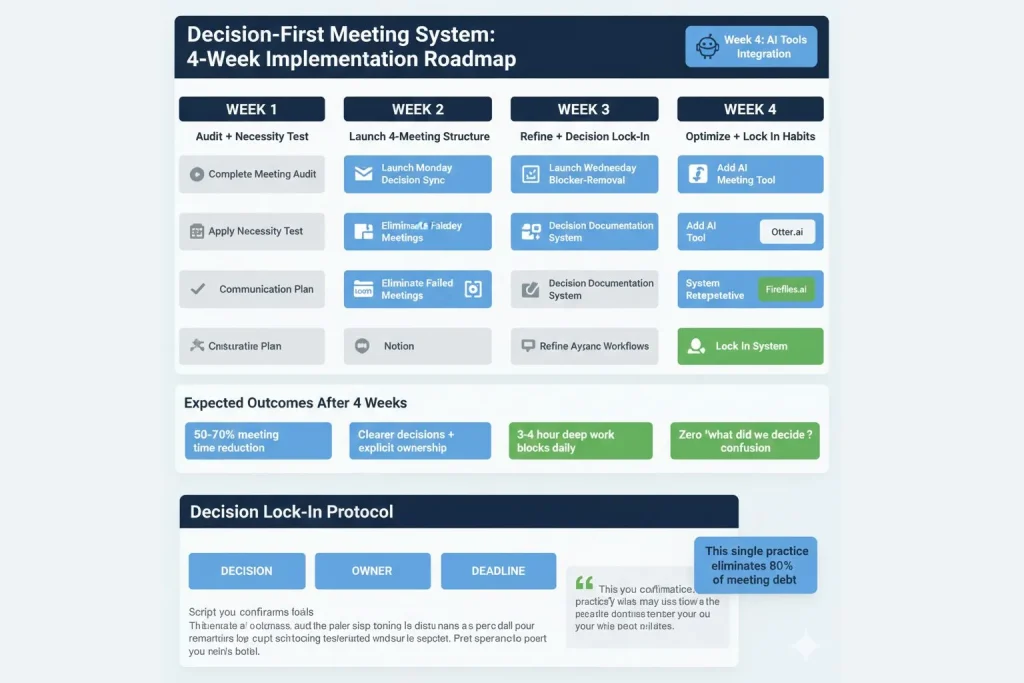
Week 1 : Audit + Necessity test
Day 1-2: Run complete meeting audit. List every recurring meeting on calendar.
Calculate organizational cost (attendees × duration × average hourly rate). Rate each meeting quality 1-5 (1=waste, 5=high value).
Day 3-4: Apply Meeting Necessity Test to each recurring meeting. Run 3-question test on every meeting. Document which meetings fail (expected: 40-60%). Draft async alternatives for meetings that fail.
Day 5: Communication plan. schedule 15-minute team meeting (yes, one last meeting about meetings). Explain new system: “We’re moving to decision-first meeting culture. Most meetings eliminated, replaced with async plus focused decision sessions.” Emphasize: This is about protecting deep work time and decision quality, not cutting collaboration.
Week 2 : Implement 4-meeting week structure
Day 1: Launch Monday Decision Sync. Invite only core decision-makers (3-5 people). Use exact agenda structure (10 minutes lessons, 20 minutes priorities, 15 minutes decisions). Practice decision lock-in protocol (confirm decisions verbally before ending).
Day 2-4: Eliminate meetings that failed necessity test. Cancel recurring meetings. Set up async alternatives (Loom for standups, Notion for proposals). Communicate changes: “We’re moving standups to async Loom videos record yours by 10am daily.”
Day 5: Launch Friday Retrospective. Full team, 30 minutes. Focus: Decide one improvement for Week 3. Practice decision documentation.
Week 3 : Refine +Add decision lock-in
Day 1: Launch Wednesday Blocker-Removal. Only schedule if blockers exist (don’t force it). Practice keeping focused on decisions only.
Day 2-3: Implement decision documentation system. Choose tool (Notion database, Slack threads, or existing project management).
Template: Decision / Owner / Deadline / Context. Start capturing all meeting decisions.
Day 4-5: Refine async alternatives based on Week 2 feedback. Adjust Loom standup format if needed. Fix any async workflows that aren’t working.
Week 4 : Optimize + Lock In Habits
Day 1-3: Add AI meeting tool (optional but recommended). Choose tool: Otter for small teams, Fireflies for analytics. Set up auto-join for remaining meetings. Start using AI summaries for decision verification.
Day 4: Retrospective on new system. What’s working? (Protect these.) What’s not? (Fix or iterate.) Any meetings creeping back that shouldn’t exist? (Eliminate.)
Day 5: Lock in system. Document your 4-Meeting Week structure. Share team guidelines on when to schedule meetings versus go async. Set calendar defaults to 25-minute meetings.
Expected Outcomes After 4 Weeks: 50-70% reduction in meeting time. Clearer decisions with explicit ownership. More deep work time (3-4 hour blocks). Less confusion about “what we decided.”
Common pitfalls to avoid:
Pitfall 1: Trying to make everyone happy. Some team members will resist losing “their” meetings. Stay firm: meeting necessity isn’t about feelings, it’s about organizational economics.
Pitfall 2: Allowing meetings to creep back. After 2-3 weeks, calendar invites will start appearing for “quick syncs.” Enforce necessity test every time: “Does this need sync time or can it be async?”
Pitfall 3: Not practicing decision lock-in. Meetings without explicit decisions create meeting debt immediately. Facilitator must confirm decisions verbally before ending no exceptions.
The decision lock-in protocol
Every meeting must output three elements before ending: decisions made (exact wording with zero ambiguity), owner (single person accountable never “team” or “we”), and deadline (specific date, not “soon” or “next week”).
The facilitator’s critical job: confirm verbally before meeting ends. Example script: “Let me confirm what we decided. We’re launching beta February 15. Sarah owns the launch. We review progress February 8 at Monday sync. Everyone clear? Any objections or concerns right now?”
Wait for verbal confirmation from each decision-maker. If anyone shows hesitation, resolve it immediately. Don’t leave the meeting without complete clarity.
AI tools capture this during meetings, but human confirmation happens in real-time. Why real-time matters: Memory fades within 24 hours, people reinterpret decisions differently when operating from memory, and real-time confirmation prevents re-litigation of decisions next week.
Post-meeting, the AI summary includes decisions section at top for easy reference. But the real work happens live—forcing clarity before people disperse.
This single practice eliminates 80% of meeting debt by ensuring everyone leaves with identical understanding of commitments made.
Common mistakes ant how to avoid them
Mistake 1: Optimizing bad meetings instead of eliminating them.
You try to make your 10-person weekly status update “more efficient” by adding an agenda. Wrong move. That meeting shouldn’t exist convert it to async Loom videos. Fix: Apply necessity test first, optimize only meetings that pass.
Mistake 2: Keeping spectators for “visibility.”
Marketing wants to “stay in the loop” on product decisions despite not contributing. They sit silently for 60 minutes. Fix: Send them the 2-minute AI summary afterward. They get visibility without the organizational cost.
Mistake 3: Scheduling meetings without prep.
You book a “quick 30-minute sync” with no agenda, no context, no clear decision to make. The meeting wanders. Fix: No meeting without decision-framed agenda. If you can’t articulate the specific decision in one sentence, you’re not ready to meet.
Mistake 4: Letting meetings run long.
Your 25-minute meeting hits 25 minutes but the discussion continues. You think “just 5 more minutes.” Those 5 become 15. Fix: Hard stop at scheduled time. If decision isn’t made, that’s feedback—you need better prep or the decision should split into smaller parts.
Cutting meetings 60% isn’t about efficiency it’s about ruthless necessity. Most meetings exist because they’ve always existed, not because they produce outcomes worth their organizational cost.
This framework gives you a system: start with the 3-question necessity test, build a 4-meeting week structure around decisions only, convert everything else to async, and enforce decision lock-in before meetings end.
The average founder implementing this system reclaims 10+ hours weekly while improving decision velocity. That’s not about working less it’s about protecting time for work that actually moves your business forward.
Ready for the complete system? Read the full guide: AI Meeting Management for Entrepreneurs
Calculate your current meeting waste:Download Meeting Cost Calculator
Need AI tools to automate your new lean system? Compare the best AI meeting assistants to handle prep, documentation, and execution tracking automatically.