
Scaling content isn’t about working harder—it’s about building repeatable systems. AI makes delegation safer and easier by standardizing workflows into clear SOPs. Whether you’re working with VAs, freelancers, or team members, structured processes ensure consistency while freeing your time for strategy. Combine AI with automation triggers, and your content engine runs smoothly at scale. This evolution from solo creator to system owner is the natural next step detailed in our comprehensive guide on AI productivity for content creation.

Turn your AI workflows into simple SOPs
The difference between personal workflow and scalable system is documentation. What works in your head doesn’t work for someone else until you write it down.
One founder learned this when she hired her first virtual assistant. She asked the VA to create social posts from blog articles. The VA delivered content that missed the mark completely. Wrong tone. Wrong format. Wrong messaging.
The problem wasn’t the VA’s skill. The problem was lack of clear process. The founder had a workflow in her mind but hadn’t documented it. The VA was guessing at expectations.
So they built an SOP together. Six simple steps. Read the blog post. Identify three key quotes. Create one carousel and two single-image posts. Use the brand voice guide. Add hashtags from the approved list. Schedule in the content calendar.
That SOP transformed everything. The VA could execute without constant questions. The founder could review final output instead of managing every micro-decision. The content stayed consistent.
A good SOP includes what to do, how to do it, and what quality looks like. Screenshots help. Templates help more. The goal is removing ambiguity so anyone following the process gets similar results.
One team I know maintains a Notion workspace with all their content SOPs. Research process. Drafting process. Editing checklist. Distribution workflow. Everything documented. New team members get up to speed in days instead of weeks.

This is how you scale without chaos. The system runs independent of any one person.
Combine AI with VAs, freelancers, and internal roles
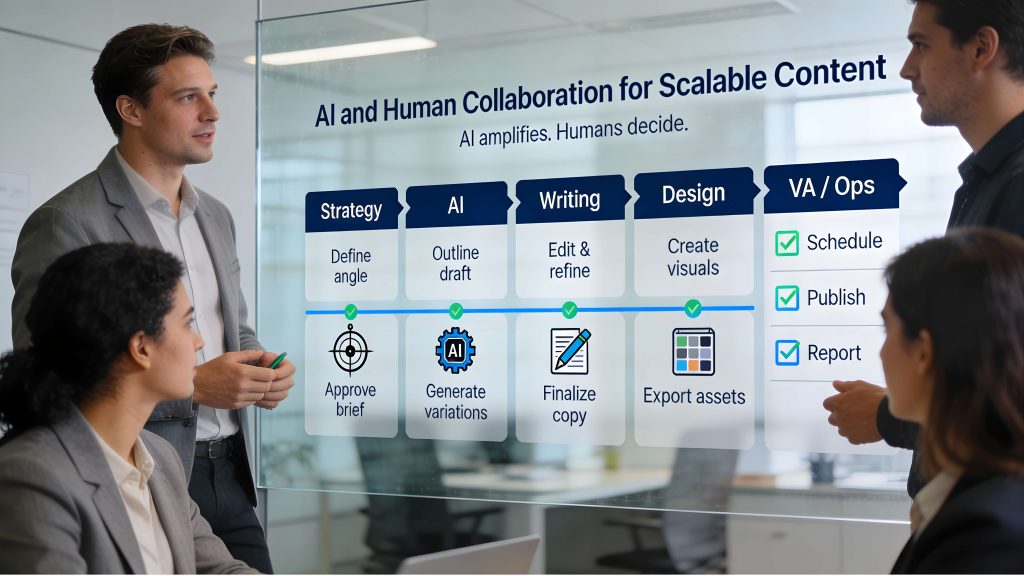
AI doesn’t replace team members. It amplifies what they can accomplish. A virtual assistant with access to AI tools produces output that used to require a full-time content manager.
One entrepreneur structured her team this way. She handles strategy and high-level content direction. Her VA uses AI to draft posts based on that direction. A freelance designer handles visual creation using AI design tools. Everyone works within documented processes.
Her content output tripled while her management time decreased. She’s not micromanaging creation. She’s reviewing finished work against clear standards.
Another founder gave his VA a library of pre-written prompts. Each prompt generates specific content types. LinkedIn thought leadership post. Instagram carousel about case studies. Email newsletter template. The VA doesn’t write from scratch. She selects the right prompt, feeds in the core idea, and refines the AI output.
This approach works because it removes the hardest part of delegation: trusting someone else with your voice. The prompts encode your style. The VA executes. You review and approve.
The key is matching AI capabilities with human strengths. AI handles structure and first drafts. Humans handle refinement and strategic decisions. AI speeds up research. Humans filter for relevance. AI generates options. Humans choose what fits.
When you design delegation with this division of labor in mind, scaling becomes manageable.
Automation ideas: triggers, templates, and no-code integrations
Automation removes repetitive manual tasks from your content workflow. Not everything can be automated. But the things that can be should be.
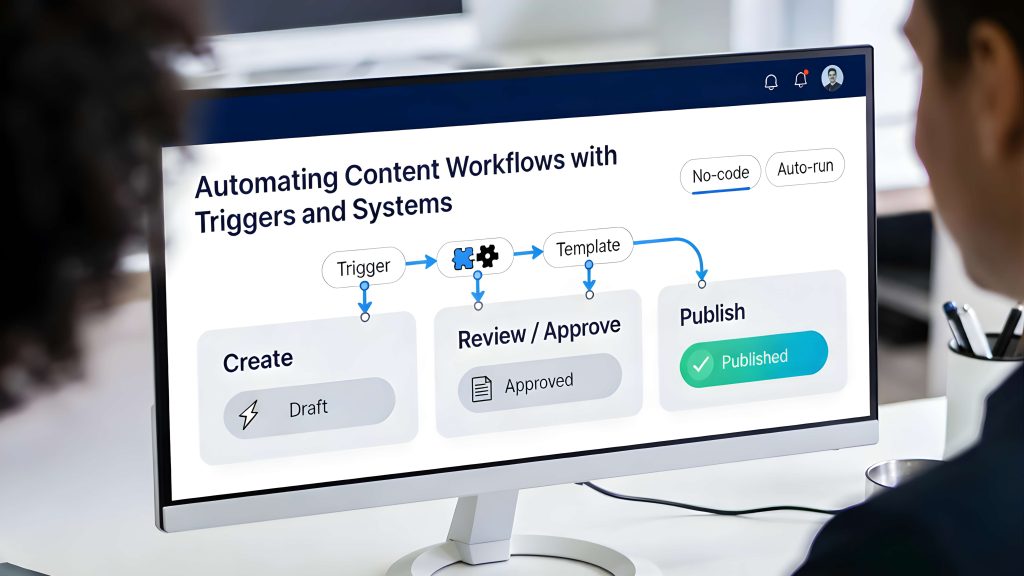
One simple automation connects blog publication to social media. When a new post goes live on your blog, a tool like Zapier automatically creates draft social posts. You review and schedule. But you don’t manually transfer content between platforms.
Another founder automated her newsletter workflow. When she adds an article to her content calendar in Notion, an automation generates an email draft in her newsletter platform. The draft includes the article summary and a call to action. She edits and sends. The manual transfer work is eliminated.
These automations save 10 to 15 minutes per post. Across 20 posts per month, that’s five hours reclaimed. Five hours you can invest in strategy instead of copy-paste tasks.
The automation mindset is simple. If you do the same task more than twice per week, ask if it can be automated. Often the answer is yes.
Common automation opportunities include moving content between platforms, scheduling posts across channels, updating content calendars when deadlines approach, sending notifications when team members complete tasks.
Tools like Zapier and Make handle most automation needs without coding. You connect apps through simple if-this-then-that logic. When X happens, do Y automatically.
One team automated their entire content approval process. Writer finishes draft in Google Docs. Automation moves it to Notion for editor review. Editor approves. Automation notifies designer. Designer adds visuals. Automation notifies scheduler. No manual handoffs. No tasks falling through cracks.
This level of automation requires upfront setup time. But once built, it runs forever with minimal maintenance.
Grow without losing control over strategic direction
The biggest fear in scaling is losing control. You worry that delegated content won’t match your standards. You worry that automation will make everything feel robotic. You worry that growth means sacrificing quality.
These fears are valid. But they’re manageable with the right structure.
One founder maintains control through a weekly content review session. Every Monday morning she spends one hour reviewing the week’s planned content. She approves topics, adjusts messaging, and provides direction. The rest of the week her team executes against that approved plan.
One hour of strategic input directs 40 hours of team execution. That’s leverage.
Another entrepreneur uses approval checkpoints. First drafts don’t get designed until she reviews them. Designed pieces don’t get scheduled until she gives final approval. The checkpoints protect quality without requiring her to create everything herself.
The key is separating strategy from execution. You own strategy. Your team owns execution within the strategic framework you define.
This requires trusting your systems. If your SOPs are clear, if your team is trained, if your quality standards are documented, then delegation works. You’re not hoping content will be good. You’re ensuring it meets defined criteria.
One founder told me that scaling forced her to get clearer on her own standards. When she had to explain what good content looked like, she realized she’d been operating on instinct. Documenting standards improved her own work and made delegation possible.
Protect your brand voice at scale
Brand voice is the hardest thing to scale. It’s deeply personal. It’s what makes your content recognizable. Losing it means losing differentiation.
The solution is creating voice guidelines that others can follow. Not vague statements like “be authentic.” Specific examples of phrases you use and phrases you avoid.
One entrepreneur built a brand voice document with three sections. Tone characteristics with examples. Common sentence structures. Words and phrases that define her style.
She gave this document to everyone creating content under her brand. Writers. Designers. Social media managers. They all referenced it. The content stayed consistent even as the team grew.
Another founder records herself talking about topics and has her team transcribe the recordings. The transcripts become first drafts written in her natural voice. An editor cleans them up while preserving the conversational tone.
This approach maintains voice authenticity while scaling production. She’s still the source of ideas and perspective. The team handles the transformation from rough thoughts to polished content.
Voice consistency requires ongoing attention. Regular reviews catch drift. Feedback loops help team members learn your preferences. Over time they internalize your voice and need less direction.
But you never fully hand off voice responsibility. It’s one area where founder involvement stays high even at scale.
Build systems that support sustainable growth
Scaling isn’t a one-time event. It’s an evolution. You start solo. You add one helper. You build SOPs for that role. You add another helper. You automate handoffs. You gradually transform from creator to content director.
Each step should feel manageable. If scaling creates overwhelm, you’re moving too fast or missing systems.
One founder scaled over 18 months. Month 1 to 6 she documented her personal workflow. Month 7 she hired a VA for five hours per week. Month 8 to 12 she refined SOPs based on what worked and what broke. Month 13 she added a freelance designer. Month 14 to 18 she built automation between tools.
By month 18 she was publishing three times the content with less personal time investment. The growth was steady and sustainable because each phase built on the previous phase.
Another entrepreneur tried to scale too quickly. Hired three people at once. No documented processes. Chaos resulted. Content quality dropped. Management time exploded. She had to pause, document systems, and rebuild slowly.
The lesson is that systems enable scale. Without systems, adding people creates complexity instead of capacity.
From solo creator to content director
The transition from doing everything yourself to directing a content operation is psychological as much as practical. You have to let go of perfection. You have to trust process over personal involvement.
One founder described it as shifting from craftsman to architect. A craftsman builds everything with their own hands. An architect designs systems that others execute.
This shift is necessary for growth. You can’t be in every piece of content and scale beyond a certain point. You have to design frameworks that produce quality outcomes without requiring your direct touch every time.
The good news is that AI makes this transition easier. It standardizes quality in ways that weren’t possible before. Your team isn’t starting from blank pages. They’re starting from AI-generated drafts built with your prompts. The baseline is higher. The variation is smaller.
Systems, delegation, and automation turn content from a personal activity into a business operation. One that can grow without requiring proportional increases in your time.
Once you’ve built these systems, the final piece is creating a practical plan to test and implement everything.