
Content creation feels impossible for most entrepreneurs. You know you need to publish consistently. You understand that visibility drives growth. But between running your business and managing daily operations, content becomes the thing you never get to.
The usual advice doesn’t help. Work faster. Batch your tasks. Hire a team. These solutions assume you have time you don’t have or money you haven’t made yet.
This is where AI productivity tools for content creation change everything. Not as a replacement for your voice or judgment. As a system that handles the mechanical parts so you can focus on strategy and connection.
Most entrepreneurs try AI as a quick writing tool and miss the real opportunity. AI isn’t about faster drafts. It’s about building a content operating system that runs predictably without consuming your life.
This guide shows you how to design that system from the ground up. Strategy before tools. Workflows before volume. Quality control before delegation. Each piece builds on the previous one until you have a complete content engine that actually works.
The transformation isn’t immediate. But it’s real. Solo founders executing like content teams. Manual processes becoming automated workflows. Random posting becoming strategic campaigns.
You don’t need more hours in your day. You need better systems for the hours you have.

Why most entrepreneurs fail at content productivity before AI
The problem isn’t what most people think. Entrepreneurs don’t fail at content because they lack creativity or writing skills. They fail because they’re trying to build a house without blueprints.
Manual content creation has a hidden cost that compounds over time. A solo coach spends four hours writing one post and publishes twice a month. That’s eight hours of work for minimal visibility. Her competitors are publishing weekly and building momentum she can’t match. The gap widens every month.
But working harder isn’t the answer. One founder tried to increase output by dedicating entire days to content. She burned out within six weeks. The content quality dropped. Her energy for client work disappeared. The experiment failed.
The real issue runs deeper than time management. It’s about productivity myths that sound reasonable but destroy results.
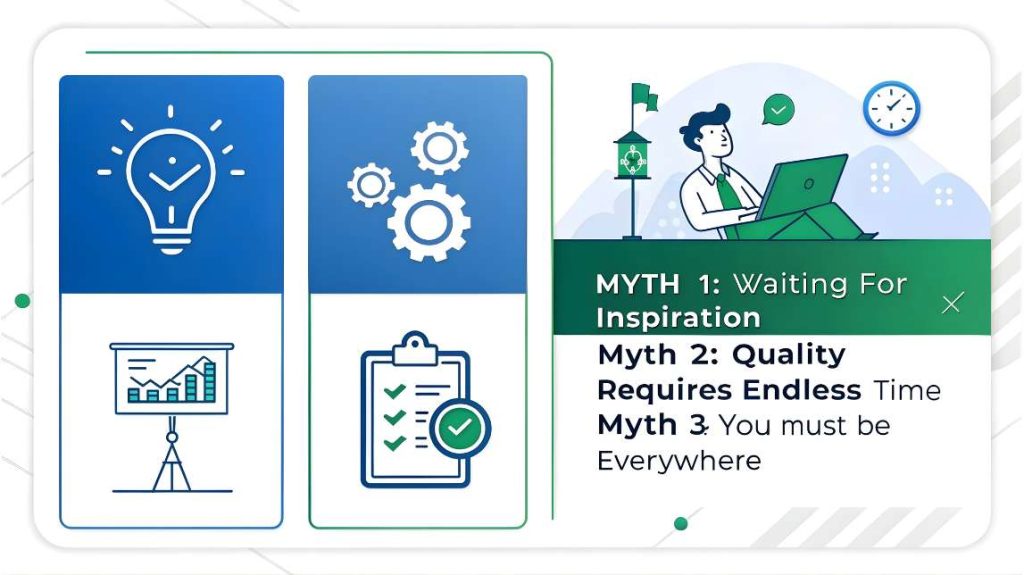
The first myth is waiting for inspiration. Entrepreneurs tell themselves they’ll post when they feel inspired. Then three weeks pass with no content. Inspiration is unreliable. It doesn’t care about your business goals or your growth timeline.
The second myth is that quality requires endless time. Founders spend six hours perfecting one article thinking that proves their commitment to excellence. But what if quality came from clarity and structure instead of time investment?
The third myth is believing you need to be everywhere. Instagram, LinkedIn, Twitter, TikTok, Pinterest. Entrepreneurs burn out trying to maintain presence on five platforms when they haven’t mastered one.
These myths create inconsistency without creating guilt. You feel bad about not posting enough but can’t figure out how to post more without sacrificing everything else.
The actual bottleneck isn’t time or ideas. It’s lack of systems. One entrepreneur kept 50 content ideas in her notes app. Great topics. Smart angles. Zero published posts. The gap between idea and execution killed her momentum before it started.
Without a process to transform thoughts into finished content, everything stays theoretical. The notes pile up. The guilt increases. The visibility stays flat.
Systems bridge that gap. A system doesn’t require inspiration or motivation. It’s a sequence of steps that produces output regardless of how you feel on any given day. One founder went from publishing once per month to once per week by building a simple five-step workflow. Same person. Same schedule. Different structure.
This is what changes when you redesign your content approach as an operating system instead of a creative project. The shift from chaos to method doesn’t require more hours. It requires intentional design.
Mapping your AI-ready content engine: Strategy before tools
The biggest mistake entrepreneurs make with AI is starting with tools. They sign up for three platforms in one week. They spend hours learning features and testing interfaces. Then they sit down to create content and realize they have no strategy.
Tools without strategy create chaos. You end up with expensive subscriptions and no clear direction. The platforms work perfectly but you don’t know what to build with them.
Strategy comes first. Before you select a single tool, you need four foundations in place. Clear business goals. Defined target audience. Core content pillar. Meaningful metrics.
One founder named Katy posted whenever she felt like it. Some weeks five posts. Other weeks nothing. Her topics covered whatever caught her attention. Marketing tips one day. Personal stories the next. Industry news. Random observations. Her audience stayed small because nobody knew what to expect from her.
Then she mapped a strategic roadmap. Every piece of content connected to her service offerings. Every post moved potential clients closer to understanding her methodology. Her publishing became predictable. Her message became clear. Within three months her consultation requests doubled. Same skills. Different strategy.
This is what happens when you build structure before you build volume. Your content serves your business instead of just filling space.
The first step is defining your core pillar. Most entrepreneurs try to cover everything. Productivity and leadership and technology and personal growth and business strategy. The result is confused audience and exhausted creator.
A consultant I worked with posted about six different topics across his channels. His engagement was terrible. People didn’t know what he stood for. We narrowed his focus to one core pillar: AI productivity. Every piece of content connected back to that single theme. His output actually decreased but his impact increased dramatically. People started recognizing him as the AI productivity expert.
Your core pillar should connect directly to your business model. If you sell coaching on time management, your pillar is productivity systems. If you offer consulting on digital marketing, your pillar is growth strategies. The pillar isn’t everything you know. It’s the one thing you want to be known for.
Once you have your pillar, you need angles. Angles are the different ways you approach your core topic. They give you variety without losing focus. One entrepreneur used a simple formula: before versus after. Every piece showed transformation. Before AI in email marketing. After AI in email marketing. Before AI in content planning. After AI in content planning. This single angle generated dozens of posts across multiple formats.
Another founder used comparison angles. Tool A versus tool B. Manual process versus AI-assisted process. Beginner approach versus advanced approach. The key is choosing three to five angles you can repeat consistently. You’re not creating from scratch every time. You’re applying proven angles to different topics within your pillar.
Now comes the hardest part for most entrepreneurs. Setting metrics that actually matter. Most people track the wrong numbers. They celebrate 500 impressions on a post. They feel defeated when engagement drops for a week. But impressions don’t pay bills. Engagement doesn’t guarantee revenue.
One founder shifted his entire measurement approach. He stopped tracking likes and started tracking qualified leads. Every piece of content had one job: move someone from stranger to conversation. He measured consultation requests. Email signups from specific lead magnets. Direct messages asking about his services. These metrics connected directly to revenue potential.
His follower count grew slower but his revenue grew faster. That’s the difference between vanity metrics and business metrics. When you define what success actually means for your business, your content becomes intentional. You stop chasing trends and start building assets.
Your content strategy only works if it supports your business model. A consultant needs different content than a course creator. A freelancer needs different content than an agency owner. One entrepreneur I worked with was creating educational posts that built authority but didn’t generate client conversations. People appreciated her content but didn’t hire her.
The disconnect was simple. Her content answered questions people had before they were ready to invest. She needed content that spoke to people actively looking for solutions. So she adjusted her mix from 100% educational to 70% educational and 30% conversion-focused. That small change doubled her consultation bookings.
Your content should move people through a journey. Awareness. Interest. Consideration. Decision. Each stage needs different content. Each piece should have a clear role in your overall strategy.
Strategy isn’t complicated but it is intentional. Answer four questions before touching any tool. What business outcome am I working toward? Who exactly am I trying to reach? What’s my core message in one sentence? How will I measure success? These four answers become your filter for every content decision.
Building your AI productivity stack for content creation
Once your strategy is clear, tool selection becomes simple. You’re not looking for features. You’re looking for solutions to specific problems you’ve already defined.
The AI tool market is overwhelming. Hundreds of platforms promise productivity. Most entrepreneurs end up with subscription bloat and minimal impact. Seven tools charging monthly. Two get used regularly. Five sit ignored.
The solution is a lean, focused stack covering four essential categories. Research to find topics worth covering. Drafting to transform ideas into structured content. Design to make content visually engaging. Distribution to get content in front of your audience.
Most entrepreneurs overcomplicate this. They want specialized tools for every micro-task. A tool for headlines. Another for outlines. A third for editing. A fourth for formatting. But complexity kills consistency. The more tools you juggle, the more friction you create.
One founder runs his entire content operation with two platforms. ChatGPT for research and drafting. Notion for organization and collaboration. That’s it. Two tools covering 70% of his content pipeline. He publishes twice per week without fail. His simple stack removes decision fatigue and keeps him focused on execution.
This doesn’t mean you can’t add specialized tools later. It means you start with a foundation that works before expanding. Master the basics before chasing advanced features.
Finding the right topics used to take hours. You’d search forums. Read competitor blogs. Guess what your audience wanted to know. The process was slow and mostly guesswork. Now you can generate 20 SEO-friendly topic ideas in five minutes.
Tools like Answer the Public or SEMrush show you exactly what people are searching for. You stop guessing and start responding to real demand. One entrepreneur shifted her entire content strategy after running keyword research. She discovered her audience wasn’t searching for the topics she kept writing about. They were asking completely different questions.
She adjusted her content calendar based on actual search data. Her organic traffic tripled in two months because she finally gave people what they were actively looking for. The key is using research tools to inform strategy, not replace it. The tool shows you what’s being searched. You decide what aligns with your business goals.
Writing assistants changed everything for time-constrained founders. A newsletter that used to take 90 minutes now takes 15 minutes to draft. The quality stays high because you’re editing output instead of staring at blank pages.
This is where most entrepreneurs see immediate ROI. You cut content creation time by 60% to 70% without sacrificing your voice or message. One founder described it this way: she used to spend an hour getting the first paragraph right. Now she spends five minutes giving the AI her key points and 20 minutes refining the output to match her style.
The process isn’t about letting AI write for you. It’s about using AI to eliminate the blank page problem. You provide direction. The AI provides structure. You add personality and precision. ChatGPT covers 90% of use cases for solo founders and small teams. The real skill isn’t finding the perfect tool. It’s developing a revision process that transforms AI drafts into content that sounds like you.
Content without visuals gets ignored. But design used to require specialized skills or expensive freelancers. Tools like Canva added AI features that generate thumbnails, social graphics, and presentation slides in seconds. You type a prompt. The tool creates three variations. You pick one and make minor tweaks.
One entrepreneur creates all her LinkedIn carousels this way. She outlines the content. Feeds it into Canva. Gets a designed carousel in 30 seconds. She publishes three to four carousels per week with zero design background.
For video content, tools like Descript handle editing through text. You edit the transcript and the video updates automatically. No timeline scrubbing. No technical video knowledge required. Another founder repurposes her podcast episodes using Descript. She pulls out 10 short clips from each long episode. Each clip becomes a social post. One 45-minute recording becomes 10 pieces of content.
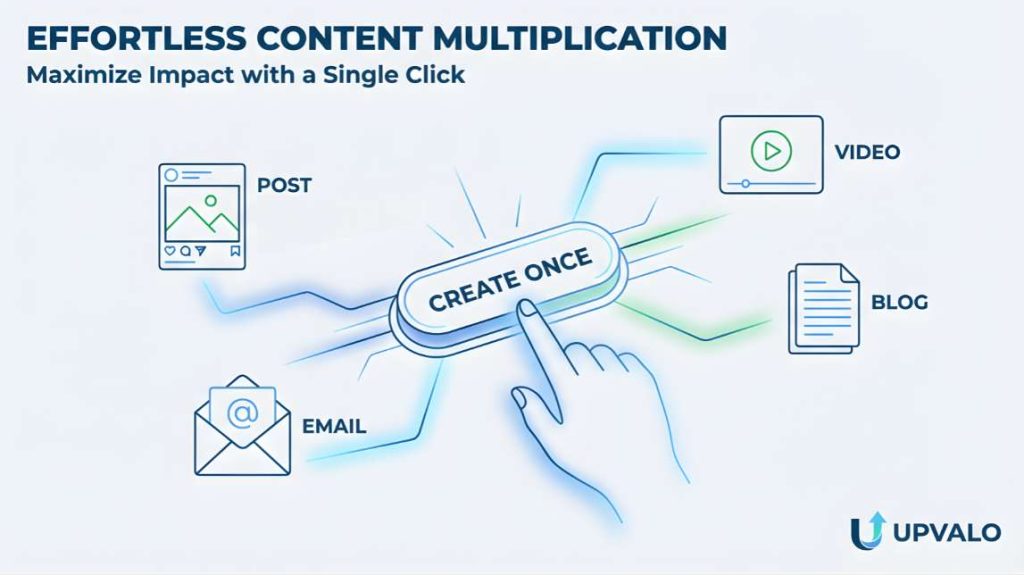
This is the leverage AI provides. You create once and multiply output without multiplying effort.
The biggest mistake is choosing tools based on what successful creators use. Someone running a team of five needs different tools than someone working solo. Someone with a $500 monthly budget has different options than someone bootstrapping on $50.
Your tool selection should match three factors. Your current skill level. Your content volume. Your available budget. If you’re just starting, free versions of ChatGPT and Canva cover everything you need. You don’t need pro subscriptions until you’re publishing consistently and hitting usage limits.
One founder spent $200 on premium tools in her first month. She used maybe 10% of the features. After three months she downgraded to basic plans and saved $150 monthly with zero impact on output. Tools should remove friction, not create it.
Start minimal. Add tools only when you identify specific bottlenecks in your workflow. This approach keeps costs low and complexity manageable. Every week a new AI tool launches. Every launch promises to revolutionize content creation. But tool hopping destroys productivity.
One entrepreneur subscribed to seven AI tools in two months. She used two regularly. The other five sat unused while charging her card monthly. That’s $300 wasted on software that created zero value. When you see a new tool, ask three questions. What specific problem does this solve? Can my current stack already handle this? Will this integrate with my existing workflow?
If you can’t answer all three clearly, don’t subscribe. Your goal isn’t having every tool. Your goal is having the right tools working together seamlessly. A small optimized stack beats a large fragmented one every time.
High-leverage AI workflows: From idea to multi-Channel content in hours
Tools are useless without workflows. A workflow is the sequence of steps that transforms one idea into multiple pieces of published content. This is where real productivity gains happen.
Most entrepreneurs treat each piece of content as a separate project. They write a blog post. Then they start from scratch on their newsletter. Then they brainstorm social media from zero again. This approach multiplies work unnecessarily.
One idea should fuel multiple formats across multiple channels. That’s what repurposing workflows accomplish. One founder uses a simple system. Write one long-form blog post every Monday. By Friday that single post becomes three LinkedIn posts, one email newsletter, and one short video script.
Same core idea. Same key messages. Different formats optimized for different platforms. Total additional time investment: 90 minutes. Output: six pieces of content from one source. This is how solo founders compete with content teams. Not by creating more. By repurposing smarter.
The workflow looks like this. Blog post becomes the foundation. Pull three key insights for LinkedIn. Reframe the main argument for email. Extract actionable steps for video. Each piece stands alone while reinforcing the others.
The hardest part of content creation used to be the first draft. Staring at a blank document. Struggling with structure. Wrestling with word choice. Hours disappearing before you had anything usable. AI eliminated that bottleneck.
Now you can get a structured first draft in under 10 minutes. The quality might be rough but rough is fixable. Blank is not. One entrepreneur outlines the main points in bullet format. Feeds the outline into ChatGPT with clear instructions about tone and structure. Gets back a 1200-word draft. Spends 20 minutes editing for voice and accuracy.
Total time from outline to polished post: 35 minutes. The old process took three hours minimum. The key is understanding what AI does well and what needs human input. AI excels at structure and initial phrasing. It struggles with nuance and authentic voice.
You provide the strategy and personality. AI provides the framework. Another founder uses AI for research synthesis. Collecting five sources on a topic. Asking AI to identify common themes and contrasting viewpoints. Using that analysis as the article outline. The AI does the heavy lifting. The founder adds perspective and examples.
This division of labor is where productivity gains happen. You’re not replacing yourself with AI. You’re delegating the mechanical parts so you can focus on the creative parts.
Once you have a long-form piece, repurposing becomes systematic. You’re not rewriting. You’re extracting and reformatting. A single blog outline can generate LinkedIn carousels in seconds. You take your main sections. Turn each section into a carousel slide. Add a hook at the beginning and a call to action at the end.
One entrepreneur creates all social content this way. Writing one comprehensive article per week. That article spawns eight social posts. Four LinkedIn. Three Twitter threads. One Instagram caption. All derived from the same source material.
The process is simple. Identify quotable statements from your article. Pull statistics or data points. Extract step-by-step instructions. Each becomes a standalone social post while driving traffic back to the full piece.
Email newsletters work the same way. Your blog post becomes your email content. You adjust the opening to feel more conversational. You shorten paragraphs for mobile reading. You add a personal note at the beginning. Same information, different packaging.
Video scripts follow the same pattern. Your blog structure becomes your video outline. Introduction, three main points, conclusion. You’re not creating new content. You’re adapting existing content to a new medium. This is why starting with long-form makes sense. It’s easier to condense than expand.
AI speeds up creation but it can’t replace judgment. Every AI-generated piece needs human review. Not just for grammar. For accuracy, relevance, and voice. One founder uses a two-minute quality check for every piece of content. Three questions guide the review. Does this sound like me? Is the information accurate? Will this help my audience?
If the answer to any question is no, revision happens. Sometimes that means rewriting entire sections. Sometimes it’s just adjusting a few phrases. But that review step is non-negotiable.
Another entrepreneur maintains a style guide. Key phrases to use. Words to avoid. Tone characteristics that define the brand. When AI generates content, checking it against the guide happens automatically. Anything that doesn’t match gets edited. This quality loop protects your brand voice across all channels.
Your LinkedIn posts sound like you. Your emails sound like you. Your blog sounds like you. The consistency builds trust and recognition. The mistake is assuming AI output is ready to publish. It rarely is. The value of AI isn’t eliminating editing. It’s reducing the time from idea to first draft.
Every entrepreneur needs a slightly different workflow. Your process depends on your content mix, your platforms, and your available time. The framework stays consistent. Start with one comprehensive piece. Extract key elements. Adapt those elements to different formats. Review for quality and voice. Publish across channels.
One founder does this weekly. Sunday night outline one article. Monday morning write the full draft. Tuesday create social derivatives. Wednesday record a video based on the script. Thursday schedule everything. Friday publish.
Another founder does it monthly. First week write four blog posts. Second week create all social content from those posts. Third week batch email newsletters. Fourth week handle video and other formats. Both approaches work because both follow the same principle. Create once, distribute many times.
Your workflow should feel manageable, not overwhelming. If you’re trying to create 50 pieces from one source, you’ll burn out. If you’re creating three quality derivatives, you’ll sustain momentum.
Scaling up: Systems, delegation and automation with AI
The difference between personal workflow and scalable system is documentation. What works in your head doesn’t work for someone else until you write it down.
A friend working with a marketing agency in San Francisco told me about a founder who learned this the hard way. She hired her first virtual assistant and asked them to create social posts from blog articles. The VA delivered content that completely missed the mark. Wrong tone. Wrong format. Wrong messaging.
The problem wasn’t the VA’s skill. The problem was lack of clear process. The founder had a workflow in her mind but hadn’t documented it. The VA was guessing at expectations.
So they built an SOP together. Six simple steps. Read the blog post. Identify three key quotes. Create one carousel and two single-image posts. Use the brand voice guide. Add hashtags from the approved list. Schedule in the content calendar.
That SOP transformed everything. The VA could execute without constant questions. The founder could review final output instead of managing every micro-decision. The content stayed consistent.
A good SOP includes what to do, how to do it, and what quality looks like. Screenshots help. Templates help more. The goal is removing ambiguity so anyone following the process gets similar results.
One team in Austin maintains a Notion workspace with all their content SOPs. Research process. Drafting process. Editing checklist. Distribution workflow. Everything documented. New team members get up to speed in days instead of weeks.
This is how you scale without chaos. The system runs independent of any one person.
AI doesn’t replace team members. It amplifies what they can accomplish. A virtual assistant with access to AI tools produces output that used to require a full-time content manager. This model works particularly well for American entrepreneurs who often hire remote VAs from different time zones.
One entrepreneur in New York structured the team this way. Handling strategy and high-level content direction personally. The VA uses AI to draft posts based on that direction. A freelance designer handles visual creation using AI design tools. Everyone works within documented processes.
Content output tripled while management time decreased. No more micromanaging creation. Just reviewing finished work against clear standards.
Another founder in Los Angeles gave the VA a library of pre-written prompts. Each prompt generates specific content types. LinkedIn thought leadership post. Instagram carousel about case studies. Email newsletter template. The VA doesn’t write from scratch. Selecting the right prompt, feeding in the core idea, and refining the AI output.
This approach works because it removes the hardest part of delegation: trusting someone else with your voice. The prompts encode your style. The VA executes. You review and approve.
The key is matching AI capabilities with human strengths. AI handles structure and first drafts. Humans handle refinement and strategic decisions. AI speeds up research. Humans filter for relevance. AI generates options. Humans choose what fits.
When you design delegation with this division of labor in mind, scaling becomes manageable.
Automation removes repetitive manual tasks from your content workflow. Not everything can be automated. But the things that can be should be. American entrepreneurs especially appreciate automation because it compensates for the always-on business culture.
One simple automation connects blog publication to social media. When a new post goes live on your blog, a tool like Zapier automatically creates draft social posts. You review and schedule. But you don’t manually transfer content between platforms.
A founder in Austin automated the newsletter workflow. When adding an article to the content calendar in Notion, an automation generates an email draft in the newsletter platform. The draft includes the article summary and a call to action. Editing and sending happens next. The manual transfer work is eliminated.
These automations save 10 to 15 minutes per post. Across 20 posts per month, that’s five hours reclaimed. Five hours you can invest in strategy instead of copy-paste tasks.
The automation mindset is simple. If you do the same task more than twice per week, ask if it can be automated. Often the answer is yes.
Common automation opportunities include moving content between platforms, scheduling posts across channels, updating content calendars when deadlines approach, sending notifications when team members complete tasks.
Tools like Zapier and Make handle most automation needs without coding. You connect apps through simple if-this-then-that logic. When X happens, do Y automatically.
One team in San Francisco automated their entire content approval process. Writer finishes draft in Google Docs. Automation moves it to Notion for editor review. Editor approves. Automation notifies designer. Designer adds visuals. Automation notifies scheduler. No manual handoffs. No tasks falling through cracks.
This level of automation requires upfront setup time. But once built, it runs forever with minimal maintenance.
The biggest fear in scaling is losing control. You worry that delegated content won’t match your standards. You worry that automation will make everything feel robotic. You worry that growth means sacrificing quality.
These fears are valid. But they’re manageable with the right structure.
One founder in New York maintains control through a weekly content review session. Every Monday morning spending one hour reviewing the week’s planned content. Approving topics, adjusting messaging, and providing direction. The rest of the week the team executes against that approved plan.
One hour of strategic input directs 40 hours of team execution. That’s leverage.
Another entrepreneur uses approval checkpoints. First drafts don’t get designed until reviewed. Designed pieces don’t get scheduled until final approval given. The checkpoints protect quality without requiring creating everything personally.
The key is separating strategy from execution. You own strategy. Your team owns execution within the strategic framework you define.
This requires trusting your systems. If your SOPs are clear, if your team is trained, if your quality standards are documented, then delegation works. You’re not hoping content will be good. You’re ensuring it meets defined criteria.
Brand voice is the hardest thing to scale. It’s deeply personal. It’s what makes your content recognizable. Losing it means losing differentiation.
The solution is creating voice guidelines that others can follow. Not vague statements like “be authentic.” Specific examples of phrases you use and phrases you avoid.
One entrepreneur in Los Angeles built a brand voice document with three sections. Tone characteristics with examples. Common sentence structures. Words and phrases that define the style.
Everyone creating content under that brand received this document. Writers. Designers. Social media managers. They all referenced it. The content stayed consistent even as the team grew.
Another founder records talking about topics and has the team transcribe the recordings. The transcripts become first drafts written in natural voice. An editor cleans them up while preserving the conversational tone.
This approach maintains voice authenticity while scaling production. Still the source of ideas and perspective. The team handles the transformation from rough thoughts to polished content.
Voice consistency requires ongoing attention. Regular reviews catch drift. Feedback loops help team members learn your preferences. Over time they internalize your voice and need less direction.
Scaling isn’t a one-time event. It’s an evolution. You start solo. You add one helper. You build SOPs for that role. You add another helper. You automate handoffs. You gradually transform from creator to content director.
Each step should feel manageable. If scaling creates overwhelm, you’re moving too fast or missing systems.
One founder scaled over 18 months. Month 1 to 6 documenting personal workflow. Month 7 hiring a VA for five hours per week. Month 8 to 12 refining SOPs based on what worked and what broke. Month 13 adding a freelance designer. Month 14 to 18 building automation between tools.
By month 18 publishing three times the content with less personal time investment. The growth was steady and sustainable because each phase built on the previous phase.
The transition from doing everything yourself to directing a content operation is psychological as much as practical. You have to let go of perfection. You have to trust process over personal involvement.
Systems, delegation, and automation turn content from a personal activity into a business operation. One that can grow without requiring proportional increases in your time.
From insight to action: your 30-day AI content productivity plan
Theory without action changes nothing. This 30-day plan turns insight into results through weekly milestones that build momentum. Week 1: audit and choose one project. Week 2: set up tools and workflows. Week 3: produce and publish. Week 4: measure and optimize. Each phase is designed to create small wins that compound into real transformation.
The first week is about clarity, not creation. Before you add AI to your workflow, you need to understand what’s actually happening in your current process.
Start with a simple audit. List every piece of content you published in the past month. Note how long each piece took to create. Track where you spent the most time. Writing? Research? Formatting? Distribution?
One founder in Austin did this audit and discovered 40% of content time went to formatting and image selection. Not strategy. Not writing. Just mechanical tasks that AI could handle in minutes.
Another entrepreneur realized he was creating content nobody asked for. His blog posts got minimal traffic because they didn’t align with what his audience was searching for. The audit revealed the disconnect.
Your audit should answer three questions. What content am I creating? How much time does it require? What results is it generating?
Once you have that baseline, choose one project for your AI experiment. Not your entire content strategy. One specific, manageable project.
Pick your most important content format. If blog posts drive your business, start there. If LinkedIn content generates leads, start there. If email newsletters build relationships, start there.
One founder in San Francisco chose to focus on the weekly newsletter. It was the most valuable channel but took three hours to write. That became the AI test project.
The goal for week one is finishing with a clear understanding of your current state and one defined project to transform. Nothing more. Clarity first, then action.
Week two is about building your foundation. You need tools and you need process. Both should be simple.
Start with tool selection. Based on your chosen project, what do you actually need? If you’re working on written content, you need a writing assistant. If you’re creating social graphics, you need a design tool. If you’re repurposing video, you need editing software.
Don’t install 10 tools. Install two or three that directly support your pilot project.
One entrepreneur set up ChatGPT for writing and Canva for visuals. That’s it. Two tools. Everything needed to transform the blog workflow.
Spend a few hours learning each tool. Not mastering every feature. Just understanding the basics. How to input your requirements. How to refine outputs. How to export what you create.
Then design your workflow. Map the exact steps from idea to published content. Write it down as a simple checklist.
One founder’s workflow looked like this: Monday research topic and create outline. Tuesday use AI to draft 800 words. Wednesday edit draft and add examples. Thursday create visual in Canva. Friday publish and promote.
Five steps. One per day. Totally manageable alongside regular work.
Another entrepreneur built a repurposing workflow. Write one LinkedIn post manually. Use AI to create three variations. Design graphics for each. Schedule across the week. Four steps total.
The workflows don’t need to be perfect. They need to be documented and executable. You’ll refine them as you go.
By the end of week two you should have your tools set up and at least two workflows written down. Ready to test in week three.
Week three is execution. You take your workflows and run them. This is where theory becomes reality.
Start with your first workflow. Follow it step by step. Don’t improvise. Don’t skip steps. Execute exactly as documented. This shows you what works and what breaks.
One founder in New York followed the blog workflow and hit a problem on day three. The AI draft didn’t match the voice. Extra time spent rewriting. That revealed the need for better prompts for week four.
Another entrepreneur’s social media workflow worked perfectly until scheduling. The realization came that a step for writing captions was missing. Quick adjustment. Problem solved.
The goal isn’t perfection. The goal is completion. Finish the workflow. Publish the content. Learn from what happens.
By mid-week you should have produced your first AI-assisted piece. Now test the repurposing workflow. Take that first piece and transform it into derivative content.
One article becomes three social posts. One video becomes five short clips. One newsletter becomes a LinkedIn article. Whatever makes sense for your channels.
One founder created a blog post on Monday. By Friday the post was published plus four social derivatives. Five pieces from one core idea. Total time investment: four hours instead of the usual 12.
That’s when the transformation becomes tangible. You’re not just using AI. You’re working within a system that multiplies your output.
End week three with at least one complete content campaign published. One main piece and two to three derivatives. Track how long everything took. Note what felt smooth and what felt difficult.
The final week is about refinement. You’ve executed your workflows. Now you improve them based on real experience.
Start by measuring time savings. Compare week three production time to your baseline from week one. Most entrepreneurs see 50% to 70% time reduction on their first AI-assisted project.
One founder in Los Angeles dropped from three hours to one hour for the newsletter. Another reduced blog post time from four hours to 90 minutes. These aren’t theoretical improvements. These are documented time savings.
Next, evaluate quality. Did your content maintain your voice? Did your audience respond positively? Did you get the results you wanted?
One entrepreneur noticed AI-generated social posts got less engagement than manual posts. The quality was there but the hook wasn’t strong enough. Prompts were adjusted to emphasize compelling openings. Engagement recovered.
Another founder found blog posts were better with AI because the structure was clearer. AI forced organizing thoughts before writing. That improved readability.
Use this feedback to optimize your workflows. Add steps that were missing. Remove steps that didn’t add value. Adjust prompts for better output. Refine your editing process.
One team updated their workflow to include a voice check step. Before publishing anything, they read it aloud to ensure it sounded like the founder. That one addition solved their consistency problem.
Document these improvements. Your workflow is now version 2. Better than version 1 because it’s based on actual experience.
Finally, decide how to scale your system. Do you apply these workflows to other content types? Do you increase frequency? Do you delegate parts of the process?
One founder decided to double publishing frequency. The improved workflow made that possible without additional time investment.
Another entrepreneur chose to teach the workflow to a virtual assistant. Strategy could be maintained while delegating execution.
The decision depends on your goals. But whatever you choose, you’re making it from a position of proven capability. You know your system works because you tested it.
This 30-day plan isn’t the end. It’s the beginning. You’ve proven that AI can transform your content productivity. Now you expand that transformation strategically.
Some entrepreneurs continue refining their pilot project for another month before adding new workflows. Others immediately apply the same approach to their second most important content channel.
Both paths work. The key is maintaining the experimental mindset. Document everything. Measure results. Optimize based on data. Scale only what works.
One founder used this 30-day approach to transform five different content types over six months. Newsletter first. Then blog. Then LinkedIn. Then video. Then email sequences. Each got the same treatment: audit, build workflow, execute, optimize.
By month six publishing 10 times more content than at the start. Same working hours. Just better systems.
Another entrepreneur spent 90 days perfecting one workflow before moving to the next. The philosophy was mastery before expansion. That approach worked for personality and schedule.
There’s no single right path. The principle stays constant: build systems that work, then repeat them.
The 30-day plan only works if you start. Not next month. Not when everything is perfect. Tomorrow.
Your first action is simple. Open a document and do your content audit. List what you published last month. Note how long each piece took. Identify your biggest time sink.
That’s day one. Thirty minutes maximum. No tools required. No AI needed. Just honest assessment of your current reality.
Day two you choose your pilot project. Day three you research tools. By day seven you complete week one.
Small steps executed consistently create transformation. Grand plans that never start create nothing.
One founder almost skipped the audit phase. The desire was to jump straight to using AI tools. But the audit revealed problems that weren’t known. It changed the entire approach.
Another entrepreneur thought 30 days was too long to see results. But breaking it into weekly phases made it manageable. Each week had a clear finish line. The structure removed overwhelm.
The plan works because it’s realistic. You don’t rebuild your entire content operation overnight. You test one workflow. You prove it works. Then you expand.
This is how solo founders build systems that compete with teams. Not through magic. Through method.
Finally, Content productivity isn’t about working faster. It’s about working within systems that multiply your effort without multiplying your hours.
AI productivity tools for content creation give solo entrepreneurs what used to require entire teams. Not by replacing human creativity or strategic thinking. By handling the mechanical parts that consume time without adding value.
The transformation happens in stages. First you understand why manual workflows fail. Then you build strategic foundations before selecting tools. You choose a lean stack that covers research, drafting, design, and distribution. You design workflows that turn one idea into multi-channel campaigns. You scale through documentation, delegation, and automation. Finally you test everything through a structured 30-day plan.
Each stage builds on the previous one. Skip steps and you end up with expensive tools that gather dust. Follow the sequence and you build a content engine that runs predictably.
The entrepreneurs who succeed with AI aren’t the ones with the most tools or the biggest budgets. They’re the ones who treat content like a system instead of an art project. They document workflows. They measure results. They optimize based on data. They scale what works and abandon what doesn’t.
This approach feels mechanical at first. You’re used to creating when inspiration strikes. You’re used to perfectionism taking as long as it takes. You’re used to doing everything yourself because it’s faster than explaining to someone else.
But those habits don’t scale. They keep you trapped in a cycle where content depends entirely on your personal time and energy. When you’re busy, content stops. When you’re tired, quality drops. When you’re focused on client work, visibility disappears.
Systems break that cycle. A documented workflow runs whether you feel inspired or not. A trained team member executes while you focus on strategy. An automated process moves content between platforms while you sleep.
This is how you build momentum that compounds. Consistent publishing builds audience. Growing audience creates opportunity. More opportunity generates revenue. Revenue funds better tools and team members. Better resources accelerate growth.
The cycle feeds itself once it starts. But it only starts when you replace random activity with intentional systems.
Your content productivity transformation begins with one decision. Not to create more content. To build better systems for creating content. That shift in thinking changes everything.
Most entrepreneurs wait for the perfect moment to start. Perfect tools. Perfect workflow. Perfect understanding of every option. But perfection is procrastination in disguise.
Start with good enough. Choose one content format. Pick two tools. Design one simple workflow. Run it for 30 days. Measure what happens. Improve based on results.
That’s the entire process. Simple but not easy. Clear but requiring commitment. Proven but demanding execution.
The entrepreneurs who transform their content productivity aren’t smarter or more creative than you. They just started before they felt ready. They tested before they felt confident. They documented while learning. They improved through repetition.
You can do the same. The tools exist. The methods work. The only question is whether you’ll take the first step.