

The quarter ends on a Friday.
By Monday, most entrepreneurs have already mentally moved on. New goals. Fresh energy. A clean slate. The temptation to just start the next quarter without looking back is almost irresistible especially if the quarter didn’t go the way you planned.
But that instinct is exactly what keeps founders running the same broken patterns, quarter after quarter, year after year.
Here’s the uncomfortable truth: a quarter you don’t review is a quarter you can’t learn from. Without a structured quarterly OKR review, the mistakes you made in Q2 will resurface in Q3. The capacity miscalculations you ignored will repeat. The OKRs that were misaligned from the start will show up again with slightly different labels.
The founders who compound who get measurably better at building their business every 12 weeks aren’t the ones with the best strategies. They’re the ones who consistently close the loop. They review, they learn, they adjust. Then they start the next quarter with sharper judgment than the one before.
This 90-minute quarterly OKR review framework, supported by AI at each stage, is how you build that habit without turning it into a draining, multi-day retrospective. Using OKR scoring, root cause analysis, and course correction, you close the loop on what worked and what didn’t then start the next quarter with sharper judgment.
Want the complete quarterly planning system this review closes? See the full framework: AI Strategic Planning for Entrepreneurs: Quarterly Framework to Align Priorities with Goals
Table of Contents
Why does quarterly OKR review with course correction matter for growth?
Why 67% of entrepreneurs skip quarterly reviews and what It costs them strategically
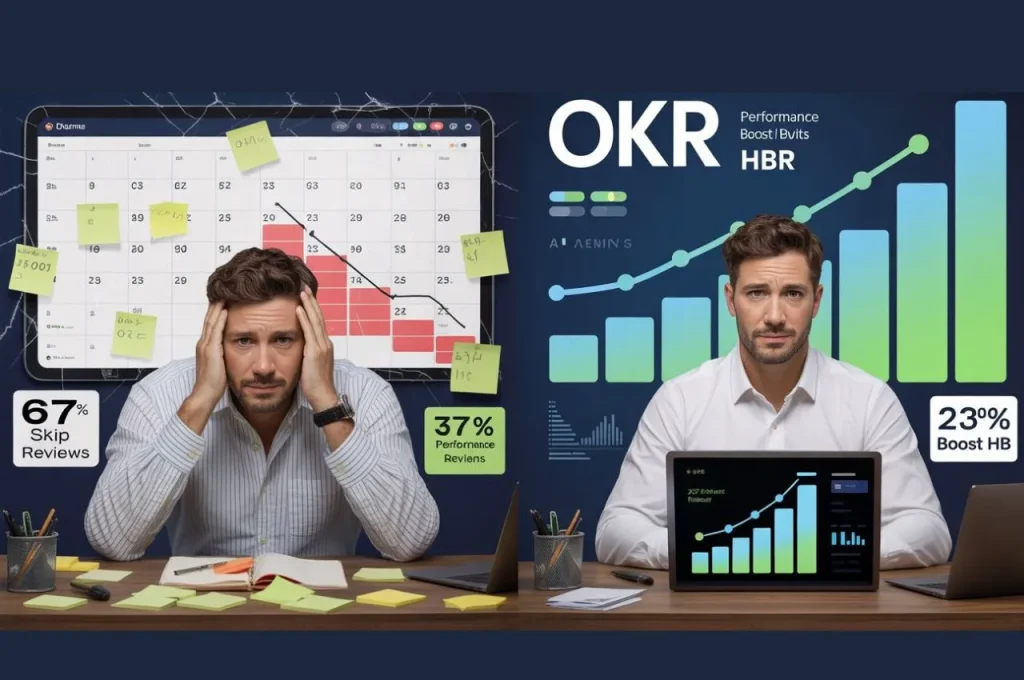
The data on quarterly reviews is stark. Research from Harvard Business Review found that structured reflection improves performance by 23% compared to continuous action without pause. Yet a survey of 500 US entrepreneurs found that fewer than a third conduct any formal end-of-quarter review.
The reasons are predictable and worth naming, because recognizing them is the first step to overriding them:
Reason 1 Review avoidance bias. When a quarter goes badly, the last thing most people want to do is sit down and analyze exactly how badly it went. The mind prefers forward motion to uncomfortable retrospection. So founders skip the review and tell themselves they’ll “do better next quarter” without ever understanding why this quarter went wrong.
Reason 2 No structured format. Without a clear process, a quarterly review becomes an open-ended reflection session that either spirals into frustration or stays surface-level. Both feel like a waste of time. The format in this article solves this.
Reason 3 The sunk cost of momentum. The quarter ends, the new quarter begins, and stopping feels like losing precious days. In reality, two hours of honest review saves you from repeating two to four weeks of misdirected effort in the next cycle.
Reason 4 Nobody’s watching. When you’re accountable only to yourself, it’s easy to let the review slide. The work of the next quarter always feels more urgent than the reflection on the last one.
None of these reasons are good enough to skip the review. They’re just human. Knowing they exist makes it easier to override them.
How does the 90-Minute framework work: OKR scoring to course correction?
The structure below is designed for a solopreneur or small team founder working alone or with a co-founder. It runs exactly 90 minutes when followed as written. No longer the constraint is intentional. Unlimited review time produces diminishing returns and increases avoidance.
Block everything else out. Close Slack. Put the phone face down.

Block 1 OKR scoring (Minutes 0–20)
Score every Key Result from 0.0 to 1.0.
- 0.0–0.3: Minimal progress. The KR barely moved.
- 0.4–0.6: Partial progress. Meaningful effort, incomplete outcome.
- 0.7: Full success. This is the target ambitious but achievable.
- 0.8–1.0: Exceptional. You exceeded what you planned.
One critical rule: score against what you actually committed to at the start of the quarter, not a revised version you quietly adjusted mid-quarter. If you planned 8 articles and published 3, that’s a 0.37 not a 1.0 because you “did your best.”
Honesty here is the entire point. A generous scoring system produces comfortable feelings and no learning.
Calculate your average score per Objective. Write it down.
Block 2 AI pattern analysis (Minutes 20–40)
This is where AI earns its place in your review process. Paste your OKRs and scores into Claude or ChatGPT with this prompt:
“Here are my Q[X] OKRs and scores: [paste full list]. Analyze these results and identify: (1) the top 3 patterns explaining why certain KRs were hit and others weren’t, (2) which Objective showed the biggest gap between planned and actual, and (3) one systemic issue not a one-off event that likely affected multiple KRs.”
The AI won’t know your business as well as you do, but it’s remarkably good at identifying structural patterns in data you’re too close to see clearly. It will often surface a connection between underperforming KRs that you hadn’t noticed for example, that three different missed KRs all required the same type of focused deep work that your calendar consistently failed to protect.
Read the output critically. Reject what doesn’t ring true. Highlight what does. This takes about 15 minutes and produces more honest insight than most founders generate from an hour of solo reflection.
Block 3 root cause analysis (Minutes 40–60)
For every KR scored below 0.5, identify the root cause. Not the surface explanation the structural one.
There are four root causes that account for the vast majority of missed KRs:
Root cause 1 Capacity overcommitment. You planned for more strategic hours than you actually had. The goal was right; the time budget was wrong. Fix: resize the KR next quarter using the capacity formula from Satellite 2.3.
Root cause 2 Priority misalignment. The KR was real, but it wasn’t actually your top priority and other work consistently displaced it. Fix: be more ruthless about the 70-20-10 allocation next quarter. If something can displace a KR repeatedly, it probably deserved higher priority weight.
Root cause 3 Strategic implementation gap. You had the hours, you had the priority, but you didn’t have a clear enough action plan for how to achieve the KR week by week. The goal was clear; the path wasn’t. Fix: next quarter, break each KR into monthly milestones and weekly deliverables before the quarter starts.
Root cause 4 External factors. A client emergency, a personal situation, a market shift that changed the context. Genuinely unpredictable. Fix: factor a 10–15% buffer into your capacity calculation next quarter for genuine unknowns.
Be precise. “I got busy” is not a root cause. “My drain rate increased from 40% to 58% in weeks 5–8 because of two unplanned client onboardings, which consumed the hours I’d allocated to OKR #1” is a root cause. The specificity is what makes the fix possible.
Block 4 Q+1 OKR draft (Minutes 60–80)
With root causes identified, draft next quarter’s OKRs. Don’t start from scratch start from what you learned.
Use this AI prompt to accelerate the drafting:
“Based on these Q[X] results and root causes: [paste summary]. Help me draft 3 OKRs for Q[X+1] that: (1) build on what worked, (2) fix the structural issues identified, and (3) are sized realistically for a founder with [X] net strategic hours per quarter.”
The output will be a draft not a final plan. Your job is to react to it, adjust it, and make it yours. This takes about 10 minutes with AI versus 45 minutes without.
One rule for this block: Q+1 OKRs must directly reflect what you learned in Blocks 1–3. If your Q[X] review showed that OKR #2 consistently lost hours to OKR #1, and you’re planning Q+1 with the exact same two objectives at equal weight you haven’t learned anything. The review should change something.
Block 5 capacity validation (Minutes 80–90)
Before you close the session, run your Q+1 plan through a quick capacity check.
Use the capacity planning formula to validate your plan fits reality: AI Capacity planning framework for 12-week cycles. this framework shows you exactly how to calculate:
- What’s your gross capacity for next quarter?
- What’s your expected drain rate (adjusted based on what you learned this quarter)?
- What’s your net strategic capacity? –
- Does your Q+1 OKR plan fit inside that number honestly?
If the answer is no, resize now. It takes five minutes to adjust a KR scope before the quarter starts. It takes six weeks of frustration to discover the same misalignment mid-quarter.
Close the session with your Q+1 OKRs validated, capacity-checked, and written down somewhere you’ll actually see them. Not buried in a folder. On your desktop, in your weekly planning doc, somewhere visible.
How to apply quarterly OKR review: Scoring, case study, and Q+1 planning
Strategic OKR scoring: What a 0.7 Score actually means for your business
The 0.7 target score deserves its own explanation, because it feels counterintuitive the first time you encounter it.
If you’re consistently scoring 1.0 on all your KRs, your goals aren’t ambitious enough. A perfect score every quarter means you’re playing it safe setting targets you know you can hit rather than targets that require genuine stretch.
Google’s original OKR framework, built by John Doerr and adopted company-wide in the late 1990s, established the 0.7 benchmark deliberately. The logic: if you’re hitting 70% of an ambitious target, you’ve made real progress. If you’re hitting 100% of a comfortable target, you’ve optimized for the feeling of success rather than actual growth.
The corollary: a quarter where you score 0.65 on an ambitious OKR is more valuable than a quarter where you score 1.0 on a safe one. What matters isn’t the score it’s whether the target was honest and the learning was real.
Case study: How an E-Commerce founder used AI to pivot Q3 and recover
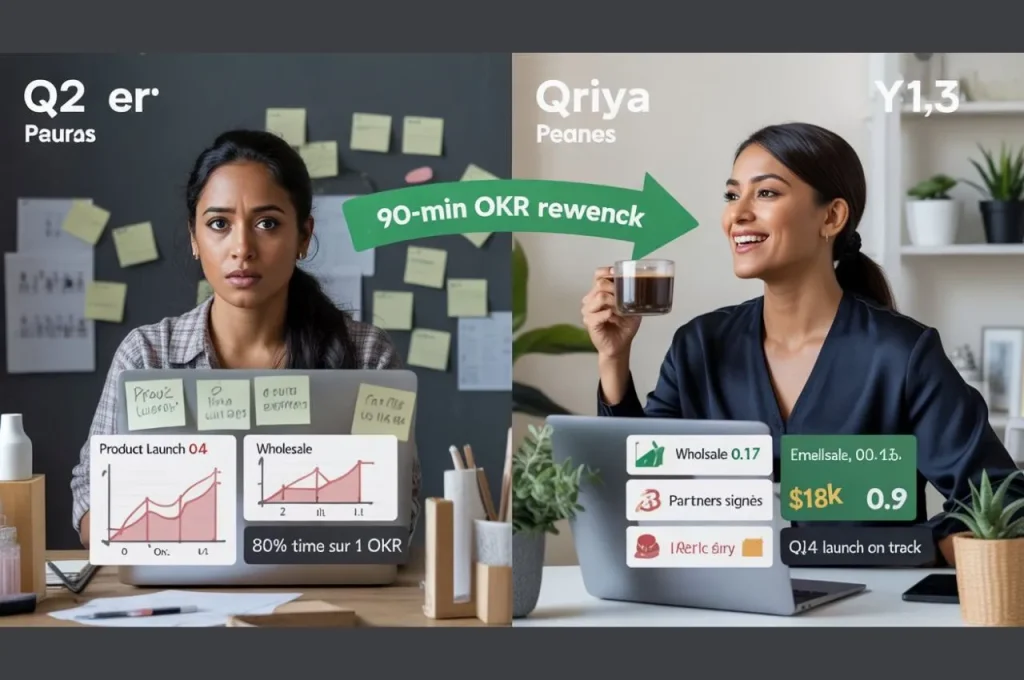
Priya runs a direct-to-consumer skincare brand she’s been building for two years. In Q2, she set three OKRs: launch a new product line, grow her email list to 8,000 subscribers, and establish two wholesale partnerships.
End of Q2 scores:
- Product launch OKR: 0.4 (product launched but 60 days late, missing the spring season)
- Email growth OKR: 0.8 (strong email list hit 7,600)
- Wholesale partnerships OKR: 0.1 (two conversations, zero signed agreements)
She almost skipped the review. The product launch delay felt too raw.
She ran the 90-minute framework anyway. The AI pattern analysis surfaced something she hadn’t consciously connected: both the product launch delay and the wholesale failure shared the same root cause she had allocated 50% of her strategic time to the product launch and 25% each to the other two OKRs, but the launch actually consumed 80% of her time from weeks 4–10, starving everything else.
The product launch didn’t fail because she worked badly. It failed because it was significantly larger than she’d scoped and when it expanded, it compressed the wholesale OKR from 25% allocation to effectively zero.
Her Q3 plan, built directly from this insight:
- OKR #1 (70%): Wholesale distribution 4 signed retail partners by end of Q3
- OKR #2 (20%): Email monetization convert list growth into revenue ($15K from email campaigns)
- OKR #3 (10%): Q4 product launch prep complete formulation and packaging only, no launch
She also reduced her product launch scope explicitly no full launch until Q4, when it had a dedicated OKR with appropriate capacity.
Q3 result: 3 wholesale partners signed (0.75 score), $18K email revenue (0.9 score), Q4 launch on track. The review that felt too uncomfortable to run became the most strategically valuable 90 minutes of her year.
Wondering how to prevent these time allocation gaps before the quarter starts? The strategic time management framework shows you exactly how to distinguish busy work from work that compounds: AI Strategic Time Management for Entrepreneurs: From Busy to Building
How to build a strategic review cadence into your operating culture
The hardest part of the quarterly review isn’t the 90 minutes. It’s making it non-negotiable.
Three practices that make it stick:
Schedule it before the quarter ends. Block the review session in your calendar on the last Friday of the quarter before the new quarter begins. Don’t leave it to “when I have time.” You won’t have time. Time is always claimed by something urgent. This session has to be protected in advance.
Create a lightweight review doc. Don’t start from a blank page. Keep a running notes file through the quarter every week, one line about what’s working and what isn’t. When the review arrives, you have raw material rather than a memory challenge.
Treat the output as a commitment. The Q+1 OKR draft you produce in the review isn’t a suggestion it’s your operating plan for the next 12 weeks. Sign off on it, literally. Write your name and the date at the bottom of the doc. Small ritual, outsized psychological effect.
Q+1 strategic planning: How AI turns quarter learnings into sharper OKRs
Every quarterly review should produce one specific upgrade to how you plan.
Not ten lessons. One concrete change to your system.
Maybe this quarter taught you that your drain rate runs 15% higher than you estimated so next quarter’s capacity plan will reflect that. Maybe it showed you that OKR #3 consistently gets abandoned so next quarter you’ll either cut it or give it real priority weight instead of the symbolic 10%. Maybe it revealed that AI-assisted mid-quarter check-ins could have caught your drift at week 4 instead of week 10.
One upgrade. Applied consistently. Each quarter slightly sharper than the last.
That’s the compound effect of the review habit not dramatic reinvention, but incremental calibration that adds up, quarter by quarter, into a founder who plans with precision and builds with purpose.
Quarterly goals don’t compound without reflection. The 90-minute framework OKR scoring, root cause analysis, course correction, and Q+1 planning turns what most founders skip into the single habit that makes every quarter sharper than the last. The quarterly OKR review isn’t about dwelling on what went wrong. It’s about extracting the structural lessons that prevent you from repeating the same capacity miscalculations, priority misalignments, and execution gaps quarter after quarter. This is the system that separates founders who plateau from founders who compound.
You’ve now completed the full quarterly cycle: strategic time management, OKR creation, capacity planning, and quarterly review. Each quarter you run this system, your judgment gets sharper and your results compound. Start your next 90-minute review with one question: what did this quarter teach me that will make the next one better? That single habit changes everything.