
| The $7,000 blind spot |
| “Your main competitor launched 8 new comparison articles last month, all targeting your best keywords. You found out when you lost rankings 6 weeks later. Recovery took 4 months and cost you $7,000 in lost revenue. In addition, the worst part? A simple automated alert would have flagged it within 48 hours.” |

This scenario plays out silently across thousands of affiliate businesses every month. The problem is not a lack of competitive awareness, most affiliates know they should monitor competitors. The problem is execution. Manual competitor checks take 6-10 hours weekly, are skipped when you are busy, and always lag behind reality.
This guide shows you how to build an automated competitive intelligence system that monitors 10 competitors simultaneously, detects threats within 48 hours, and delivers a 5-minute weekly briefing, so you can respond before rankings and revenue are affected.
Section 1: Why competitive intelligence is not optional
Affiliate marketing is a zero-sum ranking game
For any given keyword, there are 10 positions on page 1. When a competitor gains one, someone else loses one. Unlike a traditional business where you and a competitor can both grow, SEO-driven affiliate marketing has a fixed supply of prime real estate.
The US affiliate market moves especially fast. New entrants are well-funded, content teams are large, and major publishers (Forbes, NerdWallet, Wirecutter) invest heavily in SEO. As a solo affiliate or small team, your edge is speed and agility — but only if you have early warning systems.
The cost of delayed detection
| Detection Speed | Revenue Impact | Recovery Time |
| Same week | Minimal — respond before rankings shift | 1-2 weeks |
| 3 weeks later | Moderate — partial ranking loss | 4-6 weeks |
| 6+ weeks later | Severe — full ranking displacement | 3-5 months |
The compound effect is what destroys affiliate revenue. A competitor gains ranking → your traffic drops → your conversion data weakens → your ranking further deteriorates. Early detection breaks this cycle before it starts.
Beyond defense: competitive intelligence also surfaces offensive opportunities — keywords they miss, content gaps they leave open, products they abandon. The affiliates who grow fastest are not just protecting existing positions, they are systematically exploiting competitor weaknesses. This is exactly why competitive monitoring sits at the core of the AI Affiliate Intelligence Dashboard as Layer 3 of the full intelligence framework.
Section 2: The automated competitive monitoring system
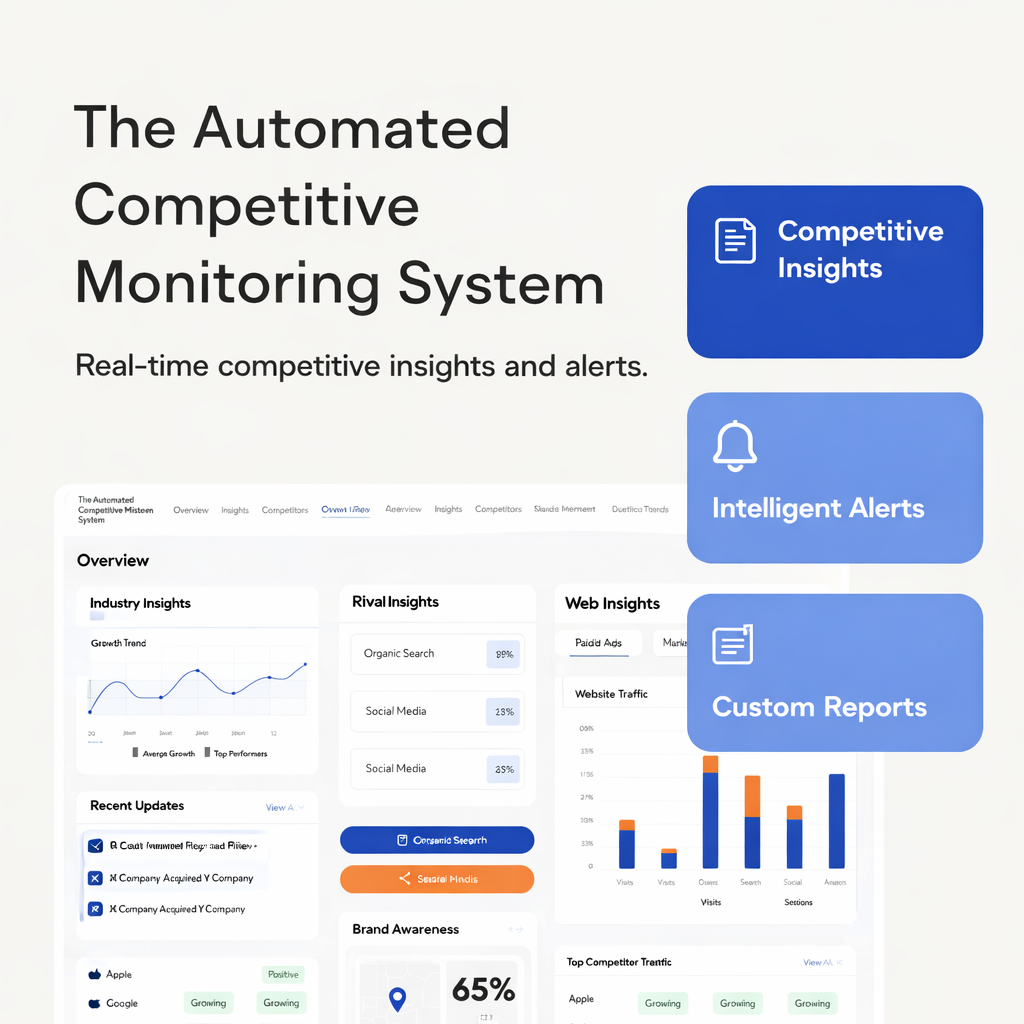
Step 1 — Identify your 5-10 priority competitors
Not all competitors deserve equal attention. Prioritize based on:
- Direct ranking overlap: Sites ranking for your exact money keywords
- Revenue size: Larger sites investing in your niche (Forbes, major blogs)
- Momentum: Smaller sites growing fast in your space (dangerous long-term)
- Content velocity: Sites publishing 4+ new articles/month in your niche
Practical shortcut: Search your top 5 keywords, list every site appearing in positions 1-10. Deduplicate. That is your competitor list. Start with 5, scale to 10 as your system matures.
Step 2 — Content monitoring (new articles and updates)
The moment a competitor publishes content targeting your keywords, your clock starts. Here is how to detect it automatically:
| Content monitoring stack |
| RSS Feeds (Free): Subscribe to competitor blogs via Feedly or Inoreader. New posts appear within hours. Takes 15 minutes to set up for 10 competitors. |
| Google Alerts (Free): Set alerts for competitor brand names + ‘[niche keyword]’. Catches mentions and new indexed content. |
| Apify ($49/month): Web scraping for competitors without RSS feeds. Schedule weekly crawls of their /blog or /reviews pages, get notified on new URLs. |
| Ahrefs Site Explorer ($99/month): ‘New pages’ filter shows all pages indexed in the last 7/30 days. Gold standard for comprehensive monitoring. |
Step 3 — Ranking surveillance for your priority keywords
Track your top 20-30 keywords daily. Flag when any competitor moves 5+ positions toward page 1. This is your early warning threshold — a site climbing from position 22 to 17 is not yet dangerous, but it signals preparation.
- Tool: Ahrefs Position Tracker or SEMrush Position Tracking (both ~$99/month)
- Free alternative: Google Search Console keyword positions (limited, but free)
- Alert setup: Email notification when any tracked keyword drops 3+ positions
Step 4 — Product positioning shifts
Competitors switching product recommendations is high-signal data. If a competitor drops a product you promote heavily, investigate immediately — they may know something you do not (declining quality, better alternative, commission cut).
How to track: Monthly manual audit of their top 10 comparison/review pages. Note which products are featured in positions 1-3. Any shift warrants investigation.
Step 5 — AI synthesis into weekly briefing
Raw monitoring data is noise until synthesized. Every Sunday, feed your collected signals into ChatGPT or Claude with this prompt structure:
| Weekly competitive briefing prompt |
| “Here is my competitive data from this week: [paste new articles, ranking changes, product shifts]. Analyze these signals and produce a 5-bullet briefing covering: (1) highest-priority threats requiring action this week, (2) medium-priority items to watch, (3) potential opportunities I should pursue, (4) recommended responses for each threat, (5) any patterns suggesting competitor strategic shifts.” |
Output: A 5-minute read that tells you exactly what happened competitively this week and what, if anything, you need to do about it. To know which articles deserve the highest defensive priority, cross-reference this briefing with your content ROI analysis — your top-revenue articles are always your first line of competitive defense.
Section 3: Responding to competitive threats strategically
The threat assessment framework
Not every competitive move warrants a response. Reacting to everything wastes time and dilutes focus. Assess each threat on two dimensions:
| Threat Level | Criteria | Response Timeline |
| 🔴 HIGH | Competitor targets your top 3 revenue keywords + produces comprehensive, better-structured content | Respond within 7-14 days |
| 🟡 MEDIUM | Competitor targets supporting keywords or produces content at parity with yours | Respond within 30 days |
| 🟢 LOW | Competitor targets tangential keywords or produces thin content | Monitor monthly, no immediate action |

The four response options
Option 1: Ignore
When: Competitor targets keywords with low revenue relevance, or their content quality is clearly inferior. Your time is better spent elsewhere.
Option 2: Match
When: Competitor publishes comprehensive content on a keyword you have covered thinly. Update your existing article to match their depth, then exceed it on one specific dimension (more recent data, more US-specific examples, better visual formatting).
Option 3: Differentiate
When: A high-threat competitor produces strong, comprehensive content targeting your main keyword. Do not try to out-generic them — you will likely lose.
Instead, find a segment-specific angle they do not cover: “Best [product] for US freelancers” vs their generic “Best [product] review.” You narrow the audience but dramatically increase relevance and conversion rate for that segment. This is the strategy that protected the Austin affiliate’s $2,100/month revenue against a larger competitor.
Option 4: Pivot
When: Competitor has fundamentally better resources (large media company, massive backlink profile) targeting your exact keyword. Defending is a losing battle. Instead, identify adjacent keywords they are not targeting and build authority there before they arrive.
Speed matters: the 14-day response window
For high-threat content, the first 14 days after competitor publication are critical. Google has not yet fully indexed and ranked their content. Your response (updating existing article, improving structure, adding unique data) can prevent their ranking ascent before it happens, rather than trying to dislodge them after they have established authority.
| Real Example : Seattle affiliate’s response playbook |
| Situation: Competitor published 3,500-word comparison guide targeting ‘best project management tools for freelancers’ — his #2 revenue keyword. |
| Detection: Ahrefs alert flagged new competitor URL on day 2. AI briefing assessed it as HIGH threat. |
| Response (days 3-12): Updated his article with a unique ‘US freelancer tax workflow’ section (angle competitor lacked), added real-world pricing comparison with current USD figures, embedded original video walkthrough. |
| Result: Competitor peaked at position 7. His article held position 3. Estimated revenue protected: $1,800/month ongoing. |
To measure the actual revenue impact of each competitive response over time, track outcomes directly inside your AI Affiliate Intelligence Dashboard — Layer 1 performance monitoring will confirm whether your intervention held or recovered the ranking.
Section 4: Turning competitive intelligence into revenue opportunities

Exploit content gaps they miss
The most valuable competitive intelligence is not about threats , it is about
the topics competitors consistently avoid. If 8 out of 10 competitors in your niche publish generic best tools’ roundups but none address the specific needs of US remote teams, that gap is a low-competition, high-intent opportunity. AI can systematically identify these gaps by analyzing the content cluster of your top 10 competitors.
Prompt: “Here are the titles and topic clusters of my top 10 competitors’ last 50 articles each [paste data]. Identify topic areas with high commercial intent that none or few of them cover. Prioritize by likely search volume and affiliate opportunity.”
Learn from products they abandoned
When multiple competitors stop featuring a product, investigate before drawing conclusions. It could signal product quality decline (avoid it yourself) or commission changes (irrelevant to audience quality). Occasionally, competitors drop a strong product for strategic reasons — leaving you a clear promotional lane.
Track product presence monthly across your competitor list. Any product disappearing from 3+ competitors’ top recommendations within 60 days is a high-priority signal to investigate
Identify underexploited traffic sources
Competitor backlink analysis reveals traffic sources they leverage that you do not. Common findings for US affiliates:
- Industry newsletters: Many affiliates earn referral traffic from niche newsletters — visible via Ahrefs referring domains
- Reddit and forum presence: Competitors with strong Reddit positioning often convert better than pure SEO traffic
- YouTube + affiliate combo: If competitors have active YouTube channels driving organic search traffic, that is a channel worth evaluating
Combining traffic source analysis with AI performance forecasting lets you anticipate which content will face competitive pressure 60-90 days out , before rivals arrive. And if you are considering entering a new competitive angle altogether, run it through your niche research validation process first to confirm the opportunity is worth defending.
From reactive to intelligence-driven
The affiliate businesses that consistently outperform competitors are not necessarily producing better content or promoting better products. They are operating with better information and responding faster
Your competitive intelligence system does not need to be complex. Start with:
- Week 1: Set up RSS feeds and Google Alerts for 5 competitors (free, 30 minutes)
- Week 2: Add keyword ranking tracking for your top 20 terms (Ahrefs or free GSC)
- Week 3: Start weekly AI briefing synthesis (15 minutes every Sunday)
- Month 2: Add Ahrefs/SEMrush for deeper competitive data as you validate ROI
Within 90 days, you will shift from discovering threats after damage is done to detecting and neutralizing them before they cost you revenue. Competitive intelligence is Layer 3 of your AI Affiliate Intelligence Dashboard , it contextualizes everything your performance and forecasting layers surface. Start with a simple weekly review, automate progressively, and you will have a system that works while you sleep.