
You have Google analytics, Shopify reports, and email metrics. But no clear direction. Data everywhere, insights nowhere.
Most ecommerce owners track vanity metrics: traffic, clicks, page views, instead of revenue signals. They know what happened last week. They do not know what to do about it next week.
AI analytics ecommerce strategies change that entirely.
AI does not just display data. It identifies patterns humans miss. It predicts which customers will churn before they leave. It surfaces which products drive the highest lifetime value. It tells you where your next revenue opportunity is hiding, before you think to look for it.
This guide shows you exactly how to use AI analytics to make better revenue decisions for your US ecommerce store. Which use cases deliver the most impact. Which mistakes destroy the value of your data. And how to implement a system that turns numbers into actions.
Let’s start with why most analytics tools fail to drive real revenue decisions.
Table of contents
Ecommerce data analytics AI: why AI goes beyond standard dashboards
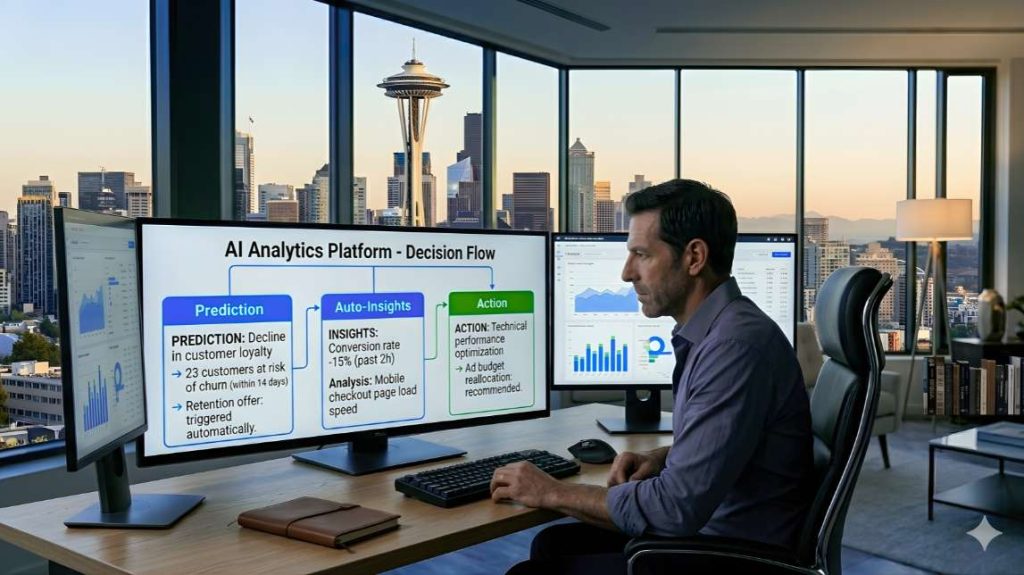
Ecommerce data analytics AI systems operate on a fundamentally different logic than the standard reporting tools most US sellers use today. Standard analytics dashboards, Google analytics, Shopify Reports, Meta Ads Manager, are visualization tools. They display what happened: traffic went up, conversions went down, ROAS improved last week. They are backward-looking.
AI analytics is different in three fundamental ways.
First, prediction over reporting: AI analytics doesn’t just show you what happened, it identifies patterns that predict what will happen. Which customers will churn in the next 30 days? Which products are approaching the end of their conversion lifecycle? Which traffic sources are generating customers with high future LTV versus low-margin one-time buyers?
Second, automatic insight surfacing: standard dashboards require you to ask the right question to find the right answer. AI analytics surfaces insights you didn’t know to look for, anomalies, correlations, behavioral shifts, without requiring manual report configuration.
Third, action recommendations: AI analytics doesn’t just identify a trend. It connects that trend to a recommended action. Churn risk identified → retention offer triggered automatically. High-LTV segment growing → ad budget reallocated toward that segment’s acquisition profile.
Key insight: Standard dashboards answer questions you ask. AI analytics surfaces questions you didn’t know to ask, and recommends what to do next.
AI ecommerce insights for Q4: why seasonal analytics decisions cannot wait
AI ecommerce insights become most critical during Q4: when data volumes spike and manual review cycles break down completely. For US ecommerce operators, Q4 is the highest-stakes period of the year. The 2025 holiday season generated record-breaking US online sales, with significant year over year growth across all major platforms. Black Friday 2025 alone set a new record in online sales volume. Shopify merchants experienced their strongest Black Friday performance to date, with substantial year over year revenue increases. During this window, every hour of data matters. Standard dashboards cannot process and act on signals fast enough. AI analytics is the only system that operates at this speed.
Standard dashboards during Q4 create analysis paralysis: data volumes spike, metrics shift daily, and the manual review cycle that works in January (weekly review, monthly decisions) breaks down completely during a 4 day Black Friday window where every hour matters.
AI analytics during Q4 provides: real-time anomaly detection (conversion rate dropped significantly in a matter of hours), automated budget reallocation to highest-performing product categories, and churn prevention for customers who purchased in Q4 last year but haven’t engaged yet this season.
A Boston WooCommerce seller implemented AI analytics specifically for Q4 planning. By identifying which product categories had their best conversion rates during specific days and times in previous Q4 seasons, they pre-scheduled promotions and ad budget increases for those windows. Q4 revenue increased substantially with the same total ad spend.
Key insight: Q4 moves too fast for manual analytics. AI analytics is the only system that operates at seasonal speed.
AI analytics ecommerce: why standard tools fail to produce actionable revenue decisions

Standard analytics tools show what happened. They don’t explain why it happened or what to do next. You see traffic increased but conversions dropped. You know which products sold well. You track email open rates. None of this tells you which decision to make tomorrow to increase revenue.
A Sacramento Shopify seller reviewed analytics weekly without clear direction. After implementing AI analytics that identified high-value customer segments and predicted churn, they knew exactly which customers to target with retention offers. Revenue from repeat customers increased substantially. The average US ecommerce store loses the majority of its customers annually. Most first-time buyers never return without a deliberate retention strategy. Standard dashboards show you this number. AI analytics tells you which customers are about to leave before they do.
Key insight: Tracking metrics without actionable insights wastes time.
Related: See how this fits into the complete AI revenue optimization framework, /ai-revenue-optimization-framework-ecommerce
Predict customer churn ecommerce: revenue metrics that actually drive decisions

AI analytics ecommerce systems go further than standard dashboards by identifying which customers are about to leave before they actually do. Vanity metrics make you feel good but don’t drive decisions: website visits, page views, social media followers, email list size.
Revenue metrics inform action: customer lifetime value, repeat purchase rate, average order value by segment, conversion rate by traffic source, profit margin by product.
A Sacramento Shopify seller tracked total site traffic as their main metric. Traffic grew steadily but revenue stayed flat. After shifting focus to conversion rate by traffic source and AOV by customer segment, they discovered paid traffic converted poorly while organic traffic had higher AOV. They reallocated budget from paid ads to SEO and content.
Key insight: Revenue metrics drive decisions, vanity metrics don’t.
AI customer lifetime value analytics: 3 use cases that identify and grow revenue
Identifying high-value customer segments
AI analytics ecommerce tools identify your highest-value customer segments automatically, without manual segmentation or weekly report reviews. Not all customers are equal. AI identifies segments automatically based on behavior patterns: purchase history, browsing behavior, email engagement, product preferences, and time between purchases.
A Memphis Shopify seller segmented customers manually by location and age. After implementing AI segmentation based on behavior (frequent buyers, high AOV buyers, seasonal buyers, discount-dependent buyers), each segment received tailored offers. Campaign performance improved across all segments. Repeat customers represent a small percentage of your customer base but generate a disproportionately large share of your total revenue. AI identifies who these customers are and what drives their behavior, so you can replicate it at scale.
Related: Apply your segment insights with AI personalization for ecommerce revenue, /ai-personalization-aov-ltv-ecommerce
Key insight: Segment by behavior, not demographics.
Predicting churn and retention opportunities
Churn signals include decreased engagement, longer time between purchases, smaller order values, unopened emails, and browsing without buying. A Raleigh WooCommerce seller had steady customer acquisition but flat revenue because churn offset new customers. After implementing AI churn prediction, they identified at-risk customers and sent personalized win-back offers before those customers left.
Key insight: Predict churn before it happens, not after.
Optimizing pricing and product mix
AI analyzes profit margin, sales velocity, customer lifetime value by first purchase, and cross-sell potential. A Nashville ecommerce store promoted products based on sales volume, high-volume products had thin margins. After implementing AI pricing and product analysis, they shifted marketing focus to high-margin products. Overall profit margin improved.
Related: Use product mix insights to optimize your ads with AI ads optimization for ecommerce, /ai-ads-optimization-roas-ecommerce
Key insight: Optimize for profit margin, not sales volume alone.
Ecommerce analytics tools: 4 steps to implement AI analytics and act on insights
Ecommerce analytics tools connect your store data, email platform, and ad accounts into one system that AI can analyze automatically.

Step 1: Define your revenue questions
Write down three to five specific questions: which customers are most profitable, which products drive repeat purchases, which traffic sources have the best LTV, when should you send promotions to maximize response.
A Columbus Shopify seller asked: which customers are likely to make a second purchase within 90 days? Which products lead to the highest customer LTV? What discount level is needed to convert first-time visitors without cannibalizing full-price sales?
Key insight: Define business questions before implementing analytics.
Step 2: Connect your data sources
AI analytics needs access to ecommerce platform data, website analytics, email platform data, and ad platform data. Most tools offer native integrations with Shopify, WooCommerce, Google analytics, Klaviyo, and major ad platforms.
Step 3: Use AI to surface insights
Once connected, AI analyzes historical data and identifies patterns automatically. Examples: customers who buy Product A within 30 days of Product B have higher LTV; traffic from organic search converts better than paid social; customers who engage with post-purchase emails have lower churn.
A Phoenix WooCommerce seller discovered customers who bought complementary products within their first purchase had much higher repeat rates. They created product bundles and promoted them heavily. Repeat purchase rate improved.
Key insight : Let AI surface insights, don’t just pull standard reports.
Step 4: Act on insights and measure impact
Implementing ai analytics ecommerce requires connecting your data sources before expecting actionable insights. A Tucson Shopify seller learned through AI analytics that their highest LTV customers made first purchases on weekends. They shifted ad budget to increase weekend traffic. New customer LTV improved because they attracted more weekend buyers.
Key insight: Implement changes based on insights, then measure results.
5 AI analytics mistakes that destroy revenue decisions for US ecommerce stores
Most US ecommerce stores that fail to get ROI from ai analytics ecommerce do so because of predictable implementation mistakes, not because the technology doesn’t work. Mistake 1: Over-complicating dashboards. A San Antonio ecommerce store set up dashboards tracking hundreds of metrics. Analysis paralysis set in. Solution: Track five to seven core revenue metrics only.
Mistake 2: Not acting on insights. A Charlotte WooCommerce seller implemented AI analytics but never changed strategy based on findings. Solution: Commit to acting on at least one insight per week.
Mistake 3: Trusting AI without validation. AI identifies patterns, but sometimes those patterns are correlations, not causations. A Louisville Shopify seller’s AI analytics suggested promoting a specific product that only worked as an add-on, not standalone. Solution: Understand why AI recommends something before implementing.
Mistake 4: Ignoring qualitative data. AI analyzes quantitative data well but misses qualitative context. A Boise ecommerce store relied entirely on AI analytics. Metrics showed a product performed well. Customer reviews revealed quality issues. Solution: Combine AI analytics with qualitative feedback.
Mistake 5: Measuring everything except profit. A Richmond WooCommerce seller celebrated revenue growth driven by AI-recommended promotions that attracted discount-dependent customers with high return rates. Net profit declined. Solution: Always track profit alongside revenue metrics.

What you should take away from this
AI analytics ecommerce is not a reporting system. It is a decision system.
Standard dashboards tell you what happened. AI analytics tells you what to do next. That distinction is worth more than any individual metric or report.
Start by defining three to five specific revenue questions. Connect your data sources. Let AI surface the patterns. Then act on at least one insight per week.
Data without action produces reports. Data with action produces revenue growth.
Your next step: analytics is the final layer of your revenue system. Discover how all four layers work together in our complete AI revenue optimization framework.
Related: AI personalization for ecommerce revenue, /ai-personalization-ecommerce-revenue
Related: AI ads optimization for ecommerce, /ai-ads-optimization-ecommerce-roas
Related: See the complete AI revenue optimization framework, /ai-revenue-optimization-framework-ecommerce