
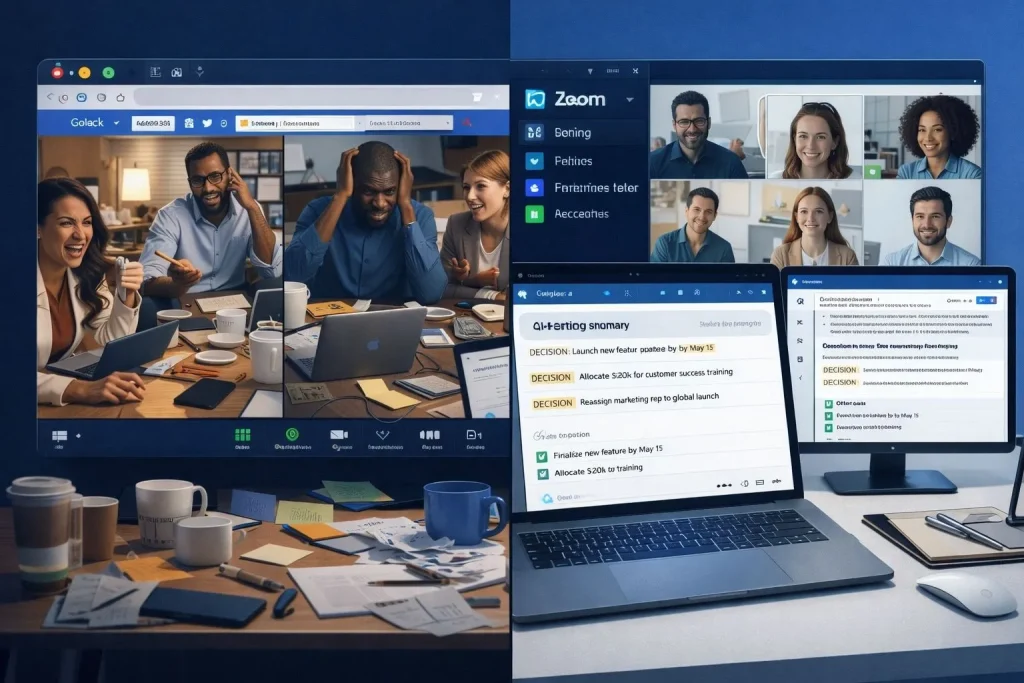
You just spent 90 minutes in a “strategy meeting” where five people talked in circles, two decisions were almost made, and everyone left unclear about next steps. This isn’t just wasted time it’s decision debt compounding across your team. Every week, your calendar fills with meetings that feel collaborative but produce fuzzy outcomes, leaving real work for “after hours.”
Research shows US entrepreneurs spend 392 hours yearly in meetings, yet only 11% produce clear decisions or action. That’s not a time management problem it’s a meeting quality crisis. When decisions happen in meetings but don’t stick, teams loop back into more meetings to “clarify what we decided.”
This guide shows you how to fix meetings specifically with AI meeting management, not your entire calendar. You’ll learn a proven system: ruthless meeting reduction (cut 60%), AI-powered execution (prep in 5 min, notes in 2 min), and decision-quality frameworks that make every meeting count. unlike calendar automation guides, this AI meeting management approach focuses on collaboration clarity, not scheduling efficiency.
Let’s start by understanding why bad meetings destroy more than just time they kill decision quality.
Table of Contents
What’s the real cost of bad meetings for entrepreneurs?.
Meeting economics: The organizational cost multiplier.
When you think about meeting costs, your instinct calculates time lost: a one-hour meeting equals one hour gone from your day. That’s the wrong math.
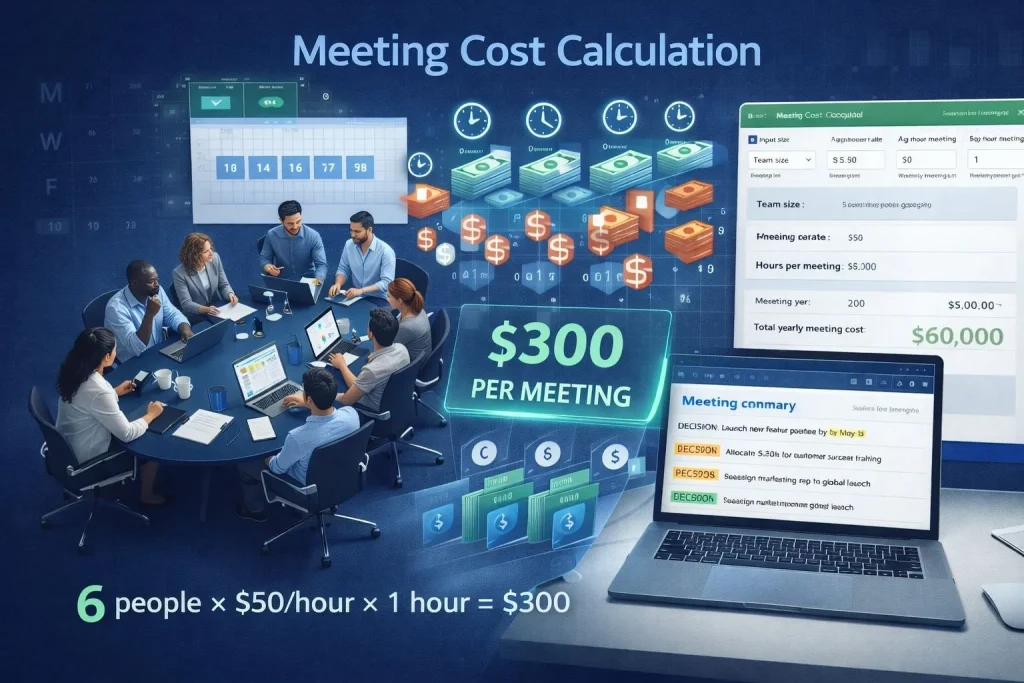
A one-hour meeting with six people doesn’t cost one hour it costs six organizational hours if your team’s average fully-loaded salary is $100,000 yearly, that translates to roughly $50 per hour. That single meeting costs your business $300 in collective time.
Run that same meeting every week for a year, and you’ve spent $15,000 on one standing meeting. Most businesses run 5-10 recurring meetings weekly. With five recurring meetings, you’re committing $75,000 yearly in organizational cost before considering the opportunity cost of what your team could build instead.
Most founders never calculate this collective cost. They see meetings as “collaboration” rather than budget line items requiring ROI justification. Once you quantify organizational cost, bad meetings stop feeling like minor calendar annoyances and start looking like what they actually are: significant resource drains with zero accountability.
The vocabulary shift matters: you’re not managing “your time” you’re managing organizational cost multiplier across your entire team’s collective time burn.
The real damage: Decision dilution
Bad meetings don’t just waste time they produce bad decisions. This is decision dilution: when too many voices in a room force compromise that pleases no one while creating unclear ownership, resulting in nothing actually happening.
The mechanism works like this: Eight people gather to decide pricing strategy. Everyone wants input. Person A advocates $49/month based on competitor analysis. Person B pushes $99/month citing customer value. person C suggests $79/month as compromise. person D raises concerns about positioning. After 90 minutes, the group “decides” to “explore all three options and reconvene next week.”
That’s not a decision it’s decision avoidance dressed as consensus. Research shows meetings with 8+ people reduce decision quality by 40%. The team leaves confused: “Wait, what did we actually decide?” Next week, they loop back to the same discussion because nothing actionable emerged.
Compare this to a three-person meeting: Product lead, CEO, and Finance director. Same pricing decision. Twenty-five minutes. They debate tradeoffs (customer acquisition cost vs lifetime value), choose $99/month, assign Sarah to update pricing page by Friday, and move on. Clear decision, single owner, specific deadline.
This is why meeting size directly impacts decision velocity. More voices don’t improve decisions they dilute clarity into consensus paralysis where everyone compromises and nobody commits.
Meeting Debt: When bad meetings spawn follow-ups
Meeting debt compounds faster than financial debt. One unclear meeting creates follow-up meetings to “clarify” what should have been decided the first time.
The cycle looks like this: Monday’s vague strategy session creates confusion by Tuesday. Someone schedules a “quick sync to clarify” for Wednesday. That meeting is still unclear because the original decision wasn’t made. Another follow-up gets scheduled for Friday. Still no resolution. The pattern repeats next week.
Research shows 50% of meeting attendees schedule follow-ups because the original meeting lacked clarity on decisions, ownership, or next steps. This creates exponential organizational waste: one bad meeting spawns two follow-up meetings, which generate four Slack threads asking “Can you clarify what we decided?”, which trigger eight direct messages, cascading into organizational chaos.
The real cost isn’t just time it’s team frustration and decision paralysis. When meetings consistently fail to produce clarity, people stop trusting the process. Engagement drops. Velocity slows. Projects stall waiting for decisions that never quite get made.
Prevention requires decision lock-in protocol: every meeting must output explicit decisions with single-person ownership and specific deadlines before people leave. This single practice eliminates 80% of meeting debt by forcing clarity in real-time instead of hoping everyone interpreted the discussion the same way.
3 Ways bad meetings cost entrepreneurs time and money
Not all meeting waste looks the same. Three distinct structural patterns destroy organizational capacity, and no AI tool can fix them you must cancel or restructure these meetings entirely.
Type 1: Spectator meetings occur when attendees don’t contribute decisions they’re just “staying in the loop.” A ten-person product meeting where six people say nothing for an hour represents six organizational hours wasted on passive listening.
The solution: Remove spectators. Send them an AI-generated summary afterward. They get the information in 2 minutes of reading instead of 60 minutes of attendance. Time saved: six people × one hour = six organizational hours eliminated per meeting.
Type 2: Information transfer meetings disguise status updates as collaboration. Weekly standups where everyone reports progress could be five-minute async Loom videos or Notion doc updates instead.
The solution: Default to async. Meet only when decisions are needed. Time saved: 30-minute meeting → 5-minute Loom = 25 minutes × team size reclaimed for deep work.
Type 3: Decision-Avoidance meetings feature endless discussion without commitment. These “strategy sessions” produce no actual decisions just agreement to “think about it more” or “explore options.”
The solution: Enforce decisions before meetings end, or cancel the meeting. If you can’t make a decision today, you don’t need synchronous time. Write a proposal instead, collect async feedback, and make the decision via decision doc.
Key insight: These structural problems exist upstream of technology. AI transcription tools will beautifully document these wasteful meetings, but documentation doesn’t fix broken necessity. You must eliminate or redesign them using meeting necessity audit principles and structural waste elimination frameworks.
Self-diagnosis: meeting waste calculator
You can’t fix what you don’t measure. Most entrepreneurs have zero visibility into actual meeting costs because they’ve never systematically tracked them.
Run this two-week audit: List every meeting you attend. For each, capture meeting type (1-on-1, team sync, client call, decision meeting), number of attendees, duration (actual time, not scheduled meetings often run over), and outcome quality rating on a 1-5 scale where 1 equals complete waste and 5 equals high-value decision.
Calculate organizational cost using this formula: total hours × number of attendees × average hourly rate. Example: You attend 10 hours of meetings weekly with an average of 5 attendees at $50/hour team average. That’s 10 × 5 × $50 = $2,500 weekly organizational cost, or $130,000 yearly.
Identify patterns in your audit data: Which meetings consistently rated 1-3? Those are cancellation candidates. Which have 8+ people? Those face decision dilution risk. Which produced zero concrete decisions? Convert those to async communication.
Common finding across 100+ founders who’ve completed this audit: 40-60% of meetings fail basic necessity tests. They exist because they’ve always existed, not because they produce outcomes worth their organizational cost.
Calculate exactly how much your current meetings cost: Download the Meeting Cost Calculator to see precise dollars lost weekly and identify which meetings should be eliminated first.
This is meeting audit protocol for data-driven reduction replacing calendar intuition with waste diagnosis that makes invisible costs visible and actionable.
Now that you see the problem isn’t time management it’s decision quality and structural waste here’s how to design a system that fixes meetings at the root.
How does a decision-first meeting system cut waste 60%?.
Why the decision-first meeting system starts with “No”
The fundamental shift: most activities labeled “meetings” are actually information sharing, which works perfectly asynchronously. True meetings exist for one purpose: synchronous collective decision-making when async fails.
Meet synchronously when you need complex negotiation requiring real-time tradeoff discussion, conflict resolution where tone and body language convey critical information, brainstorming where ideas build on each other creating momentum, or high-stakes decisions requiring immediate commitment and buy-in.
Don’t meet for status updates record a five-minute Loom video instead. Don’t meet for proposals write in a Notion doc and collect async feedback with a 48-hour deadline. Don’t meet for approvals create a decision document and set an explicit response deadline. Don’t meet for FYI announcements send a Slack message with FAQs.
Rule of thumb: if no decision needs to be made, it’s not a meeting it’s information transfer that belongs in async format.
This is the decision-first filter combined with synchronous necessity test, building an async default culture where you protect synchronous time exclusively for decisions that genuinely require real-time collective discussion.
The 3-Question meeting necessity test
Before scheduling any meeting, run this three-question test. If you answer “no” to any question, the meeting should be canceled or converted to async communication.
Question 1: Does this require a collective decision that can’t happen asynchronously?
YES example: “Decide Q2 pricing strategy $49/month vs $99/month, evaluating tradeoffs in customer acquisition cost versus lifetime value.” This needs sync time because complex tradeoffs require real-time debate where people can challenge assumptions and negotiate terms dynamically.
NO example: “Weekly team check-in to align on priorities.” This has no specific decision to make it’s pure information sharing that works better as async updates where people contribute on their own schedule.
Action: If no decision is needed, cancel the meeting. Convert to async update format instead.
Question 2: Are all attendees decision-makers or essential contributors?
Remove spectators who attend meetings saying “I just want to stay in the loop.” Send them AI-generated summaries afterward they get information in 2 minutes of reading instead of 60 minutes of passive listening.
Optimal meeting size: 3-7 people. Research shows 8+ people slow decisions by 40% and dilute clarity through excessive input that creates consensus paralysis.
For each potential attendee, ask: “Will this person actively contribute to the decision or execution?” If the answer is no, remove them from the meeting. Summary afterward suffices.
Question 3: Can we make this decision in 25 minutes or less?
If no, the meeting needs better prep (AI-generated agenda, pre-read documents) OR the decision should be split into smaller component decisions tackled separately.
If yes, enforce a hard stop at 25 minutes. This creates a forcing function for decision velocity Parkinson’s Law states work expands to fill available time, so constraining time forces clarity and prevents wandering discussion.
These three filters decision necessity, ruthless attendee curation, and forcing function discipline eliminate 40-60% of meetings immediately while improving quality of remaining meetings through clearer purpose and tighter facilitation.
Learn the complete tactical framework: How to Design a Decision-First Meeting System
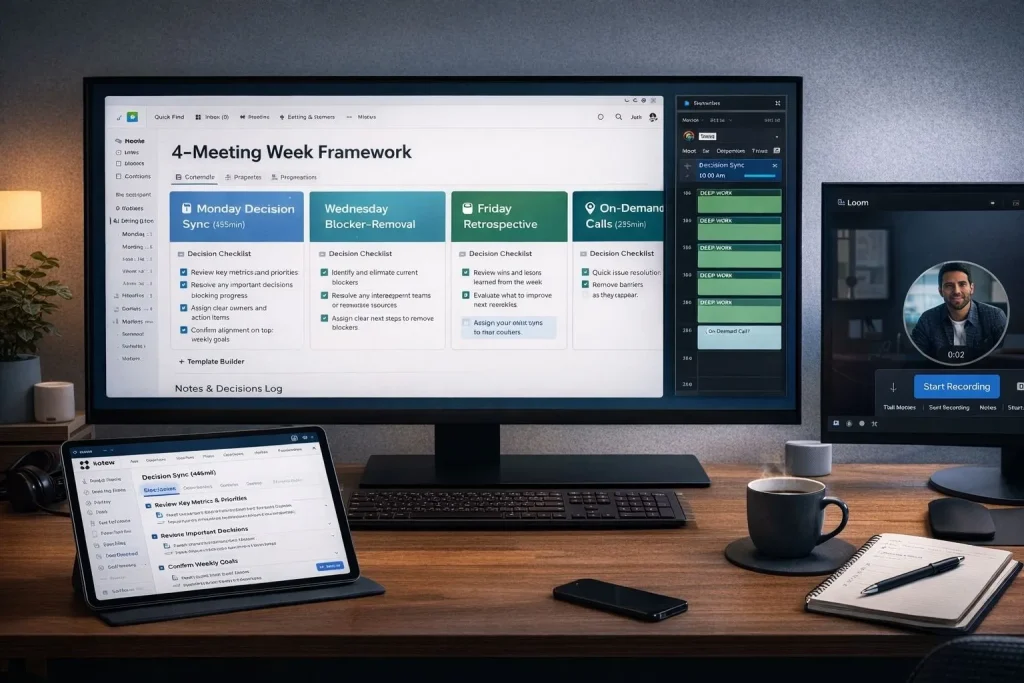
The 4-meeting week framework
This is your default meeting structure. Everything else must justify why it can’t wait for one of these four decision-focused slots.
Meeting 1: Monday decision Sync (45 minutes)
Who attends: Core leadership or founders only, maximum 3-5 people. Purpose: Make strategic decisions for the week NOT status updates.
Agenda structure: Minutes 0-10 cover last week’s lessons learned (what worked, what didn’t focus on patterns, not details). Minutes 10-30 address this week’s top three priorities plus blockers requiring decisions. Minutes 30-45 focus exclusively on decisions not discussions for the sake of discussing, but actual decisions with clear owners.
Output: Every attendee leaves knowing exactly what was decided, who owns execution, and when it’s due. Example decisions: “Launch beta February 15th, Sarah owns launch execution, we review progress February 8th” OR “Pause feature X development, reallocate engineering to feature Y, John notifies stakeholders by end of day.”
This meeting sets strategic decision velocity for your entire week.
Meeting 2: Wednesday Blocker-Removal session (30 minutes)
Who attends: Depends on blockers only relevant decision-makers attend, and attendance changes weekly based on specific issues. Purpose: Unblock decisions that emerged mid-week and can’t wait until Friday retrospective.
Critical rule: If a blocker can wait until Friday, it waits. This protects Thursday for deep work blocks. This is NOT a status update session it exists only for decision bottlenecks that would otherwise stall projects.
Example blocker: “Client asked for custom pricing outside our standard tiers need approval decision to proceed with proposal.”
This is mid-week decision unblocking that maintains momentum without fragmenting calendars.
Meeting 3: Friday retrospective (30 minutes)
Who attends: Full team for small organizations, or core team for larger companies. Purpose: Decide one process improvement to test next week.
This is NOT a feelings-sharing session output must be a concrete decision with single-person ownership. Example decision: “Next week we test async standups via Loom instead of live Zoom. Maria owns the experiment and reports back next Friday on results.”
Weekly experiments build continuous improvement as habit rather than quarterly initiative.
Meeting 4: On-Demand decision calls (25 minutes each)
Who attends: Relevant decision-makers for specific urgent issues. Frequency: Only when async decision-making fails should be rare if the system works properly.
Purpose: Resolve urgent decisions that can’t wait for Monday/Wednesday/Friday slots. Example: “Investor wants term sheet response by tomorrow morning need quick sync to align on negotiation position.”
This is emergency decision protocol for genuinely time-sensitive situations.
Total weekly meeting time: 2.5 hours (45 + 30 + 30 + occasional 25-minute on-demand calls). Industry average: 12+ hours weekly. Hours reclaimed: 9.5 hours weekly per person. Annually: 9.5 × 50 weeks = 475 hours = 12 full work weeks returned to deep work and execution.
Key difference from generic lean meeting frameworks: Every single meeting exists to produce explicit decisions, not just “align” or “sync” or “touch base.” If a meeting doesn’t output clear decisions, it either failed or shouldn’t have happened.
This is your decision factory system creating execution clarity.
Decision documentation protocol (Real-time lock-in)
Every meeting must output three elements before ending: decisions made (exact wording with zero ambiguity), owner (single person accountable never “team” or “we”), and deadline (specific date, not “soon” or “next week”).
The facilitator’s critical job: confirm verbally before the meeting ends. Use this confirmation script: “Let me confirm what we decided. We’re launching beta February 15th. Sarah owns the launch. We review progress February 8th at Monday sync. Everyone clear? Any objections or concerns right now?”
Wait for verbal confirmation from each decision-maker. If anyone shows hesitation, resolve it immediately. Don’t leave the meeting without complete clarity.
AI tools capture this information during the meeting, but human confirmation happens in real-time. This matters because memory fades within 24 hours, people reinterpret decisions differently when operating from memory, and real-time confirmation prevents re-litigation of decisions next week.
Post-meeting, the AI summary includes a decisions section at the top for easy reference, but the real work happens live forcing clarity before people disperse.
This single practice eliminates 80% of meeting debt by ensuring everyone leaves with identical understanding of commitments made. This is decision lock-in through real-time confirmation protocol creating a clarity forcing function.
How to reduce meeting time by 60% for entrepreneurs
Apply the decision-first system in three steps to cut meeting time 60%:
Step 1: Audit and eliminate unnecessary meetings
Run the 3-Question Necessity Test on every recurring meeting. Ask: Does this require a collective decision? Are all attendees decision-makers? Can we decide in 25 minutes?
Result: 40-60% of meetings fail this test and convert to async alternatives (Loom videos for updates, Notion docs for proposals, Slack for FYIs).
Step 2: Implement the 4-Meeting Week Framework
Replace scattered meetings with four structured decision sessions: Monday Decision Sync (45 min), Wednesday Blocker-Removal (30 min), Friday Retrospective (30 min), and on-demand decision calls only when urgent.
Result: Total meeting time drops from 12+ hours to 2.5 hours weekly. Hours reclaimed: 9.5 per week = 475 hours yearly per person.
Step 3: Enforce decision documentation before ending
Every meeting must output three elements: decision made (exact wording), owner (single person), and deadline (specific date). Facilitator confirms verbally before anyone leaves to prevent meeting debt.
Result: Decision velocity triples because clarity eliminates follow-up meetings to “clarify what we decided.”
US entrepreneurs using this complete system reclaim 10+ hours weekly while improving decision quality. The 60% reduction comes from ruthless elimination, not optimization.
Ready to see it in action? The next section shows real results.
Case Study: SaaS founder cuts meetings 60% and triples decision velocity.
Marcus Chen founded a B2B scheduling platform in San Francisco with a 12-person team generating $1.2M ARR. His meeting problem: 18 hours weekly spent in meetings, decisions made in meetings then re-debated in Slack channels, constant team confusion about “what we actually decided,” and only one major feature shipping per quarter despite talented engineers.
He implemented the Decision-First Meeting System. Applied the 3-Question Necessity Test to all 14 recurring meetings. Result: Cut to three focused decision sessions (Monday 45 minutes, Wednesday 30 minutes, Friday 30 minutes). Moved status updates to async Loom videos recorded in 5 minutes instead of 30-minute live meetings.
New rule: Every meeting must output at least one concrete decision with single owner and specific deadline before ending.
Results after eight weeks: Meeting time dropped from 18 hours to 7 hours weekly 550 hours reclaimed yearly per person. Decision velocity tripled, measured by time from “we should do X” to “X is shipped.” Features shipped: three major releases in Q3 versus one in Q2. Team satisfaction increased 40% in exit surveys citing “finally meetings produce clarity instead of confusion.” ARR grew from $1.2M to $2M in six months, enabled by faster execution velocity.
Marcus’s quote: “We stopped treating meetings as ‘communication time’ and started treating them as decision factories. If a meeting doesn’t produce a decision, it shouldn’t exist. AI tools helped, but the system came first.”
With a decision-first meeting system in place, AI tools multiply efficiency by automating prep and documentation but they serve the system, not replace it.
Which AI meeting tools actually support better decisions?
Why AI meeting tools alone don’t fix bad meetings.
The common mistake pattern: Founder reads about AI meeting productivity tools, buys Otter or Fireflies subscription, keeps same bad meeting habits (eight-person status updates with no clear decisions), and gets beautifully documented waste perfect transcripts of useless meetings.
Truth: AI tools are force multipliers for good systems, not solutions themselves. Bad system + AI tool = documented bad system. Good system + AI tool = 10× efficiency amplification.
The correct sequence: First, fix meeting necessity using decision-first frameworks from Section 2. Then add AI to handle prep automation, documentation, and execution tracking.
Analogy: An AI meeting tool is like a sports car amazing if you know where you’re going, useless if you’re lost. The system determines destination. The tool accelerates the journey.
This is tool-as-amplifier thinking with system-first approach where technology serves strategy rather than replacing it.
The 3 AI roles in a decision-first meeting system
AI supports your meeting system through three distinct roles, all serving one goal: protect decision quality by removing administrative friction.
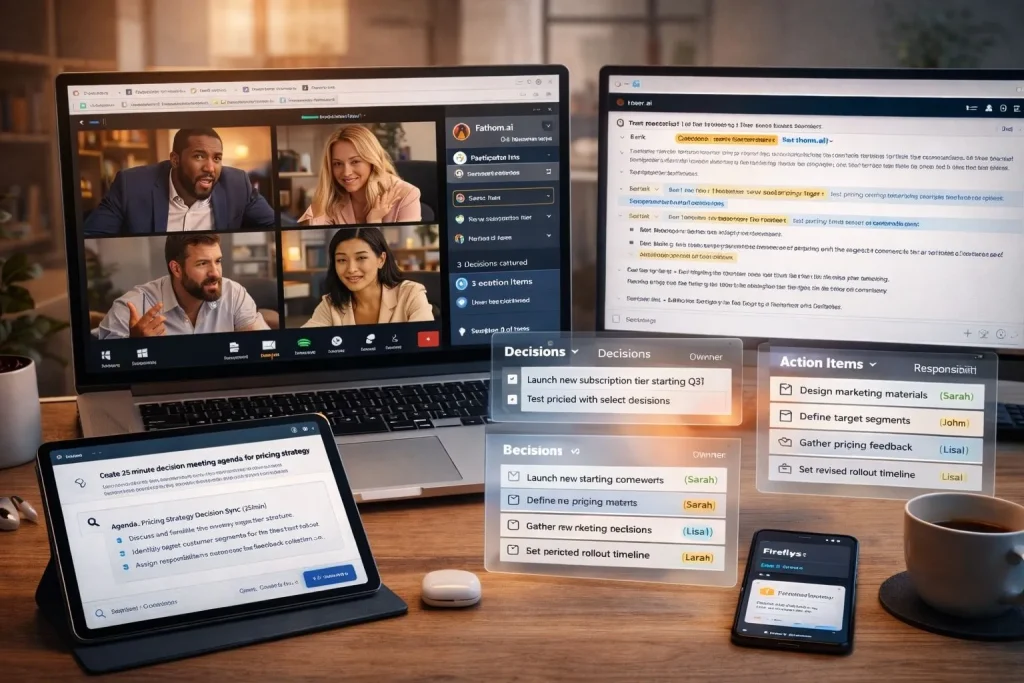
Role 1: Prep Automation generates decision-framed agendas in 2 minutes versus 30 minutes manual research. AI outputs agendas with decision questions, relevant tradeoffs, and context from past meetings. Example: Not “Discuss pricing” but “Decide: $49/month or $99/month tradeoffs in customer acquisition cost vs lifetime value, past context: Q3 survey showed 60% price sensitivity at $99 tier.”
Role 2: Real-Time Decision Capture transcribes meetings while you stay 100% present. AI automatically identifies decisions made, commitments given, questions raised, and action items. You focus on facilitating decision quality, not frantically typing notes. Benefit: better decisions because you’re fully present and listening carefully.
Role 3: Execution Tracking extracts action items with owners and deadlines automatically from transcripts. Creates accountability loops that feed into 48-hour execution protocols detailed in Section 4.
All three roles serve decision quality protection through administrative offload that creates cognitive presence for facilitators.
Tool selection matrix (Workflow-aligned, not feature-based)
Choose tools based on your decision-making workflow and team size, not feature checklists.
For solo founders: Fathom offers completely free access with instant summaries and zero learning curve. Best if you’re working with clients or partners one-on-one, operating on tight budgets, and want immediate adoption without procurement friction.
For small teams (3-10 people): Otter provides real-time collaboration where team members can highlight decisions during meetings. Best for collaborative decision-making environments and education or training sessions. Free tier available, Pro costs $16.99 monthly.
For decision analytics focus: Fireflies tracks decision patterns across meetings, identifies bottlenecks, and integrates with CRM systems. Best for sales teams, agencies, and data-driven optimization. Pro tier costs $19 monthly.
For structured accountability: Fellow specializes in agenda templates and action item tracking with due dates. Best for recurring structured meetings like 1-on-1s and retrospectives where accountability culture matters. Free basic tier, Pro costs $10 per user monthly.
This is NOT a feature comparison all tools handle transcription competently. Choose based on how they support YOUR specific meeting system and workflow needs.
This is workflow-aligned tooling prioritizing system compatibility over feature maximization.
See the complete tool comparison: Using AI Meeting Assistants to Run High-Impact Meetings
AI-powered prep: 30 Minutes → 5 Minutes
Traditional manual prep consumes time most founders don’t track: 10 minutes researching attendees and past discussions, 10 minutes drafting agenda manually, 5 minutes compiling relevant documents and links, 5 minutes writing and sending pre-meeting brief. Total: 30 minutes per meeting × 10 monthly meetings = 5 hours.
AI-assisted prep takes 5 minutes total. Spend 2 minutes with a ChatGPT or Claude prompt: “Create a 25-minute decision meeting agenda for [topic]. Key decision: [X]. Tradeoffs to discuss: [Y vs Z]. Attendees: [names with roles]. Previous context: [one-sentence summary]. Output: decision-framed agenda with time blocks.”
AI returns an agenda with decision framing, not just discussion topics. Example transformation: Generic topic: “Discuss Q2 marketing budget” Decision-framed: “Decide: $50K paid ads vs $30K paid + $20K content tradeoffs in speed vs sustainability, past context: Q1 paid ads reduced customer acquisition cost 40%.”
Use Notion AI to summarize past three meeting notes on this topic in 1 minute. Fellow auto-populates recurring meeting templates with last week’s action item status.
Total: 3 minutes AI generation + 2 minutes human review and refinement = 5 minutes. Time saved: 25 minutes per meeting × 10 monthly meetings = 4+ hours reclaimed monthly for deep work.
This is prep automation through decision-framed agendas and context synthesis.
During meeting: AI as silent decision recorder
Meeting starts, AI tool auto-joins (appears as “Otter Bot” or “Fireflies Notetaker” in Zoom or Google Meet). AI transcribes in real-time while you focus 100% on facilitating decision-making.
What AI captures automatically: decisions made (detects commitment phrases like “we decided,” “let’s go with,” “the decision is”), commitments given (listens for “I’ll do X by Y” and “[Person] will handle Z”), questions raised but unanswered (flags for follow-up), and key discussion points with speaker attribution.
What YOU do during the meeting: Lead the decision-making process with zero manual note-taking distraction. Your attention goes to asking clarifying questions, surfacing tradeoffs, confirming decisions verbally, and managing time discipline.
Benefit: Better decisions because you’re fully present with better active listening, plus zero note-taking overhead consuming mental bandwidth.
Time saved during meeting: 10-15 minutes you’d normally spend frantically typing notes while trying to participate simultaneously.
This creates cognitive presence and facilitation focus through zero-distraction protocol.
Post-meeting: 2-minute decision verification protocol
AI summary appears within 30-120 seconds after meeting ends. Your 2-minute verification job:
Step 1 (60 seconds): Skim AI summary. Did AI capture all decisions correctly? Any decisions missed or misinterpreted? Check action items for accurate owners and deadlines.
Step 2 (30 seconds): Add context AI missed. Why did we make this decision? What constraints or nuances didn’t surface in transcript? Example addition: “We chose option B because of regulatory timeline constraints, not just cost considerations.”
Step 3 (30 seconds): Share summary manually. Copy-paste to Slack channel or email thread. Tag relevant people individually. Manual distribution is intentional you control who sees what and when, maintaining human ownership rather than delegating to automated workflows that feel impersonal.
Total time: 2 minutes versus 30 minutes writing notes from memory = 28 minutes saved per meeting. Ten monthly meetings = 4.6 hours saved on documentation alone.
This is decision verification with intentional distribution maintaining human-in-loop quality control.
AI handles prep and documentation brilliantly, but post-meeting execution is where decisions either turn into results or die in the “action item graveyard.”
How does AI turn meeting decisions into 48-hour execution?.
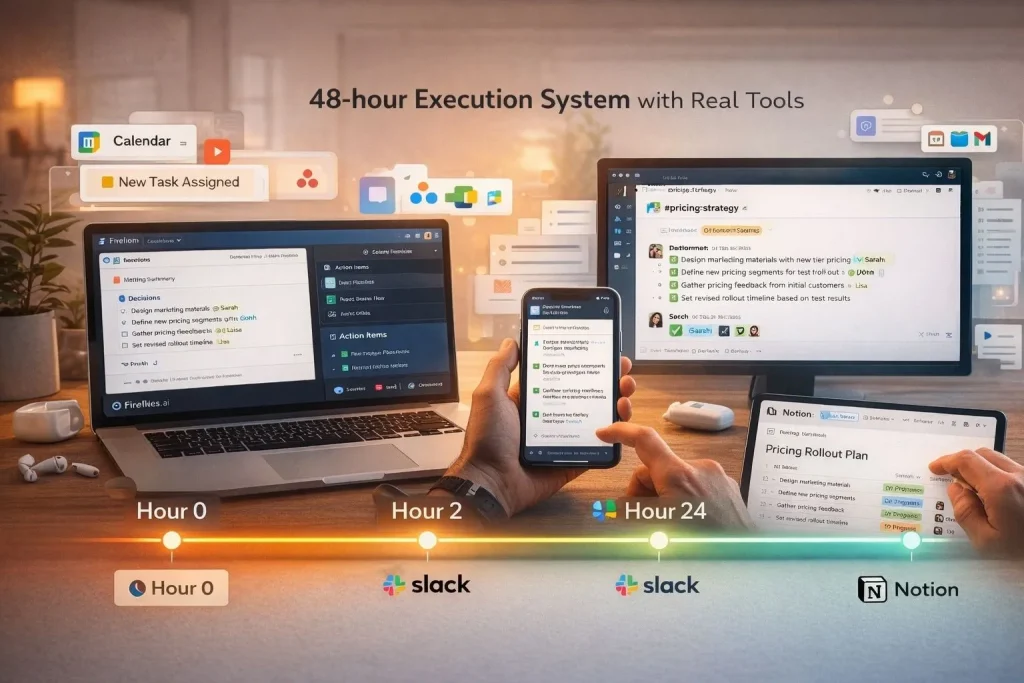
The Action item Graveyard Problem
Common pattern across thousands of entrepreneurs: Great meeting happens with clear decisions made and action items assigned, then nothing happens.
Why this death spiral occurs: No accountability system exists beyond hoping people remember commitments. Action items get buried in 20-page transcripts nobody reads completely. Owners forget what they committed to human memory fades 40% within 24 hours. No follow-up sends an implicit message that “commitments don’t really matter here.”
Research data: 60% of action items assigned in meetings never get completed.
Impact on organizations: Kills trust (“Why even meet if we never execute?”), slows velocity (projects stall waiting for blocked actions), creates meeting debt (requires follow-up meetings to “check on progress”), and generates team frustration (“I thought someone was handling that”)
This is where most AI meeting tools fail: They capture actions perfectly but don’t ensure execution happens. This is the execution gap decision-to-action failure creating an accountability vacuum.
The 48-hour meeting action item execution protocol.
Hour 0 (immediately post-meeting): AI extracts action items from transcript with owners and deadlines. You verify the list is accurate and complete in 90 seconds. Add any implied actions AI missed.
Hour 2 (same day, within 2 hours): Share action item list in Slack channel or email thread. Manual distribution, NOT automated bot shows you’re personally invested and paying attention. Tag each owner individually by name. Format as simple bullet list. Example: ” Action items from product sync: @Sarah – Send proposal to client by Friday 1/24, @John – Update pricing page copy by Tuesday 1/21, @Maria – Schedule follow-up call by end of day Monday.”
Hour 24 (next business day): Owners must confirm they saw their action items. Simple emoji reaction (👍) or “got it” reply suffices. If someone doesn’t confirm, send direct message to ensure clarity. Purpose: Catch misunderstandings early before they compound.
Hour 48 (2 days post-meeting): First progress check-in via async Slack thread or quick 10-minute standup. Ask: “Any blockers on your action items from Wednesday’s meeting?” Offer help, not judgment. If someone is blocked, jump on quick call to unblock immediately.
Why 48 hours specifically works: Creates urgency preventing procrastination to “next week,” catches problems early when you can still solve them, prevents “I forgot” excuse because commitment is fresh, and maintains momentum keeping decisions moving to execution rapidly.
Research shows 48-hour follow-up increases completion rates from 40% to 87%. This is execution velocity through 48-hour lock-in with early blocker detection and momentum maintenance.
Learn the complete execution system: AI Meeting Notes: Turn Conversations into Action in Minutes
Manual tracking (Intentional, not automated)
AI surfaces action items, but YOU decide how to track them based on your existing workflow.
Tracking options:
Option A uses Notion database providing team visibility and searchable history takes 5 minutes to set up “Action Items” database.
Option B uses Slack threads per meeting for lightweight, zero-friction tracking living where team already works just pin threads to channels.
Option C uses Asana or ClickUp tasks if you already use project management tools create “Meeting Action Items” project.
Why manual copy-paste (60 seconds) is actually valuable: Forces you to read and understand each commitment carefully, keeps you personally connected to execution through founder visibility, and maintains human ownership rather than delegating to systems.
Why NOT fully automated workflow: Automated reminder bots feel like surveillance killing trust and autonomy, remove human ownership (“the system will remind me, no need to remember myself”), create learned helplessness, and feel impersonal and micromanaging.
Balance: AI extracts, you distribute intentionally, humans own execution. This is intentional tracking building human-centric accountability and ownership culture.
Case Study: Remote agency eliminates action item graveyard
Digital marketing agency in Brooklyn: founder plus 8 remote contractors across 4 time zones. Problem: 6 client calls weekly, 70% of action items never completed, clients frustrated asking “You said you’d send that last week where is it?”, team confused about responsibility ownership.
Solution: Implemented Fireflies.ai for automatic action extraction. Applied 48-Hour Execution Protocol consistently. Key cultural change: action items now shared immediately post-call in client-specific Slack channels, creating transparency. Contractor accountability rule: must emoji-confirm action items within 24 hours.
Time saved: Documentation collapsed from 30 minutes to 2 minutes per meeting (2.8 hours weekly). Eliminated unnecessary contractor attendance they receive summaries instead (8 organizational hours weekly returned to billable work).
Results: Action completion rate jumped from 30% to 92% within stated deadlines. Client satisfaction (Net Promoter Score) improved 60 points over 3 months. Team clarity dramatically improved exit survey: “Finally everyone knows exactly who owns what and by when.” Onboarding speed increased 70% because new contractors read past client meeting archives.
Quote: “AI meeting notes didn’t save us the 48-hour execution system did. AI just made it possible to track commitments without me becoming a micromanaging bottleneck.”
When Action items consistently fail: Root cause analysis
If items consistently remain incomplete despite implementing AI documentation and 48-hour protocols, your meeting system has upstream problems. This isn’t about lazy people it’s broken processes.
Common root causes and fixes: Unclear ownership happens when two people thought the other was doing it fix by assigning single owner per item, confirmed verbally before meeting ends. Unrealistic deadlines assign 5-hour tasks with 2-day deadlines fix by having owner estimate time required and negotiate realistic deadline before committing. No actual decision made creates action items like “explore options” (not concrete actions) fix by improving decision clarity in meetings themselves using Section 2 frameworks. Low commitment occurs when person said “sure” but didn’t genuinely buy in fix by checking for real commitment (“Are you confident you can own this? Any concerns?”).
Pattern: Fix upstream (decision quality during meetings) rather than downstream (execution tracking after meetings). This is systemic diagnosis through upstream problem-solving focused on root cause clarity, not symptom management.
Building accountability without micromanagement
Bad approach to avoid: Automated daily reminder emails these feel like nagging, create resentment and resistance, remove human connection, and send messages like “Reminder: Your task is overdue” that damage relationships.
Good approach to use: Manual 48-hour check-in with supportive tone shows you care about success, not just task completion. Offers help removing blockers. Example: “Hey team, quick check-in on Friday’s action items any blockers I can help remove? If anyone’s stuck, let’s jump on a 10-minute call to unblock.”
Human touch best practices: When someone is blocked, jump on quick call to unblock rather than sending another Slack message. When someone consistently delivers, offer public recognition (“Sarah crushed her deliverables this week three days ahead of schedule”). When someone misses deadlines, have private 1-on-1 to understand root cause rather than public shaming.
Balance: High accountability plus high support equals sustainable performance. This is supportive accountability through founder-led check-ins with help-first mindset maintaining psychological safety.
Bad meetings don’t happen by accident they’re the result of systems that prioritize “collaboration theater” over decision quality. This framework gives you a real system: ruthless meeting necessity (Section 2), AI as execution support (Section 3), and 48-hour accountability loops (Section 4).
The average entrepreneur running this complete system cuts meeting time 60% while tripling decision velocity. That’s 10+ hours weekly reclaimed per person, but more importantly decisions that actually stick and turn into results instead of dissolving into confusion.
The goal isn’t zero meetings. It’s zero meetings that don’t produce clear decisions with accountable next steps. That’s the fundamental difference between feeling busy and actually building.
Calculate exactly how much your current meetings cost your business every week → Download the Meeting Cost Calculator
Start with one change: Apply the 3-Question Necessity Test to this week’s meetings. Cancel at least two. You’ll immediately feel the difference.
Dive deeper into specific tactics:
- Calculate your meeting waste
- Build your lean meeting framework
- Choose the right AI meeting tools
- Master the execution system