
Launching a successful AI marketing automation campaign promises revolutionary customer engagement but 60% of first attempts fail within 30 days. The problem isn’t technology it’s ambition exceeding capability.
Teams try automating everything simultaneously. They build workflows with 15 steps, seven conditional branches, and three AI decision points. Then nothing executes correctly because one integration breaks.
This guide provides a proven 7-day framework for launching your first AI marketing automation campaign successfully. The approach prioritizes learning over perfection, delivering measurable results while building skills. Understanding AI-powered business automation provides context for where marketing automation fits in broader operational strategy.
Table of Contents
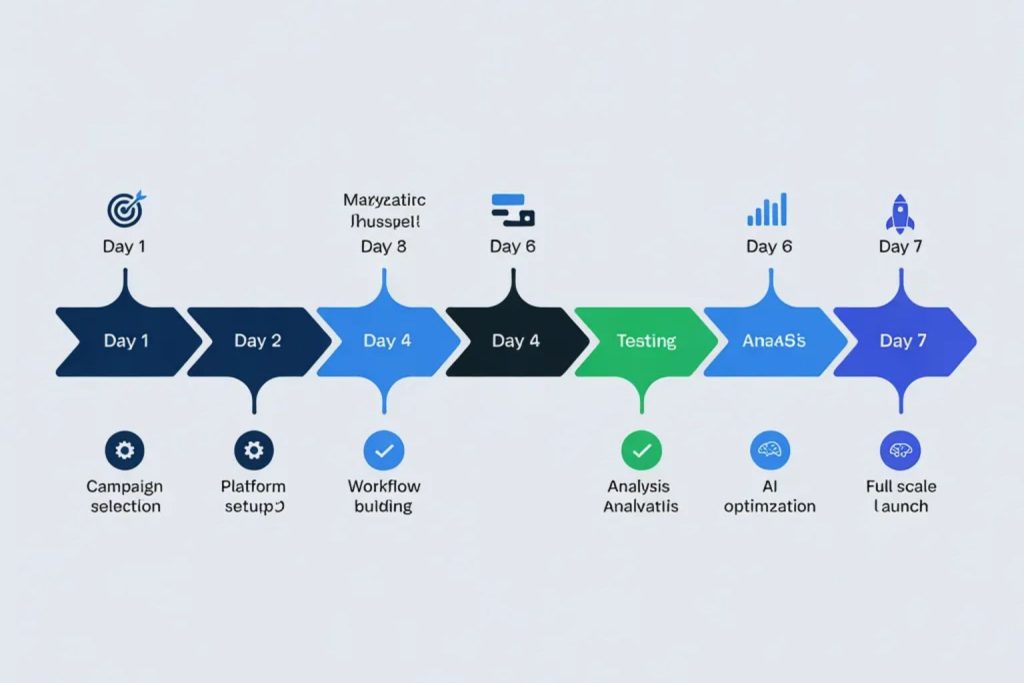
Day 1: Choose your AI marketing automation campaign type
Morning: Choose your high-impact campaign type
Start with campaigns running frequently and producing clear, measurable outcomes. Welcome sequences convert 3-5x better than one-off promotional emails. Post-purchase follow-ups drive 20-30% repeat purchase rates. Abandoned cart recovery generates immediate revenue.
The foundation of successful AI marketing automation campaign is choosing the right campaign type from the start.
According to HubSpot’s Email Marketing Report, automated welcome sequences generate 320% more revenue than non-automated emails.
Avoid campaigns requiring complex segmentation initially. If your ideal campaign analyzes five data points to determine messaging, save it for campaign three.
Afternoon: Document current performance metrics
Measure existing campaign performance before automating anything. Track open rates, click-through rates, conversion rates, and revenue per recipient for 14 days minimum.
This baseline reveals whether your AI marketing automation campaign improves outcomes or just makes mediocre campaigns run faster. Without baseline data, you can’t prove ROI.
For a complete ROI measurement framework, see our guide on how to calculate AI automation ROI.
Create a simple tracking spreadsheet: Campaign Name | Send Date | Recipients | Opens | Clicks | Conversions | Revenue. Update after every manual send.
Evening: Map your customer journey
Break your AI marketing automation campaign into distinct stages with clear purposes. A welcome sequence might include: immediate confirmation (builds trust), day-2 value delivery (demonstrates expertise), day-5 case study (proves results), day-10 conversion offer (drives action).
Each stage needs specific timing, content, and desired next action. Vague “checking in” emails waste attention and damage engagement.
Day 1 checklist:
- Selected high-frequency campaign type
- Documented 14 days of current performance
- Mapped journey with 3-5 clear stages
- Identified decision points for AI optimization
Day 2: Set up your AI marketing automation campaign platform
Morning: Select your automation platform
Platform choice depends on existing tech stack and budget. If you’re already using HubSpot, Mailchimp, or ActiveCampaign, start there rather than switching.
Switching loses historical data, breaks existing integrations, and creates transition friction. Leverage what you already pay for.
Your platform is the engine of your AI marketing automation campaign choosing the right one determines how fast you scale.
If starting fresh, prioritize platforms with native AI features. ActiveCampaign includes predictive sending. HubSpot offers predictive lead scoring. These work immediately without external services.
Not sure which platform to choose? See our complete AI automation tools guide for small businesses
Afternoon: Configure essential integrations
Connect your AI marketing automation campaign platform to CRM, website analytics, and e-commerce systems. Data flows between systems enable personalization and intelligent routing.
Test each integration with one record. Does CRM update when someone clicks? Do analytics capture conversions accurately? Does unsubscribe status sync to all platforms?
Integration failures cause the most common automation problems. Someone unsubscribes but keeps receiving emails because the status didn’t sync. That’s a legal and reputation problem.
Evening: Build your trigger and first message
Start with the trigger the specific event initiating your AI marketing automation campaign. “New contact added to Welcome List” is clear and specific. “New subscriber” is vague.
Specific triggers prevent campaigns from firing unexpectedly or missing intended recipients. Test your trigger with one contact before proceeding.
Write your first message. Subject lines should convey immediate value, not clever wordplay. “Your guide to [specific outcome]” outperforms “Welcome aboard!” by 40%.
Day 2 checklist:
- Selected automation platform (existing or new)
- Configured CRM, analytics, e-commerce integrations
- Built specific trigger with test validation
- Created first message with value-focused subject line
Day 3: Build your AI marketing automation campaign workflows
Morning: Add subsequent messages
Create messages for each journey stage mapped on Day 1. Each email should advance the relationship or provide specific value.
Structure body content with one primary call-to-action. Multiple CTAs split attention and reduce conversion rates. Secondary links are fine, but one button dominates visual hierarchy.
Preview every email on desktop and mobile. 60% of emails open on mobile devices. Designs perfect on desktop often break on small screens.
Litmus’s Email Analytics report confirms that mobile email opens have increased consistently over the past five years.
Afternoon: Configure AI decision points
Add AI optimization at natural choice points in your AI marketing automation campaign. After your first email, let the system analyze engagement opened, clicked, ignored, or unsubscribed.
This is where your AI marketing automation campaign truly differentiates itself from traditional rule-based email sequences.
Instead of rigid “if opened, send email B” rules, AI models weight multiple signals. Open plus click suggests high interest. Open without click indicates curiosity but hesitation.
Set appropriate delays between messages. Daily emails create fatigue. Two-week gaps lose momentum. Most effective sequences use 2-3 day intervals initially, extending to weekly touches after first 10 days.
Evening: Add fallback paths for non-responders
Someone ignoring your first three messages needs different treatment than someone clicking every link. Fallback might reduce frequency, change content angles, or shift channels to social or SMS.
Configure these paths before launch. Decide in advance what happens when engagement patterns diverge from your AI marketing automation campaign ideal paths.
Day 3 checklist:
- Created all messages for campaign stages
- Previewed emails on mobile and desktop
- Configured AI decision logic at choice points
- Built fallback paths for non-responders
Day 4: Test and launch your AI marketing automation campaign
Morning: Conduct multi-device testing
Test links by clicking every CTA and URL. Broken links destroy credibility and waste automation efforts.
Thorough testing ensures your AI marketing automation campaign launches without technical issues undermining first impressions.
Verify unsubscribe links function correctly and sync status to all systems. This is legally required and prevents reputation damage.
Send test emails to team members using different email clients: Gmail, Outlook, Apple Mail. Display inconsistencies surface quickly with diverse testing.
Afternoon: Launch with small control group
Test with 50-100 contacts maximum. Small groups reveal technical issues quickly while limiting potential damage.
Watch the first 48 hours closely. Verify messages send on schedule, links work correctly, tracking pixels fire properly, and data updates in connected systems.
Keep a monitoring log: timestamp of sends, any errors encountered, engagement rates as they come in, issues needing immediate attention.
Evening: Review initial performance data
Check open rates from first sends. Industry benchmarks: 15-25% for cold audiences, 25-40% for warm audiences, 40%+ for engaged subscribers.
Significantly below expectations? Your AI marketing automation campaign subject lines need work. Significantly above? You’ve found something resonant worth scaling.
Don’t make changes yet. 48 hours isn’t enough data for statistical confidence. You’re gathering initial signals, not optimizing.
Day 4 checklist:
- Tested all links and unsubscribe functionality
- Validated display across email clients
- Launched to test group (50-100 contacts)
- Monitored first 48 hours of performance
Day 5: Analyze and optimize your AI marketing automation campaign results.
Morning: Compare against your baseline
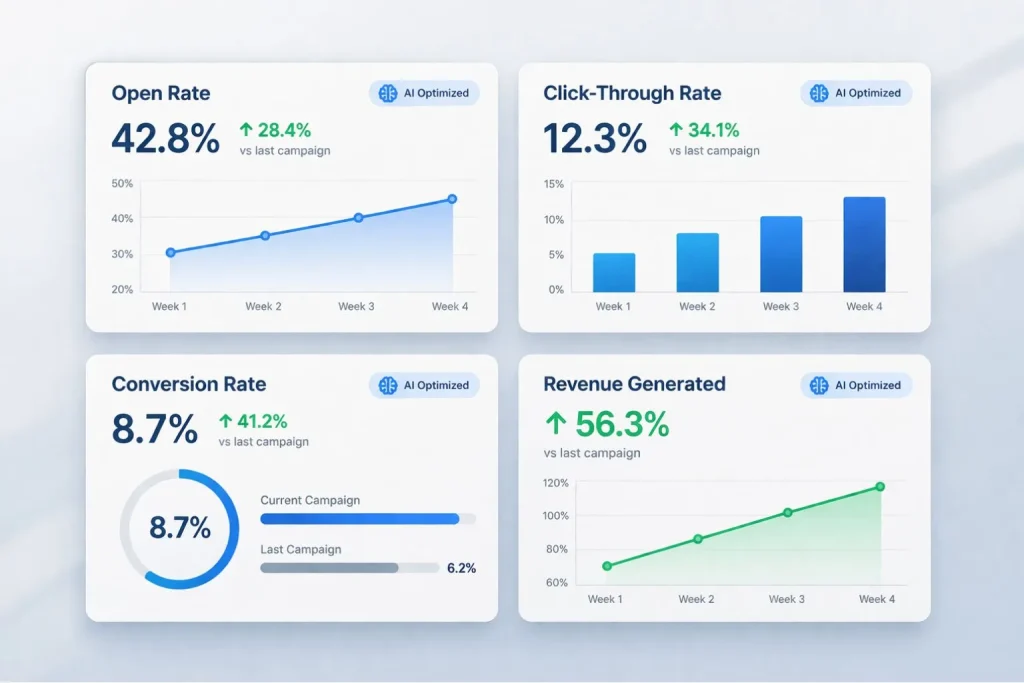
Pull your pre-automation performance data from Day 1. Compare apples-to-apples: same campaign type, similar audience size, equivalent time period.
Comparing baseline metrics against automated results reveals the true impact of your AI marketing automation compaing implementation.
If manual campaigns achieved 23% open rates and automation delivers 19%, something needs fixing-likely subject lines or send timing. If automation reaches 28%, you’ve validated the approach.
Calculate engagement progression through your sequence. What percentage opens message 1? Of those, what percentage clicks? Of clickers, what percentage opens message 2?
Afternoon: Identify Drop-Off Points
Where do contacts disengage from your AI marketing automation campaign? High open rate but low click rate suggests compelling subject but weak content. High clicks on message 1 but low opens on message 2 indicates poor follow-through timing or content relevance.
These patterns reveal specific fix opportunities. Don’t try fixing everything focus on the largest drop-off point first.
Evening: Make One-Variable Adjustments
Change subject lines OR modify delays OR update content-never all three simultaneously. Multiple changes make it impossible to determine what drove improvements or declines.
Test subject line variations if opens are low. Create three options emphasizing different value propositions. Let AI adaptive testing identify the winner.
Adjust delays if engagement drops sharply between messages. Maybe 3 days is too long or too short for your specific audience.
Day 5 checklist:
- Compared performance against baseline metrics
- Identified primary drop-off point in sequence
- Made single-variable adjustment to address issue
- Documented change for future analysis
Day 6: Activate advanced AI marketing automation campaign features
Morning: Enable predictive sending
If your platform supports it, activate predictive sending. The system analyzes when individual contacts typically engage and schedules delivery accordingly.
This single feature often lifts open rates 15-25% with zero additional work. Predictive sending is the highest-ROI feature in any AI marketing automation campaign platform enable it before scaling.
Campaign Monitor’s benchmarks show that AI-optimized send times consistently outperform fixed-schedule campaigns.
Afternoon: Configure content personalization
Beyond first-name tokens, enable behavior-based personalization. AI systems analyze past engagement to determine which content types drive action for specific contacts.
Someone who clicked three case studies but ignored how-to guides should see more case studies. The system prioritizes content formats resonating with individual behavior patterns making your AI marketing automation campaign more effective with every send.
Evening: Set up lead scoring integration
If running lead generation campaigns, configure lead scoring that analyzes engagement patterns. Traditional scoring assigns fixed points per action. AI scoring identifies which behavior combinations predict actual purchases.
Scores become predictive rather than merely reactive. Your sales team focuses on high-probability conversations generated by your AI marketing automation campaign.
Day 6 checklist:
- Activated predictive sending for optimal timing
- Enabled behavior-based content personalization
- Configured AI lead scoring (if applicable)
- Verified all AI features functioning correctly
Day 7: Scale your AI marketing automation campaign to full audience
Morning: Expand to 25% of full audience
Once test group shows positive results, expand your AI marketing automation campaign to 25% of your full list. Monitor for performance changes patterns working for early adopters sometimes don’t translate to broader audiences.
If performance holds steady for 3-5 days, scale to 50%, then 100% over following two weeks. Gradual scaling catches issues before affecting entire database.
Afternoon: Document your process and learnings
Create a simple playbook documenting what worked, what didn’t, and what you’d do differently. Include specific metrics: “Changed subject line from X to Y, open rates improved from 22% to 31%.”
This documentation accelerates future campaigns and helps when training team members. Your institutional knowledge becomes transferable.
Evening: Plan your second campaign
Use patterns learned from your first AI marketing automation campaign to build campaign two faster. You now understand data flow between systems, where common errors occur, and which message formats resonate.
Most teams build their second automation in 40% less time than their first. Each campaign teaches you patterns that make your entire AI marketing automation system smarter and faster.
For comprehensive strategies on expanding capabilities, explore our AI business process optimization guide.
Day 7 checklist:
- Expanded to 25% of full audience
- Created documentation of process and learnings
- Identified second campaign to automate
- Scheduled weekly performance review meetings
Your complete AI marketing automation campaign 7-day launch checklist
Day 1: Foundation
- Select high-frequency campaign type
- Document 14-day baseline performance
- Map customer journey (3-5 stages)
- Identify AI decision points
Day 2: Platform setup
- Choose automation platform
- Configure essential integrations
- Build trigger and test
- Create first message
Day 3: Workflow building
- Add all sequence messages
- Configure AI decision logic
- Set delays between messages
- Build fallback paths
Day 4: Testing
- Multi-device email testing
- Link and unsubscribe validation
- Launch to test group (50-100)
- Monitor first 48 hours
Day 5: Analysis
- Compare to baseline
- Identify drop-off points
- Make one-variable adjustment
- Document changes
Day 6: AI optimization
- Enable predictive sending
- Configure personalization
- Set up lead scoring
- Verify AI features
Day 7: Scale
- Expand to 25% of audience
- Document process learnings
- Plan second campaign
- Schedule ongoing reviews
Transform your business with AI marketing automation campaign this week
The goal isn’t perfection on day one. It’s an AI marketing automation campaign running reliably, delivering measurable value, and teaching you how automation works in your context.
Every AI marketing automation campaign you launch improves the next one automatically the knowledge compounds with each iteration.
That knowledge compounds. Campaign two builds faster. Campaign three incorporates advanced features confidently. Within 90 days, you’ve automated your entire marketing engine.
Start your 7-day launch this week. One week from today, your first AI marketing automation campaign will be running automatically while you focus on strategy instead of execution.
Download your free 7-Day Launch Template: Pre-built workflows, email templates, performance tracking spreadsheet, and daily task checklists. Everything you need in one package. Get your template
Watch our campaign launch walkthrough: Free 45-minute video showing actual implementation with real platform screenshots and configuration steps. Watch the walkthrough.
Get personalized launch support: Book a free strategy call. We’ll review your campaign idea and provide a customized 7-day plan. Schedule your call
What’s the biggest challenge you face launching marketing automation? Share your specific situation in the comments and we’ll provide actionable solutions within 24 hours.