

Every entrepreneur eventually reaches the same moment.
They have tried three AI writing tools. They have watched the tutorials. They have set up automations, built Notion databases, and spent hours exploring prompts. And they are still behind on content. Still inconsistent. Still wondering why AI is not delivering the results they were promised.
The answer is almost always the same: they have tools, but no AI productivity system for entrepreneurs.
A tool is an instrument. A system is the structure that tells you which instrument to use, when to use it, and what outcome to expect. Without that structure, even the most powerful AI tools produce random, unsustainable results.
This guide is the complete reference for building an AI productivity system for entrepreneurs from scratch. It covers what a real system looks like, why most entrepreneurs do not have one yet, how to build it in four layers, which tools belong inside it, and how to keep it running long after the initial motivation fades.
If you follow this guide, you will leave with a working AI productivity system for entrepreneurs – not a tool list, not a prompt library, but a real operational structure you can run every week.
Table of Contents
What an AI productivity system for entrepreneurs actually looks like
Before building anything, it helps to understand what you are building toward.
An AI productivity system for entrepreneurs is not a collection of apps. It is not a content calendar. It is not a prompt library, however well-organized. It is a repeatable operational structure – a set of connected workflows that moves work from idea to published output, consistently, every week.
The anatomy of a real system
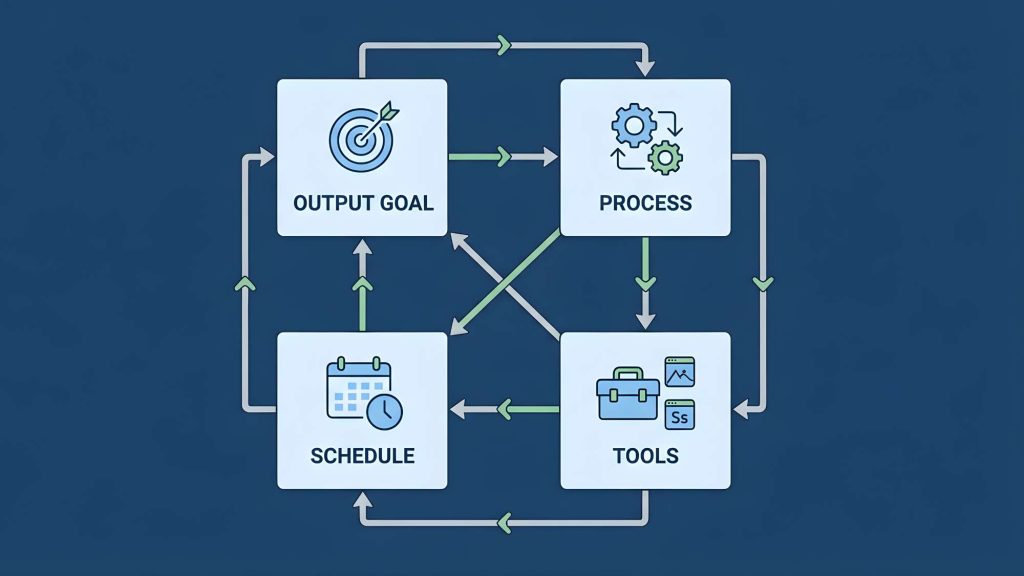
A functioning entrepreneur productivity system has four visible components working together:
1. A defined output goal. The system knows what it is producing. One article per week. Four social posts. One newsletter. The goal is specific, measurable, and fixed – not “more content” but “one 1,500-word article published every Thursday.”
2. A repeatable process. The system follows the same sequence of steps every time. Research. Outline. Draft. Review. Optimize. Publish. Repurpose. The sequence does not change week to week. What changes is the content inside it.
3. Assigned tools. Each step in the process has a designated tool. Not five options to choose from – one tool per task. This eliminates the daily decision fatigue that drains momentum before the real work begins.
4. A fixed schedule. The system runs on a calendar, not on inspiration. Same days. Same time blocks. Same duration. The schedule is what transforms a process into a habit – and a habit into a compounding engine.
When these four components exist and connect, you have an AI productivity system for entrepreneurs that works. When any one of them is missing, the system leaks – and output becomes inconsistent.
What a system is not
An AI productivity system for entrepreneurs is not the same as being busy with AI tools. Many entrepreneurs spend significant time on AI-related activities – exploring new platforms, testing prompts, watching tutorials – without ever producing consistent output.
Activity is not output. Exploration is not a system. The goal of this guide is to help you move from the first category to the second.
Why most entrepreneurs don’t have a real AI productivity system yet
If an AI productivity system for entrepreneurs is this valuable, why do so few entrepreneurs actually have one?
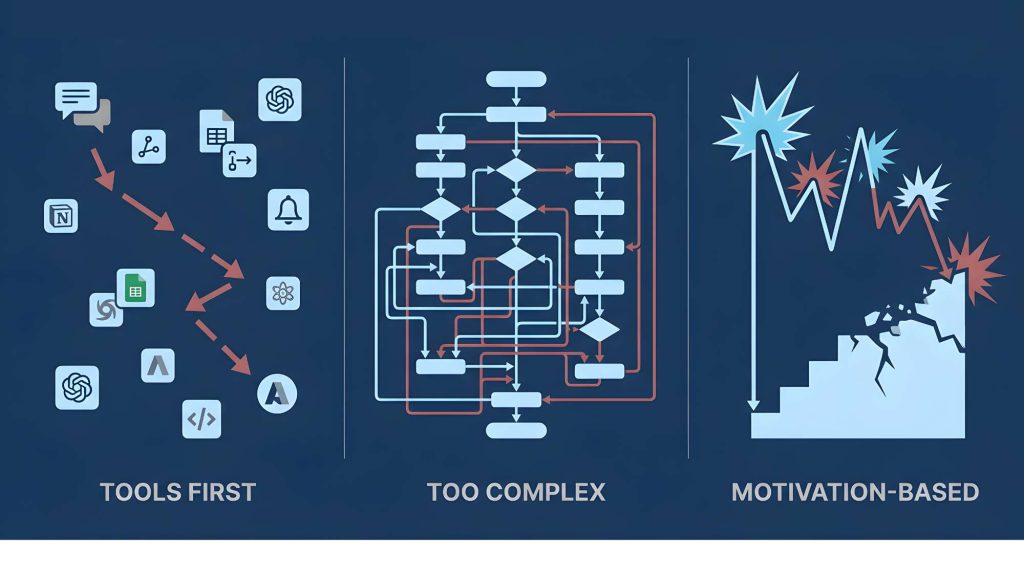
The answer is not laziness or lack of interest. It is a combination of three predictable traps that catch almost every entrepreneur who tries to build a system without a clear model to follow.
Trap 1 – Starting with tools instead of structure
The most common entry point into AI productivity is a tool recommendation. Someone mentions ChatGPT. A newsletter features Notion AI. A podcast episode covers Zapier automations. The entrepreneur signs up, explores the tool, and tries to build a workflow around it.
This approach produces the same result every time: a tool that gets used enthusiastically for two weeks and then abandoned. Not because the tool is bad, but because there was no AI productivity system for entrepreneurs to integrate it into.
Tools are components. They need a system to serve. Building the tool before the system is like buying furniture before designing the floor plan.
Trap 2 – Confusing complexity with effectiveness
A second trap: the belief that a more complex system is a better system. Multi-step workflows. Color-coded databases. Twelve-layer Notion setups. Automated triggers across five platforms.
These systems look impressive in screenshots. They rarely survive contact with a real entrepreneurial week.
The most effective AI productivity system for entrepreneurs is the simplest one that consistently produces the required output. Complexity is the enemy of consistency. Every step you add to a system is another point where the system can fail.
Trap 3 – Designing for motivation, not for reality
The third trap is the most insidious. Entrepreneurs design their AI productivity system for entrepreneurs during a high-motivation moment – after a productive weekend, following a compelling podcast, in the first week of a new quarter. The system they design reflects their best possible self.
Then reality intervenes. A difficult client. A chaotic week. A stretch of low energy. The system they designed for their best self fails their actual self – and they conclude that the system does not work, when the real issue is that it was never designed for real conditions.
A working AI productivity system for entrepreneurs is designed for average weeks, not ideal ones. It has a full version for good weeks and a minimum viable version for hard ones. It assumes interruption and builds recovery in from the start.
How to build your AI productivity system in 4 layers
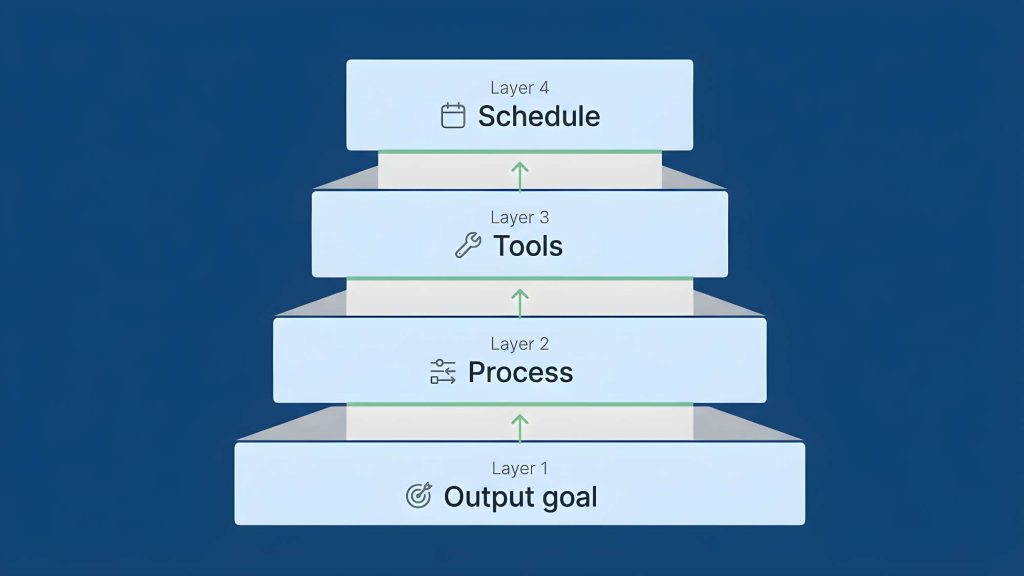
Building an AI productivity system for entrepreneurs follows the same four-layer model regardless of your content type, publishing frequency, or team size. Each layer builds on the previous one.
Layer 1 – Define your output goal
The first layer of any AI productivity system for entrepreneurs is clarity on what the system must produce.
This sounds obvious. It is consistently skipped.
Entrepreneurs often start building workflows before answering the most fundamental question: what does one successful week of output look like? Without a clear answer, the system has no target to optimize toward.
Define your output goal in one sentence: “My system produces [specific deliverable] for [specific audience] every [specific frequency].”
Examples:
- “My system produces one 1,500-word SEO article for US entrepreneurs every Thursday.”
- “My system produces four LinkedIn posts and one newsletter every week.”
- “My system produces two YouTube scripts and one blog post every two weeks.”
Once this sentence exists, every decision that follows – which process to use, which tools to select, how to allocate time – becomes easier. The output goal is the north star of your AI productivity system for entrepreneurs.
Layer 2 – Map your process
With the output goal defined, the next layer maps the steps required to achieve it.
A process for a long-form article typically looks like this:
| Step | Description | Type |
|---|---|---|
| 1. Confirm topic | Select from monthly content list, validate keyword | Strategic |
| 2. Research | Validate angle, check competition, gather supporting data | Research |
| 3. Outline | Build H2/H3 structure, define examples and CTA | Creative |
| 4. AI draft | Generate first draft from outline using AI assistant | AI-assisted |
| 5. Human review | Voice edit, add personal examples, check logic | Human |
| 6. SEO optimize | Keyword placement, meta title, meta description, internal links | Technical |
| 7. Format + publish | Mobile formatting, images, alt text, publish | Execution |
| 8. Repurpose | Extract social posts, newsletter intro, quote cards | AI-assisted |
This process does not change from week to week- the content changes. The sequence does not. That stability is what makes an AI productivity system for entrepreneurs reproducible at scale.
The key rule: if a step does not directly contribute to the final output, remove it. Start with the minimum viable process. Add steps only after running the lean version consistently for four weeks.
Layer 3 – Assign tools to each step
Layer three assigns a specific tool to each step in the process. This is the only point in building an AI workflow for business where tool selection happens – inside the process, not before it.
The assignment rule is simple: one tool per step. Not two options. Not “it depends.” One tool. The goal is to eliminate the micro-decisions that accumulate into decision fatigue.
For each step, answer one question: what is the most efficient way to complete this step given my current skill level and budget? Then select the tool that best answers that question and commit to it for a minimum of six weeks before evaluating alternatives.
Layer 4 – Set the schedule

The final layer of an AI productivity system for entrepreneurs is the schedule. A process without a schedule is a plan. A process with a schedule is a system.
The schedule answers three questions: which day does each step run, at what time, and for how long?
A realistic weekly schedule for a solo entrepreneur producing one long-form article looks like this:
| Day | Step(s) | Time Block | Duration |
|---|---|---|---|
| Monday | Confirm topic + research | 8:00–9:00am | 60 min |
| Tuesday | Outline + AI draft | 8:00–9:00am | 60 min |
| Wednesday | Human review + voice edit | 8:00–8:45am | 45 min |
| Thursday | SEO optimize + format + publish | 8:00–8:30am | 30 min |
| Friday | Repurpose into social + newsletter | 8:00–8:30am | 30 min |
Total: 3 hours and 45 minutes per week. Output: one fully optimized article + four to five social and email assets.
When the schedule is set, building an AI productivity system execution becomes mechanical, which is exactly the goal. Mechanical systems do not require motivation. They require only the decision to sit down and start.
The tools that belong inside your AI productivity system
An AI productivity system for entrepreneurs does not require an expensive or complex tool stack. It requires the right tools, assigned to the right steps, used consistently.
The following categories cover every step in a standard content production workflow. Within each category, choose one tool and commit to it.
Research and topic validation
What it does: Validates your topic angle, identifies what competitors are covering, surfaces supporting data and examples.
Recommended tools: Perplexity AI for research queries, Google Search Console for keyword validation, AnswerThePublic for question-based angles.
How it fits: This step is human-led. AI assists with research queries but does not make the strategic call. You decide whether the topic is right. The tool surfaces the evidence.
Outlining and structure
What it does: Transforms your topic into a structured skeleton – H2s, H3s, key points, examples, and calls to action.
Recommended tools: ChatGPT or Claude for outline generation from a keyword + persona + tone prompt. Notion or Google Docs for storage.
How it fits: Provide the keyword, the audience, and the angle. Let AI generate the structure. Review and adjust before moving to drafting.
Drafting and writing assistance
What it does: Generates a working first draft from the approved outline.
Recommended tools: ChatGPT (GPT-4), Claude, or Jasper for long-form drafting. The tool matters less than the prompt quality and the human review that follows.
How it fits: The AI draft is a starting point, never a final product. Every draft requires a human review pass – voice edits, personal examples, logic checks – before it is ready to publish.
SEO optimization
What it does: Checks keyword placement, meta elements, internal linking, and readability.
Recommended tools: Surfer SEO or NeuronWriter for on-page optimization. Yoast or Rank Math if publishing on WordPress.
How it fits: This step runs after the human review, not before. Optimize a draft that already reads well – not a draft that still needs structural work.
Scheduling and distribution
What it does: Schedules social posts, email newsletters, and cross-platform distribution.
Recommended tools: Buffer or Later for social scheduling. ConvertKit or Mailchimp for email.
How it fits: This is the final step of the weekly workflow. Repurpose the published article into platform-specific assets using AI, review for voice accuracy, and schedule everything in one session.
| System Layer | Tool Category | Commitment Rule |
|---|---|---|
| Research | Perplexity / Search Console | One tool, six weeks minimum |
| Outlining | ChatGPT / Claude | One tool, six weeks minimum |
| Drafting | ChatGPT / Claude / Jasper | One tool, six weeks minimum |
| SEO | Surfer / NeuronWriter | One tool, six weeks minimum |
| Distribution | Buffer / Later | One tool, six weeks minimum |
The AI productivity tools that work best are not always the most advanced. They are the ones you use consistently, in the right sequence, inside a defined process.
How to keep your system running long-term
The first challenge is building an AI productivity system for entrepreneurs. Keeping it running is the second – and the one most guides skip entirely.
The minimum viable week
Every AI productivity system for entrepreneurs needs a minimum viable version – a compressed workflow for weeks when time or energy is limited.
Define it in advance. If your standard system takes three hours and produces one full article, your minimum viable version takes 60 minutes and produces one shorter, less optimized piece. It is not ideal. But it keeps the publishing chain alive – and a live chain is infinitely more valuable than a perfect system that stops running.
The monthly review protocol
Once per month, spend 20 minutes reviewing your AI productivity system for entrepreneurs. Ask three questions:
- Which step created the most friction this month?
- Which tool underperformed or slowed me down?
- What one change would make next month noticeably smoother?
Make one adjustment. Not five. One deliberate change per month compounds into a dramatically improved system over six months.
The quarterly reset
Every three months, step back and evaluate the system as a whole. Is the output goal still the right one? Has your audience or content strategy shifted? Are the tools still the best fit for each step?
A quarterly reset is not a rebuild. It is a realignment – ensuring the AI productivity system for entrepreneurs you are running still serves the business you are building.
Protecting the human layer
As the system matures and AI handles more of the execution, one risk increases: the gradual erosion of your voice. Content that starts strong can drift toward generic as AI efficiency increases and human review time decreases.
Protect the human layer deliberately. Reserve time every week – even 20 minutes – for reading, thinking, and observing without a prompt open. This is the input that keeps your AI-assisted output worth reading.
FAQ
How long does it take to build an AI productivity system for entrepreneurs from scratch?
The initial design – defining your output goal, mapping the process, assigning tools, and setting the schedule – takes two to three hours. The first week of execution will reveal friction points you did not anticipate. By week three, most entrepreneurs report that the AI productivity system for entrepreneurs feels natural. By week six, it feels automatic. The investment is front-loaded. The returns compound indefinitely.
Do I need to be technical to build an AI productivity system for entrepreneurs?
No. The most effective AI productivity system for entrepreneurs uses three to five tools, most of which have simple interfaces designed for non-technical users. ChatGPT, Notion, Buffer, and a basic SEO plugin cover the full workflow for most solo entrepreneurs. Technical complexity is a trap, not a requirement. The simpler the system, the more sustainable it is.
How do I know when my system is working?
Your AI productivity system for entrepreneurs is working when three things are true: you publish consistently without heroic effort, your output quality is stable or improving, and the system survives your hard weeks – not just your good ones. If all three are true after four consecutive weeks, the system is working. If anyone is false, identify the single point of failure and fix that before changing anything else.
Can I use this system for content types other than blog articles?
Yes. The four-layer model – output goal, process, tools, schedule – applies to any content type. YouTube scripts, podcast show notes, email newsletters, LinkedIn posts, and client proposals. The specific steps and tools change. The structural logic does not. Build one system for one content type first. Once it runs consistently, apply the same model to the next format.
The real shift
An AI productivity system for entrepreneurs is the difference between using AI and producing with AI.
Tools alone do not create consistency. A defined output goal, a repeatable process, assigned tools, and a fixed schedule – those four layers create a system. And a system, run consistently, creates the compounding output that builds authority, audience, and business results over time.
The path is straightforward. Define what your system must produce. Map the steps from zero to done. Assign one tool per step. Set the schedule and protect it.
Start with one content type. Run the system for four weeks. Review, adjust, and continue.
An AI productivity system for entrepreneurs does not need to be perfect on day one. It needs to be running. Because a working system – however simple – will always outperform a perfect system that never launches.