
You’re getting traffic. You’re making sales. But revenue feels stuck.
Most US Shopify sellers hit this wall around $30K–$80K/month. The instinct is to spend more on ads. The problem is that ad costs keep rising while margins shrink — and the real revenue gap isn’t in traffic. It’s in what happens after the visitor lands.
AI changes that equation. Not as a magic fix, but as a practical system that optimizes pricing, personalizes communication, and activates upsell flows — all running with minimal manual input.
This guide gives you a complete framework to scale profit from your existing store. No extra ad budget required.
Why US Shopify Sellers Plateau at the Same Revenue
Most founders assume flat revenue means a traffic problem. It rarely does.
The real issue is margin erosion and missed repeat purchases. Static pricing leaves money on the table when demand spikes. Generic email campaigns fail to bring buyers back. No upsell system means every transaction closes at its lowest possible value.
The Cost of Manual Pricing and Generic Email Campaigns
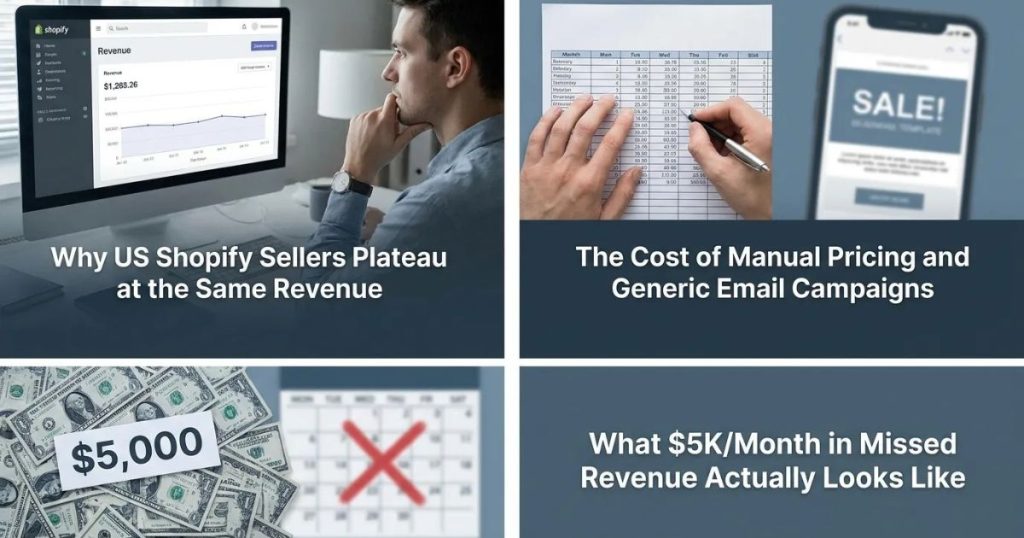
A Shopify seller in Austin running $45K/month with static pricing and weekly batch emails is likely losing $3K–$6K in recoverable revenue every month. Not from bad products — from systems that don’t adapt.
Manual pricing can’t respond to competitor moves or demand signals in real time. Generic emails generate 1–2% click rates when AI-segmented flows average 4–7% for the same list.
What $5K/Month in Missed Revenue Actually Looks Like
- 200 repeat buyers who never received a relevant follow-up offer
- 15% margin gap on 80 products priced below market for 3 weeks
- 400 post-checkout moments with no upsell — at an average $12 missed per order
These aren’t hypothetical. They’re the baseline for most US SMBs operating without AI revenue systems.
Ai pricing strategy: capture margin you’re already leaving behind
Pricing is the fastest lever. It requires no new traffic, no new products — just smarter signals.
How Dynamic Pricing Works on Shopify in 2026
AI pricing tools analyze demand patterns, competitor price movements, inventory levels, and seasonal signals to recommend or automatically adjust prices within guardrails you define.
You set a floor (never go below this) and a ceiling (never exceed this). The AI moves within that range based on real-time data. A product running low on stock during a demand spike gets priced up. A slow mover gets a targeted discount before it ties up capital.
Tools like Prisync or Wiser integrate directly with Shopify — no developer needed, setup in under a day.
Example — Austin DTC brand recovers 18% margin in 30 Days
A home goods DTC brand in Austin was pricing manually across 340 SKUs. Competitor prices shifted weekly but their catalog stayed static. After activating an AI pricing tool with defined guardrails, they recovered an average 18% margin on their top 60 products within the first month — adding $4,200 in net revenue with zero change in traffic.
Ai personalization: turn one-time buyers into repeat customers
Repeat purchase rate is the most undervalued metric in e-commerce. A 10% improvement in repeat rate can outperform a 30% increase in new traffic — at a fraction of the cost.
CLV impact of Ai-driven email segmentation
AI segmentation tools like Klaviyo analyze purchase history, browsing behavior, and engagement signals to build dynamic customer segments. Instead of one weekly email to your full list, buyers receive flows triggered by their actual behavior.
A customer who bought running shoes gets a follow-up featuring socks and insoles — not a generic newsletter. A lapsed buyer who hasn’t purchased in 60 days gets a win-back sequence with a time-sensitive offer.
The result for a Chicago SMB running Klaviyo AI flows: 23% lift in repeat order rate within 8 weeks, generating $3,100 in additional monthly revenue from the existing customer base.
Product recommendation engines — ROI for US SMBs
On-site recommendation engines (integrated via Shopify apps) display relevant products based on real-time behavioral signals. A visitor browsing yoga mats sees complementary blocks, bolsters, and straps — not random bestsellers.
Average AOV lift from recommendation engines for US Shopify stores: 12–19%, with setup time under 3 hours.
Ai upsell & cross-sell systems that run on autopilot
Most Shopify stores close every transaction at its minimum value. One upsell system changes that permanently.
Post-checkout, cart, and PDP upsell flows on Shopify
There are three high-converting moments every Shopify store should activate:
- Post-checkout upsell — highest conversion rate (buyer is already in purchase mode, credit card just used). One-click add-on, no re-entry of payment details.
- Cart upsell — complementary product shown before payment. Lower friction than a separate page.
- PDP cross-sell — “frequently bought with” block on the product page, powered by AI purchase pattern data.
Tools like ReConvert or Zipify Pages handle all three with native Shopify integration.
New York solo founder adds $2,400/month with one workflow
A solo founder in Brooklyn selling skincare products activated a single post-checkout upsell — a travel-size version of the product just purchased, offered at $14. Conversion rate on the upsell: 22%. With 550 monthly orders, that’s $1,694 in additional monthly revenue from one upsell alone. After adding a cart cross-sell for complementary items, total upsell revenue reached $2,400/month within 3 weeks.
Measuring revenue growth: the metrics that actually matter
Vanity metrics don’t build profit. These three do.
CLV, AOV, repeat rate — how to track them in GA4 + Shopify
| Metric | What it measures | Target improvement |
|---|---|---|
| CLV (Customer Lifetime Value) | Total revenue per customer over time | +15–25% in 90 days with AI personalization |
| AOV (Average Order Value) | Revenue per transaction | +12–20% with upsell/cross-sell activation |
| Repeat Purchase Rate | % of customers who buy again | +10–15% with AI email flows |
Track these in Shopify Analytics combined with GA4 custom events for internal link clicks and scroll depth on key pages.
What a healthy Ai revenue dashboard looks like
A Miami DTC brand tracks three numbers weekly: CLV trend, AOV delta, and repeat rate by cohort. Each number maps to one AI system — pricing, upsell, or email. When a number drops, they know exactly which system to adjust. No guesswork, no wasted meetings.
Our 30-day Ai revenue action plan
Week 1–2: pricing audit + tool setup
- Audit your top 50 SKUs for pricing gaps vs. competitors
- Install an AI pricing tool (Prisync or Wiser) with defined floor/ceiling rules
- Set up GA4 + Shopify revenue tracking baseline
Week 3–4: personalization + upsell activation
- Activate Klaviyo AI segmentation — start with 3 flows (welcome, post-purchase, win-back)
- Install ReConvert for post-checkout upsell on your top 5 products
- Add PDP cross-sell blocks on your 10 highest-traffic product pages
Realistic 30-day outcome for a $40K/month Shopify store :