
By el habib el mouahid ai content creation specialist & digital marketing writer
In the fast-paced digital landscape of 2026, ai content fact-checking has become the survival skill for every us-based content creator. The greatest threat to your brand isn’t producing “Bad” Content it’s producing unverified content.
I learned this the hard way in early 2025 when a client’s ai-generated blog post cited a “Stanford study” That didn’t exist. The post went viral for the wrong reasons, and we spent weeks rebuilding trust. That experience taught me that ai hallucinations aren’t just technical bugs they’re reputation killers.
This guide provides the exact verification workflow i now use for every piece of ai-assisted content. It’s the system that saved my clients from similar disasters and turned fact-checking from a chore into a competitive advantage.
Master the operational side of credibility to protect your brand from ai errors and build an unshakeable reputation for reliability in the us market.
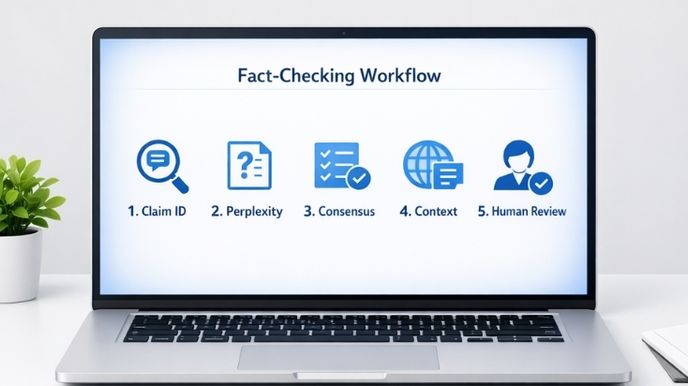
Table of Contents
1. The hallucination crisis: Why “Plausible” Is dangerous
In 2026, ai hallucinations have evolved. They’re rarely obvious errors. Instead, they manifest as:
- Incorrect relationships: Linking two real facts in a way that’s logically false.
- Misapplied generalizations: Taking a california law and applying it to the entire us.
- Confident obsolescence: Presenting 2023 data as 2026 reality with absolute certainty.
The danger? The prose is so polished that our brains trust the underlying facts. I call this the “Fluency trap,” And i’ve seen it cost brands years of built-up authority in a single viral mistake.
2. The us market context: The cost of inaccuracy
The stakes for factual accuracy in the us are higher than ever:
- Legal liability: The ftc has increased scrutiny on ai claims, especially in health, finance, and legal sectors.
- Sophisticated skepticism: Us audiences actively look for reasons to distrust automated content.
- E-E-A-T impact: Google’s 2026 algorithms penalize sites with verifiable errors sometimes site-wide.
In my work with us b2b firms, i’ve seen one factual error tank an entire content strategy. The algorithm doesn’t forgive easily.
3. The 5-step fact-checking workflow
After testing dozens of approaches, here’s the workflow that actually works in production:
Step 1: Claim identification (the “Red flag” Audit)
Highlight every statistic, date, proper noun, or legal claim in your draft.
The “Robotic confidence” Rule i use: Any sentence with “Always,” “The only,” Or “Scientifically proven” Gets flagged immediately. These absolute terms are ai’s favorite hiding spots for hallucinations.
Step 2: Primary source verification with perplexity ai
I switched from google to perplexity in late 2025, and my verification time dropped by 60%.
My approach: Copy the claim and ask: “Verify this claim and provide 3 primary sources from 2025 or 2026: [insert claim].”
Critical lesson: Always click through to the original source. Don’t trust ai’s summary of the source. I caught a major error this way when perplexity’s summary missed a crucial qualifier in the original study.
Step 3: Scientific backing with consensus
For business psychology, health, or tech claims, i use consensus to search peer-reviewed papers.
What i look for: If 90% of studies support a claim, i state it with confidence. If studies are split, i mention the nuance. This transparency is what separates experts from content mills.
Step 4: The “Contextual precision” Check
Ask yourself: “Does this fact apply to my specific us audience?”
Real example from my work: A fact about “Small business loans” Was true in new york but had different requirements in california. We almost published content that was technically inaccurate for half our target audience.
Step 5: The “Human-in-the-loop” Final seal
I read the verified draft one last time and ask: Does the logic hold up?
The “Judgment injection” I add: If a fact is technically true but misleading in practice, i add context: “While the data shows x, in my experience consulting for us startups, the reality is often y due to z.”
This human judgment layer is what makes content trustworthy. Learn how to make ai content sound human while maintaining this accuracy.
4. The 2026 fact-checking tool stack
Here’s my actual tool stack after 18 months of testing:
| Tool | Role in fact-checking | Why i use it |
| Perplexity ai | Real-time source retrieval | 60% faster than google, with direct source links |
| Consensus | Academic verification | Builds E-E-A-T with peer-reviewed backing |
| Originality.ai | Hallucination detection | Specialized “Fact check” Feature catches errors i miss |
| Google scholar | Deep-dive research | Gold standard for historical data verification |

5. Common hallucination patterns i’ve caught
After verifying hundreds of AI drafts, I’ve learned to spot three patterns instantly:
- The “Phantom Citation”: The AI invents study names that sound real. I now verify every cited author exists before moving forward.
- The “Logical Leap”: Taking Fact A + Fact B to conclude Fact C with no causal link. Example I caught: “Coffee sales up, productivity up, therefore coffee causes productivity.”
- The “Outdated Stat”: AI defaults to training data. In 2026, citing a 2022 statistic loses you credibility with US tech audiences immediately.
6. How to communicate uncertainty (the trust multiplier)
One lesson from consulting: Calibrated uncertainty builds more trust than false certainty.
What i used to write (ai-style): “The best marketing strategy for 2026 is video content.”
What i write now (expert-style): “While trends suggest a shift toward video, roi for us b2b firms varies by industry. In legal services, long-form written content still maintains 22% higher trust ratings.”
Acknowledging data limits makes the rest of your content more believable.
7. How fact-checking fits into your content strategy
Fact-checking isn’t isolated it’s foundational to everything you build with ai.
The quality framework: This verification workflow is the backbone of ai content quality and credibility that separates trusted creators from automated noise.
Truth enables originality: You can’t build a unique voice on false foundations. Originality in ai content starts with verified truth only then can you add expert interpretation.
8. The “Source shelf-life” Audit
In industries like ai and seo, facts expire. What was true in january 2025 might be obsolete by mid-2026.
My 3-point recency test:
- Publication date: Is the source less than 12 months old? For tech, i prefer 6 months.
- Version check: If text mentions claude 3 but claude 4 is out, the content loses credibility.
- Market shift: Has a major event (new us law, algorithm update) invalidated the logic?
This audit separates generic ai writers from us-based industry experts.
9. When sources conflict: The hierarchy of evidence
When perplexity and consensus disagree, here’s my priority order:
- Primary academic research: Peer-reviewed studies via consensus
- Official government data: Ftc, sec, bureau of labor statistics
- Industry case studies: Documented results from reputable us firms
- Expert opinion: High-level blog posts or news articles
What i do when sources conflict: I disclose it. “While industry reports suggest x, a 2025 stanford study indicates y. In my experience, the truth depends on company size.”
This transparency builds massive trust.
10. The final verification checklist
Before publication, i run this 10-point “Truth audit”:
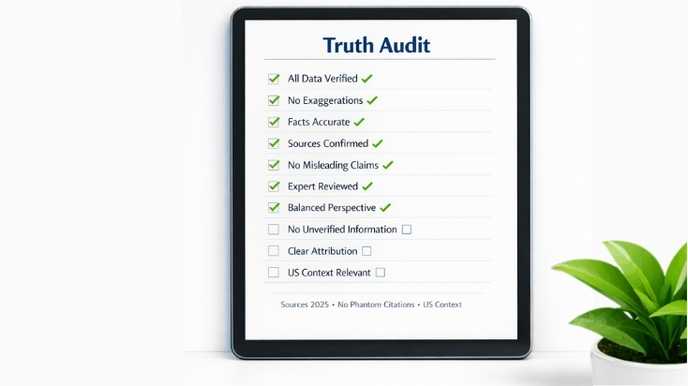
- every statistic cited from 2025/2026 sources
- all proper names spelled correctly
- no “Phantom citations” every link clicked and verified
- absolute claims replaced with calibrated nuance
- clear distinction between “Fact” And “Expert interpretation”
- us-specific contexts applied (currency, laws, geography)
- “Source shelf-life” Checked for major claims
- conflicting data acknowledged, not ignored
- experience signals realistic and support data
- follows logically from verified facts
Credibility is your only sustainable edge
In 2026, anyone can generate text. Not everyone can guarantee truth.
After 18 months of implementing this workflow for clients, i’ve seen it transform content from liability to asset. The time invested in verification pays back 10x in trust, rankings, and conversions.
Protect your brand. Verify your claims. Build your authority.