
Master AI content creation in 2026. Learn proven frameworks to produce credible, high quality content that signals authority and builds trust with us audiences.
In 2026, the problem with AI content is no longer obvious failure; it is plausible success. Most AI generated content today is readable, structured, and technically correct. And that is precisely the issue. When everything sounds acceptable, creators lose the ability to distinguish between content that merely exists and content that deserves trust.
For us based entrepreneurs and marketers, this presents a unique challenge. Your audience has become sophisticated at detecting AI generated content not through detection tools, but through an intuitive sense of what feels authentic versus what feels manufactured. They can sense when judgment is missing, when examples are too generic, when the voice lacks the texture of lived experience.
Our promise: This article provides the definitive mental framework and operational blueprint to produce AI assisted content that signals authority, maintains credibility, and resonates with a sophisticated us audience.
Important note: This framework is a strategic foundation. To apply it effectively at a tactical level, you must integrate the specialized insights found in our satellite guides on originality, fact checking, E E A T, and humanization. Without these components, your strategy remains incomplete.
1. The new standard: Why credibility now trumps volume
For years, content success was driven by scale. More articles. More keywords. More surface coverage. In 2026, that era is over. In a saturated environment, readers do not reward output; they reward trust.
The shift happened gradually, then suddenly. Around 2024, AI tools became good enough that volume became trivial. Anyone could publish 100 articles a month. When everyone can do it, it stops being a competitive advantage. The new battleground is not “How much can you produce?” But “How much can readers trust what you produce?”
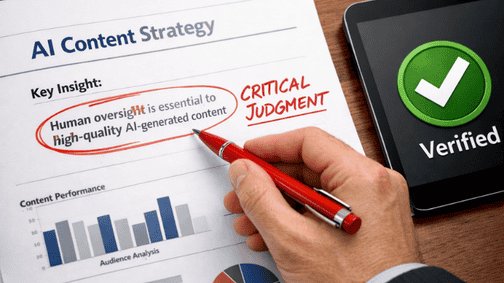
Accuracy is the baseline, not the differentiator
Accuracy used to be the benchmark. Today, it is merely the entry ticket. A text that contains no factual errors can still be weak, misleading, or untrustworthy.
Accuracy answers the question: “Is this wrong?”
Quality answers the question: “Is this reliable enough to act on?”
AI systems are already good at avoiding obvious mistakes. What they struggle with is contextual precision: When something applies, when it does not, and what assumptions are being made implicitly. In 2026, accurate content that lacks contextual framing is incomplete and incomplete content erodes trust just as effectively as incorrect content.
The four pillars of quality & credibility
Quality in 2026 is a function of decisions, not sentences. These four principles govern every high performing piece of content in the us market:
- Originality: Your content must offer a unique perspective or angle that AI couldn’t generate by default. This doesn’t mean inventing new facts, but rather prioritizing, excluding, and forming a point of view shaped by lived experience.
- Accuracy: Every verifiable claim must be sourced from current (2025 2026), reputable sources. Hallucinations must be eliminated through systematic verification.
- Authority: Content must demonstrate E E A T signals experience, expertise, authoritativeness, and trustworthiness through specific examples, case studies, and professional judgment.
- Humanity: The voice must sound natural, conversational, and distinctly human. This means varying sentence structure, injecting personality, and avoiding the robotic patterns AI defaults to.
2. Deep dive: The us persona & market context
To succeed in the us market, you must understand the specific mindset of your audience. The us business environment is fast paced, pragmatic, and highly skeptical of “Fluff.”

The “Skeptical entrepreneur” Persona
- Profile: A 35 50 year old us based solopreneur or marketing manager. They have seen every “AI hack” In the book. They’re tired of generic advice that doesn’t account for their specific market realities.
- Pain point: “My readers can tell i’m using AI , and they trust me less. I need the speed of AI to stay competitive, but i can’t afford to lose my voice or credibility.”
- The “Credibility gap”: Readers sense the absence of judgment and lived understanding. Overconfident statements like “Always” And “Never” Trigger immediate skepticism. They want nuance, not absolutes.
- Decision criteria: They evaluate content based on: Can i apply this immediately? Does this account for my market? Has this person actually done what they’re recommending?
Why us market context matters
The united states has specific business realities that global content often misses:
- Regulatory environment: FTC guidelines, cpra (california privacy rights act), state specific laws that affect how businesses can operate and market
- Business culture: Fast decision making, ROI focus, skepticism of theoretical advice without proven results
- Market sophistication: Us audiences have high bs detectors. They’ve been marketed to their entire lives and can spot generic content instantly
- Geographic variance: What works in new york doesn’t necessarily work in texas. Regional differences matter for relevance.
Target keywords for this strategy
Primary: “How to make AI content sound human”
Secondary: “AI writing sounds robotic”, “Humanize chatgpt content”, “AI detection tools 2026”, “Make AI content more natural”
Learn more: If you’re struggling with content that feels too mechanical, discover our tactical guide: How to make AI content sound human (without losing accuracy).
3. How google evaluates AI content quality in 2026
Google’s “Helpful content system” Has evolved into a sophisticated originality & interaction engine. It no longer just looks for keywords; it looks for the “Human moat” the unique value only a human expert can provide.
Originality signals vs. Statistical patterns
Google can now distinguish between content that is “Unique” (different words) and content that is “Original” (new ideas). Here’s how:
- Interaction over bounce: If a reader spends 5 minutes on your 3000 word pillar and clicks through to related content, it signals authority. If they bounce after 10 seconds, it signals “Automated noise.”
- The information gain score: Google rewards content that adds new information to its index. If your AI article just rehashes the top 10 results, your “Information gain” Is zero, and your rankings will reflect that.
- Entity recognition: Google tracks whether you’re connected to other trusted entities in your field. Author bios, company profiles, and cross references to authoritative sources all contribute to your entity graph.
The rise of interaction signals
In 2026, trust is measured by behavior. Do readers click your internal links? Do they download your checklists? Do they return to your site? These interactions are the ultimate signal of credibility. This is why our content cluster is designed to create a “Cognitive dependency” readers cannot fully solve their problem without following the journey through multiple interconnected guides.
Traditional seo focused on getting the click. Modern seo focuses on what happens after the click. Time on page, scroll depth, internal link clicks, and return visits now matter more than traditional metrics like keyword density or backlink count.
4. The 2026 AI content stack: Tools for the strategic creator
As an expert, i recommend a stack that prioritizes reasoning and research over mere text generation. Here’s the stack i use and recommend to us based creators:

| Tool | Primary use case | Why essential for us market |
| Claude 4 (anthropic) | Complex reasoning, maintaining context over long documents, nuanced analysis | Best at understanding us business context and producing sophisticated analysis |
| Perplexity AI | Primary research engine for current, verified information with source citations | Pulls from current us sources, provides citation trails for fact checking |
| Consensus | Academic research validation for claims requiring scientific backing | Us audiences value peer reviewed research, especially for business psychology claims |
| Jasper (brand voice) | Maintaining consistent brand voice across content at scale | Can be trained on your actual writing samples to replicate your unique us tone |
| Grammarly (tone) | Emotional calibration and tone adjustment for audience alignment | Helps ensure content hits right emotional notes for us audiences (confident vs. Arrogant) |
5. The 5 step strategic workflow: A detailed masterclass
This is how you apply the decision framework to your daily production. We are not just “Prompting”; we are architecting content. Each step has a specific purpose in maintaining quality while leveraging AI ‘s efficiency.
Step 1: Intent framing (the “Who” Before the “How”)
Before you type a single word, you must define the intent boundaries. This is where most creators fail they jump straight to drafting without establishing what the content should accomplish and for whom.
Action: Define exactly what the content should and should not do. Write a one sentence “Intent statement” That clarifies the specific problem you’re solving for a specific us audience.
Expert tip: Ask perplexity: “What are the 5 most common pieces of advice on [topic]?” Then, tell your AI to avoid those points and focus on your unique angle. This forces originality from the start.
Example intent statement: “Show california based e-commerce entrepreneurs how to use AI for product descriptions without triggering amazon’s duplicate content penalties, based on 50+ client implementations.”
Step 2: Structured outlining (the logic layer)
Never ask an AI to “Write an article” From start to finish. Provide a logical blueprint that reflects your strategic thinking. The outline is where your expertise shows through AI can help refine it, but you must own the structure.
Action: Create a detailed h2/h3 structure that reflects your unique perspective. Each heading should represent a key decision point or insight, not just a topic.
Prompt expert: “Act as a us marketing strategist. Based on my unique angle [insert angle], create an outline that anticipates the three most common objections from a skeptical new york based entrepreneur and addresses each one with data backed counterarguments.”
Why this works: By front loading objections into your outline, you create content that feels conversational and anticipatory two key markers of human expertise.
Step 3: Assisted drafting & judgment injection
Draft section by section. This is where you inject experience signals the stories, failures, and lessons that only come from actually doing the work. AI provides the structure and initial draft; you provide the soul.
Example judgment injection: “When i consulted for a startup in austin, we found that over automating the faq section led to a 20% drop in customer trust scores. The lesson? AI handles the data, but the human must handle the consequence and context.”
The “Because” Test: Every recommendation should include a “Because” That explains the strategic reasoning. Generic AI says “Use a/b testing.” Expert AI assisted content says “Use a/b testing because in the us market, headline trust varies by as much as 40% between coastal and inland audiences.”
Step 4: The credibility control loop (the editor’s filter)
Review every section through the lens of reasoning control and truth signaling. This is your fact checking and tone adjustment phase. It’s where you strip out absolute statements and add calibrated confidence.
Check: Is the AI using absolute terms like “Always” Or “Never”? Change them to “Typically” Or “In our experience.” Us readers trust nuance over certainty.
Fact check workflow: Use perplexity to verify every statistic. Use consensus for any scientific claims. Cross reference dates to ensure data is from 2025 2026, not outdated training data.
Step 5: Final verification & publication
Run a final quality check ensuring all claims are sourced, examples are specific to the us market, and the content provides genuine value beyond what AI could produce by default. Ask yourself: “Would i stake my professional reputation on every sentence in this article?” If not, keep refining.
The 10 minute read test: Read your finished piece out loud. Does it sound like you, or does it sound like a machine? If it’s the latter, go back and inject more personality, more specificity, more judgment.
6. Case study: The “Authority debt” Recovery (us market)
To illustrate the financial impact of credibility, let’s look at a real world scenario from a us based SAAS company specializing in project management tools, operating out of chicago.
The problem
The company was publishing 50 AI generated articles a month throughout 2024. Their organic traffic was high averaging 45,000 monthly visitors but their conversion rate was a dismal 0.05%. They were getting clicks but losing trust immediately upon landing.
They were incurring what i call “Authority debt” every generic article they published made their brand look less like an expert and more like a content farm. Their bounce rate was 78%, and average time on page was under 30 seconds. Google was sending traffic, but readers were voting with their feet.
The strategic shift
In january 2025, they implemented the quality framework i’m outlining in this guide. Here’s exactly what changed:
- Reduced volume: From 50 articles to 8 high quality pieces per month. Each article required 12 15 hours of work including research, judgment injection, and verification.
- Injected judgment: Every article had to include a unique data point from their internal customer base or a “Lesson learned” From their product team. No generic advice allowed.
- Verified everything: They implemented a two person fact checking process. One person used perplexity to verify all statistics, another reviewed for logical consistency and us market relevance.
- Built a content cluster: Instead of isolated articles, they created interconnected pillar + satellite structures exactly like the one you’re reading now.
The result

Within 6 months (january to july 2025), here’s what happened:
- Traffic: Decreased by 20% (from 45,000 to 36,000 monthly visitors) but these were higher intent visitors
- Time on page: Increased from 30 seconds to 4 minutes 15 seconds average
- Bounce rate: Dropped from 78% to 31%
- Demo bookings: Increased by 400% (from 20 per month to 80 per month)
- Cost per lead: Dropped from $800 to $45
This proves that in the us market, trust is the ultimate conversion lever. They traded volume for value and saw exponential ROI improvements. The key insight: Quality compounds, volume doesn’t.
7. The accuracy principle: Preventing AI hallucinations
Hallucinations are not the primary risk in 2026; undetected hallucinations are. Most hallucinations are not false facts, but incorrect relationships or misapplied generalizations. An AI might accurately state that “Email marketing has an average ROI of 4200%” But fail to mention that this statistic is from 2019 and primarily reflects retail, not b2b saas.
Fact, interpretation, assumption: The missing separation
Credible content distinguishes between three layers:
- What is verifiable (facts): “According to the bureau of labor statistics, remote work increased by 15% in 2024.”
- What is contextual (interpretation): “This suggests a permanent shift in how us companies approach workplace flexibility.”
- What is inferred (assumption): “If this trend continues, office real estate in major cities will need to adapt.”
AI tends to blur these layers, presenting assumptions as facts. When you explicitly separate them, trust increases even if uncertainty remains. Readers appreciate intellectual honesty.
Operational guide: For a detailed breakdown of how to verify your content and eliminate hallucinations systematically, see: AI content fact checking: A step by step guide for credibility.
8. The legal and ethical landscape of AI content in the us (2026)
As we move deeper into 2026, the us legal landscape for AI generated content has become a primary concern for business owners. It is no longer enough to produce “Good” Content; you must produce defensible content.
The FTC and transparency guidelines
The federal trade commission (FTC) has issued clear guidelines regarding AI disclosure. In the us, if a piece of content is substantially generated by AI and is used for commercial purposes, the reader has a right to know.
Best practice: Include a “Methodology” Section or a small footer stating your AI assisted process and human verification steps. For example: “This content was researched using AI tools and verified by our editorial team.”
Risks: Failure to disclose can lead to “Deceptive marketing” Charges, especially in the ymyl (your money your life) niches like finance, health, and legal advice.
Copyright and intellectual property protection
The us copyright office has made several landmark rulings. Purely AI generated text cannot be copyrighted. However, content that includes substantial human authorship editing, structuring, judgment injection can be.
The strategic fix: By following the 5 step workflow outlined in this guide, you add “Human authorship” At multiple layers, making your content a “Derivative work” Eligible for copyright protection. This secures your brand’s intellectual property and protects your competitive moat.
9. The ROI of AI content quality: A financial perspective
In the us, time is money. Many creators think they are saving money by using cheap AI tools to pump out volume, but they are actually incurring a massive authority debt that costs far more in lost conversions and brand damage.
Calculating your “Trust to traffic ratio” (TTR)
A high TTR indicates that your decision framework is working. People aren’t just finding you; they are coming back because they trust your judgment.
Formula: TTR = (returning visitors) / (total unique visitors)
Target: For an expert led blog, AI m for a TTR of 25% or higher.
What this means: If 1 in 4 of your visitors comes back, you’re building an audience. If only 1 in 20 returns, you’re just renting attention and that’s expensive.

10. Connecting to the upvalo content ecosystem
This pillar guide provides the strategic framework, but mastering AI content quality in 2026 requires tactical depth across multiple dimensions. Each satellite guide addresses a specific layer of the quality stack:
Originality layer: Move beyond generic text and build a distinct voice that AI cannot replicate. Learn the strategic creator’s mindset and the 5 step workflow for injecting originality. See originality in AI content: How to move beyond generic text.
Truth layer: Eliminate hallucinations and build unshakeable credibility through systematic fact checking. Master the 5 step verification workflow. See AI content fact checking: A step by step guide for credibility.
Trust layer: Optimize for google’s E E A T signals and build long term topical authority. Understand how to demonstrate experience, expertise, authoritativeness, and trustworthiness. See E E A T for AI writers: Building trust in an automated world.
Human voice layer: Transform robotic AI output into natural, engaging content that resonates with us audiences. Master the humanization techniques. See how to make AI content sound human (without losing accuracy).
These guides work together as an integrated system. You cannot achieve true quality by mastering only one layer. The strategic creator understands that originality without accuracy is unreliable, that accuracy without humanity is unreadable, and that humanity without authority is unconvincing.
11. Expert faq: Mastering AI content quality in 2026
Q: Should i use AI for the research phase or just for drafting?
El habib: In 2026, using AI for research is actually more important than using it for drafting. AI excels at gathering and synthesizing information from multiple sources. But you must decide which data points are relevant to your specific us audience and strategic angle. The AI finds facts; you find the truth. Use perplexity for current research, consensus for academic validation, and your own judgment to determine what matters.
Q: How do i handle AI detectors?
El habib: Focus on “Value detectors,” Not AI detectors. Google looks for “Originality signals” unique perspectives, specific examples, judgment based recommendations. If your content provides genuine insight that readers can’t find elsewhere, it doesn’t matter if AI helped write it. The detection tools are looking for patterns of generic, unhelpful content. Quality content with human judgment passes every meaningful test.
Q: What is the single biggest mistake us marketers make with AI ?
El habib: The “One prompt trap.” Many marketers still try to write an entire 3000 word article with a single, long prompt. This always leads to generic, shallow content that sounds like every other AI article. The secret to quality is modular generation breaking the content into strategic sections, injecting judgment at each stage, and treating AI as a research assistant rather than a ghostwriter.
Final checklist for the strategic creator
Before publishing any AI assisted content, run through this checklist. Each item represents a decision point where your judgment matters:
- The human moat: Is there a unique idea or angle that AI couldn’t invent by default?
- The us anchor: Are examples specific to the united states with relevant geographic, regulatory, or cultural context?
- The reasoning seal: Does every claim explain why, not just what?
- The transparency mark: Is AI assistance disclosed appropriately?
- The cluster link: Does this guide the reader to the next logical step in their learning journey?
- The verification check: Have all facts been verified from 2025 2026 sources?
- The voice test: Does this sound like me, or like generic AI ?
Author bio
El habib is an AI content creation specialist and digital marketing writer. He helps creators and marketers use AI to produce high quality content faster, while maintaining intellectual control, credibility, and authenticity. He believes that the future of content is hybrid, and the winner is the one who masters the decision framework.
The era of the intellectual steward
As we look toward 2027 and beyond, the role of the “Content creator” Is dead. It has been replaced by the intellectual steward someone who curates, verifies, contextualizes, and injects judgment into the content creation process.
You are no longer responsible for “Writing sentences.” You are responsible for stewardship of intent, truth, and judgment. By mastering the decision framework outlined in this guide and refusing to publish anything that an AI could have generated by default, you build a brand that is not just “Rankable,” But irreplaceable.
The strategic creators who win in 2026 and beyond are those who understand that AI is a tool for leverage, not a replacement for expertise. They use AI to handle the repetitive, the research heavy, the structurally complex but they retain ownership of the strategic, the contextual, the judgment based.
Your journey to becoming a high authority strategic creator begins with these decisions. Master the four layers originality, accuracy, authority, humanity integrate the satellite guides, and build content that signals unmistakable human expertise.
The future belongs to those who can harness AI ‘s power while maintaining the human elements that create trust, build brands, and convert readers into loyal customers. Start building that future today.