
Your average order value is lower than it should be. More traffic will not close that gap.
AI personalization ecommerce strategies will.
Most ecommerce stores run the same generic recommendations for every visitor. The same discount popup. The same follow-up email. The same homepage regardless of who is browsing.
That approach leaves significant revenue on the table every single day.
Real personalization works differently. It shows each customer what they are most likely to buy next, at the moment they are most likely to buy it. The result is higher average order value, stronger customer lifetime value, and better margins, without increasing your ad spend.
This guide shows you exactly how to implement AI personalization for your ecommerce store. Which levers to activate first. Which mistakes to avoid. And how to measure real revenue impact, not just clicks.
Let’s start with why personalization is your most underused revenue multiplier.
Table of contents
Why AI Personalization Ecommerce Beats Customer Acquisition

Every new customer costs money to acquire. The real profit comes from increasing what they spend per order and how often they return.
A Miami Shopify seller with steady monthly revenue had a modest average order value. After implementing AI-powered product recommendations based on browsing behavior and cart contents, AOV increased significantly within months. Same ad spend, substantially more revenue per transaction.
In the current US market, increasing LTV from existing customers is the most efficient revenue lever available. Better personalization after the first purchase drives more revenue without increasing acquisition spend.
For US sellers preparing for Q4, personalization sequences set up in September convert higher during Black Friday windows because the customer already has a relationship with the brand.
Key insight: Increasing AOV and LTV is more profitable than acquiring new customers.
Related: Personalization starts with strong product content. Read our AI product content optimization guide.
Related: See how this fits into the complete AI revenue optimization framework.
AI Personalization Ecommerce: 3 Levers That Drive Revenue Per Order

Product recommendations (upsell and cross-sell)
Generic recommendations don’t work. Standard recommendation widgets show irrelevant products because they’re based on past aggregate data, not individual behavior. AI personalization analyzes what this specific customer viewed, how long they stayed on each page, what they added to cart, and what they abandoned. It predicts what they’re most likely to buy next. A Sacramento WooCommerce store selling outdoor gear had generic recommendations driving a small portion of revenue. After switching to AI-powered personalized recommendations that tracked individual browsing patterns, recommendations drove a much larger share of revenue. Key insight: Personalized recommendations match customer intent, generic ones don’t.
Personalized pricing and offers
Different customers respond to different incentives. A first-time visitor might need a discount to convert. A returning customer who abandoned cart twice might only need free shipping. A VIP customer doesn’t need discounts at all. AI tracks customer behavior and assigns the minimum incentive needed to close the sale. You’re not giving away margin unnecessarily. A Las Vegas Shopify seller offered the same discount to everyone through popup forms. After implementing AI-powered dynamic offers, conversion rates improved substantially. Profit margins also improved because fewer discounts were needed. Key insight: Match incentives to customer behavior, not blanket discounts.
Post-purchase retention sequences
The sale doesn’t end at checkout. AI personalization customizes follow-up based on what the customer bought, how much they spent, and how they interacted with previous emails. A customer who bought running shoes gets running tips and gear maintenance advice, not generic product catalogs. An Indianapolis ecommerce store selling home fitness equipment sent identical post-purchase emails to everyone. After personalizing sequences based on product purchased, repeat purchase rates within 90 days increased significantly. Key insight: Personalized follow-up drives repeat purchases better than generic emails. recommendations
AI Personalization Ecommerce Tools: Behavioral Targeting, Email and Dynamic Pages
AI for behavioral product recommendations
AI watches what each visitor does: time spent on pages, products viewed in sequence, items added then removed from cart, searches performed, previous purchases. It builds a behavior profile and predicts next likely purchase. A Raleigh Shopify seller selling pet supplies implemented behavioral AI recommendations. Average products per order increased. Customers buying dog food now regularly add treats or toys suggested based on their dog’s breed and size inferred from previous purchases.
AI for segmented email personalization
AI segments customers by lifetime value, purchase frequency, product preferences, and engagement level. High-value customers get exclusive previews. Recent buyers get complementary product suggestions. Inactive customers get win-back offers. A Columbus WooCommerce store with thousands of email subscribers sent monthly newsletters to everyone. After implementing AI segmentation, revenue per email increased substantially. Key insight: Segment by behavior, not demographics.
AI for dynamic landing pages
The same homepage doesn’t work for everyone. A first-time visitor needs to understand what you sell. A returning customer wants to see what’s new. A cart abandoner should see their abandoned items. A San Antonio Shopify seller implemented dynamic homepages. First-time visitors see bestsellers and brand story. Returning visitors see new arrivals. Cart abandoners see their cart items with free shipping offer. Overall conversion rates improved. Key insight: One homepage doesn’t fit all visitor types.

AI Personalization Ecommerce: Human Oversight and CCPA Compliance
Human oversight at scale
AI personalization at scale requires human supervision at three critical points. First, offer logic: AI minimizes the incentive to close a sale, but humans must verify that offer stacking, combining discounts, free shipping, and loyalty points simultaneously, doesn’t create margin-destroying combinations that the algorithm doesn’t flag. Second, segment drift: AI segments evolve as customer behavior changes. A segment labeled ‘high-value’ in January may include customers whose purchasing pattern has shifted. Review segment definitions quarterly to ensure AI is acting on current data. Third, edge cases: AI sees patterns in aggregate data. Individual customers in unusual situations, a returned order, a billing dispute, a loyalty redemption, may receive inappropriate automated messages if human review doesn’t catch them. The rule is simple: AI personalizes at scale, humans validate at the margins. Key insight: Automate what follows clear patterns. Supervise what doesn’t.
Privacy-conscious personalization: the US CCPA reality
California’s Consumer Privacy Act (CCPA) and similar state-level regulations in Virginia, Colorado, and Connecticut create specific obligations for US ecommerce personalization. Customers have the right to opt out of sale of personal data and the right to know what data you collect. Practically for personalization: your email sequences must include clear disclosure of how personalization works. Dynamic pricing based on behavioral data must comply with opt-out rights. AI recommendation engines using third-party behavioral data need consent architecture. Heavy personalization can feel invasive if customers don’t understand why they’re seeing specific content. A Charlotte ecommerce store used browsing data to send highly targeted emails. Customers complained about being watched. Solution: Add a clear, human-readable explanation in your personalized emails: “We’re suggesting these products based on items you recently viewed.” Privacy-transparent personalization builds trust, not resistance. Key insight: CCPA compliance isn’t optional for US sellers. Privacy-conscious personalization builds long-term trust.
AI Personalization Ecommerce: 4 Steps to Increase Customer Lifetime Value
Step 1: Identify your highest-value customer segments
Pull customer data from Shopify or WooCommerce. Segment by total spend, number of orders, average order value, and recency of last purchase. Identify your top customers by revenue, your VIPs. Identify customers who made one purchase recently but haven’t returned, your retention priorities. Related: Measure your segment performance with our AI analytics for ecommerce decisions guide.
Step 2: Set up AI-powered product bundles
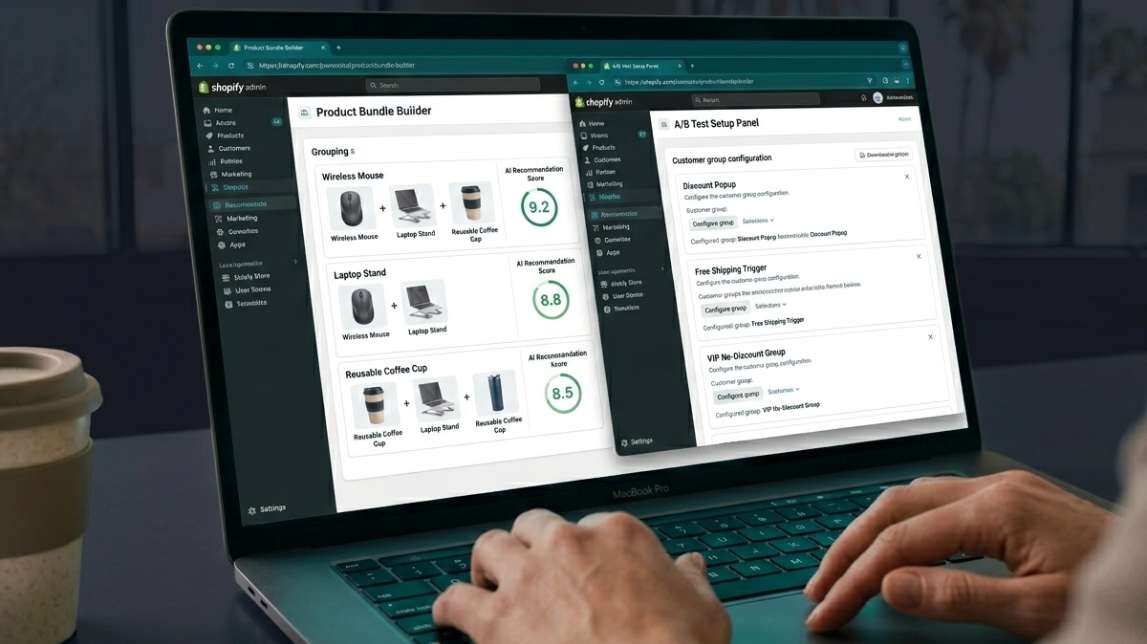
Choose your top 10 best-selling products. For each, identify 2-3 complementary products frequently bought together using order history data. Create AI-powered bundles that appear when someone adds the main product to cart.
Step 3: Test personalized offers
Don’t give the same discount to everyone. Set up three test groups: Group A gets immediate discount popup. Group B gets free shipping after cart abandonment. Group C (returning customers) gets no discount but priority support. Run the test for two weeks. Measure conversion rate and profit margin per group.
Step 4: Measure incremental revenue
Track AOV before and after personalization. Track repeat purchase rate. Track customer lifetime value by cohort. If AOV increases but LTV stays flat, your personalization drives one-time upsells but doesn’t build loyalty. Adjust strategy to focus on retention. Key insight: Measure both immediate impact (AOV) and long-term impact (LTV).
AI Personalization Ecommerce: 5 Mistakes to Avoid Before You Launch
Mistake 1: Over-personalizing without testing
More personalization isn’t always better. A Phoenix Shopify seller personalized everything and the site became inconsistent and confusing. Solution: Start with one high-impact area.
Mistake 2: Ignoring customer privacy concerns
Heavy personalization without transparency creates resistance. Solution: Be transparent about personalization. Add explanatory copy to targeted emails.
Mistake 3: Not measuring incremental revenue
A Nashville WooCommerce seller implemented personalized discount offers. Revenue went up but profit margin went down. Solution: Always compare profit, not just revenue.
Mistake 4: Using personalization only for discounts
Discounts are the last lever, not the first. Solution: Personalize value first, relevant products, helpful content, better matches. Discounts come last.
Mistake 5: Forgetting mobile experience
A Tucson ecommerce store implemented dynamic product recommendations that loaded slowly on mobile. Solution: Test every personalization feature on mobile before full deployment.
Key insight: Start small, test every layer, and measure profit, not just revenue.
Your Next Step with AI Personalization Ecommerce

AI personalization ecommerce is not a standalone tactic. Every successful AI personalization ecommerce strategy starts with one lever, then builds layer by layer. It works only when it sits inside a complete revenue optimization framework. Strong product content comes first. Personalization multiplies what is already working. Analytics tells you what to adjust next. Start with one lever: product recommendations. Measure AOV before and after. Then add dynamic offers. Then retention sequences. Each layer compounds the previous one. That is how you increase average order value without increasing your ad spend. Key insight: AI personalization ecommerce delivers results only when it is part of a complete revenue framework, not a standalone tactic. Related: Scale your revenue further with our AI-powered ads optimization guide. Ready to build the full system? See the complete AI Revenue Optimization Framework.