
By El Habib El Mouahid – AI content creation specialist & digital marketing writer
Master Google’s E-E-A-T framework for AI content. Build experience, expertise, authoritativeness & trustworthiness that survives algorithm updates.
This guide explains how E-E-A-T for AI writers has evolved under google E-E-A-T 2026 and what it means for AI content authority. In the SEO landscape of 2026, google’s E-E-A-T (experience, expertise, authoritativeness, and trustworthiness) is no longer just a set of guidelines for quality raters it is the survival code for every US-based content creator. As AI- generated text saturates every corner of the web, search engines have pivoted their algorithms to hunt for the one thing AI cannot fake: Human-verified authority.
For the strategic creator, the challenge isn’t whether to use AI, but how to use it while signaling unmistakable evidence of lived experience and professional judgment. This guide explores how to build a long-term ecosystem of authority that survives algorithm updates and wins the trust of a sophisticated us audience.
Our promise: Master the advanced signals of E-E-A-T to ensure your AI- assisted content ranks as an authoritative resource, not as automated noise.
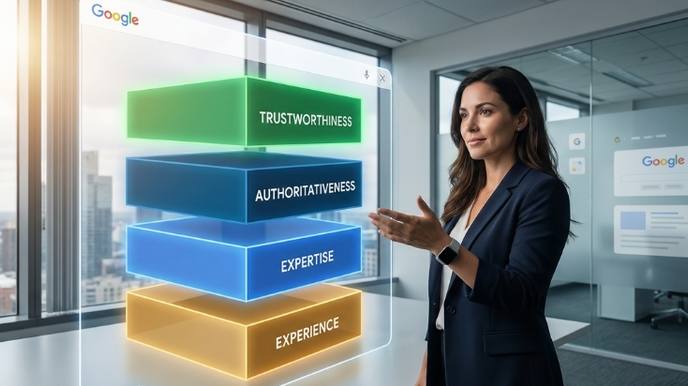
Table of Contents
1. E-E-A-T for AI writers in 2026: Why experience is the new ranking factor
In 2026, the “E” For experience has moved to the front of the line. Google’s algorithms have become incredibly efficient at identifying “Theoretical knowledge” content that describes how something works based on existing data. What they prioritize now is “Applied knowledge” content that proves the author has actually done the work.
The difference between knowing and doing
- Generic AI expertise: “To improve conversion rates, you should use a/b testing on your headlines.” (theoretical, easily replicated).
- E-e-a-t driven experience: “In our last campaign for a miami-based saas, we found that a/b testing headlines with a ‘loss-aversion’ angle outperformed ‘benefit-driven’ angles by 18%.” (applied, unique, and authoritative).
For a us audience, experience is the only differentiator that justifies their time. If your AI- assisted content doesn’t signal that a human was “In the room” When the results happened, it will fail the E-E-A-T test.
E-e-a-t is the foundation of the broader ai content quality & credibility framework that defines modern content standards for 2026.
2. Demonstrating expertise with ai: The “Judgment injection” Method
Expertise in 2026 is defined by prioritization and exclusion. While AI tends to be exhaustive (trying to cover every possible angle), an expert is selective.
The “Strategic curator” Framework
As an expert, your role is to guide the AI to focus on what matters. This is done through judgment injection:
- Define the hierarchy: Tell the AI which points are critical for a us business and which are secondary.
- Add the “Why”: AI can state a fact, but an expert explains the strategic implication of that fact.
- Challenge the model: Ask the AI for the “Standard” Advice, then explicitly instruct it to provide a more nuanced or contrarian take based on your professional judgment.
Localizing expertise for the us market
Expertise is not universal; it is contextual. To signal authority to a us audience, you must reference:
- Specific us regulations: Mentioning the impact of the latest california privacy rights act (cpra) updates on marketing data.
- Us business culture: Understanding the nuances of “B2B sales cycles in the midwest” Vs. “Tech startups in silicon valley.”
- Regional data: Using us dollars and referencing US-based industry benchmarks (e.g., gartner or forrester reports).
3. Building authoritativeness: The cluster effect
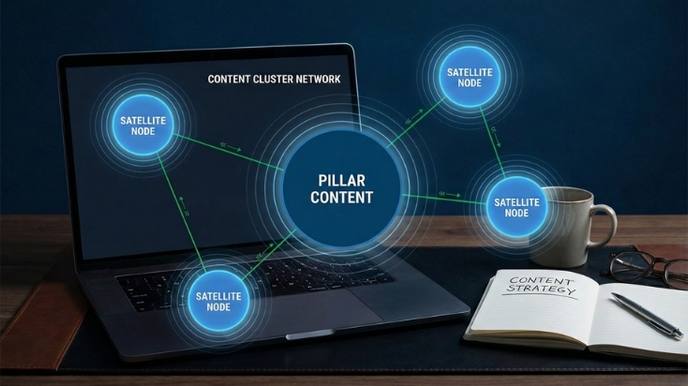
Authoritativeness is not built on a single page; it is the result of a consistent ecosystem of content. This is where your “Content cluster” Strategy becomes your greatest E-E-A-T asset.
The pillar-satellite architecture
By linking your detailed satellites back to your main pillar page, you signal to google that you have “Topical depth.”
- The pillar page: Defines the broad boundaries of the topic.
- The satellites: Dive deep into specific sub-problems (originality, fact-checking, E-E-A-T).
This architecture proves that you aren’t just writing one-off articles to rank for keywords; you are building a comprehensive knowledge base for your audience.
External authority signals
In 2026, google also looks for “Off-page E-E-A-T.” This includes:
- Author profiles: Ensuring your bio (like the one at the bottom of this page) is consistent across linkedin, upvalo, and other platforms.
- Citations: When other US-based experts or publications link to your “Unique angles,” Your authoritativeness score increases exponentially.
4. Trustworthiness: The final filter
Trustworthiness is the most important component of e-e-a-t. It is the “Reason for being” For your content. In an automated world, trust is built through transparency and accuracy.
The transparency standard
In the us, being “Ai-assisted” Is not a crime, but being “Ai-hidden” Is a trust-killer.
- Action: Disclose your process. Tell your readers how you used AI to research and how you personally verified the results.
- The “Methodology” Section: For high-stakes content, include a small section explaining your data sources and verification steps.
Preventing hallucinations (the trust shield)
Nothing destroys E-E-A-T faster than a factual error. This is why your fact-checking workflow is actually a core part of your E-E-A-T strategy.
Trust is built on truth. To see our step-by-step process for eliminating AI hallucinations, explore our ai content fact-checking guide.
5. Operationalizing E-E-A-T for AI writers: 2026 checklist
To ensure every piece of content meets the 2026 standard, use this “E-E-A-T injection” Checklist during your final review:
- Personal anecdote: Does the article include at least one real-world example of “When this worked” Or “When this failed”?
- Expert nuance: Does the content avoid “Always/never” Statements in favor of “It depends on [context]”?
- Us anchoring: Are the examples and data points relevant to a US-based entrepreneur?
- Source verification: Are all statistics cited from reputable 2025/2026 sources?
- Author transparency: Is there a clear author bio that links to a proven track record in the industry?
6. Case study: E-E-A-T transformation for a us marketing agency
To illustrate the power of these signals, let’s look at a real-world scenario from 2025. A mid-sized marketing agency in chicago was struggling with a 30% drop in organic traffic following a major google core update. Their blog was 90% AI- generated, and while the content was accurate, it lacked “Experience signals.”
The “E-E-A-T audit” Process
The agency implemented a three-step “Human-in-the-loop” Overhaul:
- The practitioner interview: For every article, the AI writer was required to interview a senior account manager for 10 minutes to gather real “Battlefield” Anecdotes.
- The local anchor: Every article was updated to include US-specific benchmarks and references to local industry events (like “Adweek new york”).
- The transparency footer: They added a detailed “How we wrote this” Section to every post, explaining the role of AI and the human verification process.

The results
Within four months, the agency didn’t just recover their lost traffic they saw a 50% increase in “High-intent” Leads. By shifting from “Volume” To “Authority,” They attracted clients who were looking for experts, not just content. This proves that in the us market, E-E-A-T is not just an SEO tactic; it’s a business growth strategy.
7. Deep dive: The future of E-E-A-T – “Entity authority”
As we look toward 2027, google is moving toward entity-based authority. This means they aren’t just looking at your keywords; they are looking at you as an “Entity” (a person or brand) and how you relate to other trusted entities in the us market.
How to prepare for entity authority
- Be consistent: Use the same name, bio, and headshot everywhere.
- Collaborate: Co-author content with other us experts to “Link” Your entities together.
- Build a community: Engagement signals (comments, shares from real us users) are becoming a direct proxy for trust.
8. Troubleshooting: When E-E-A-T signals feel “Fake”
One common mistake us creators make is “Over-engineering” Their experience signals. If you add a personal story that feels forced or irrelevant, the reader’s “Bs detector” Will go off instantly.
The “Authenticity test”
Before publishing, ask yourself:
- Is this story necessary? Does it actually clarify a complex point, or is it just there for seo?
- Is the tone consistent? Does the personal anecdote sound like the same person who wrote the rest of the article?
- Is it specific? Instead of “I once had a client who…”, use “In 2024, while working with a logistics firm in seattle…”. Specificity is the hallmark of truth.
Human signals in content build trust with audiences and satisfy google’s experience requirements. Learn more about how to make AI content sound human while maintaining these critical trust signals.
9. Final E-E-A-T for AI writers checklist (google E-E-A-T 2026 edition)
Ensure your content is “Algorithm-proof” With this final review:
- Experience: Does the content include a “Lessons learned” Or “What we saw” Section?
- Expertise: Does the article prioritize the most important 3 points instead of listing 10 generic ones?
- Authoritativeness: Does the page link to other relevant satellites in your cluster?
- Trustworthiness: Is there a clear, verifiable author bio with a link to a professional profile?
- Localization: Are all examples and data points relevant to the us market?
- Transparency: Is the role of AI in the creation process clearly disclosed?
- Recency: Are all cited studies and tools the most current versions available in 2026?
E-E–A–T as your competitive advantage
In 2026, E-E-A-T for AI writers is no longer optional. It is the foundation of sustainable visibility under google E-E-A-T 2026. In a world where AI can write anything, your reputation is the only thing it cannot replicate. By focusing on the “Experience” And “Expertise” Layers of your content, you move from being a “Writer” To being a trusted authority.
Don’t just publish content. Build a legacy of trust.
Author bio:
El habib is an AI content creation specialist and digital marketing writer. He helps creators and marketers use AI to produce high-quality content faster, while maintaining intellectual control, credibility, and authenticity. He believes that the future of content is hybrid, and the winner is the one who masters the decision framework.