
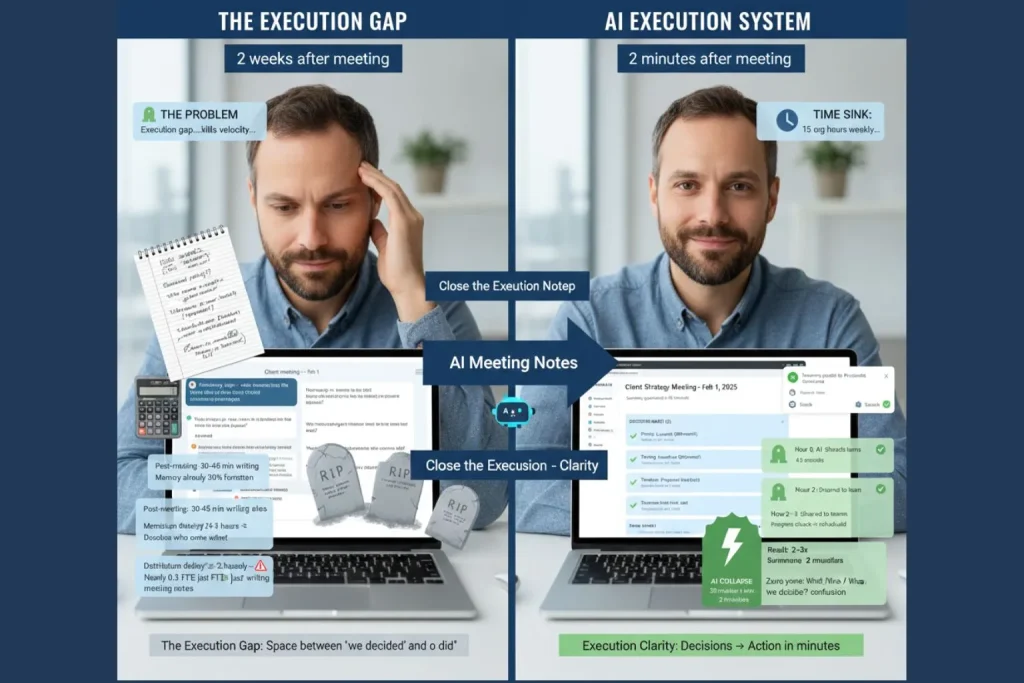
Great meetings lose impact when decisions stay trapped in notebooks. You spent an hour making clear commitments, but two weeks later nobody remembers who owns what. The execution gap the space between “we decided” and “we did” kills velocity more than bad meetings ever could. AI meeting notes turn conversations into clear summaries with assigned next steps in minutes instead of forcing someone to spend 30 minutes reconstructing discussion from memory. This supports a larger AI-focused meeting management approach that transforms how decisions become results.
Table of Contents
From meeting to execution: AI documentation system
The post-Meeting time sink problem
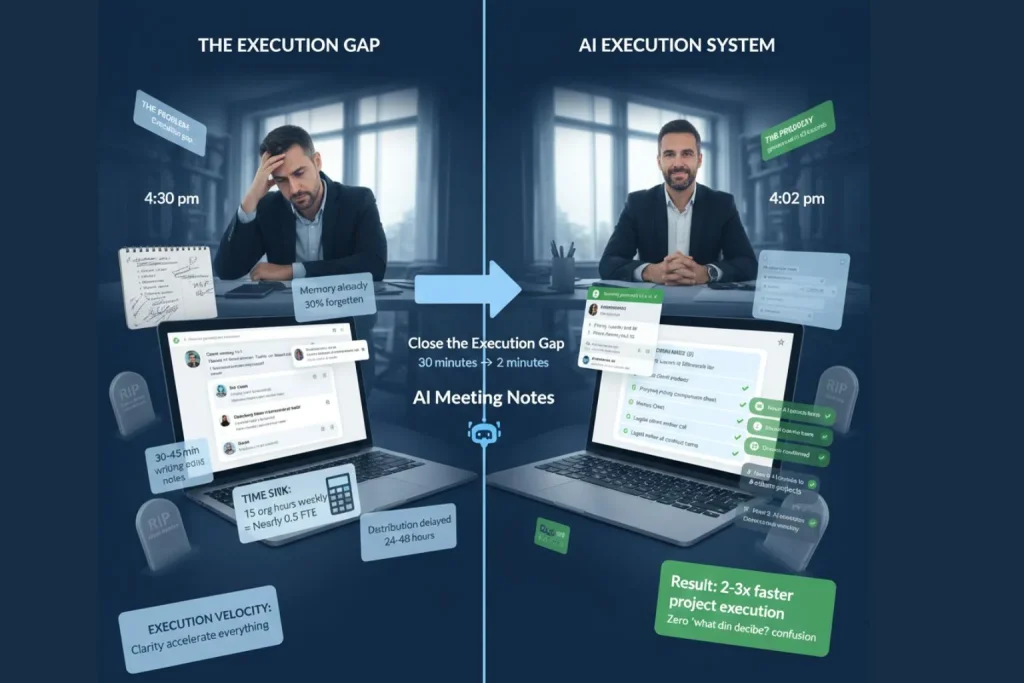
Traditional meeting documentation creates a brutal time sink most founders never quantify. After a 1-hour meeting, someone spends 20-45 minutes writing notes manually: recalling details from memory (with 30% already forgotten), organizing messy shorthand into coherent summaries, extracting action items buried in paragraph-form discussion, formatting for readability, and finally distributing to the team.
The problems compound quickly. Procrastination sets in “I’ll write these up later” and later becomes tomorrow or never. Notes are incomplete because memory fades. Distribution is slow, so the team waits 24-48 hours before getting clarity on what was actually decided.
The result: the Action Item Graveyard. Decisions made in meetings never turn into executed work because nobody has clear documentation of commitments, ownership, or deadlines.
Calculate the organizational cost: 5 meetings weekly × 30 minutes documentation time × team size. For a 6-person team, that’s 2.5 hours weekly per person, totaling 15 organizational hours nearly half a full-time employee spent just writing meeting notes.
This isn’t a documentation problem. It’s an execution clarity crisis that creates a bottleneck between decision-making and action-taking. Every hour delayed in documentation is an hour your team operates without alignment.
AI Summary generation: The 2-Minute protocol
AI collapses the documentation timeline from 30 minutes to 2 minutes through automated transcription and intelligent analysis.
Here’s how the workflow operates in practice: during the meeting, tools like Otter, Fireflies, or Fathom transcribe every word spoken in real-time. Post-meeting, natural language processing analyzes the full transcript identifying decisions made, action items with clear ownership, questions raised but left unanswered, and key discussion topics that consumed significant time.
Within 30 to 120 seconds after the meeting ends, the AI outputs a structured summary. Your job is a simple 2-minute human review protocol.
Step 1 (60 seconds): Skim the summary for accuracy. Did the AI catch all major decisions? Are action items correctly assigned with owners and deadlines? Most AI meeting tools operate at 85–95% accuracy you’re verifying, not rewriting.
Step 2 (30 seconds): Add the nuance the AI couldn’t capture. Context matters. Why did you make this decision? What tradeoffs were on the table? This single habit prevents the classic “wait, why did we decide that?” confusion three weeks later.
Step 3 (30 seconds): Share with the team. Copy-paste the summary into your Slack channel or email thread. Tag relevant people. This manual distribution is intentional you control who sees what and when, maintaining human ownership of communication rather than handing it to an automated bot.
Total time investment: 2 minutes versus the traditional 30-minute note-writing approach. That’s 28 minutes saved per meeting. For entrepreneurs running 5 meetings weekly, that’s 2.3 hours reclaimed every week time that flows directly back into deep work or strategic priorities.
The vocabulary shift matters: you’re implementing async-first distribution with AI-powered execution velocity, not just “saving time on notes.”
Action item extraction: AI identifies commitments
AI meeting tools excel at capturing the commitments humans most often miss or forget under the pressure of real-time conversation.
The technology listens for specific commitment language patterns. When someone says “I’ll send the proposal by Friday,” the AI detects the full structure: action verb (send), object (proposal), owner (I/John), deadline (Friday). It extracts a clean output: Action Send proposal to client. Owner John. Due Date Friday.
Other patterns the AI reliably recognizes include: “[Person] will [action] by [date]”, “Can you [task] before [deadline]”, and “Let’s make sure we [commitment].” The system captures these across natural, unstructured conversation no rigid meeting format required.
Accuracy typically ranges between 85–90%. You review the remaining 10–15% the AI missed usually implied commitments or vague language like “Yeah, I can look into that” with no deadline attached. Your facilitation job is simple: confirm commitments verbally before the meeting ends so the AI has clear, structured material to capture.
Once action items are surfaced, you choose your tracking method based on your workflow:
- Option A: Notion database for team visibility and searchable history
- Option B: Asana or ClickUp if you already use a project management tool
- Option C: Slack threads or calendar events for lightweight, low-friction tracking
The key insight here: the manual copy-paste step (60 seconds) is intentional, not inefficient. It ensures you personally understand each commitment and maintain ownership rather than delegating accountability to an automated system that no one feels responsible for.
This is execution clarity in action closing the decision-to-action gap that kills velocity in most teams.
The 48-Hour execution protocol
Turning action items into completed work requires a systematic accountability loop, not just better documentation.
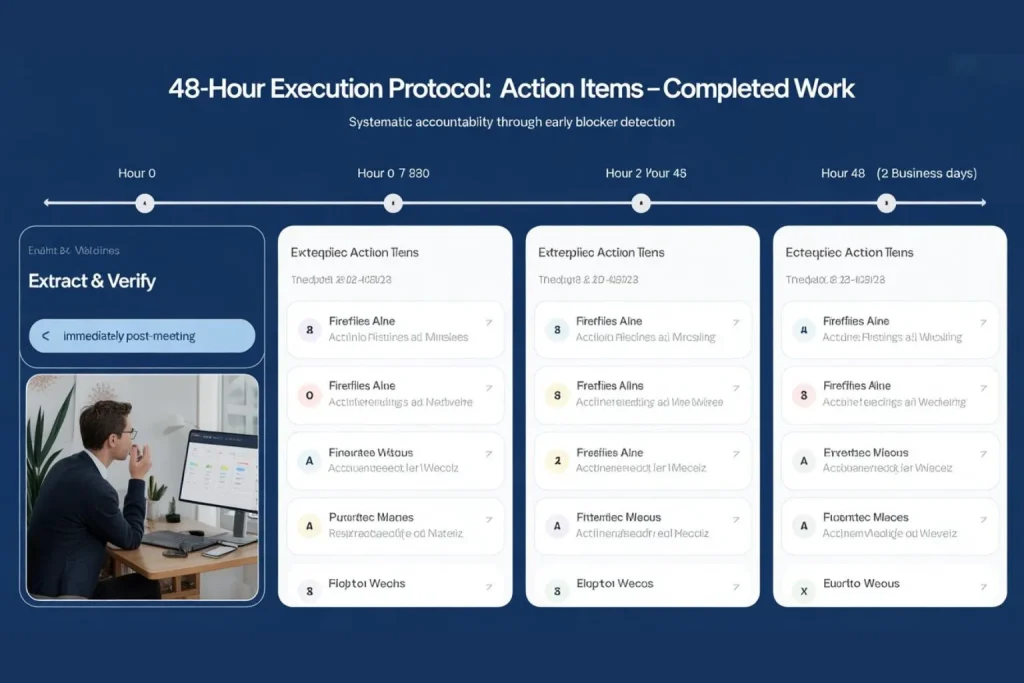
Hour 0 (immediately post-meeting): AI extracts action items with owners and deadlines. You verify the list is accurate in 90 seconds. If something is unclear in the transcript, that’s a meeting facilitation failure fix it next time by confirming commitments verbally before ending.
Hour 2 (same day, within 2 hours): Share the action item list in your team Slack channel or email thread. Manual distribution, not automated bot this shows you’re personally invested. Tag each owner individually so they get notified.
Hour 24 (next business day): Owners must confirm they saw their action items. Simple emoji reaction or “got it” reply. If someone doesn’t confirm within 24 hours, send a direct message to ensure clarity. No assumptions.
Hour 48 (2 days post-meeting): First progress check-in via async Slack thread. Question: “Any blockers on your action items from Wednesday’s meeting?” Offer help proactively, not judgment.
Why the 48-hour window works: It creates urgency that prevents procrastination to “next week.” It catches problems early if someone is blocked on day 2, you know immediately and can unblock. It eliminates the “I forgot” excuse because multiple touchpoints ensure visibility.
The vocabulary: execution velocity through 48-hour lock-in with early blocker detection. This isn’t micromanagement it’s systematic accountability that respects autonomy while maintaining momentum.
Manual tracking (Intentional, not Automated)
AI surfaces action items automatically, but tracking completion should be intentionally manual, not fully automated.
Your options for tracking:
Option A: Notion database provides team visibility and searchable history. Create a simple database with columns: Action Item, Owner, Due Date, Status, Meeting Source. Anyone can see what’s in flight.
Option B: Slack threads work for teams that live in Slack. Lightweight, low friction, and conversations happen where work already flows. Pin action items in relevant channels.
Option C: Asana or ClickUp makes sense if your team already uses project management tools. Copy AI-extracted items into your existing workflow rather than introducing new systems.
Why manual copy-paste (60 seconds) is valuable: It forces you to read and understand each commitment. You maintain connection to execution as a founder or leader. It prevents the “set it and forget it” mentality where automated systems create false security.
Why NOT fully automated workflow: Automated reminder bots feel like surveillance, which kills trust. They remove human ownership people rely on “the system will remind me” instead of personal accountability. This creates learned helplessness rather than execution ownership.
The balance: AI extracts commitments, you distribute information, humans own execution. This is intentional tracking with human-centric accountability, not productivity theater through over-automation.
Building searchable meeting archive
Without organized meeting history, teams constantly rehash old discussions. Someone asks “What did we decide about pricing?” and nobody remembers. New team members join and ask questions already answered three months ago. You repeat the same strategic discussions quarterly.
A searchable meeting archive solves institutional amnesia.
Simple setup using Notion as example: Create a database titled “All Meetings.” Add properties: Title (e.g., “Q2 Planning Session”), Date, Attendees, Meeting Type (strategy, client, 1-on-1), Summary (paste AI-generated summary), Action Items (link to tracking system), Recording Link.
Weekly ritual (5 minutes): Add this week’s meeting summaries to the database. Tag with relevant topics using inline tags: #product, #marketing, #hiring, #pricing.
Making it searchable: Notion’s native search becomes powerful. Type “pricing strategy” and instantly find every meeting where pricing was discussed. Click through to read summaries or watch recording segments.
Use case for onboarding: New employee starts Monday. Instead of spending 30 minutes explaining strategic context, send them 3-5 relevant past meeting summaries: “Read these to understand our Q2 priorities and why we made certain tradeoffs.” They’re context-ready for their first team meeting.
This builds organizational memory your company’s knowledge base that grows with every documented conversation instead of evaporating when meetings end.
Case study – Agency saves 14 hours weekly
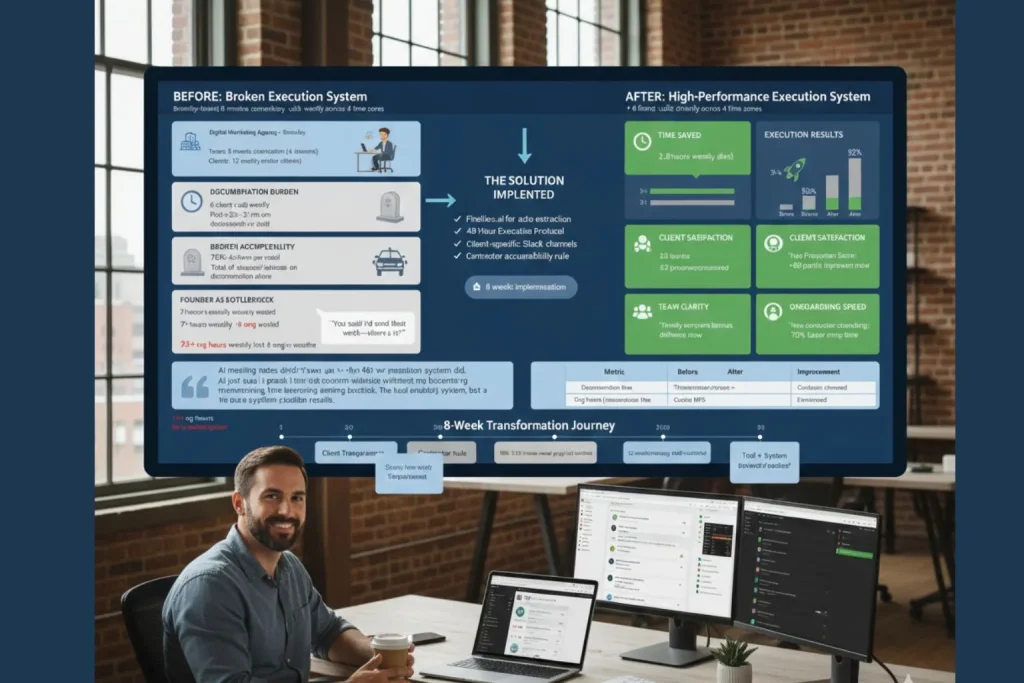
Profile: Digital marketing agency based in Brooklyn with 8 remote contractors across 4 time zones, serving 12 monthly retainer clients.
The Problem:
The founder ran 6 client calls weekly. Post-call documentation consumed 25-35 minutes per call writing notes from memory, extracting action items, sending recap emails. Total: 3+ hours weekly on documentation alone.
Execution was broken: 70% of action items assigned in meetings never got completed. Items fell through cracks between contractors. Clients grew frustrated: “You said you’d send that last week where is it?” Team members constantly confused: “Wait, was that my responsibility or Sarah’s?”
The founder became a bottleneck, manually following up on every commitment because no systematic accountability existed.
The Solution:
Implemented Fireflies.ai for automatic action item extraction. Applied the 48-Hour Execution Protocol consistently. Made one key cultural change: action items now shared immediately post-call in client-specific Slack channels, creating transparency for clients.
Added contractor accountability rule: Must emoji-confirm action items within 24 hours of posting, signaling they saw and understood their commitments.
Time Saved:
Documentation time collapsed: 30 minutes manual notes → 2 minutes AI review per meeting. Savings: 28 minutes × 6 meetings weekly = 2.8 hours weekly reclaimed.
Contractor attendance eliminated: Previously, 2 contractors attended every client call “to stay in loop” (unnecessary). Now they receive AI summaries. Savings: 2 people × 1 hour × 4 calls weekly = 8 hours organizational time returned to billable work.
Total: 10.8 hours weekly reclaimed across the team.
Execution Results:
Action item completion rate: 30% → 92% within stated deadlines. Client satisfaction (Net Promoter Score): +60 points improvement over 3 months. Team clarity dramatically improved exit survey: “Finally everyone knows exactly who owns what and by when.”
Onboarding speed increased 70%: New contractors read past client meeting archives instead of requiring extensive founder explanation.
Founder’s Quote: “AI meeting notes didn’t save us the 48-hour execution system did. AI just made it possible to track commitments without me becoming a micromanaging bottleneck. The tool enabled the system, but the system created the results.”
Building accountability without micromanagement
Systematic accountability doesn’t mean constant surveillance. The approach matters as much as the system.
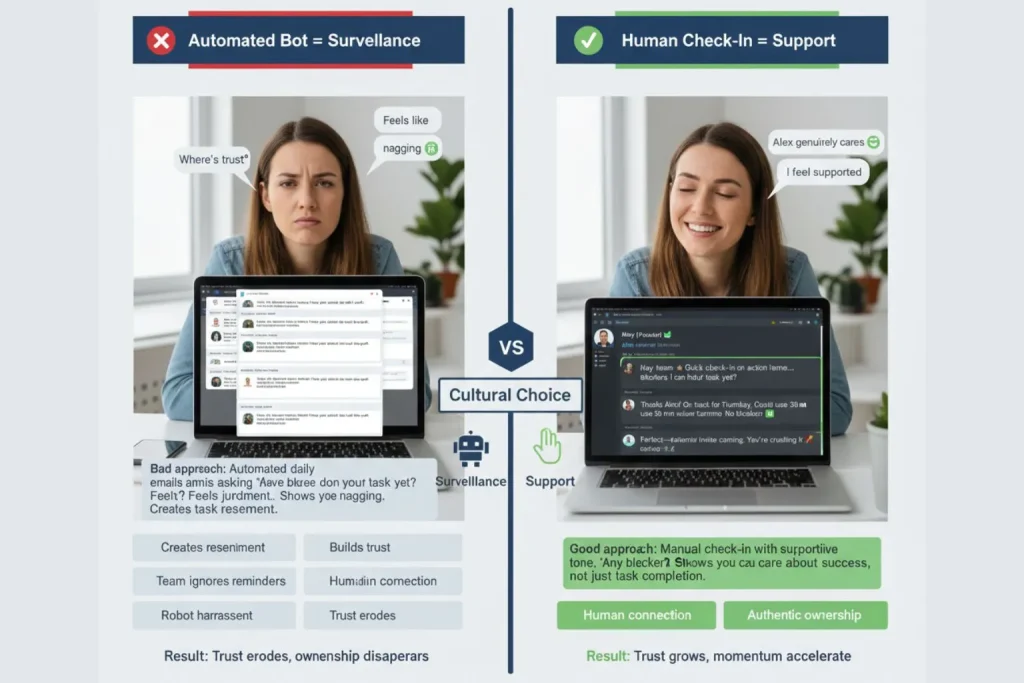
Bad approach: Automated daily reminder emails asking “Have you done your task yet?” This feels like nagging. It creates resentment. People start ignoring reminders. You’ve replaced human connection with robot harassment.
Good approach: Manual 48-hour check-in with supportive tone. Example Slack message: “Hey team, quick check-in on Friday’s action items any blockers I can help remove? No judgment, just want to make sure nobody’s stuck.”
The framing shows you care about their success, not just task completion.
Human touch matters in execution accountability. When someone is blocked on an action item, jump on a quick 15-minute call to unblock them. Don’t just send another message provide actual help. When someone consistently delivers ahead of deadlines, offer public recognition in team channels: “Sarah crushed her deliverables this week shipped the proposal 2 days early.”
This is supportive accountability through founder-led check-ins with a help-first mindset. You’re removing obstacles, not adding pressure. That cultural distinction determines whether your accountability system builds trust or erodes it.
When action items consistently fail: Root cause analysis
If action items consistently remain incomplete after implementing AI documentation and 48-hour protocols, your meeting system has upstream problems. This isn’t about lazy people it’s broken processes.
Common root causes and fixes:
Unclear ownership: Two people thought the other was doing it. Neither takes action. Fix: Assign single owner per action item, confirmed verbally before meeting ends. “Sarah, you’re owning the client proposal correct?”
Unrealistic deadlines: 5-hour task assigned with 2-day deadline during busy sprint. Nobody says it’s impossible in the meeting. Item predictably fails. Fix: Owner estimates time required and negotiates realistic deadline before meeting ends. “That’s probably 6 hours of work. Can I deliver it Thursday instead of Tuesday?”
No actual decision made: Action item was “explore options” or “think about approach” vague non-commitment masquerading as action. Fix: Improve decision clarity in meetings. Force concrete commitments. Replace “explore options” with “Research 3 vendor options, create comparison doc, share by Friday.”
Low commitment: Person said “sure” to keep meeting moving but didn’t genuinely buy into ownership. Fix: Check for real commitment before ending. “Are you confident you can own this, or should we find someone else?” Permission to decline creates authentic accountability.
Pattern: Fix upstream (decision quality, facilitation discipline) rather than downstream (adding more tracking tools). This is systemic diagnosis with upstream problem-solving focused on root cause clarity, not symptom management.
Common mistakes and how to avoid them
Mistake 1: Trusting AI 100% without review
AI achieves 85-95% accuracy, not 100%. It sometimes misses nuance, misinterprets sarcasm, or assigns action items to the wrong person. Fix: Always complete the 60-90 second review protocol. Verify AI captured decisions correctly before distributing.
Mistake 2: Hoarding notes instead of sharing
You have a perfect AI summary but forget to share it with the team. Days pass. Everyone remains confused about decisions. The documentation exists but creates zero alignment because it stayed in your dashboard. Fix: Make sharing part of the mandatory 2-minute protocol. Documentation without distribution is worthless.
Mistake 3: No action item follow-through
AI extracts action items perfectly, but nobody tracks completion. Items sit in summaries, never migrate to accountability systems. Teams revert to “action item graveyard” despite having great notes. Fix: Designate specific owner for tracking completion (usually founder or project lead). Weekly Slack check-in becomes non-negotiable ritual.
Mistake 4: Recording everything including sensitive conversations
AI records performance feedback, confidential strategy discussions, or personal conversations. Privacy concerns emerge. Trust erodes. Fix: Disable AI for sensitive meetings with one-click pause. Announce at meeting start: “This is being recorded via AI let me know if you need me to pause for any sensitive topics.”
All mistakes share common theme: broken human-in-loop quality control. AI is powerful tool, not autonomous solution. Maintain distribution discipline and intentional review.
AI meeting notes solve the execution gap the space between “we decided” and “we did” by turning conversations into structured documentation in 2 minutes instead of 30. This eliminates the action item graveyard and keeps teams aligned without endless follow-up meetings to clarify “what we decided last week.”
For teams running 5-10 meetings weekly, the time savings compound: 2-4 hours saved per person on documentation alone. But the bigger win is execution velocity. When everyone knows exactly what was decided, who’s responsible, and when it’s due, projects move at 2-3x normal speed. Clarity accelerates everything.
Great meetings produce great notes. AI makes sure it happens every time, not just when someone has 30 minutes to spare after the call.
This is one piece of a complete meeting system. See how execution protocols integrate with decision-first frameworks ,AI meeting tools, and the full system for 12+ hours weekly reclaimed.
Start with the diagnosis: Calculate exactly how much your meetings cost to justify implementing this execution system.