
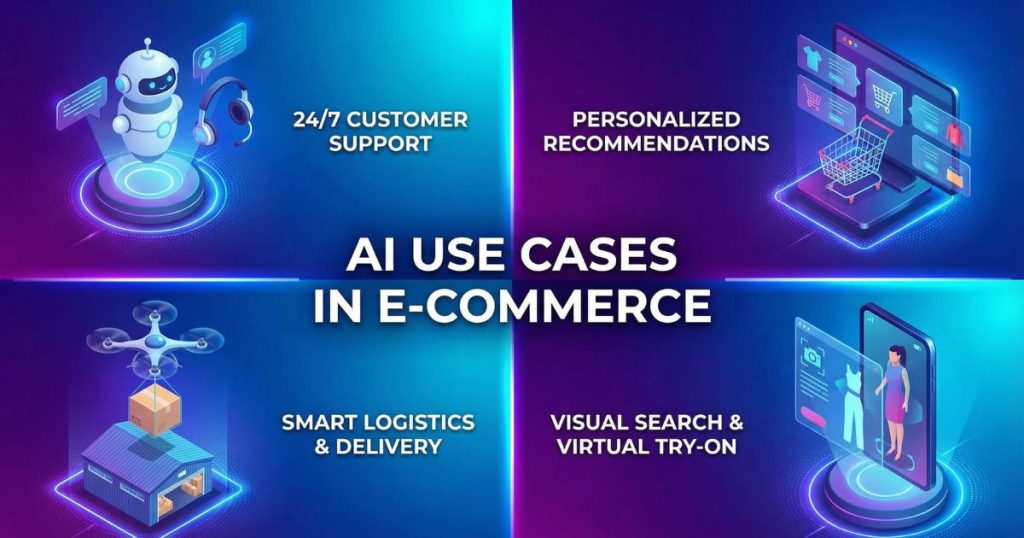
The e-commerce industry is undergoing a significant transformation, driven by the integration of artificial intelligence to enhance customer experience and operational efficiency.Online retailers are leveraging AI for e-commerce to offer personalized product recommendations, intelligent search capabilities, and efficient inventory management, among other innovations.These e-commerce solutions are not just trends but are becoming essential for successful online retail strategies, enabling businesses to drive growth and stay competitive.
As the industry continues to evolve, understanding the applications and benefits of artificial intelligence in e-commerce is crucial for businesses aiming to thrive in the digital marketplace.
The evolution of AI in e-commerce
AI’s role in e-commerce has evolved substantially, from simple automation to complex intelligence systems. Initially, AI was utilized for basic tasks such as data processing and customer service inquiries. However, with advancements in machine learning and natural language processing, AI now enables online retailers.These use cases are not isolated solutions. They are part of the complete transformation of e-commerce through AI, reshaping how online businesses operate and grow in a data-driven environment
to analyze complex customer data, predict behavior, and personalize shopping experiences.
The evolution of AI in e-commerce is marked by significant milestones, including the development of advanced algorithms and the integration of AI with existing e-commerce platforms.
From basic automation to advanced intelligence
The journey of AI in e-commerce began with basic automation, focusing on streamlining routine tasks. Advanced AI technologies have now enabled online retailers to gain deeper insights into customer behavior and preferences.
Key benefits of AI implementation for online retailers
The implementation of AI in e-commerce offers numerous benefits, including enhanced customer satisfaction, improved operational efficiency, and increased sales through targeted marketing. The following table summarizes the key benefits:
| Benefit | Description | Impact |
| Enhanced Customer Satisfaction | Personalized shopping experiences through AI-driven recommendations | Increased customer loyalty |
| Improved Operational Efficiency | Automation of routine tasks and processes | Reduced operational costs |
| Increased Sales | Targeted marketing through AI-driven insights | Higher conversion rates |
Personalized product recommendations
AI-driven personalized product recommendations are transforming online shopping experiences by providing customers with tailored suggestions that align with their preferences and behaviors.
This personalized approach not only enhances customer satisfaction but also significantly boosts sales for e-commerce businesses. The technology behind these recommendations involves complex algorithms that analyze vast amounts of customer data.
Collaborative filtering algorithms
Collaborative filtering algorithms are a cornerstone of personalized product recommendations. These algorithms work by analyzing the behavior of similar users to suggest products.
They are based on the premise that if User A and User B have similar preferences, they are likely to be interested in similar products.
How Netflix and Amazon use collaborative filtering
Netflix and Amazon are prime examples of companies that effectively utilize collaborative filtering. They analyze user history and preferences to recommend content and products.
Content-based recommendation systems
Content-based recommendation systems focus on the attributes of the products themselves. They suggest items that have characteristics similar to products a customer has previously shown interest in.
Hybrid approaches and success metrics
Hybrid approaches combine multiple techniques, such as collaborative filtering and content-based systems, to achieve more accurate and diverse recommendations.
Success metrics for these systems include click-through rates, conversion rates, and customer satisfaction scores.
| Recommendation Technique | Description | Key Benefits |
| Collaborative Filtering | Analyzes behavior of similar users | Personalized suggestions based on user behavior |
| Content-Based | Focuses on product attributes | Recommends products with similar characteristics |
| Hybrid Approaches | Combines multiple techniques | More accurate and diverse recommendations |
AI-powered search and discovery
AI-powered search and discovery are transforming the e-commerce landscape by providing more intuitive and personalized shopping experiences. This transformation is driven by several key technologies that enhance how customers interact with e-commerce platforms.
Natural language processing for search queries
One of the critical components of AI-powered search is Natural Language Processing (NLP). NLP enables customers to search for products using everyday language, making the search process more intuitive and user-friendly. By understanding the nuances of language, NLP can provide more accurate search results, improving customer satisfaction.
Visual search capabilities
Another significant advancement is visual search capabilities. This technology allows customers to search for products using images, which is particularly useful in categories like fashion and home decor. By leveraging image recognition technology, e-commerce platforms can help customers find products that match their preferences more effectively.
Image recognition in fashion and home decor
In the fashion and home decor sectors, image recognition technology is being used to allow customers to upload pictures of products they like and find similar items. This capability not only enhances the shopping experience but also increases the likelihood of conversion.
Semantic understanding and intent recognition
Semantic understanding and intent recognition are also crucial in AI-powered search. These technologies enable search algorithms to comprehend the context and intent behind search queries, providing more relevant results. By understanding what customers are looking for, e-commerce platforms can offer more personalized recommendations, enhancing the overall shopping experience.
Intelligent chatbots and virtual assistants
The integration of intelligent chatbots and virtual assistants is revolutionizing the e-commerce landscape. These AI-powered tools are not only enhancing customer service but also driving sales and improving operational efficiency.
Customer service automation
Intelligent chatbots automate customer service inquiries, providing instant responses to common questions and freeing human customer support agents to focus on more complex issues. This automation significantly reduces response times and improves customer satisfaction.
Sales assistance and conversational commerce
Chatbots also act as sales assistants, engaging customers in conversational commerce and guiding them through the purchasing process. By offering personalized recommendations and support, chatbots can increase conversion rates and average order values.
Integration with existing e-commerce platforms
Integration with existing e-commerce platforms is crucial for the successful implementation of chatbots. Many solutions are available for popular platforms like Shopify and Magento, making it easier for online retailers to adopt this technology.
Case studies: Shopify and Magento AI integrations
Several case studies have demonstrated the effectiveness of AI chatbot integrations on Shopify and Magento platforms. For instance, a leading online retailer saw a 30% increase in customer engagement after implementing a chatbot solution on their Shopify store.
| Platform | Integration Benefits | Key Features |
| Shopify | Enhanced customer experience, increased sales | Personalized product recommendations, 24/7 support |
| Magento | Improved operational efficiency, reduced support queries | Automated order tracking, conversational commerce capabilities |
AI for e-commerce use cases in inventory management
Inventory management in e-commerce is being redefined by the power of artificial intelligence. AI is revolutionizing the way online retailers manage their stock, enabling them to make data-driven decisions and optimize their supply chains.
Demand forecasting is a critical aspect of inventory management, and AI-powered predictive analytics is making it more accurate. By analyzing historical sales data, seasonal trends, and external factors, AI algorithms can predict future demand with high precision.
Demand forecasting and predictive analytics
AI-driven demand forecasting allows e-commerce businesses to anticipate and prepare for fluctuations in demand. This involves analyzing large datasets, including sales history, weather patterns, and economic indicators, to predict future sales.
Automated replenishment systems
Automated replenishment systems use AI to automatically order stock when inventory levels fall below certain thresholds. This ensures that products are always available when customers need them, reducing stockouts and overstocking.
Supply chain optimization and logistics
AI also optimizes supply chain and logistics operations by identifying the most efficient routes and methods for product delivery. This results in faster shipping times, reduced costs, and improved customer satisfaction.
By adopting AI-driven inventory management solutions, online retailers can significantly improve their operational efficiency, reduce costs, and enhance customer satisfaction.
Personalized marketing and customer engagement
The integration of AI in e-commerce has opened new avenues for personalized marketing and enhanced customer engagement. By leveraging AI-driven strategies, online retailers can now offer highly tailored experiences to their customers, significantly improving the overall shopping experience.
Dynamic pricing strategies are a prime example of AI’s impact on personalized marketing. AI algorithms can analyze market demand, competitor pricing, and customer behavior in real-time to adjust prices accordingly. This not only helps in maximizing revenue but also in offering customers competitive pricing.
Dynamic pricing strategies
Dynamic pricing allows e-commerce businesses to stay competitive by adjusting prices based on real-time market conditions. AI algorithms analyze historical sales data, market trends, and external factors like weather or economic conditions to determine the optimal price for a product at any given time.
Customer segmentation and behavioral analysis
AI enables businesses to segment their customer base more effectively by analyzing behavioral data, purchase history, and demographic information. This segmentation allows for targeted marketing campaigns that resonate with specific customer groups, enhancing engagement and conversion rates.
As:”The future of marketing lies in understanding the individual needs of each customer and delivering personalized experiences that meet those needs”.Highlights the importance of personalized marketing in today’s competitive landscape.
Omnichannel personalization and customer journey mapping
Omnichannel personalization ensures that customers receive a consistent and personalized experience across all touchpoints, from browsing on the website to interacting on social media. AI-driven customer journey mapping helps identify key moments in the customer journey where personalized interventions can make a significant impact.
By implementing these AI-driven marketing strategies, e-commerce businesses can significantly enhance customer engagement, improve conversion rates, and drive revenue growth. The key lies in leveraging AI to understand customer behavior and preferences, enabling truly personalized marketing efforts.
the future of AI in e-commerce
The integration of AI in e-commerce has transformed the way businesses operate, making them more efficient and customer-centric. As explored, AI applications range from personalized product recommendations and AI-powered search to intelligent chatbots and inventory management.
Looking ahead, the future of AI in e-commerce is poised for significant advancements. Emerging AI trends will continue to shape the industry, enabling online retailers to deliver more personalized experiences, streamline operations, and stay competitive in a rapidly evolving market.
With advancements in machine learning and natural language processing, AI will play an increasingly vital role in driving business growth and meeting customer expectations. As e-commerce continues to evolve, embracing AI technologies will be crucial for businesses aiming to stay ahead of the curve.