

You wrapped up another insane week. Fifty-five hours logged. Emails answered, fires put out, clients kept happy, team calls handled. You were on all week.
Then Friday afternoon hits, and you open your notes from January the ones where you wrote down what you actually wanted to build this year.
You’ve barely moved the needle.
This isn’t a time management problem. You have the same 168 hours as every other founder. The real issue is something most productivity guides never touch: you’re confusing high activity with strategic progress. AI strategic time management makes this gap visible showing exactly where your hours go versus where they should go. That difference between staying busy and actually building is where most entrepreneurs quietly lose months, then quarters, then years.
Here’s how AI-assisted strategic planning closes it starting with the complete quarterly framework.
Table of Contents
How does AI transform time into strategic capital for entrepreneurs?
Why working hard doesn’t equal strategic growth: The busy vs strategic divide
There’s a pattern almost every founder goes through at some point. Early stage, you hustle hard and it works raw effort drives results. Every hour you put in moves things forward. So your brain wires itself to equate effort with progress.
Then the business gets more complex. You have more to manage, more people pulling on you, more fires to contain. You keep putting in the hours more of them, actually but the needle stops moving the way it used to. You feel productive all day and still end every quarter wondering what you actually accomplished.
The problem isn’t your work ethic. The problem is that the rules changed and you didn’t notice.
Early-stage growth is fueled by activity. Mature growth is fueled by priority alignment putting your best hours toward the highest-leverage work, not just the most urgent work. The two feel identical from the inside. That’s what makes this trap so dangerous.
Research backs this up: a McKinsey study found that executives who proactively prioritize high-impact work outperform reactive counterparts by 25% in productivity not because they work more hours, but because those hours compound differently.
How AI makes time as strategic capital visible
Here’s the reframe that changes how you operate: your time isn’t a resource to manage. It’s capital to invest.
When you think of time as a resource, the goal is to not waste it. You optimize for busyness fill the calendar, clear the inbox, check the boxes. Efficiency becomes the metric.
When you think of time as capital, the goal is return on investment. You ask: “Which investments of my hours this quarter will compound into the most meaningful outcomes?” Strategy becomes the metric.
This shift sounds subtle. The operational change is massive.
A founder managing time asks: “How do I fit everything in?” A founder investing time asks: “What deserves my best hours and what doesn’t deserve my hours at all?”
The first approach keeps you busy. The second approach builds something.
Every quarter, you have a fixed amount of strategic capital. The question isn’t how to spend it efficiently. It’s how to invest it toward outcomes that actually move your business forward.
The 3-Level time investment framework: Where your hours actually Go
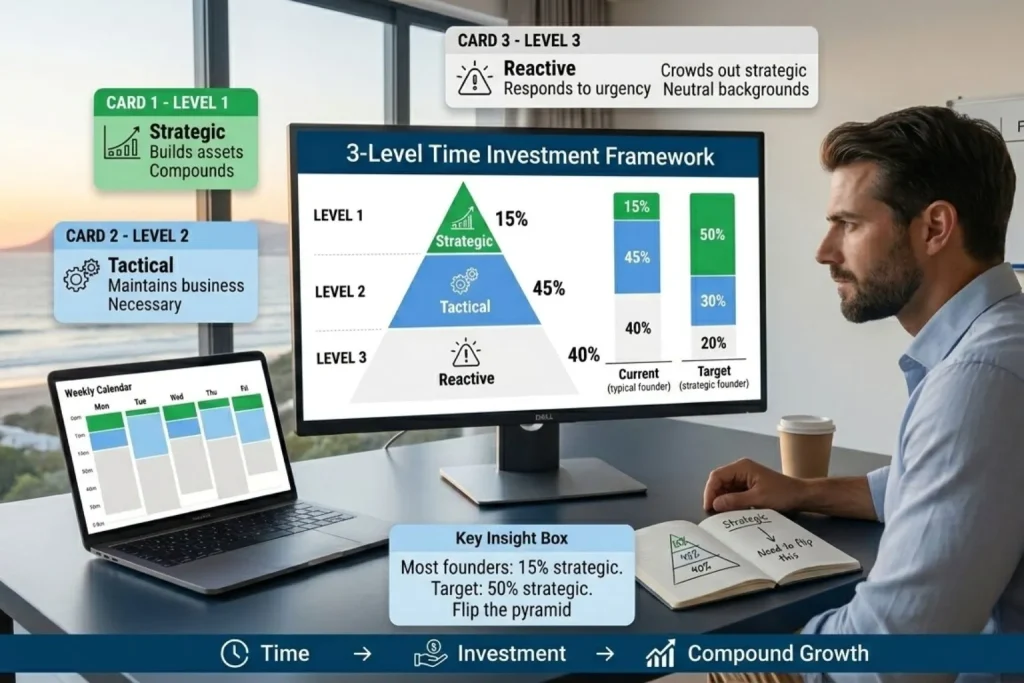
Not all time use is created equal. Once you start thinking in terms of strategic capital, it helps to sort your work into three distinct levels:
Level 1 Strategic time: Hours spent on work that directly builds your core business goals. Writing content that will rank and convert for the next two years. Building systems that remove you from bottlenecks. Developing relationships with partners who open doors. This is the work that compounds. It’s rarely urgent. It almost always gets pushed.
Level 2 Tactical time: Hours spent on work that keeps the business running. Client communication, team management, content distribution, operational decisions. Necessary but not compounding. If you’re a solopreneur, this likely consumes 40–60% of your week by default.
Level 3 Reactive time: Hours spent responding to what comes at you. Unplanned requests, unexpected problems, context-switching between tasks that weren’t on your plan. Some reactive time is unavoidable. Most founders let it consume far more than it should.
The strategic mistake most entrepreneurs make isn’t being bad at Level 3. It’s letting Level 2 and Level 3 crowd out Level 1 entirely.
You end the week feeling busy because Level 2 and Level 3 always feel productive. Answering an email feels like progress. Taking a client call feels like service. The problem is that none of it compounds.
AI-Assisted time audit: Where did your last quarter Go?
Before you can change your time allocation, you need to see it clearly. Most founders dramatically overestimate how much strategic time they’re actually getting.
Try this audit for your last 12 weeks:
Look at your calendar and estimate honestly what percentage of your hours fell into each level. Don’t count meetings as strategic just because the topic was important. Count it as strategic only if it directly advanced one of your top 3 quarterly goals.
Most entrepreneurs who do this audit discover the same uncomfortable truth: Strategic Level 1 work represents less than 15% of their actual week. Everything else client calls, inbox management, team check-ins, firefighting, admin absorbs the other 85%.
That’s not a time scarcity problem. That’s a priority allocation problem. And it’s fixable but only once you see it.
Why does AI strategic time management fail without the right mindset?
Operator vs strategist: The hidden tension every entrepreneur faces
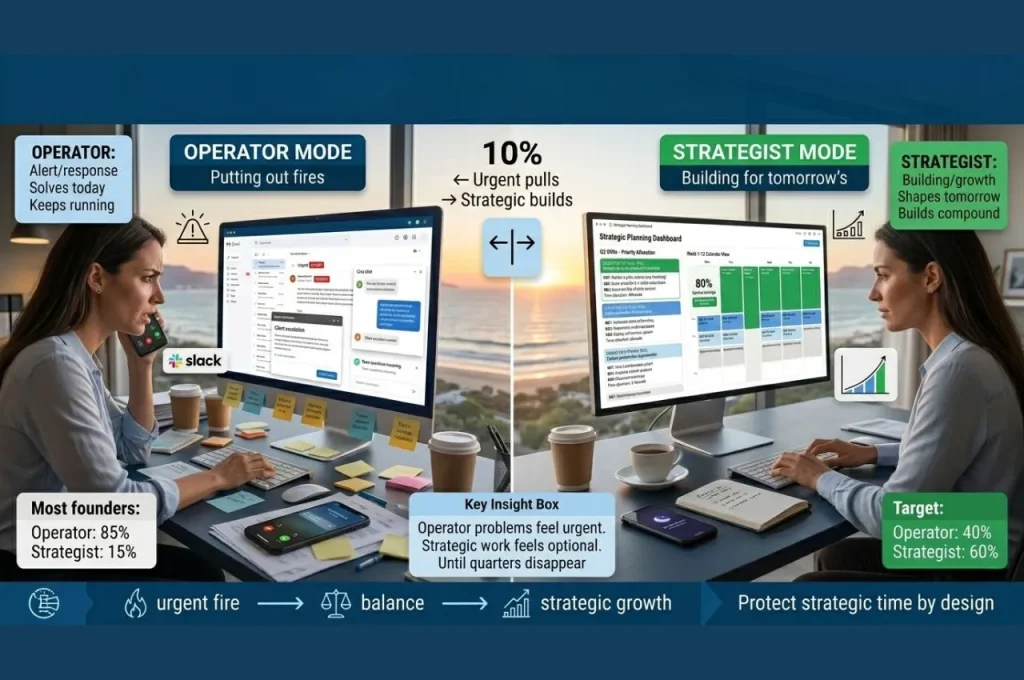
There’s a reason this pattern is so common: running a business constantly pulls you into operator mode.
The operator solves today’s problems. They answer the urgent email, handle the client escalation, jump on the unexpected team issue. The operator keeps everything from falling apart. You need this mode without it, the business breaks down.
The strategist shapes next quarter’s trajectory. They design the systems, set the priorities, build the assets that compound. The strategist creates the conditions for growth. Without this mode, the business plateaus.
The brutal reality: operator problems always feel more urgent than strategist work. An unanswered client email creates immediate discomfort. Not working on your content strategy this week creates no immediate pain at all until three quarters later when you realize you’ve built nothing.
Sam Altman, writing about what separates fast-growing startups from stagnant ones, put it simply: the founders who win are the ones who consistently protect time for the work that matters most, even when everything else screams for their attention.
That protection doesn’t happen by accident. It happens by design through a system that forces you to allocate strategic time before reactive time fills the calendar.
Why tactical excellence fails without AI strategic alignment
Here’s a scenario that plays out more often than most founders admit:
You get really good at execution. You optimize your workflows, you use AI tools to move faster, you build systems that make the tactical work efficient. You’re genuinely impressive at running the day-to-day.
And at the end of the year, you’re still in roughly the same place you started because all that efficiency was applied to the wrong priorities.
This is the trap of tactical excellence without strategic alignment. You can be extraordinarily productive at work that doesn’t move your business forward. Better tools make you faster at the wrong things. Better systems scale activities that shouldn’t be scaled.
The solution isn’t better tactics. It’s deciding clearly, explicitly, before the quarter starts which 2 or 3 outcomes actually matter this quarter. Then allocating your strategic capital accordingly.
Everything else either supports those priorities or gets cut.
What priority allocation question does AI force entrepreneurs to answer?
When most entrepreneurs plan their week, they start with the question: “What’s urgent?”
The question that changes everything is different: “What work, if I did it consistently this quarter, would compound into a meaningfully better business by the end of Q4?”
That question filters out most of what fills the average founder’s calendar. The client email that feels urgent but could wait 48 hours. The team meeting that should be an async Loom. The social media activity that creates noise without building anything durable.
It points clearly toward the work that creates compounding returns: content that ranks and generates leads for years. Systems that remove you from bottlenecks permanently. Strategic partnerships that open distribution channels. Offers that convert at a higher rate.
This isn’t about working less. It’s about the deliberate choice to invest your best hours in the work that actually builds instead of defaulting to whatever demands attention first; The next step is learning how to structure those priorities into quarterly goals that stick.
How to apply AI strategic time management: From theory to results
Case study: How 2 entrepreneurs get opposite results with AI time management
Consider two solopreneurs in the same niche, both working 45 hours a week.
Founder A spends the first two hours of every day on strategic Level 1 work writing content that targets high-intent keywords, building their email list, developing a lead magnet that will generate warm leads for the next 18 months. The rest of the day handles client work, admin, and reactive tasks. Strategic work gets protected. It happens first, before the day takes over.
Founder B opens their inbox first thing, handles the most urgent items, jumps on client calls, manages their team’s questions, and squeezes in “content work” when there’s time left which is rarely. They’re responsive, reliable, and completely stuck.
At 6 months, both are still running. At 12 months, Founder A has an asset generating 2,000 monthly visitors, a 1,500-person email list, and a pipeline that runs without cold outreach. Founder B is exactly where they started, wondering why nothing is compounding.
Same hours. Different allocation. Radically different outcomes.
3 Steps to start AI-Assisted strategic time Management today
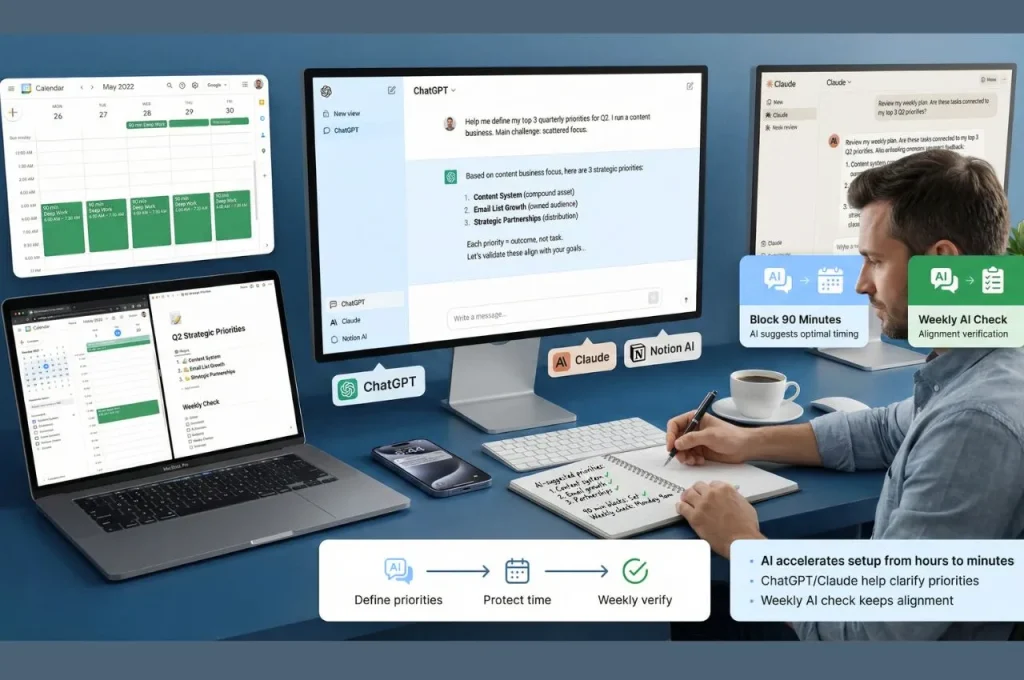
You don’t need a full planning system on day one. Start with three simple shifts this week:
Shift 1 Name your top 3 quarterly priorities. Not a task list. Three outcomes that would make this quarter meaningfully successful. If you can’t name them without looking something up, that’s your first problem.
Shift 2 Block your first 90 minutes. Before the inbox, before Slack, before the day’s urgency takes over protect 90 minutes for Level 1 strategic work. This single habit separates founders who build from founders who maintain.
Shift 3 Run a weekly priority check. Every Monday, ask: “Is what I’m planning this week actually connected to my top 3 priorities or am I filling time?” Honest answer. Adjust accordingly.
These three shifts won’t fix everything. But they’ll make the gap between busy and strategic visible and once you can see it, you can close it.
The gap between staying busy and actually building doesn’t close by accident. It closes when you stop treating time as something to fill and start treating it as strategic capital to invest. AI strategic time management makes that shift visible showing you exactly where your hours go versus where they should go. The 3-level framework, the operator-strategist tension, the priority allocation question these aren’t productivity hacks. They’re the system that separates founders who plateau from founders who compound.
You already have the hours. The question is whether you’ll keep spending them on urgency or start investing them in outcomes that build something real. Start with one shift this week: protect 90 minutes for Level 1 strategic work before the inbox takes over. That single habit repeated consistently changes everything.