
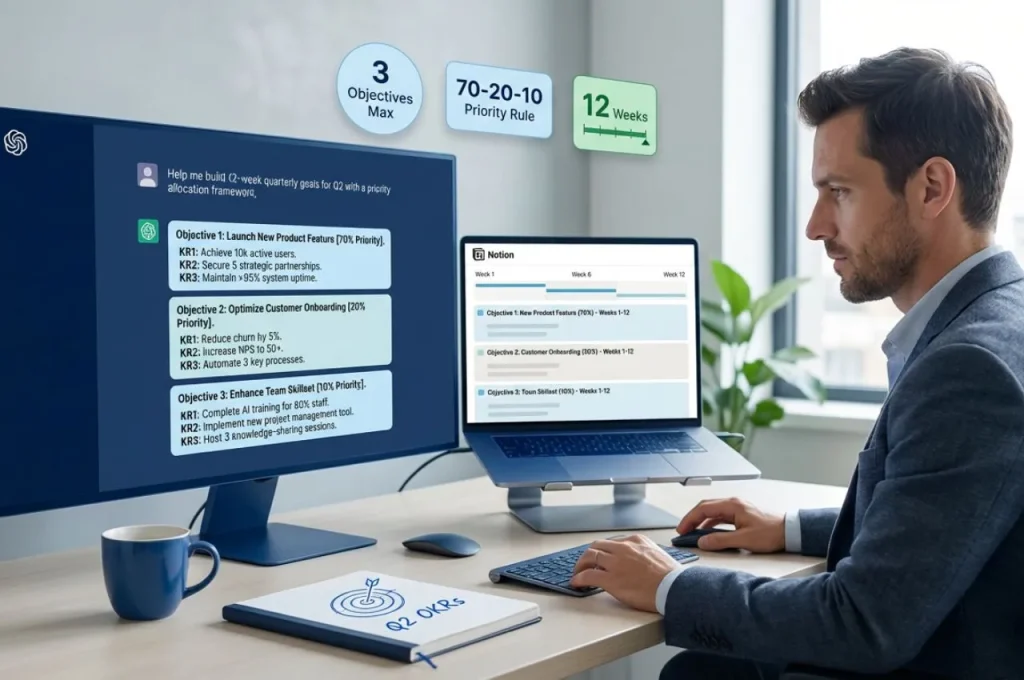
You’ve probably tried setting quarterly goals before. Maybe you used a template you found online, wrote three ambitious objectives in a Notion doc, felt genuinely motivated for about ten days and then watched the whole thing quietly collapse under the weight of your actual workload.
By week four, the doc was gathering digital dust. By end of quarter, you’d hit maybe one of the three goals, partially, by accident.
This isn’t a willpower problem. It’s a system design problem and AI-assisted OKRs solve it.
Most OKR guides focus on how to write goals. Very few address the real reason quarterly goals fail: they’re set without any honest connection to how you actually plan to spend your time. Goals without priority allocation are just wishes with better formatting. AI-assisted OKRs change that by connecting your objectives directly to where your hours actually go.
Here’s how to build AI-assisted OKRs that stick and why the 12-week framework works when annual planning fails.
This is part of a complete AI strategic planning system. For the full quarterly framework including capacity planning, time allocation, and review cycles, see: AI Strategic planning for entrepreneurs
Table of Contents
How does AI build powerful OKRs with priority allocation?
Why do OKR guides ignore priority allocation?
The standard OKR advice goes like this: write an inspiring Objective, attach three measurable Key Results, check in monthly, adjust as needed. It’s clean, logical, and completely divorced from how a founder’s quarter actually unfolds.
What the standard advice skips: the explicit connection between your Key Results and where your hours are going.
You can have a perfectly written OKR ambitious objective, measurable KRs, clear timeline and still completely fail to achieve it. Not because you didn’t care, but because you never built the bridge between “what I want to achieve” and “what I’m actually doing with my Tuesdays.”
Priority allocation is that bridge. It’s the answer to the question every founder should ask before committing to a quarterly plan: “Which of these objectives deserves 70% of my strategic hours and am I actually willing to protect that time?”
Without that answer, OKRs are decoration. With it, they become a real operating system.
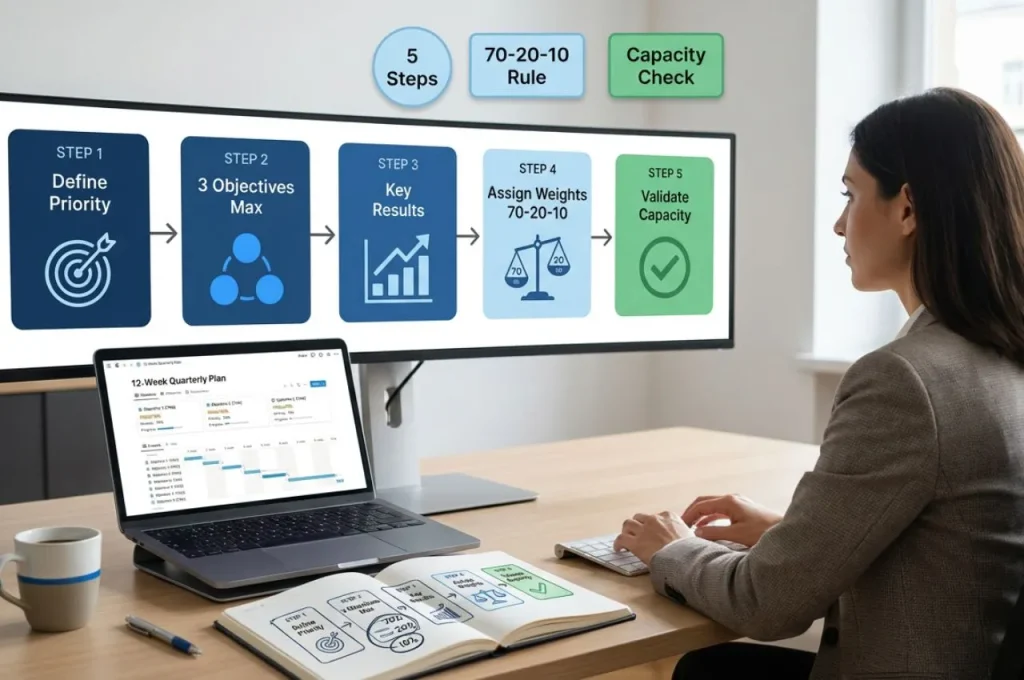
The 12-Week strategic OKR framework: Full step-by-step for entrepreneurs
The 12-week cycle works better than annual planning for one simple reason: it’s long enough to achieve meaningful outcomes but short enough to stay urgent. When your deadline is 12 months away, your brain treats it as optional. When it’s 12 weeks away, it’s real.
Here’s how to build yours:
Step 1 Define your single biggest business priority this quarter. Not a list. One answer. If your business grew significantly this quarter, what would that growth be driven by? New revenue? Audience growth? A product launch? System that removes a bottleneck? Start here.
Step 2 Write 3 Objectives maximum. Each Objective should be qualitative, inspiring, and directional. It describes what you’re building toward, not how you’ll measure it. Example: “Establish UPVALO as the go-to AI productivity resource for US solopreneurs.”
Step 3 Attach 3 Key Results per Objective. Each KR must be quantitative, specific, and achievable within 12 weeks. It answers: “How will I know with hard data that I made real progress on this Objective?”
Step 4 Assign priority weight. This is the step most frameworks skip. Before you finalize your OKRs, explicitly decide: which Objective gets 70% of your strategic capacity this quarter? Which gets 20%? Which gets 10%? Write it down. This allocation shapes your weekly schedule not the other way around.
Step 5 Validate against capacity. Can you realistically hit these KRs given your actual available hours?
Not sure how to calculate your actual available capacity? This guide breaks it down step-by-step: Time Capacity Planning for 12-Week Business Cycles: Stop Overcommitting Your Quarter
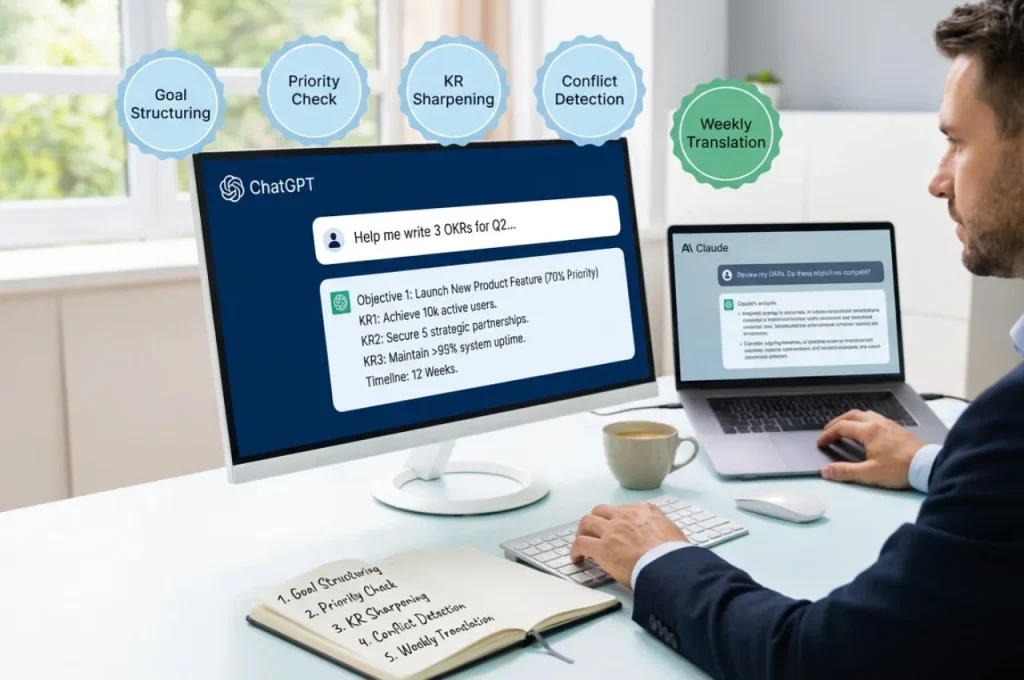
AI-Assisted OKR creation : 5 Strategic prompts that actually work
This is where AI earns its place in your planning process. Not as a replacement for strategic thinking you still have to know your business and your priorities. But as an accelerant that turns a vague sense of direction into a structured, actionable plan in under 30 minutes.
Prompt 1 Goal structuring : “I’m a [role] building [type of business]. My main business priority for Q[X] is [1-sentence description]. Help me write 3 OKRs each with 1 Objective and 3 Key Results framed around priority allocation. Make each KR specific, measurable, and achievable in 12 weeks.”
This prompt alone saves 45 minutes of staring at a blank doc. Claude or ChatGPT will give you a structured draft you can react to which is 10x faster than building from scratch.
Prompt 2 Priority weight check: “Here are my 3 OKRs for Q[X]: [paste OKRs]. Based on my stated business priority, which Objective should receive the most strategic time investment this quarter, and why? Suggest a 70-20-10 allocation with reasoning.”
Prompt 3 Key result sharpening: “This Key Result feels vague: [paste KR]. Make it more specific, measurable, and tied to a 12-week timeline. Give me 3 stronger versions.”
Prompt 4 conflict detection: “Here are my 3 Objectives for Q[X]: [paste]. Do any of these objectives compete for the same type of strategic time? If yes, identify the conflict and suggest how to resolve it.”
Prompt 5 Weekly priority translation: “My top OKR for Q[X] is [paste]. Break this down into monthly milestones, then suggest what Level 1 strategic work I should be doing each week to stay on track.”
Combined, these five prompts turn your quarterly planning session from a two-hour ordeal into a focused 25-minute exercise with a clear output.
Why the 3-Objective rule beats high-volume OKR planning?
Every quarter, you’ll be tempted to add a fourth objective. Maybe a fifth. There are always legitimate reasons a new opportunity, a partnership that came up, a product idea that feels urgent right now.
Resist it. The 3-objective limit isn’t arbitrary it’s structural.
When you have 4+ objectives, your strategic capital gets spread thin enough that none of them receive the focused investment they need to compound. You make partial progress on everything and complete progress on nothing. This is the quarterly equivalent of multitasking it feels productive and produces mediocre results across the board.
Google, which popularized OKRs, built their early growth on a strict prioritization rule: when everything is a priority, nothing is. The teams that consistently hit their OKRs weren’t the ones with the most objectives they were the ones who committed hardest to the fewest.
Three objectives. One that gets 70% of your strategic focus. Two that share the remaining 30%. That constraint forces clarity and clarity is the actual driver of quarterly progress.
How do AI-Assisted OKRs work: Real results and common mistakes?
How one solopreneur used AI-Assisted OKRs to triple quarterly revenue?
Marcus runs a one-person content business in the B2B SaaS space. At the start of Q1 last year, he had decent traffic, a small email list, and inconsistent revenue mostly from one-off consulting projects.
His previous quarterly goals looked like a wishlist: grow the newsletter, launch a course, improve SEO, build a YouTube channel, land two anchor clients. Five priorities. Zero focus. He’d been running this pattern for six quarters.
For Q1, he did something different. He ran his goals through an AI-assisted OKR session and forced himself to answer the priority weight question honestly.
His output:
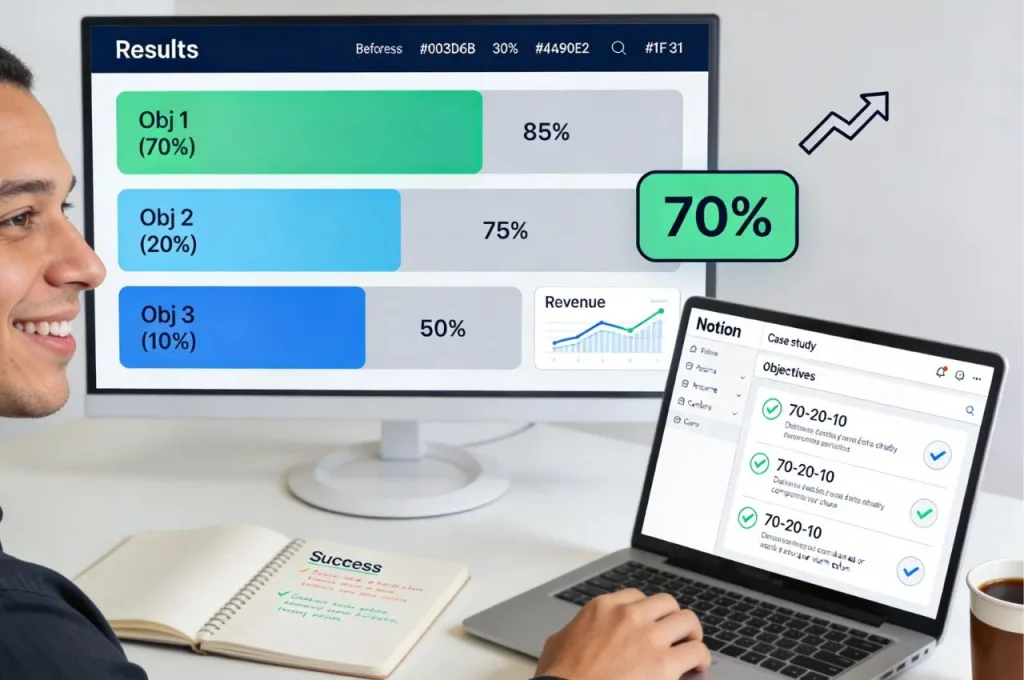
Objective 1 (70% of strategic time): Build a content engine that generates qualified leads without direct outreach.
- KR1: Publish 6 long-form articles targeting high-intent keywords (target: top 10 ranking by end of Q2)
- KR2: Grow email list from 340 to 1,200 subscribers via one lead magnet
- KR3: Generate 3 inbound consulting inquiries per month from content by week 12
Objective 2 (20% of strategic time): Stabilize revenue through a productized service offer.
- KR1: Package consulting into a defined 6-week engagement at $4,500
- KR2: Close 4 clients at the new rate before end of Q1
- KR3: Document the delivery process to reduce time-per-client by 30%
Objective 3 (10% of strategic time): Build one strategic partnership for distribution.
- KR1: Identify 10 newsletters in adjacent niches with 5K+ subscribers
- KR2: Pitch 5 collaboration proposals
- KR3: Secure 1 confirmed partnership for Q2
By end of Q1: Objective 1 hit 85% of KRs. Objective 2 closed 3 of 4 clients. Objective 3 landed one partnership that fed Q2 growth. Combined Q1 + Q2 revenue: $180K.
The difference wasn’t hustle. It was the explicit allocation of 70% of his best hours to the one thing that compounded content that generated inbound leads. Everything else was secondary by design.
The most common OKR mistakes and how AI helps you avoid them
Even with a solid framework, certain patterns show up repeatedly in quarterly planning. AI is surprisingly good at catching them before they cost you a quarter.
Mistake 1 Activity-based KRs instead of outcome-based KRs. Weak KR: “Publish 8 blog posts.” Strong KR: “Publish 8 articles that each generate 200+ monthly organic visits within 90 days.” The first measures output. The second measures impact. AI can flag the difference instantly when you ask it to review your KRs.
Mistake 2 Objectives that don’t actually connect. Three objectives that point in three different directions don’t form a quarterly strategy they form a to-do list with better formatting. Ask AI: “Do these three objectives reinforce each other, or do they compete?” The answer often reveals a focus problem you hadn’t noticed.
Mistake 3 KRs with no baseline. If you don’t know your current number, you can’t measure progress. Before finalizing any KR, confirm you have the baseline data. AI prompt: “For this KR, what data do I need to track before the quarter starts?”
Mistake 4 Ignoring the 70% rule. Writing three equal-weight objectives is the most common planning mistake. Nothing gets the focused investment it needs. Force the allocation conversation before you finalize the plan.
Which AI tools track quarterly OKRs most effectively?
What AI OKR tracking tools actually work?
Writing great OKRs is half the job. Tracking them without adding 3 hours of admin per week is the other half.
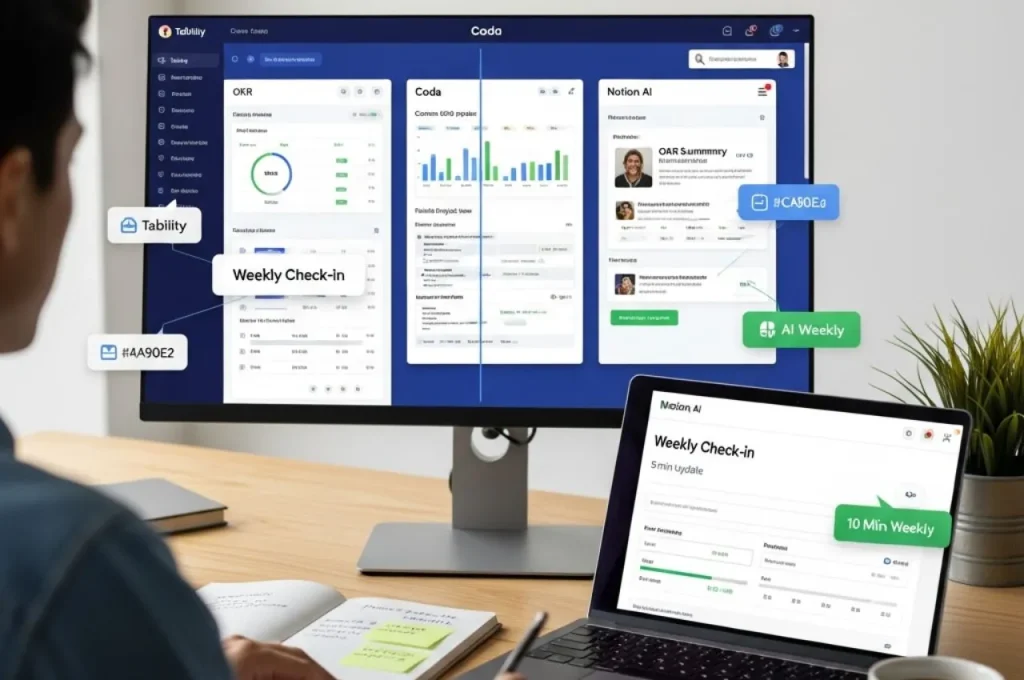
Tability is purpose-built for OKR tracking you set your objectives and KRs, connect data sources where possible, and get weekly check-in prompts that take under 5 minutes. Strong option for solopreneurs and small teams who want structure without complexity.
Coda gives you more flexibility you can build a custom OKR dashboard that connects your goals to your project work and weekly plans. Steeper setup curve but more powerful if you want everything in one place.
Notion AI works well if you’re already living in Notion. Build an OKR template, use Notion AI to generate weekly check-in summaries from your notes, and keep your goals visible alongside your daily work. Lower overhead, slightly less structured.
The tool matters less than the habit: one weekly check-in, under 10 minutes, every Monday. Are you on track for each KR? If not, what’s the adjustment?
How do monthly AI check-ins keep OKRs on track?
At the end of month one and month two, run a 20-minute AI-assisted check-in using this prompt:
“Here are my Q[X] OKRs and current progress: [paste OKRs + current numbers]. We’re [X] weeks in. Am I on track to hit each KR by end of quarter? For any KR below pace, what are the most likely causes and what should I adjust?”
This check-in isn’t about judgment it’s about catching drift early. A KR that’s 30% behind at week 4 is recoverable. The same KR at week 10 is a write-off.
Mid-quarter adjustments aren’t failure. They’re the system working.
Quarterly goals don’t fail because you picked the wrong objectives. They fail because you never connected those objectives to where your hours actually go. AI-assisted OKRs fix that gap by forcing the priority allocation conversation upfront which objective gets 70% of your strategic time, and are you willing to protect it? The 12-week framework, the 5 strategic prompts, the 3-objective rule these aren’t productivity hacks. They’re the system that turns ambitious goals into executed outcomes.
You already know what you want to build this quarter. The question is whether you’ll allocate your best hours toward it or let reactive work crowd it out again. Start with one shift: run the 12-week framework, assign priority weights, and protect 70% of your strategic capacity for the one objective that compounds. That single decision changes everything.