
Creating separate content for each platform drains time and energy. Smart entrepreneurs use repurposing workflows to multiply output without multiplying effort. One pillar idea becomes a blog post, email sequence, LinkedIn carousel, and video script—all in hours, not days. The key is a structured, AI-assisted process with clear steps and quality checkpoints. These workflows transform productivity by focusing on systems, not speed-a core concept in our complete approach to AI-powered content engines.
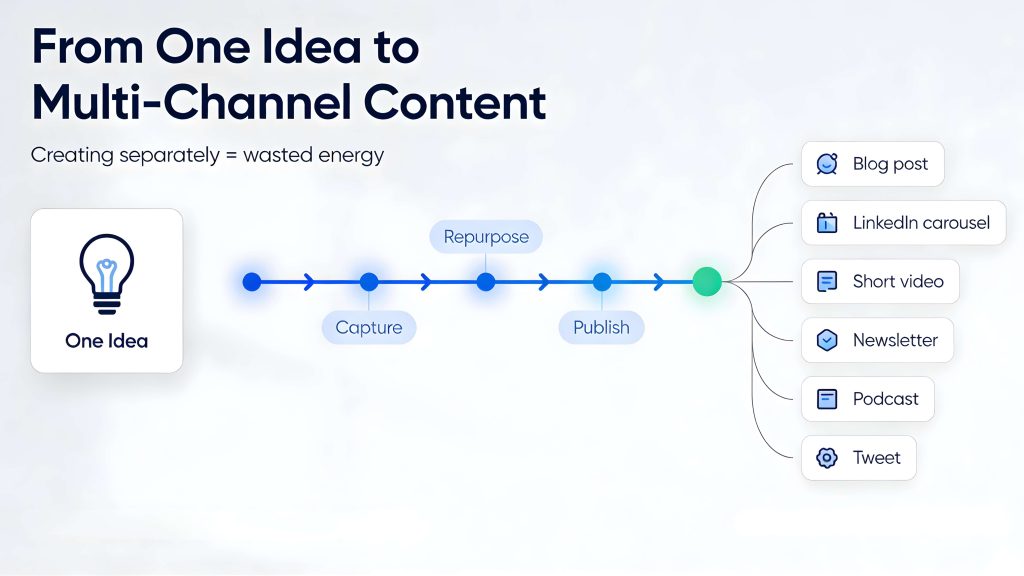
The one idea to one week of content workflow
Most entrepreneurs treat each piece of content as a separate project. They write a blog post. Then they start from scratch on their newsletter. Then they brainstorm social media from zero again.
This approach multiplies work unnecessarily. One idea should fuel multiple formats across multiple channels. That’s what repurposing workflows accomplish.
One founder I know uses a simple system. She writes one long-form blog post every Monday. By Friday that single post becomes three LinkedIn posts, one email newsletter, and one short video script.
Same core idea. Same key messages. Different formats optimized for different platforms. Total additional time investment: 90 minutes. Output: six pieces of content from one source.
The workflow looks like this. Blog post becomes the foundation. Pull three key insights for LinkedIn. Reframe the main argument for email. Extract actionable steps for video. Each piece stands alone while reinforcing the others.
This is how solo founders compete with content teams. Not by creating more. By repurposing smarter.
Using AI to draft and refine long-form content
The hardest part of content creation used to be the first draft. Staring at a blank document. Struggling with structure. Wrestling with word choice. Hours disappearing before you had anything usable.
AI eliminated that bottleneck. Now you can get a structured first draft in under 10 minutes. The quality might be rough. But rough is fixable. Blank is not.
One founder described her process this way. She outlines her main points in bullet format. Feeds the outline into ChatGPT with clear instructions about tone and structure. Gets back a 1200-word draft. Spends 20 minutes editing for voice and accuracy.
Total time from outline to polished post: 35 minutes. Her old process took three hours minimum.
The key is understanding what AI does well and what needs human input. AI excels at structure and initial phrasing. It struggles with nuance and authentic voice. You provide the strategy and personality. AI provides the framework.
Another entrepreneur uses AI for research synthesis. She collects five sources on a topic. Asks AI to identify common themes and contrasting viewpoints. Uses that analysis as her article outline. The AI does the heavy lifting. She adds perspective and examples.
This division of labor is where real productivity gains happen. You’re not replacing yourself with AI. You’re delegating the mechanical parts so you can focus on the creative parts.
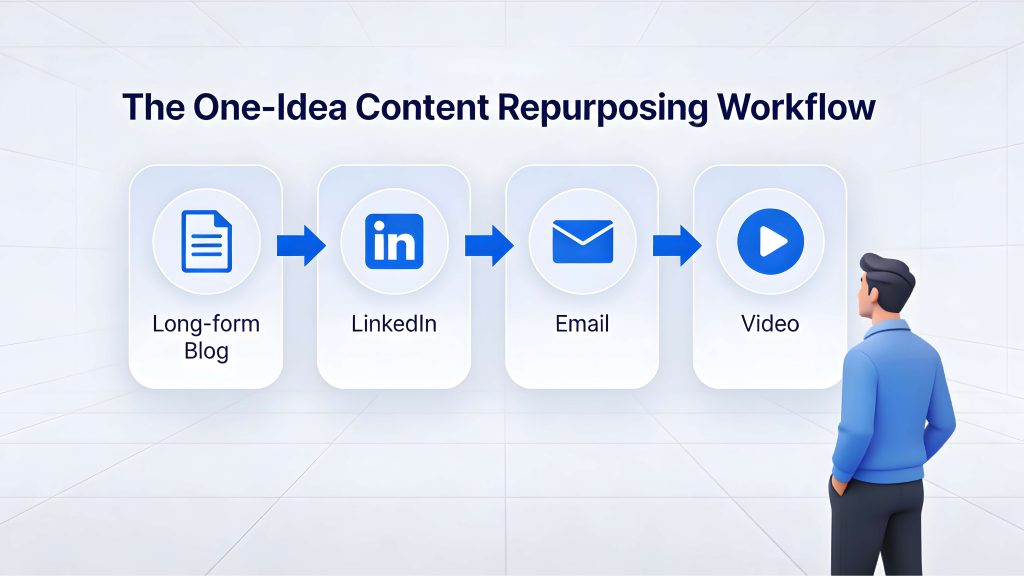
Turning one source into multiple formats using AI
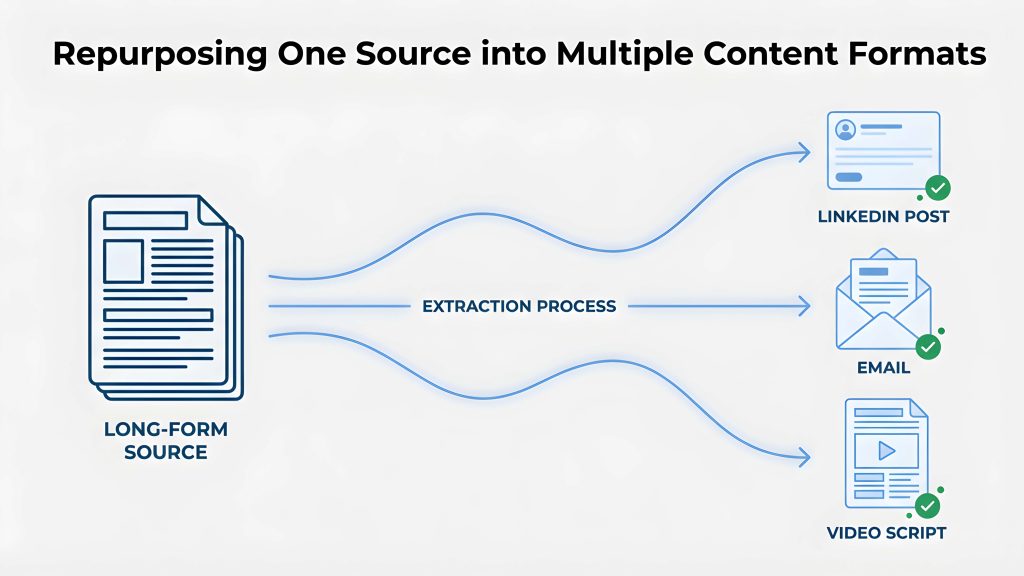
Once you have a long-form piece, repurposing becomes systematic. You’re not rewriting. You’re extracting and reformatting.
A single blog outline can generate LinkedIn carousels in seconds. You take your main sections. Turn each section into a carousel slide. Add a hook at the beginning and a call to action at the end.
One founder creates all his social content this way. He writes one comprehensive article per week. That article spawns eight social posts. Four LinkedIn. Three Twitter threads. One Instagram caption. All derived from the same source material.
The process is simple. Identify quotable statements from your article. Pull statistics or data points. Extract step-by-step instructions. Each becomes a standalone social post while driving traffic back to the full piece.
Email newsletters work the same way. Your blog post becomes your email content. You adjust the opening to feel more conversational. You shorten paragraphs for mobile reading. You add a personal note at the beginning. Same information, different packaging.
Video scripts follow the same pattern. Your blog structure becomes your video outline. Introduction, three main points, conclusion. You’re not creating new content. You’re adapting existing content to a new medium.
This is why starting with long-form makes sense. It’s easier to condense than expand. Write comprehensive. Then extract short-form pieces from that foundation.
Quality control through human revision loops
AI speeds up creation but it can’t replace judgment. Every AI-generated piece needs human review. Not just for grammar. For accuracy, relevance, and voice.
One founder uses a two-minute quality check for every piece of content. She asks three questions. Does this sound like me? Is the information accurate? Will this help my audience?
If the answer to any question is no, she revises. Sometimes that means rewriting entire sections. Sometimes it’s just adjusting a few phrases. But that review step is non-negotiable.
Another entrepreneur maintains a style guide. Key phrases she uses. Words she avoids. Tone characteristics that define her brand. When AI generates content, she checks it against the guide. Anything that doesn’t match gets edited.
This quality loop protects your brand voice across all channels. Your LinkedIn posts sound like you. Your emails sound like you. Your blog sounds like you. The consistency builds trust and recognition.
The mistake is assuming AI output is ready to publish. It rarely is. The value of AI isn’t eliminating editing. It’s reducing the time from idea to first draft. You still need to transform that draft into something that represents you properly.
Design your personal repurposing system
Every entrepreneur needs a slightly different workflow. Your process depends on your content mix, your platforms, and your available time.
The framework stays consistent. Start with one comprehensive piece. Extract key elements. Adapt those elements to different formats. Review for quality and voice. Publish across channels.
One founder does this weekly. Sunday night she outlines one article. Monday morning she writes the full draft. Tuesday she creates social derivatives. Wednesday she records a video based on the script. Thursday she schedules everything. Friday she publishes.
Another founder does it monthly. First week she writes four blog posts. Second week she creates all social content from those posts. Third week she batches email newsletters. Fourth week she handles video and other formats.
Both approaches work because both follow the same principle. Create once, distribute many times. The specific schedule matters less than the systematic approach.
Your workflow should feel manageable, not overwhelming. If you’re trying to create 50 pieces from one source, you’ll burn out. If you’re creating three quality derivatives, you’ll sustain momentum.
From single posts to content campaigns
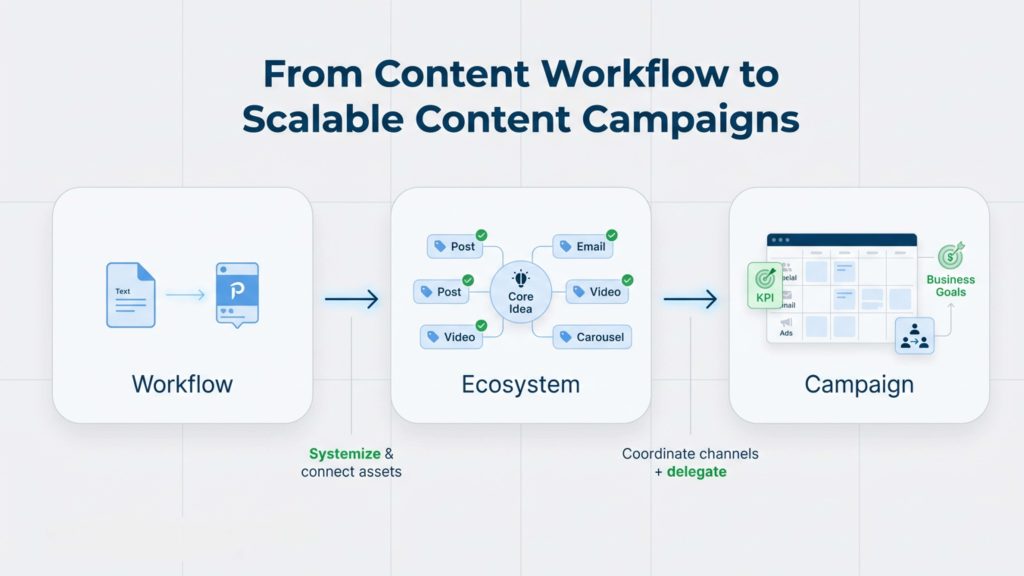
Once you master basic repurposing, you can build complete content campaigns from one pillar idea. Not just a blog post and a few social updates. An entire interconnected content ecosystem.
One entrepreneur launched a campaign around AI productivity. Her pillar piece was a comprehensive guide. From that guide she created five blog posts covering specific subtopics. From those posts she generated 20 social media pieces. From the social content she developed email sequences. From the emails she built a lead magnet.
One core idea became a month of coordinated content. Every piece reinforced the others. The social posts drove traffic to the blog. The blog promoted the email list. The emails delivered the lead magnet. The lead magnet started conversations with potential clients.
This is how you build momentum. Not through random acts of content. Through strategic campaigns where every piece serves a purpose.
The workflow stays the same. You’re just applying it at a larger scale. Start with the big idea. Break it into components. Adapt each component to multiple formats. Connect everything back to your business goals.
Build your workflow with clarity
Repurposing isn’t about cutting corners. It’s about maximizing the value of every idea you develop. When you spend time creating something valuable, that value should reach as many people as possible through as many appropriate channels as possible.
The workflow makes this possible without requiring more hours. You invest time once in the core content. Then you systematically extract and adapt. The total time investment stays reasonable while the output multiplies.
Start simple. One blog post becomes three social posts. Master that pattern before expanding. Once it feels natural, add email. Then add video. Then add whatever channels matter for your audience.
The goal is building a repeatable process that you can execute consistently. Not a complex system you use once and abandon. A simple workflow that becomes automatic over time.
When your repurposing workflow is solid, the next step is scaling. That means turning your personal process into something a team can run.