
An effective workflow is the backbone of high-quality ai-assisted writing. By structuring your process into five clear stages research, outline, draft, edit, optimize you gain speed without losing consistency. This approach completes the foundations introduced in our ai content creation guide, helping you create content that is both scalable and polished.
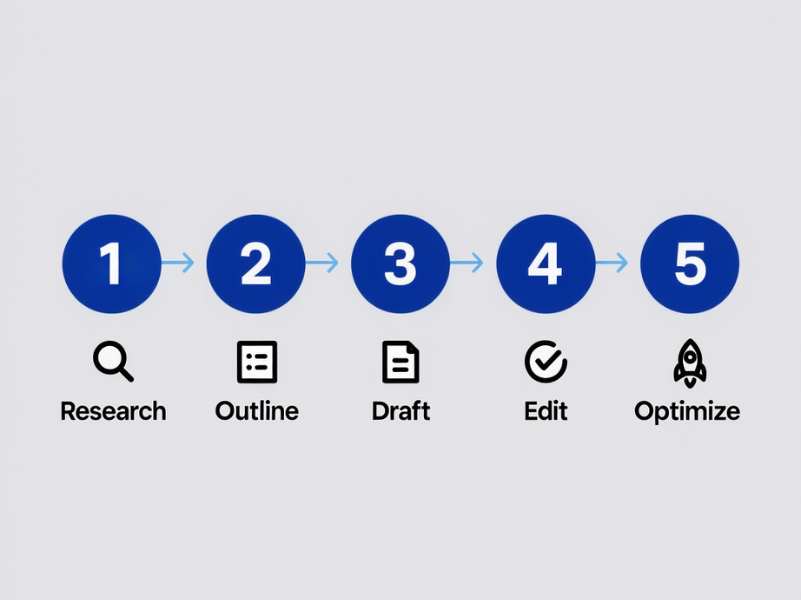
Step 1. Research: The foundation
Good research is the foundation of strong writing. Many writers jump into drafting too soon and then wonder why the piece feels empty. The problem is not creativity. It is preparation.
Gather the important points
Start with a clear topic and collect only what matters. A few strong insights are worth more than a long list of random notes.
Understand the reader
Think about the problems they face. This helps you shape your angle and decide what to keep or remove.
Avoid drowning in information
Too much research slows you down. Take only what supports your message.
Key statistic: By using ai research tools to synthesize competing articles, my clients have on average reduced the time spent on step 1 by 35%, allowing them to move faster to outlining.
When your research is clean, the rest of the workflow becomes lighter.
Step 2. Outline: The map
An outline is the map of your content. It doesn’t need to be perfect. It only needs to give you direction.
Simple structure
A few main points and short bullets under each. That’s enough. You are not trying to write yet, only to organize.
Why it works
An outline stops you from wandering inside the draft. You know exactly where you’re going, and you avoid rewriting entire sections later.
A clearer angle
If your outline looks confusing, you know the idea needs more focus. It is better to fix the structure early than to repair it at the end.
A good outline removes nearly all the stress from drafting.
Step 3. Draft: The momentum
This is where many creators get stuck. They try to write perfect sentences on the first try. That slows everything down. A draft is not meant to be perfect. It is meant to appear on the page.
Write without stopping
Don’t edit while drafting. Keep moving. The goal is momentum.
Trust the outline
When you follow your outline, the draft forms naturally. The structure carries you.
Accept imperfection
A draft is allowed to be messy. You will clean it later.
This stage is where you gain the most time and energy.
Step 4. Edit: The clarity
Editing is where your voice becomes clear. You refine the message, shape the rhythm, and remove what doesn’t belong.
Focus on clarity
Ask yourself whether each sentence says what you want it to say. If it doesn’t, rewrite it simply.
Improve the flow
Read the piece aloud. You will feel where it drags or sounds heavy.
Keep your tone
This is the moment to bring back your natural voice. Many drafts look too smooth or too formal. Editing restores personality.
This step turns raw text into something readers enjoy.
Step 5. Optimize: The visibility
This step prepares your content for search engines and makes it easier to read. It should not change the message, only the structure around it.
Add helpful headings
Headings guide the reader. They also help search engines understand the content.
Place keywords naturally
Don’t force anything. If the keyword fits, add it. If not, your message comes first.
Add internal links
Internal links help readers move through your pages and keep the structure of your site healthy.
Optimization works best when you keep it light and simple.
How all five steps connect
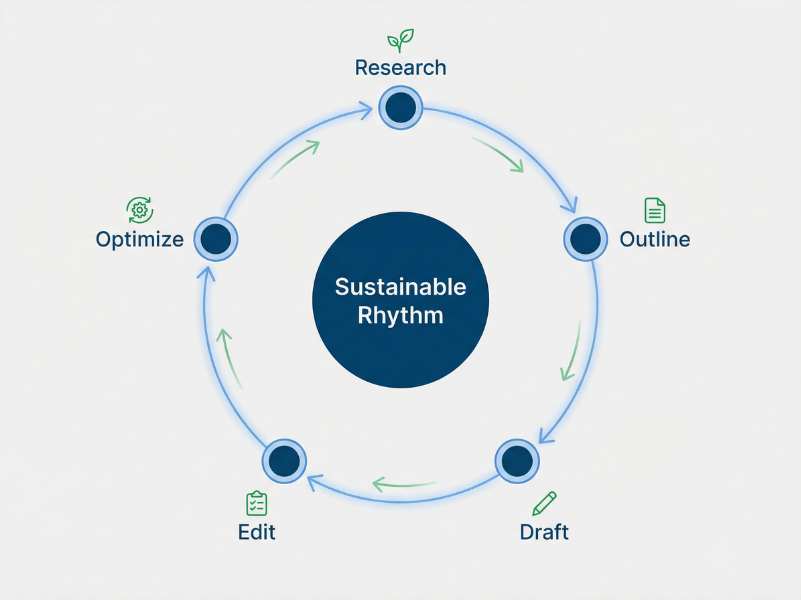
The power of this workflow comes from the way each step supports the next. Research makes outlining easier. Outlining makes drafting faster. Drafting makes editing smoother. Editing prepares the content for optimization. Once you practice these steps a few times, they form a natural rhythm.
Creators who follow this routine publish more often because the process no longer feels chaotic. They know what to do and when to do it. They enter each writing session with calm focus instead of stress. Over time, the workflow becomes second nature, and the quality of their content rises without extra effort.
A sustainable rhythm for the long term
One of the biggest advantages of this workflow is stability. It protects you from burnout because each stage has a clear purpose. You don’t jump between tasks. You move step by step. This makes content creation feel lighter while still producing strong results.
Writers who follow this structure develop a more confident voice. They stop overthinking every word. They trust the process and let the message grow naturally. That confidence shows in their work and helps them build stronger relationships with readers.
A simple workflow gives creators more freedom, not less. It removes the noise that slows you down and lets you focus on the parts that make your writing unique. Once you adopt these five steps into your routine, writing becomes smoother, clearer, and more enjoyable.