
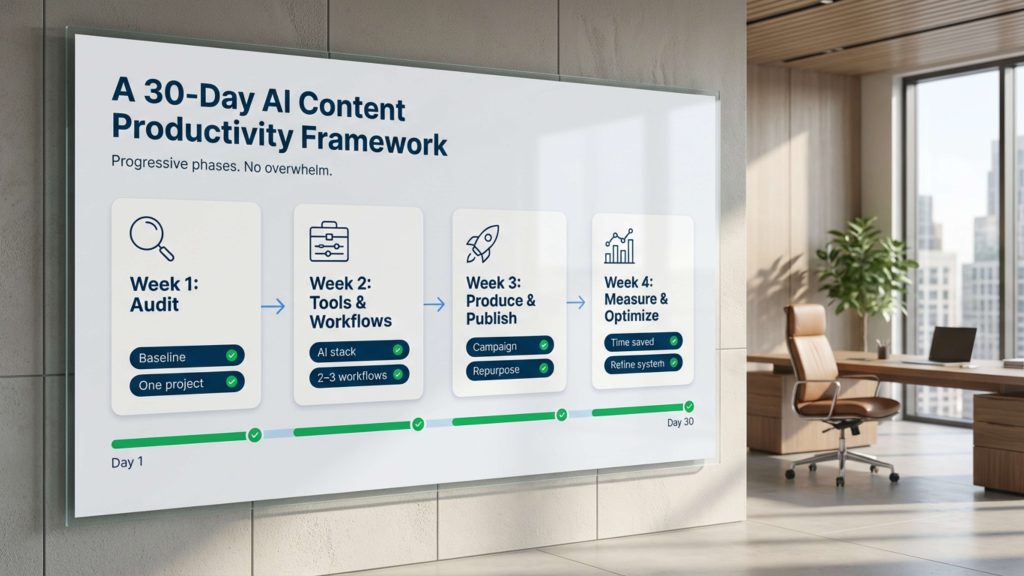
Theory without action changes nothing. This 30-day plan turns insight into results through weekly milestones that build momentum. Week 1: audit and choose one project. Week 2: set up tools and workflows. Week 3: produce and publish. Week 4: measure and optimize. Each phase is designed to create small wins that compound into real transformation. This structured, experiment-based approach removes overwhelm and builds confidence – exactly what we recommend throughout our full guide on AI productivity for content creation.
Week 1: Audit your current content and select one AI pillar project
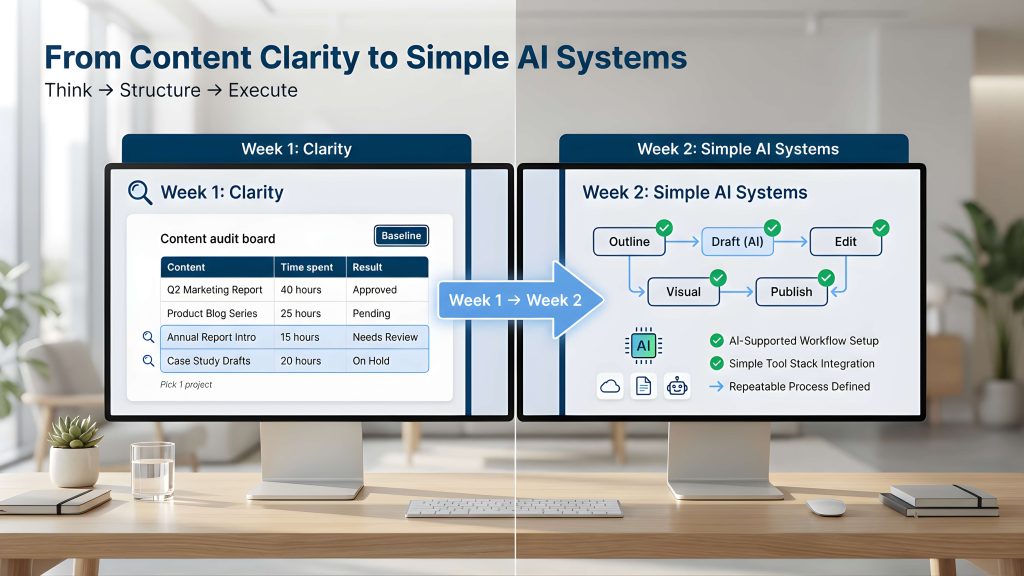
The first week is about clarity, not creation. Before you add AI to your workflow, you need to understand what’s actually happening in your current process.
Start with a simple audit. List every piece of content you published in the past month. Note how long each piece took to create. Track where you spent the most time. Writing? Research? Formatting? Distribution?
One founder did this audit and discovered she spent 40% of her content time on formatting and image selection. Not strategy. Not writing. Just mechanical tasks that AI could handle in minutes.
Another entrepreneur realized he was creating content nobody asked for. His blog posts got minimal traffic because they didn’t align with what his audience was searching for. The audit revealed the disconnect.
Your audit should answer three questions. What content am I creating? How much time does it require? What results is it generating?
Once you have that baseline, choose one project for your AI experiment. Not your entire content strategy. One specific, manageable project.
Pick your most important content format. If blog posts drive your business, start there. If LinkedIn content generates leads, start there. If email newsletters build relationships, start there.
One founder chose to focus on her weekly newsletter. It was her most valuable channel but took three hours to write. That became her AI test project.
The goal for week one is finishing with a clear understanding of your current state and one defined project to transform. Nothing more. Clarity first, then action.
Week 2: Set up your AI stack and design 2-3 key workflows
Week two is about building your foundation. You need tools and you need process. Both should be simple.
Start with tool selection. Based on your chosen project, what do you actually need? If you’re working on written content, you need a writing assistant. If you’re creating social graphics, you need a design tool. If you’re repurposing video, you need editing software.
Don’t install 10 tools. Install two or three that directly support your pilot project.
One entrepreneur set up ChatGPT for writing and Canva for visuals. That’s it. Two tools. Everything she needed to transform her blog workflow.
Spend a few hours learning each tool. Not mastering every feature. Just understanding the basics. How to input your requirements. How to refine outputs. How to export what you create.
Then design your workflow. Map the exact steps from idea to published content. Write it down as a simple checklist.
One founder’s workflow looked like this: Monday research topic and create outline. Tuesday use AI to draft 800 words. Wednesday edit draft and add examples. Thursday create visual in Canva. Friday publish and promote.
Five steps. One per day. Totally manageable alongside her regular work.
Another entrepreneur built a repurposing workflow. Write one LinkedIn post manually. Use AI to create three variations. Design graphics for each. Schedule across the week. Four steps total.
The workflows don’t need to be perfect. They need to be documented and executable. You’ll refine them as you go.
By the end of week two you should have your tools set up and at least two workflows written down. Ready to test in week three.
Week 3: Produce and publish your first AI-powered campaign
Week three is execution. You take your workflows and run them. This is where theory becomes reality.
Start with your first workflow. Follow it step by step. Don’t improvise. Don’t skip steps. Execute exactly as documented. This shows you what works and what breaks.
One founder followed her blog workflow and hit a problem on day three. The AI draft didn’t match her voice. She spent extra time rewriting. That told her she needed better prompts for week four.
Another entrepreneur’s social media workflow worked perfectly until scheduling. She realized she hadn’t included a step for writing captions. Quick adjustment. Problem solved.
The goal isn’t perfection. The goal is completion. Finish the workflow. Publish the content. Learn from what happens.
By mid-week you should have produced your first AI-assisted piece. Now test the repurposing workflow. Take that first piece and transform it into derivative content.
One article becomes three social posts. One video becomes five short clips. One newsletter becomes a LinkedIn article. Whatever makes sense for your channels.
One founder created a blog post on Monday. By Friday she had published the post plus four social derivatives. Five pieces from one core idea. Total time investment: four hours instead of her usual 12.
That’s when the transformation becomes tangible. You’re not just using AI. You’re working within a system that multiplies your output.
End week three with at least one complete content campaign published. One main piece and two to three derivatives. Track how long everything took. Note what felt smooth and what felt difficult.
Week 4: Measure, optimize, and stabilize your system
The final week is about refinement. You’ve executed your workflows. Now you improve them based on real experience.
Start by measuring time savings. Compare week three production time to your baseline from week one. Most entrepreneurs see 50% to 70% time reduction on their first AI-assisted project.
One founder dropped from three hours to one hour for her newsletter. Another reduced blog post time from four hours to 90 minutes. These aren’t theoretical improvements. These are documented time savings.
Next, evaluate quality. Did your content maintain your voice? Did your audience respond positively? Did you get the results you wanted?
One entrepreneur noticed his AI-generated social posts got less engagement than his manual posts. The quality was there but the hook wasn’t strong enough. He adjusted his prompts to emphasize compelling openings. Engagement recovered.
Another founder found her blog posts were better with AI because the structure was clearer. AI forced her to organize thoughts before writing. That improved readability.
Use this feedback to optimize your workflows. Add steps that were missing. Remove steps that didn’t add value. Adjust prompts for better output. Refine your editing process.
One team updated their workflow to include a voice check step. Before publishing anything, they read it aloud to ensure it sounded like the founder. That one addition solved their consistency problem.
Document these improvements. Your workflow is now version 2. Better than version 1 because it’s based on actual experience.
Finally, decide how to scale your system. Do you apply these workflows to other content types? Do you increase frequency? Do you delegate parts of the process?
One founder decided to double her publishing frequency. Her improved workflow made that possible without additional time investment.
Another entrepreneur chose to teach the workflow to a virtual assistant. She could maintain strategy while delegating execution.
The decision depends on your goals. But whatever you choose, you’re making it from a position of proven capability. You know your system works because you tested it.

Beyond the 30 days: building lasting momentum
This 30-day plan isn’t the end. It’s the beginning. You’ve proven that AI can transform your content productivity. Now you expand that transformation strategically.
Some entrepreneurs continue refining their pilot project for another month before adding new workflows. Others immediately apply the same approach to their second most important content channel.
Both paths work. The key is maintaining the experimental mindset. Document everything. Measure results. Optimize based on data. Scale only what works.
One founder used this 30-day approach to transform five different content types over six months. Newsletter first. Then blog. Then LinkedIn. Then video. Then email sequences. Each got the same treatment: audit, build workflow, execute, optimize.
By month six she was publishing 10 times more content than she had been at the start. Same working hours. Just better systems.
Another entrepreneur spent 90 days perfecting one workflow before moving to the next. His philosophy was mastery before expansion. That approach worked for his personality and schedule.
There’s no single right path. The principle stays constant: build systems that work, then repeat them.

Your first step tomorrow
The 30-day plan only works if you start. Not next month. Not when everything is perfect. Tomorrow.
Your first action is simple. Open a document and do your content audit. List what you published last month. Note how long each piece took. Identify your biggest time sink.
That’s day one. Thirty minutes maximum. No tools required. No AI needed. Just honest assessment of your current reality.
Day two you choose your pilot project. Day three you research tools. By day seven you complete week one.
Small steps executed consistently create transformation. Grand plans that never start create nothing.
One founder told me she almost skipped the audit phase. She wanted to jump straight to using AI tools. But the audit revealed problems she didn’t know existed. It changed her entire approach.
Another entrepreneur thought 30 days was too long to see results. But breaking it into weekly phases made it manageable. Each week had a clear finish line. The structure removed overwhelm.
The plan works because it’s realistic. You don’t rebuild your entire content operation overnight. You test one workflow. You prove it works. Then you expand.
This is how solo founders build systems that compete with teams. Not through magic. Through method.