
Understanding when ai automation content quality suffers is the most underrated skill in modern content marketing. Ai automation makes content creation faster. That’s real and measurable. But faster is only better when quality holds.
For a growing number of us creators and marketing teams in 2026, the speed gains from ai have come with a hidden cost: Content that ranks less effectively, converts at lower rates, and quietly damages the brand credibility it was supposed to build.
This is not an anti-ai argument. I use ai tools in my own workflow every day and have helped dozens of creators build efficient ai-assisted content operations. But there are specific points where automation crosses from helpful to harmful and understanding those points is as important as knowing where ai adds value.
Table of Contents
The automation trap
The automation trap happens when creators confuse operational efficiency with content quality. Ai can produce a 1,500-word article in minutes. That capability doesn’t mean it should be used without judgment for every piece of content in every situation.
The trap closes when volume becomes the goal. Once you’re optimizing for how many articles you publish per week, quality decisions start getting made by the automation pipeline rather than by editorial judgment. Topics get covered because they’re in a keyword list, not because you have something genuine to say about them. Drafts get published because they passed a spell check, not because they passed a reader test.
In the us content market, where audiences in most niches have high information standards and multiple alternatives for every query, this trap produces content that looks productive on a dashboard and underperforms everywhere that matters.

5 scenarios where AI automation hurts content quality
Not every content type responds the same way to automation. Here are the five situations where ai automation content quality degradation is most predictable and most damaging.
1. Topics that require lived experience
Ai is excellent at synthesizing publicly available information. It is poor at providing the kind of grounded, experiential insight that makes content genuinely useful. When you’re reviewing a tool you’ve actually tested, advising on a strategy you’ve personally executed, or addressing the specific context of a us audience you know well, the ai draft needs substantial human addition to be credible.
Publishing automation-heavy content on experience-dependent topics signals to readers that the author hasn’t actually done the thing they’re writing about. In niches where credibility is built on demonstrated expertise digital marketing, personal finance, business strategy, technical skills this erosion of trust is hard to recover from.
2. Producing more content than you can review
Many creators set up automated pipelines that produce articles faster than they can thoughtfully edit them. The result is a content library that is technically present but editorially uneven. Some articles are carefully refined; others are minimally reviewed first drafts.
Google’s quality systems evaluate content clusters, not just individual articles. Inconsistent quality within a cluster signals that the content is not produced by a genuine expert with consistent editorial standards. This undermines the topical authority you’re trying to build, even when your best articles are excellent.
3. Over-automating internal linking
Some teams use ai to automatically insert internal links based on keyword matching algorithms. The result is often links that are technically present but contextually awkward placed because a keyword matched, not because the link genuinely helps the reader go deeper on something they care about at that point in the article.
For us readers who engage with long-form content carefully, forced links reduce trust and reading flow. For google, contextually irrelevant internal links provide significantly weaker authority signals than links placed with genuine editorial judgment. The automation saves time. The quality loss costs more.
4. Ymyl topics without rigorous review
Ymyl your money or your life is google’s designation for content categories where inaccurate information can cause real harm: Personal finance, health, legal advice, career guidance, and similar subjects. These categories are held to the highest quality standards by google’s quality raters.
For us creators operating in ymyl categories, ai automation without rigorous human review is a significant seo and reputational risk. A single unchecked ai hallucination about a medical symptom or a financial regulation can produce the kind of accuracy failure that takes months of rebuilding to recover from.
5. Trending topics without genuine depth
Ai makes it easy to produce content quickly on any trending topic. But content produced quickly on a subject you don’t have genuine expertise in is rarely the best content available and in 2026, us audiences searching for trending topic information have dozens of alternatives. The sites that capture and hold that traffic are those that demonstrate the deepest understanding, not those that published first.
Chasing trends with automated content produces short-term traffic spikes and long-term authority damage. The pattern is consistent enough that many experienced us content marketers now deliberately avoid trend-chasing in favor of evergreen cluster content that compounds over time.
Evaluating whether a topic is appropriate for ai-assisted production comes down to a set of clear quality criteria. The question is never ‘can ai write this?’ it’s ‘will ai produce something credible enough to publish?’ for a practical framework on that decision, the guide on is ai generated content safe for seo covers exactly where that line sits in 2026.
How to detect when ai automation is hurting content quality
Engagement metrics at the article level
Time on page, scroll depth, and click-through rate to related content are the most direct indicators of whether your content is serving readers. Articles produced with heavy automation and minimal review consistently underperform on these metrics compared to carefully edited pieces on the same topics. If you see a pattern across your automated content, the signal is clear.
Ranking trajectory after the initial index
Highly automated content often gets an initial index and ranking based on technical seo signals, then drops as google’s quality evaluation systems get more data on reader behavior. A pattern of initial ranking followed by gradual decline is a strong indicator of quality issues that automation is contributing to.
Brand perception in your audience
The most immediate signal is often the most overlooked: Reader feedback. If regular readers of your content start commenting that your recent articles feel different, or if your email list open rates drop on content promotion emails, or if social shares decline these are early quality signals that often precede the seo indicators by weeks.
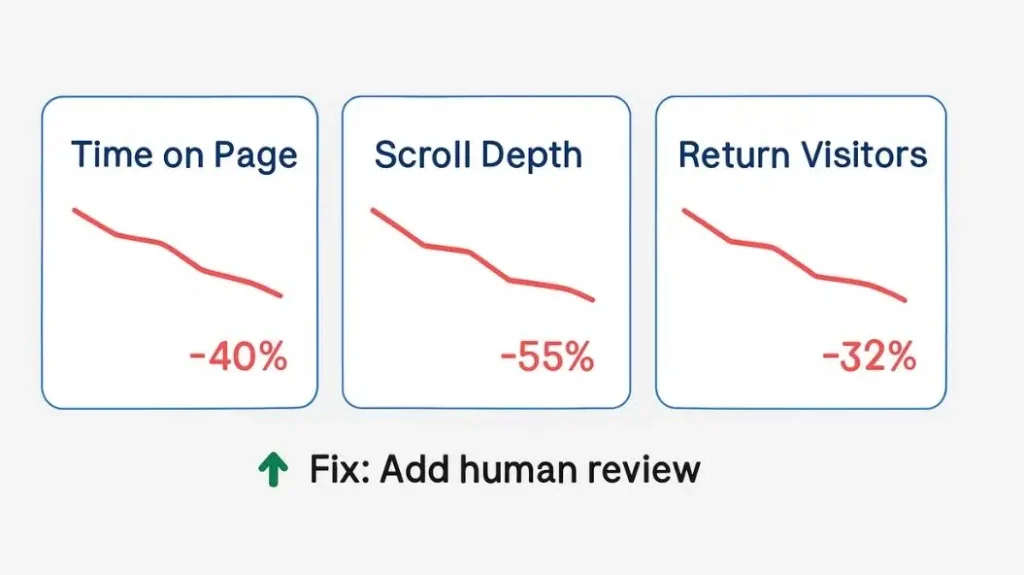
The Right AI Automation Boundary for Content Quality
There’s no universal formula for where automation should stop and human judgment should start, but a useful principle is this: AI should accelerate your execution of editorial decisions you’ve already made. It should not be making editorial decisions for you.
The topics, the angles, the depth requirements, the quality standards, the audience specificity these are strategic decisions that belong to you. AI handles the drafting once those decisions are made. When the automation pipeline starts making those decisions by default, quality degrades in ways that are hard to detect until the damage is done.
Protecting Content Quality as You Scale AI Automation
Scaling content production with AI is a legitimate goal, and it’s achievable without sacrificing quality. But quality standards need to scale with production capacity. That means building your editorial process before building your automation pipeline.
Know what good looks like for your content. Document your standards. Assign clear review responsibilities. And maintain a minimum review threshold a set of quality gates that every article must pass before publication, regardless of how efficiently it was produced.
The US content market in 2026 does not reward the creator who publishes the most. It rewards the one whose content readers and search engines trust most consistently. Automation in service of that trust is a competitive advantage. Automation that erodes it is a liability.
The editorial framework that makes consistent quality possible at scale isn’t complicated but it has to be systematic. The four-pass approach covered in the guide on human editing and fact-checking in AI content creation gives you a repeatable process that holds quality steady regardless of how much you’re publishing.
AI Automation and Content Quality Are Not Opposites
AI is a capability, not a strategy. Used within clear editorial boundaries where human judgment sets the direction and AI accelerates the execution it’s one of the most powerful content production tools available. Used as a replacement for editorial thinking, it consistently produces the kind of content that looks productive and performs poorly.
Know where your automation boundaries are. Build your review process before you build your pipeline. And never publish content you wouldn’t be comfortable defending as entirely your own work.
For the strategic architecture that organizes your content so every piece reinforces the others cluster design, E-E-A-T integration, and performance measurement the complete guide to AI content strategy in 2026 covers the full system that makes sustainable quality at scale possible.
About the Author
| El Habib El MouahidEl Habib is an AI Content Creation Specialist and digital marketing writer. He helps creators and marketers use AI tools to write faster, improve their workflow, and scale their content without losing authenticity. With a background in marketing and a deep interest in artificial intelligence, he writes guides, tutorials, and in-depth reviews that make AI accessible to everyone especially those who want real results, not technical jargon. |