
If you’ve been using AI to create content and your results are not what you expected rankings that plateau, readers who bounce, a growing library that somehow doesn’t add up to authority the problem is probably not the tools. It’s the AI content strategy.
In 2026, AI is not a content strategy. It’s a capability. What you do with that capability is the strategy. And most creators in the US market are still figuring out the difference.
I’ve spent years testing AI content workflows with creators, marketers, and entrepreneurs. The ones who are winning are not the ones using the most AI. They’re the ones who built a clear system around it: a defined content authority, a cluster architecture, an editorial process, and a consistent voice. This guide covers every element of a complete AI content strategy in five practical steps.
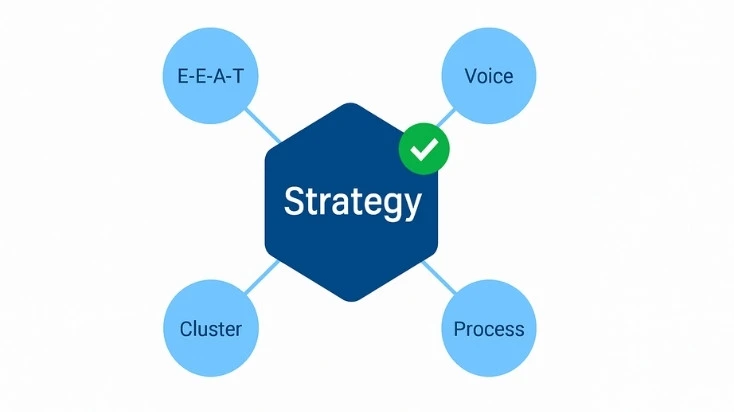
Table of Contents
Why most ai content strategies are failing in 2026
The failure pattern is predictable. A creator discovers AI writing tools, gets excited by the speed, and starts producing content at a pace they could never manage manually. After a few months, they have dozens of articles live. Organic traffic is flat. Rankings are inconsistent. And somehow the content doesn’t sound like them anymore.
This happens because volume is not an AI content strategy. A real AI content strategy produces content that is high quality, well-organized, and genuinely useful to your audience. Producing more content faster only compounds your results if the content is high quality, well-organized, and genuinely useful to your audience. Without those conditions, you’re scaling a problem, not solving one.
Google’s Helpful Content updates in 2024 and 2025 made this precise point with algorithmic force. Sites that relied on high-volume, low-quality AI content took significant ranking hits. The message was clear: the US search market rewards depth, expertise, and human judgment not output speed.
One of the first questions creators ask when they start this journey is whether AI-generated content is even safe to publish. The answer is nuanced and the full breakdown is in the guide on is AI generated content safe for SEO in 2026, which covers exactly what Google penalizes, what it doesn’t, and how to produce AI-assisted content that ranks without risk.
Step 1 – define your content authority zone
What it means and why it matters
Your content authority zone is the specific territory where your expertise, your audience’s needs, and real search demand intersect. It’s not a broad category like ‘marketing’ or ‘technology.’ It’s a specific, defensible niche something like AI tools for independent course creators, or content automation for DTC brands under $2M in annual revenue.
The more specific your authority zone, the faster you build topical authority. Google doesn’t need you to cover everything. It needs you to cover your subject more comprehensively and credibly than anyone else.
Before you build any AI content strategy, answer this question clearly: what is my authority zone, and can i genuinely defend it?, answer this question clearly: what is my authority zone, and can I genuinely defend it?
How to map your zone
Start with your actual expertise and work outward. What do you know that most people in your niche don’t? What problems have you personally solved for clients or for yourself? Where has your direct experience given you an edge that public information can’t replicate?
Then validate that zone against search demand. Use tools like Semrush, Ahrefs, or Google’s related searches to confirm that US audiences are actively searching for information in your zone. The sweet spot is where your genuine expertise meets real, ongoing search intent.
Step 2 – build a cluster architecture
The pillar and satellite model
Once your authority zone is defined, organize your content into clusters. Each cluster has one central pillar article a comprehensive 2,500 to 3,500-word guide that covers the full scope of a core topic. Around that pillar, you build satellite articles that go deep on specific sub-topics the pillar introduces but doesn’t fully explore.
This structure serves two purposes. For Google, it signals topical authority: your site doesn’t just have one article on a subject, it has an interconnected set of pieces that demonstrate comprehensive understanding. For your readers, it creates a logical content journey they can start anywhere and find clear paths to everything related.
Cluster architecture is the structural core of every effective AI content strategy. For US content in 2026, it isn’t optional it’s the foundation your entire AI content strategy is built on. It’s the standard approach for any site competing in a category with established players.
How internal linking makes clusters work
The power of a cluster comes from its internal linking. Each satellite article links back to the pillar using descriptive anchor text. The pillar links out to each satellite at the natural point where a reader would want to go deeper. Satellites can link to each other when the connection is logical and serves the reader.
Every link should feel like a natural recommendation, not a forced insertion. If you find yourself adding a link just to satisfy an architecture requirement, rephrase the surrounding text until the link fits the reading flow. Forced links hurt both user experience and SEO.
Step 3 – the e-e-a-t framework and why it defines your ai content strategy
Understanding what google is actually evaluating
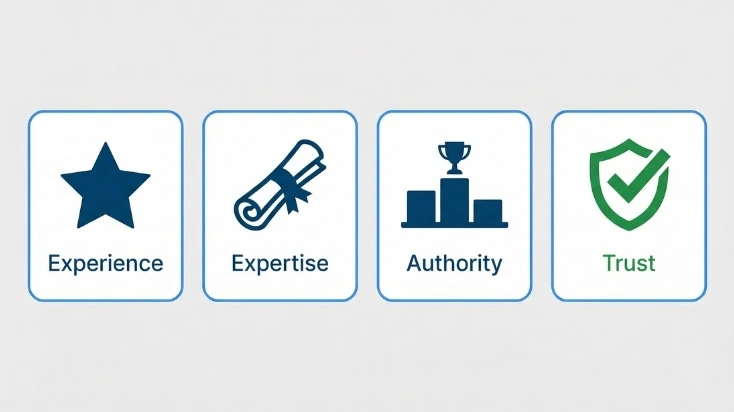
E-E-A-T stands for Experience, Expertise, Authoritativeness, and Trustworthiness. These are the four dimensions Google uses to evaluate content quality and they apply at the content level, the author level, and the site level simultaneously.
In 2026, E-E-A-T is more important than ever because AI has made it easy to produce content that looks polished but lacks substance. Google’s quality raters specifically look for the human elements that AI cannot generate on its own: personal experience, verifiable expertise, a track record of accurate information, and transparency about sources and methodology.
For US audiences especially, these signals drive trust. Readers who find genuinely expert content bookmark it, share it, and return. Those engagement signals reinforce your rankings over time.
building E-E-A-T into every article
E-E-A-T is not a checklist you add at the end. It’s a perspective you write from the beginning. Every article should have a named, credentialed author with a real bio. Every factual claim should be traceable to a primary source. Every piece of advice should be grounded in direct experience or clearly attributed expertise.
The most overlooked E-E-A-T element is the Experience component. This is where you include observations from your own work something you tested, a client situation you navigated, a result you achieved or failed to achieve. AI cannot generate this. Only you can. And it’s the element that most clearly distinguishes your content from everything else on the same topic.
Satisfying E-E-A-T requires more than just adding an author bio. It demands a systematic editorial process applied to every AI draft before it goes live. The four-pass approach covered in the guide on human editing and fact-checking in AI content creation shows exactly how to verify facts, inject experience, and align voice in a way that meets Google’s quality standards.
Step 4 – the human-ai editorial process
Why this is the most important part of your ai content strategy
The human-AI editorial process is what separates a functional AI content strategy from a liability. AI handles drafting. Humans handle quality. Without this layer, no AI content strategy holds up over time. This is the only sustainable division of labor in content production, and it’s the one most creators get wrong.
The mistake is treating AI as a final draft machine. You prompt it, get something that looks finished, make a few surface edits, and publish. The result is content that’s technically coherent but editorially thin no personal insight, no verified facts, no genuine voice. Over time, this erodes your audience’s trust and your search rankings.
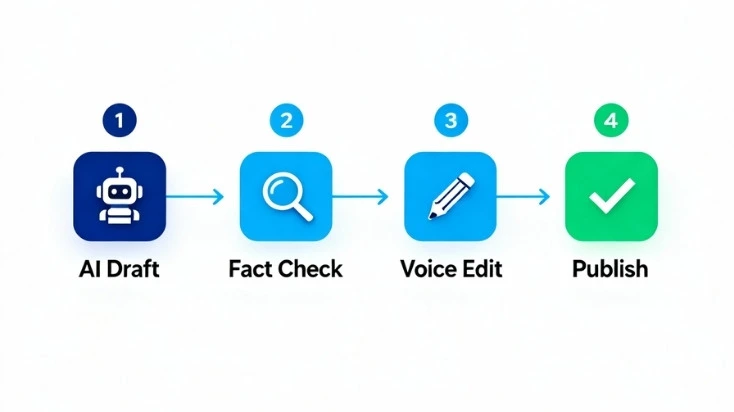
A real editorial process treats AI output as a first draft useful for structure and synthesis, requiring human work to become publishable. That work includes fact verification, experience injection, voice refinement, and strategic internal linking. It takes time. But it’s the time that separates content that builds authority from content that fills a library.
The four-pass editing system
When editing AI drafts, I use four passes, each with a specific objective.
- Factual pass every specific claim, statistic, and attribution gets verified against a primary source. Anything that can’t be verified gets removed, qualified, or replaced. This is non-negotiable for E-E-A-T compliance and reader trust.
- Experience pass i read the draft asking: where is the human in this? I add personal anecdotes, real client examples, and first-hand observations that AI couldn’t generate. These additions don’t need to be long even a single paragraph of genuine experience changes the character of an article entirely.
- Voice pass i read the article aloud and rewrite every sentence that doesn’t sound like me. Generic transitions, clichéd phrases, and overly formal language all get replaced with the direct, clear, practical tone my US audience expects.
- Reader value pass i ask: after reading this, what can my reader do or understand that they couldn’t before? If any section fails to deliver a specific, actionable answer to that question, I strengthen it before publishing.
Step 5 – protecting brand voice at scale
The dilution problem
When you use AI at scale, voice consistency becomes a real challenge. Different prompts, different tools, and different levels of editing produce content that gradually loses cohesion. Readers notice, even when they can’t articulate why. The site stops feeling like a unified editorial voice and starts feeling like a content farm.
The solution is systematic, not instinctive. Before you scale, document your voice. Write a voice reference document that captures your tone, your vocabulary preferences, your signature structures, and three to five examples of your best content. Use this document in every prompt and every editing session.
Building this voice reference document is a one-time investment that pays returns across every piece of content you produce. The complete system including prompt templates, negative examples, and a cluster-level consistency audit is covered in the dedicated guide on how to maintain brand voice when using
Why voice is an SEO asset
A consistent, recognizable voice builds the kind of reader loyalty that produces the engagement signals Google uses to evaluate content quality. Return visits, low bounce rates, time on page, and newsletter sign-ups all correlate with editorial consistency. In any serious AI content strategy, voice isn’t just a creative concern it’s a rankings factor. Protect it as you would any other component of your AI content strategy.
Where ai automation hurts more than it helps
The trap most creators fall into
There are specific scenarios where automating content production creates more problems than it solves. Understanding these boundaries is as important as knowing where AI adds value.
Topics that require lived experience cannot be automated without losing the quality signal that makes them valuable. If you’re reviewing a tool you’ve actually used, advising on a strategy you’ve personally executed, or speaking to the specific experience of a US audience you know well, the AI draft needs substantial human addition to be credible.
Automating faster than your review capacity is another common trap. When you produce more content than you can thoughtfully edit, quality becomes inconsistent and Google’s systems are increasingly effective at detecting inconsistency within a content cluster. The five specific automation scenarios that most often hurt US creators are covered in detail in the article on when AI automation hurts content quality, including how to identify whether your own workflow has already crossed the line.
Measuring your AI content strategy
Track at the cluster level
Individual article performance tells you something. Cluster performance tells you whether your AI content strategy is working. When a pillar article rises in rankings alongside its satellites, that’s topical authority compounding. When a cluster underperforms despite individual article optimization, the problem is usually in the linking architecture or the coverage depth.
The metrics that tell you whether your AI content strategy is working live in Google Search Console track impressions and clicks at the cluster level. Track the pillar keyword and its satellite keywords together. Rising impressions across the cluster indicate growing topical authority, even before rankings fully materialize.
The quality signals that matter most
Beyond rankings, the quality signals worth monitoring are time on page, scroll depth, and return visitor rate. These tell you whether readers are finding genuine value in your content. In the US market, a well-targeted article in a specific niche should hold readers for three to five minutes on average. Shorter than that consistently usually means the content is answering a different question than the reader came with.
Your ai content strategy in practice: A 90-day framework
The first 30 days are for foundation. Define your content authority zone. Map your first cluster one pillar topic, four to six satellite topics. Document your brand voice. Set up your editorial process with the four-pass system.
Days 31 to 60 are the execution phase of your AI content strategy. Publish your pillar article. Publish two satellite articles. Monitor initial performance in Search Console. Adjust your voice documentation based on what you learn in editing.
Days 61 to 90 are for optimization. Publish the remaining satellites. Add internal links from the pillar to each satellite at natural points in the text. Review your first cluster’s performance and identify the content that’s getting the most engagement. Use those signals to plan your second cluster.
By day 90, you have a complete cluster, a documented process, and real data on what works for your specific US audience. That’s the foundation for everything that follows.
Strategy first, tools second
AI is the most powerful content production tool available in 2026. But tools don’t create authority. Strategy does. The creators who will build lasting presence in the US content market are those who use AI to execute a clear, expert, audience-first AI content strategy not those who use it to produce content faster without thinking about why.
These five steps are the architecture of every AI content strategy that compounds: define your authority zone, build your clusters, develop your editorial process, protect your voice, and measure at the cluster level. Develop your editorial process. Protect your voice. Measure at the cluster level. These are the decisions that compound. The tools just help you move faster once the foundation is in place.
About the Author
El Habib El Mouahid is an AI Content Creation Specialist and digital marketing writer. He helps creators and marketers use AI tools to write faster, improve their workflow, and scale their content without losing authenticity. With a background in marketing and a deep interest in artificial intelligence, he writes guides, tutorials, and in-depth reviews that make AI accessible to everyone especially those who want real results, not technical jargon.