

Maintaining content consistency when life gets busy is where most content systems collapse.
A packed week hits- back-to-back meetings, urgent deadlines, a sick kid, or all three at once- and suddenly your content plan feels impossible.
You skip Monday. Could you tell yourself you’ll catch up on Tuesday? This is exactly how content consistency becomes impossible to maintain when life gets busy. Tuesday gets eaten by a crisis. By Thursday, you’ve abandoned the whole week. The system that worked last month now feels like another obligation you’re failing.
Here’s what’s actually happening. Your system is demanding the same input regardless of what else is competing for your time. It was built for normal weeks, not the chaos you’re living through right now.
Most advice tells you to “just stay consistent” or “make time.” That’s useless when time isn’t the problem-available energy is. You might have 15 minutes, but your brain is already running four mental tabs about work emergencies and you can’t access the focus your content process expects.
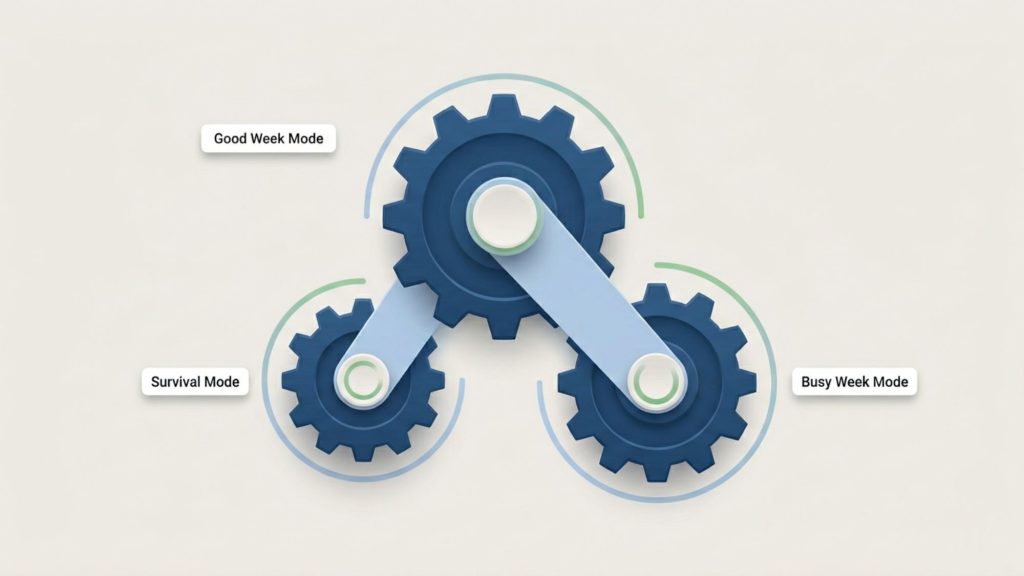
AI content consistency doesn’t come from forcing output when you’re overwhelmed. It comes from building a system with three different gears: one for good weeks, one for busy weeks, and one for survival mode.
When the structure adjusts to your actual capacity, you can maintain content consistency without guilt, burnout, or watching your momentum disappear.
Table of Contents
Why “just be consistent” advice fails when life gets busy
The fixed-input trap that kills content consistency
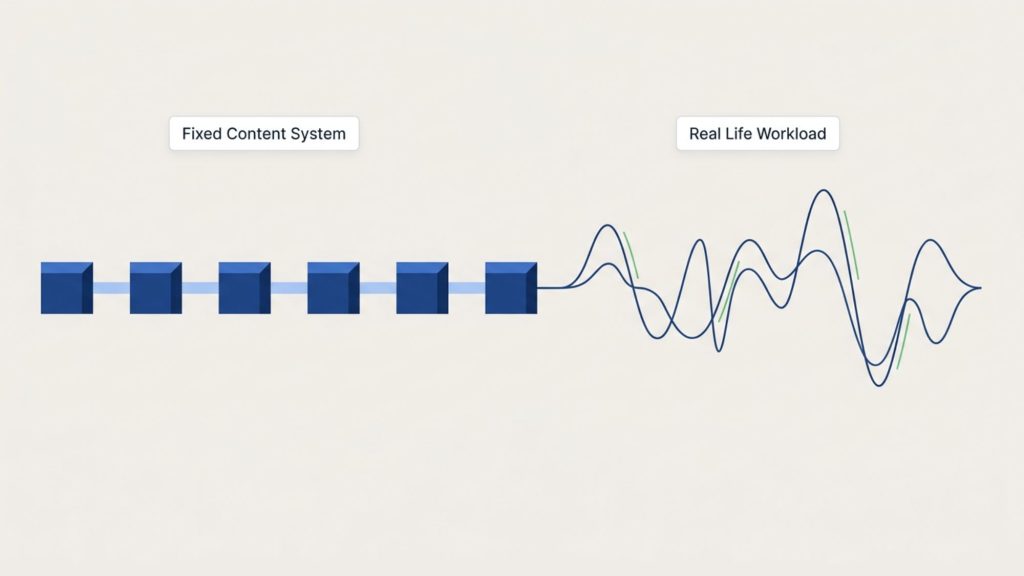
Your content system was designed during a calm week. You had time to think, space to create, energy to edit. So you built a system that requires those same conditions every single time.
Then life gets busy. Your available time drops from two hours to twenty minutes. Your mental energy is split across five urgent priorities. But the system still expects the same input you gave it during setup week.
The system says: “Give me 90 focused minutes, clear mental space, and creative energy.”
You say: “I have 15 distracted minutes between calls and my brain is fried.”
The system says: “Then skip today.”
So you skip. Then you skip tomorrow. Three skipped days later, momentum is gone and you’re starting from zero again.
My friend Lisa in Boston hit this constantly. Her content system required two uninterrupted hours every Tuesday and Thursday morning. Worked great in January. February came with three client emergencies and a product launch. She couldn’t deliver those two-hour blocks anymore. System had no backup plan. By week three, she’d stopped creating content entirely.
The problem wasn’t Lisa’s discipline. The problem was a system that couldn’t maintain content consistency when life gets busy – because it was designed around fixed inputs that real life rarely delivers.
Why time management doesn’t solve content consistency problems
People will tell you to “block time on your calendar” or “wake up earlier” or “eliminate distractions.”
That advice assumes the problem is poor time allocation. It’s not.
The problem is available cognitive capacity. You might have time blocked, but if you’re mentally running three work emergencies, a family issue, and you’re exhausted from a bad night’s sleep, you can’t access the focus needed for deep content creation.
Time management solves scheduling conflicts. It doesn’t solve energy depletion, cognitive overload, or competing mental priorities.
Jake in Seattle learned this hard way. He woke up at 5am to create content before his day started. Gave himself the time. But he was running on five hours of sleep, worried about a client presentation at 9am, and couldn’t generate a single useful idea. Sat there for 45 minutes staring at a blank screen, then gave up feeling worse than if he’d just slept in.
More time doesn’t help when your brain isn’t available to use it productively.
The guilt spiral that breaks content systems permanently
Here’s how the guilt spiral works.
You miss Monday because you’re overwhelmed. Feel guilty. Promise yourself you’ll do extra on Wednesday to make up for it. Wednesday arrives. You’re still overwhelmed. Now you’re trying to do Monday’s work plus Wednesday’s work. It’s too much. You do neither. Guilt intensifies.
By Friday, you’re three sessions behind. The backlog feels impossible. Guilt has turned into shame. You abandon the entire system because facing it feels worse than quitting.
A creator I know in Denver fell into this exact pattern. Missed one content day during a busy week. Spent the rest of the week feeling guilty and trying to “catch up.” Never caught up. Just accumulated more missed sessions until the whole thing felt hopeless and she quit.
The guilt spiral kills more content systems than actual busyness does. Because once you’re in it, the system becomes psychologically painful instead of helpful.
The three-gear content consistency system that survives chaos
Here’s how the three-gear content consistency system works in practice. Each mode adjusts to your real capacity instead of demanding the same effort regardless of what’s happening in your life.
| Mode | When To Use | Time Required | AI Involvement | Output Quality | Output Volume |
|---|---|---|---|---|---|
| Good Week | Calendar clear, energy high | 60-90 min sessions | AI assists, you lead | High | 3-5 pieces/week |
| Busy Week | Moderate chaos, some time | 20-30 min sessions | AI does heavy lifting | Good enough | 1-2 pieces/week |
| Survival | Complete overwhelm | 10-15 min sessions | Minimal new creation | Minimum viable | 1 piece/week (repurposed) |
Gear 1: Good week mode – full content creation process
This is your ideal workflow. You have time, energy, and mental space. You’re running the full content creation process you designed.
Time commitment: 60-90 minute sessions
What you do:
- Full research and ideation
- AI generates first drafts from detailed prompts
- You edit for voice, accuracy, and polish
- Create original content from scratch
- Aim for your quality baseline
Output: 3-5 pieces of content per week
Example week: Monday you process five ideas into drafts using AI. Wednesday you edit three of them and schedule for next week. Friday you create one high-effort piece (long-form article, video script, detailed guide).
This is the gear you want to be in most of the time. But you won’t always be here, and that’s fine.
Gear 2: Busy week mode – streamlined content creation
Your calendar is packed but not impossible. You have pockets of time but not deep focus blocks. Energy is medium. You can create content but not at full capacity.
Time commitment: 20-30 minute sessions
What you do:
- Let AI do more of the work
- Use pre-built prompt templates (no custom prompts)
- Skip the research phase, work from existing ideas only
- Edit for accuracy only, not perfection
- Repurpose one existing piece into two formats instead of creating from scratch
- Focus on “good enough” over “great”
Output: 1-2 pieces of content per week
Specific tactics:
Use this prompt template: “Turn this outline into a 500-word post: [paste outline]. Conversational tone. No jargon.”
Don’t research new topics. Only process ideas you’ve already captured.
Publish AI drafts with minimal editing. Fix obvious errors, ensure accuracy, schedule it.
My friend in Austin switches to this mode whenever she has a product launch. It’s how she maintains content consistency when life gets busy without burning out. Drops from three posts per week to one. Uses AI more heavily. Doesn’t feel guilty because she planned for this exact scenario.
Gear 3: survival mode – minimum viable content output
Life is chaos. You have almost no time and zero mental energy. Content creation feels impossible. This is the mode that keeps you visible without breaking you – and it only works if you’ve built your emergency content bank in advance.
Time commitment: 10-15 minute sessions
What you do:
- Deploy pre-created content from your emergency bank
- Republish or update an old high-performing piece
- Create micro-content only (short social posts, quick threads, simple updates)
- No new long-form creation
- No AI drafting, just publishing what already exists
Output: 1 piece per week minimum
Emergency content bank examples:
- Five evergreen posts you wrote during good weeks
- Three “best of” roundups linking to your previous content
- Two testimonial/case study posts you prepared in advance
- One “behind the scenes” photo carousel that requires zero writing
A guy I know in Phoenix built his emergency bank during two good weeks in January. Ten pieces total. When his father got sick in March and he had to fly out for two weeks, he deployed those pieces. Published once per week. Zero new creation. System didn’t break. Momentum continued.
Sarah in Seattle keeps a Google Doc with ten “grab and publish” posts. Every good week, she adds one. Bad weeks, she pulls one out. Has never had to completely stop publishing because survival mode always works.
How the three-gear content system helps you shift without losing momentum
| Decision Point | Question To Ask | Answer | Action |
|---|---|---|---|
| Monday morning | How does this week look? | Calendar light, energy good | Stay in Good Week Mode |
| Calendar moderate, energy okay | Shift to Busy Week Mode | ||
| Calendar packed, energy low | Shift to Survival Mode | ||
| Mid-week check | Is current mode working? | Yes, keeping up | Continue current mode |
| No, falling behind | Drop one gear down | ||
| Mode too easy, have extra capacity | Can shift up next week (not mid-week) |
Recognizing which content consistency mode you’re in
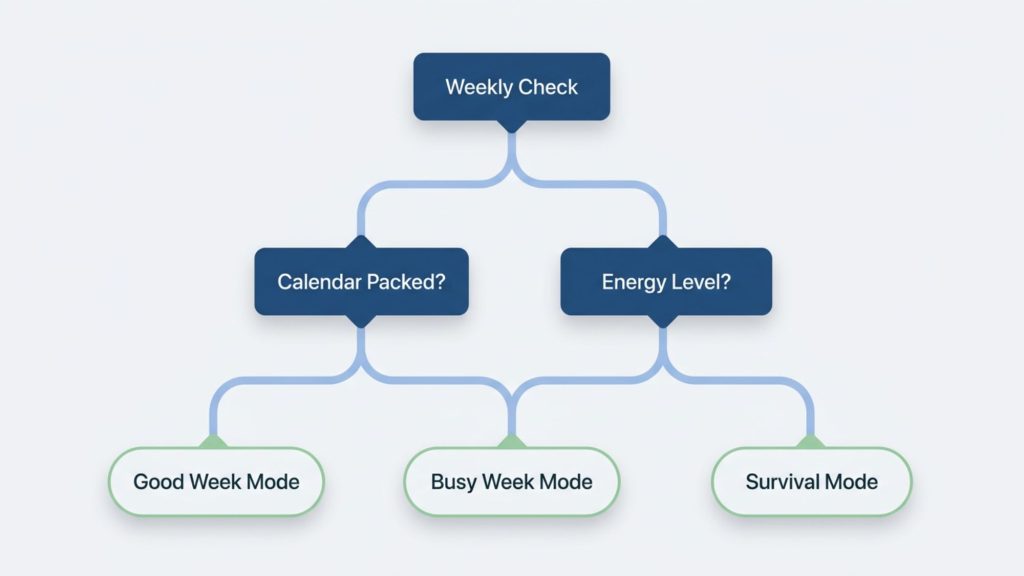
Every Monday morning, ask yourself two questions:
How packed is my calendar this week? Light, moderate, or completely full?
What’s my energy level? High, medium, or running on fumes?
Those two answers tell you which gear to use.
Light calendar + high energy = Good Week Mode
Moderate calendar + medium energy = Busy Week Mode
Packed calendar OR low energy = Survival Mode
It’s a 30-second decision. You’re not guessing or hoping. You’re honestly assessing your real capacity for the week ahead.
Quick decision framework for your weekly content mode
If you’re not sure which mode to use, here’s the fast test:
Can you block two focused 60-minute sessions this week?
Yes → Good Week Mode
No, but I can find two 30-minute pockets → Busy Week Mode
No, I can barely find 15 minutes → Survival Mode
Make the decision Monday morning. Commit to that mode for the entire week. Don’t switch mid-week unless something major changes (sudden crisis, project canceled, energy crashes).
Preventing gear- shifting from becoming procrastination
The three-gear system only works if you’re honest about your capacity.
The trap: Using Busy Week Mode when you could actually run Good Week Mode because it feels easier.
The fix: If you’re choosing a lower gear, you should feel some resistance or guilt. That’s normal. If you feel relief without any guilt, you’re probably underestimating your capacity.
The honest test: If someone offered you $500 to run Good Week Mode this week, could you do it?
If yes, you’re probably capable of it. If no, you genuinely need the lower gear.
Jake in San Diego used to drop to Survival Mode every time he felt a little busy. Realized he was avoiding work, not managing capacity. Started being more honest. Now he only uses Survival Mode when truly overwhelmed. Busy Week Mode handles most stressful weeks just fine.
Now he only uses Survival Mode when truly overwhelmed. Busy Week Mode handles most stressful weeks just fine. If you want to go further, learn how to design a weekly AI content system with built-in flexibility that prevents burnout.
Building your emergency content bank
An emergency content bank ensures you can keep publishing even during chaotic weeks.
| Content Type | When To Create | How Many | Storage Location |
|---|---|---|---|
| Evergreen posts | During good weeks | 5-10 pieces | Google Doc or Notion |
| Repurposed content | After publishing winners | 3-5 pieces | Same doc, separate section |
| Quick updates | Batch create in one session | 5-7 pieces | Scheduling tool or doc |
| Visual content | During creative energy highs | 3-5 carousels/graphics | Design tool or folder |

What to pre-create during good weeks
Your emergency bank needs content you can publish with zero additional work. That means it’s already written, edited, and formatted. You’re just hitting “schedule” or “post.”
Evergreen posts: Content that’s always relevant. No time-sensitive references. No “this week” or “recently” language. Topics like core lessons, frameworks you use, common mistakes you see, principles that don’t change.
Example: “Three questions I ask before taking on any client project” or “Why most people misunderstand X concept.”
Repurposed winners: Take your three best-performing pieces from last quarter. Rewrite them with fresh angles or updated examples. Save the new versions for emergencies.
Quick micro-content: Short posts, simple threads, single-image posts with short captions. Things that take two minutes to publish but keep you visible.
My friend in Denver spends one good week per quarter building her bank. Creates ten evergreen posts in a single afternoon. Knows she has ten weeks of survival mode covered if life gets chaotic.
How to store it for easy access
Don’t bury your emergency content where you’ll forget it exists.
Option 1: Google Doc titled “Emergency Content Bank” with sections for each type.
Option 2: Notion database with a “ready to publish” status filter.
Option 3: Scheduling tool with content pre-loaded but not scheduled. When you need it, you just pick a date.
The key is making it visible and accessible when you’re overwhelmed. If you have to hunt for it, you won’t use it.
Label it clearly: “SURVIVAL MODE CONTENT – GRAB AND PUBLISH”
When to deploy it without guilt
You deploy emergency content when you’re in Survival Mode. That’s how you maintain content consistency when your capacity hits zero.
Don’t feel guilty about publishing pre-created content. Your audience doesn’t know when you wrote it. They only know it showed up consistently even during your chaotic month.
A creator I know in Portland uses her emergency bank 4-6 weeks per year. Product launches, family emergencies, intense client work. Nobody has ever noticed or cared that some posts were created weeks earlier.
Consistency matters more than novelty. Your survival mode content beats publishing nothing because you’re too overwhelmed to create something new. Discover the backup protocols that prevent system collapse before your next busy period hits.
Recovery protocol: how to maintain content consistency after survival mode
How to ramp back up after survival mode
You’ve been in Survival Mode for two weeks. The crisis passed. Calendar is clearing. Energy is returning.
Don’t jump straight back to Good Week Mode. You’ll burn out again.
Week 1 post-crisis: Stay in Survival Mode one more week even though you could do more. Let your system recover.
Week 2 post-crisis: Move to Busy Week Mode. Run the streamlined process. Ease back in.
Week 3 post-crisis: Return to Good Week Mode if capacity feels solid.
This prevents the whiplash of going from minimum effort to maximum effort overnight. Your brain and your content system both need the gradual ramp.
Lisa in Boston learned this after crashing twice. Now when she exits Survival Mode, she gives herself a full week in Busy Week Mode before returning to full capacity. Hasn’t crashed since.
Avoiding the “all or nothing” restart trap
The trap: You’ve been in Survival Mode. You feel guilty. You decide next week you’ll do twice as much to “make up for it.”
What actually happens: You set an unrealistic goal, can’t hit it, feel worse, and quit entirely.
The rule: Never try to make up for lost time. Just return to your normal mode when capacity allows.
If you were in Survival Mode for three weeks and only published three pieces total, you don’t owe yourself nine pieces to catch up. You just return to Good Week Mode and publish your normal three pieces next week.
Forward motion beats retroactive compensation every time.
Jake in Seattle used to do this constantly. Would go dark for two weeks, then promise himself he’d publish seven pieces the following week to catch up. Never worked. Just created more guilt and more crashes. When he stopped trying to catch up and just restarted at normal volume, consistency returned.
The real shift
Content consistency during busy periods doesn’t come from willpower or better time management.
It comes from a three gear content system that adjusts to your actual capacity instead of demanding the same input regardless of what’s happening in your life.
Good weeks, you run full process. Busy weeks, you streamline. Overwhelming weeks, you deploy your emergency bank. That’s how content consistency when life gets busy stops being a struggle and becomes a system.
You’re not maintaining the same output across all three modes. You’re maintaining visibility and forward motion. That’s what actually matters.
When your system has gears instead of one fixed speed, it stops breaking every time life gets chaotic. You shift down, keep moving, shift back up when capacity returns.
Build the three modes once. Load your emergency bank during good weeks. When the next busy period hits, you’ll have a system that survives it instead of collapsing under it.
Ready to build a system that survives your busiest weeks?
Now that your three-gear content consistency system is in place, here are your next steps :
- Build the complete framework with the complete calm content system guide
- Design a weekly AI content system that never burns you out
- Understand why content systems fail and fix yours before it breaks