
Most entrepreneurs build an ai content system that collapses within a month – and understanding why is the first step to fixing it.
You set up the system during a good week. Energy is high, the calendar is clear, and everything clicks. It works perfectly for two or three weeks.
Then life gets messy. Meetings stack up. A project goes sideways. You get sick for three days. The system, built for ideal conditions, can’t flex. It demands the same input you gave it during setup week. When you can’t deliver, everything stops.
Here’s the truth: the problem isn’t you. The problem is building rigid systems for ideal conditions that don’t exist.
Real content consistency comes from a content consistency system built around calm, flexible structure – not willpower. A system that survives reality instead of requiring perfect conditions. One that adapts to your actual capacity without burning you out.
This guide shows you how to build that ai content system – one designed for reality, not ideal conditions. You’ll learn the three core principles that make AI content systems sustainable, the complete workflow that separates thinking from execution, and the backup protocols that keep everything running when life gets chaotic.
A calm AI content system doesn’t require you to be perfect. It just requires you to build once for reality instead of building repeatedly for conditions that never last.

Table of Contents
Why most AI content systems break (and why it’s not your fault)
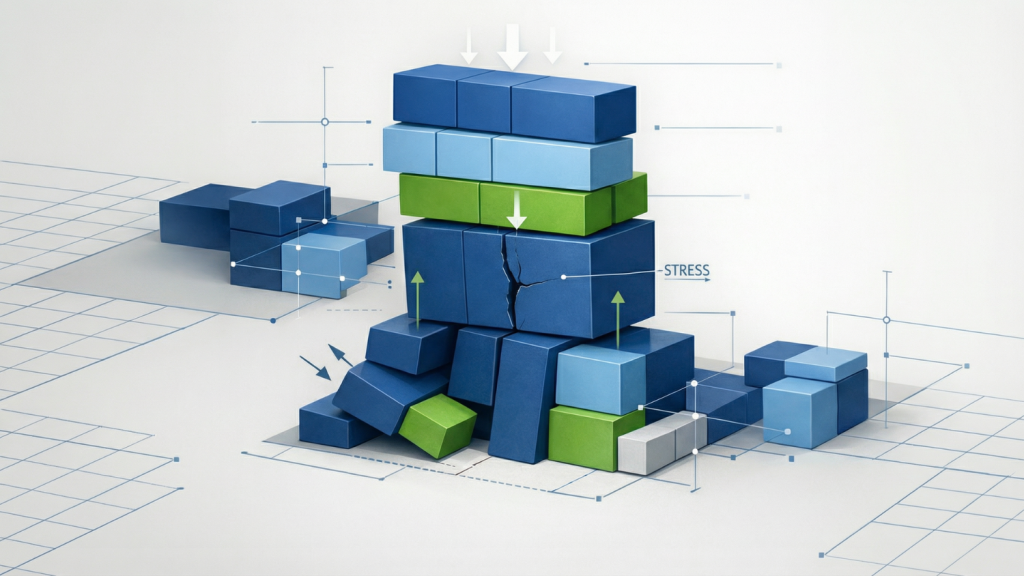
Systems fail because of design flaws, not discipline problems.
The most common ai content system mistake? Treating consistency as a personal trait instead of a design feature. The system asks for discipline when it should be providing structure. It punishes disruption instead of absorbing it.
Here’s what actually happens. You design the system during a good week. Two focused hours every morning. Clear mental space. Full energy. Everything clicks.
So you build around that version of your life- the one where nothing urgent pops up and you always have consistent energy. Then reality returns. A client emergency hits. You get sick. Your schedule explodes. The system can’t flex. When you can’t deliver, the whole thing stalls.
Five design flaws kill most AI content systems:
| Design flaw | What it looks like | Why it kills your system |
| Building for ideal conditions | Requires 2 hours of focused time every morning | Breaks the first time your schedule gets disrupted |
| No failure protocol | System has no answer for “what if I miss a day?” | One missed session cascades into abandoned system |
| Tool dependency | Entire workflow relies on one specific AI tool | System collapses if tool changes or has downtime |
| Input rigidity | Demands same time and energy daily | Can’t adapt when you’re tired, busy, or distracted |
| No maintenance schedule | System degrades slowly, never gets updated | Small problems compound until nothing works |
The fix isn’t working harder or finding more motivation. It’s redesigning the system to survive bad weeks, shifting priorities, and days when you just don’t want to think.
When the structure can bend without breaking, output becomes predictable again- even when you’re not at your best.
The 3 core principles of a calm AI content system
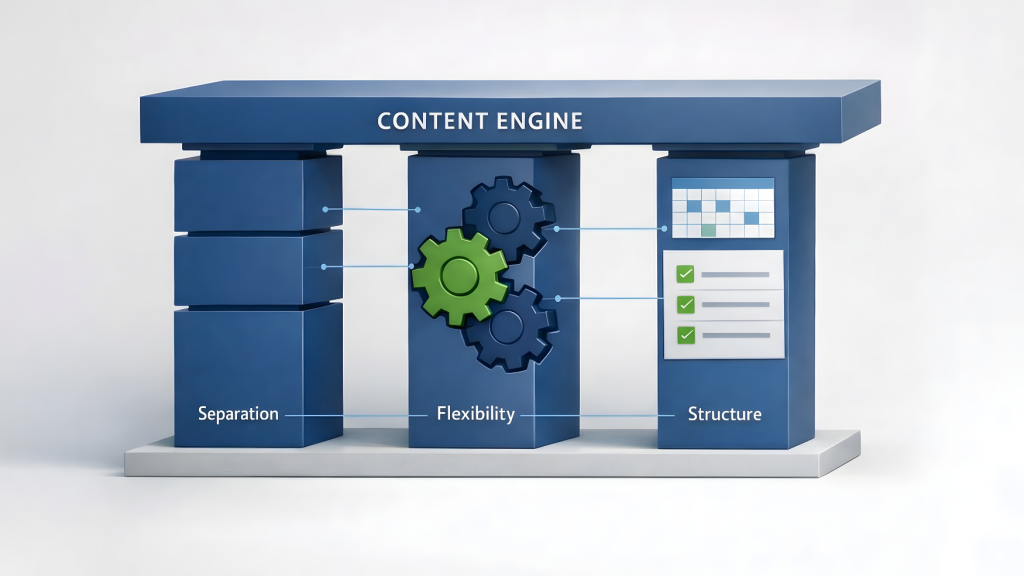
A calm ai content system that survives reality is built on three principles. Not tactics. Not tools. Principles that shape how the entire system operates.
| Principle | What it means |
| Separation over speed | Separate capture from processing from publishing. Never try to do all three at once. Capture happens when ideas show up (30 seconds). Processing happens on a fixed schedule with AI (30-60 min sessions). Publishing happens on a different day with fresh eyes (15-30 min per piece). When each phase has one job, your brain stops trying to be creative, strategic, and editorial all at the same time. |
| Flexibility over rigidity | Build three gears that match your actual capacity. Good Week Mode runs the full process with high quality. Busy Week Mode is streamlined- AI does more heavy lifting. Survival Mode deploys your emergency content bank with minimum effort. The system always runs. Only the intensity changes. No guilt for using the mode that matches your reality today. |
| Structure over discipline | The system provides the consistency, not your willpower. Fixed processing schedule. Pre-built prompts. Clear checkpoints. Backup protocols for when things go wrong. When the structure handles the decisions, you just show up and follow the process. Consistency becomes automatic instead of requiring constant motivation. |
These three principles remove decision fatigue, adapt to reality, survive disruption, and maintain momentum. They’re the foundation of every calm AI content system.
Building your calm AI content system: The complete workflow
The calm AI content system has three components that work together. The weekly rhythm provides structure. The editorial workflow separates the work. The three-gear system provides flexibility.
Component 1: The weekly rhythm – when your AI content system runs
Your system runs on a weekly cycle with fixed sessions:
Monday or Tuesday: Processing session (30-60 min). Review captured ideas. Run 3-5 ideas through AI. Generate rough drafts. No editing-just creation.
Wednesday or Thursday: Publishing session (30-45 min). Review Monday’s drafts. Edit for voice and accuracy. Schedule for following week. Close tools until next session.
Throughout the week: Capture ideas when they show up (30 sec – 2 min per idea). Save raw notes in one trusted location. No development- just raw capture.
The weekly rhythm is the backbone of your ai content workflow – two focused sessions instead of scattered hours every day. Learn how to design a weekly AI content system that never burns you out. You batch the work. Your brain stays in one mode. Context switching disappears.
Component 2: The editorial workflow – how your AI content system works
Your ai editorial workflow runs on three distinct phases that never overlap:
Phase 1: Capture. When inspiration hits, get it out of your head. Two sentences max. No structure required. Job: save the seed so you don’t forget it.
Phase 2: Process. Fixed schedule, 1-2 times per week. Turn captured ideas into rough drafts using AI. Don’t edit. Don’t polish. Just generate. Output: 3-5 rough drafts ready for review.
Phase 3: Publish. Separate day, 24-48 hours after processing. Review drafts with fresh eyes. Edit for voice and accuracy. Schedule or post. Output: published content.
The 24-hour gap between processing and publishing is critical. Fresh eyes catch mistakes, tone issues, and weak spots you miss when you’re too close to the content. Discover the complete AI editorial workflow that takes you from ideas to published content.
Component 3: The three-gear system – built-in flexibility for real life
Match your mode to your actual capacity each week:
| Mode | Session length | Quality bar | Output |
| Good Week Mode | 60-90 min | Full process, high quality, AI assists | 3-5 pieces/week |
| Busy Week Mode | 20-30 min | Streamlined, AI does heavy lifting, good enough | 1-2 pieces/week |
| Survival Mode | 10-15 min | Deploy emergency bank, no new creation, minimum viable | 1 piece/week |
On good weeks, you run the full workflow on your weekly schedule. On busy weeks, you shift to streamlined mode. On overwhelming weeks, you deploy your emergency bank.
The system always runs. Only the intensity changes. You’re not maintaining the same output across all three modes. You’re maintaining forward motion.

Setting up your AI content system: The 30-minute quick start
You need four things to get started. Nothing fancy. Just the essentials.
Step 1: Choose one capture tool for your content ideas (5 minutes)
Pick one place where you’ll save ideas. Notes app, Notion, or Google Doc. One location. Easily accessible. Title it “Content Ideas.” That’s it.
Step 2: Block your processing schedule on the calendar (5 minutes)
Block two 30-60 minute sessions per week on your calendar. Same days, same times. Non-negotiable calendar blocks. These are your processing sessions where you turn ideas into drafts.
Step 3: Set your publishing schedule on a separate day (5 minutes)
Block a different day from processing. 24-48 hours after your processing session. 30-45 minute blocks. This is when you review drafts with fresh eyes and schedule them for publication.
Step 4: Create your brief template to power your content creation system (15 Minutes)
Create a one-page template with these fields: who you’re talking to, what you want them to do, your specific take on the topic, why they should believe you, tone guidelines, and what you won’t claim.
This template tells the AI exactly what to produce. You fill it out once per piece- takes two minutes. It saves you from reviewing 800 words of AI output that sounds like a press release.
That’s the entire setup. Thirty minutes. You now have a working ai content system ready to run.
The first week:
Monday: Capture 3-5 ideas throughout the day.
Wednesday: 30-minute processing session. Turn 2-3 ideas into drafts with AI.
Friday: 20-minute review session. Edit and schedule one piece.
Output: One published piece for next week. If you hit that target, the system works. Repeat next week.
Maintaining your content consistency system so it doesn’t break in 30 days
Systems that survive require maintenance. Not every day. Once a month. Thirty minutes.
The monthly AI content system audit: 30 minutes, first monday
Answer three questions:
What’s working? Keep doing it. Maybe do more of it.
What’s breaking? Fix it now before it kills the whole system.
What needs updating? Better tools available? Prompts producing weaker outputs? Process getting clunky?
Backup protocols you need:
If you miss a session: Skip it. Don’t try to catch up. Continue with the next scheduled session. Never try to do double work.
If your tool is down: Have one AI alternative identified. Know how to run the process manually. The system continues regardless.
If you’re sick or traveling: Deploy emergency content bank. One piece minimum. No guilt- that’s what the bank is for.
Building your emergency content bank:
Create during good weeks: 5-10 evergreen posts, 3-5 repurposed winners, 5-7 quick micro-content pieces.
Store where you can grab them fast: Google Doc titled “Emergency Content Bank” or Notion with “ready to publish” status.
The emergency bank isn’t failure. It’s smart design. It’s what keeps your system running when life doesn’t cooperate. Learn exactly how to maintain content consistency when life gets busy without breaking your system.
Early warning signs your system is fragile:
- You dread opening content tools
- You skip sessions without guilt
- Outputs feel generic
- Can’t remember last publish
- System only works on “good” days
- One missed session derails everything
- Fighting the system constantly
- Haven’t reviewed system in 2+ months
Two or more checks: Address those issues this week. Four or more checks: Run full system recovery.
Common AI content system failure points and quick fixes
When something breaks, you need fast diagnosis and clear fixes. This table shows the most common problems and what to do about them.
| Symptom | Root cause | Quick fix |
| Ideas never become content | No processing schedule | Block 2× 30-min sessions/week |
| Editing during processing | Wrong phase, perfectionism | 5-minute timer per idea |
| Publish same day as draft | No fresh-eye review | Force 24h gap minimum |
| 80+ ideas, paralysis | No filtering system | Archive ideas older than 30 days |
| Every draft feels different | No prompt templates | Create 2-3 reusable prompts |
| System broke after 3 weeks | Built for ideal conditions | Add three-gear flexibility |
| Can’t maintain during busy weeks | No backup modes | Install Busy/Survival modes |
| Guilt spiral after missing one day | No failure protocol | “Skip it and continue” rule |
If your system has already collapsed, don’t start from zero. Read the complete guide on why AI content systems fail after 30 days and how to fix yours with a 3-step recovery plan.
The AI content system recovery protocol: 3 steps to restart
Step 1: Diagnostic (15 min). When did it stop working? What changed right before? Which part broke first? What couldn’t you deliver?
Step 2: Simplification (20 min). Cut to bare essentials. Remove non-critical steps. Keep only: Capture → Process → Publish.
Step 3: Restart (1 week). Prove the simple version works. Publish one piece minimum. Don’t add complexity back yet.
After three consistent weeks, gradually add back features if needed. Most people find the simple version works better anyway.

The calm content engine for entrepreneurs
Most AI content systems fail because they’re built for perfect conditions that don’t exist.
You designed it during a good week. It worked for two or three weeks. Then life got messy and the system couldn’t adapt. It demanded the same input you gave it during setup. When you couldn’t deliver, everything stopped.
A calm AI content system is designed for reality – not for the version of your life you wish you had. Here’s what makes this ai content system different from everything you’ve tried before:
It separates capture, processing, and publishing so you’re never trying to be creative, strategic, and editorial all at once.
It adapts to your actual capacity with three gears-Good Week, Busy Week, Survival Mode.
It provides structure instead of demanding discipline.
It survives bad weeks without breaking.
The real shift: consistency comes from system design, not willpower.
What you now have:
A complete workflow that separates thinking from creating.
Three gears that match your real capacity.
Backup protocols for when life gets messy.
A maintenance schedule to catch problems early.
Start with the 30-minute setup. Run it for one week. Publish one piece. That proves the system works. Then keep running it. The structure handles consistency. You just show up and follow the process.
A calm content engine for entrepreneurs doesn’t require you to be perfect. It just requires you to build once for reality instead of building repeatedly for ideal conditions that never last.