

You just spent 90 minutes in a “strategy meeting” with seven people. The conversation wandered through last quarter’s metrics, someone’s weekend plans, and three tangential debates. Two decisions were almost made. Everyone left unclear about next steps. That wasn’t just a bad meeting it was a $700 organizational loss. And if it’s a recurring weekly slot? You just committed $35,000 yearly to producing confusion. This isn’t about time management. It’s about recognizing that your meeting culture might be the single largest drain on your business and knowing exactly what it’s costing you. That’s what we cover in the complete guide AI Meeting Management for Entrepreneurs
Table of Contents
Understanding the true cost of meeting culture
The meeting epidemic: 392 hours lost yearly
US entrepreneurs spend an average of 392 hours in meetings every year. That’s nearly 10 full work weeks sitting in conference rooms or on Zoom calls. But here’s what makes this number devastating: only 11% of those meetings produce clear decisions or actionable outcomes. That means roughly 348 hours yearly are spent in meetings that generate ambiguity, debate without resolution, or information that could’ve been shared asynchronously.
The typical week breaks down like this: five one-on-ones at 30 minutes each, three team syncs at 45 minutes, two client calls at an hour, one all-hands at 90 minutes, plus the random “quick syncs” that materialize throughout the week. Total: 12-15 hours weekly in scheduled meetings, not counting the spontaneous ones that pop up.
For a founder already working 60-hour weeks, that’s 20-25% of your time in meetings. The question isn’t whether you’re spending time in meetings it’s whether those meetings are producing outcomes worth that investment. Most aren’t. And the cost multiplies exponentially when you consider who else is in the room.
The organizational cost multiplier
When you think about meeting costs, your instinct calculates time lost: a one-hour meeting equals one hour gone from your day. That’s the wrong math.
A one-hour meeting with six people doesn’t cost one hour it costs six organizational hours. If your team’s average fully-loaded salary is $100,000 yearly, that translates to roughly $50 per hour. That single meeting costs your business $300 in collective time.
Run that same meeting every week for a year, and you’ve spent $15,000 on one standing meeting. Most businesses run 5-10 recurring meetings weekly.
Let’s make this concrete with a real scenario. You run a small SaaS company with 10 employees. Average salary is $90,000, which equals $45 per hour. Your recurring meeting structure looks like this:
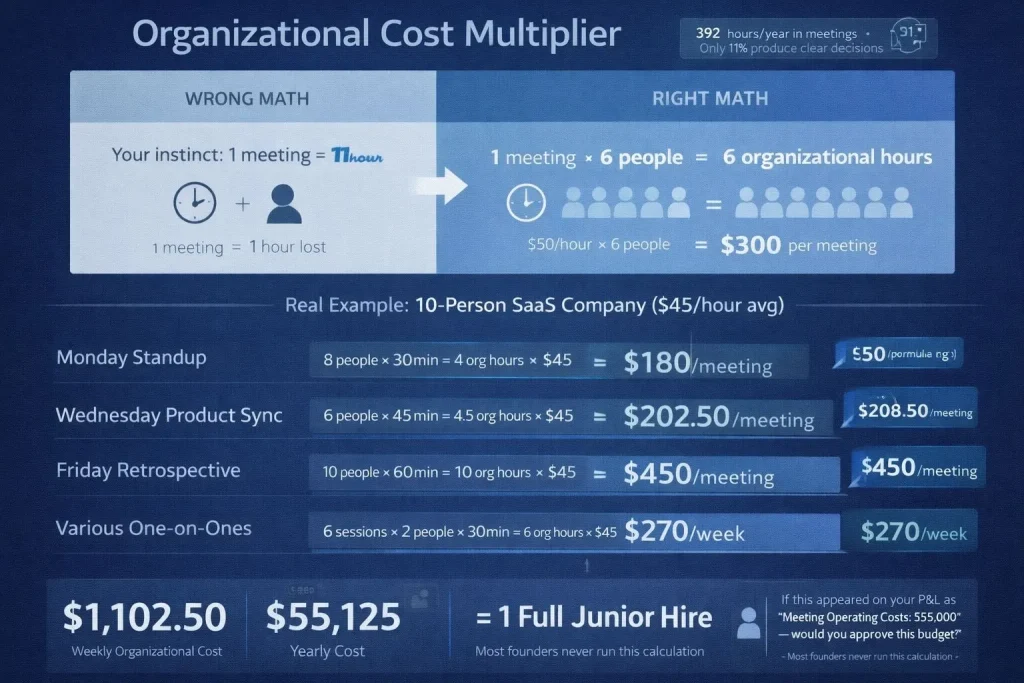
- Monday standup: 8 people × 30 minutes = 4 hours × $45 = $180 per meeting
- Wednesday product sync: 6 people × 45 minutes = 4.5 hours × $45 = $202.50 per meeting
- Friday retrospective: 10 people × 60 minutes = 10 hours × $45 = $450 per meeting
- Various one-on-ones: 6 sessions × 2 people × 30 minutes = 6 hours × $45 = $270 per week
Weekly organizational cost: $1,102.50. Yearly cost: $55,125 (assuming 50 working weeks).
That’s $55,000 in salary you’re paying people to sit in meetings. For many early-stage companies, that’s equivalent to a full junior hire’s entire compensation package.
Now ask yourself: if those meetings were a line item on your P&L labeled “Meeting Operating Costs: $55,000,” would you approve that budget? Would you demand ROI metrics? Would you audit whether each meeting justified its cost? Most founders never run this calculation. Once you do, bad meetings stop feeling like minor annoyances and start looking like what they actually are: significant budget drains with no accountability.
Decision bandwidth depletion
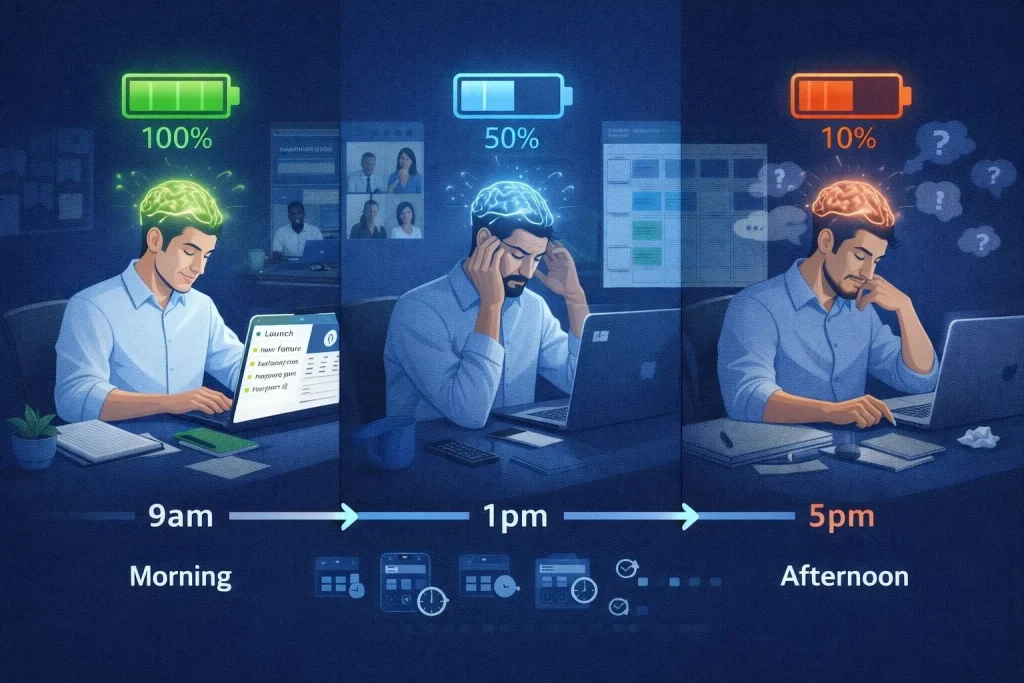
Here’s the insidious part that doesn’t show up in time tracking: unproductive meetings don’t just waste the hour they occupy they drain your decision-making capacity for hours afterward.
Decision fatigue is real. Research in behavioral economics shows that decision quality degrades as you make more decisions throughout the day. Every meeting that forces you to process information, weigh options, and navigate group dynamics consumes cognitive bandwidth.
Bad meetings are especially draining because they force you to make dozens of “meta-decisions” constantly: Should I speak up or let this tangent continue? Is this person making a valid point or derailing us? Do we actually need to decide this today or can it wait? Should I end this meeting early or keep pushing for clarity?
You’re burning mental energy on process management instead of the actual decision the meeting was supposed to produce. By the end of a poorly facilitated 90-minute meeting, you’ve made dozens of micro-decisions about meeting dynamics and you’re mentally exhausted before you’ve even addressed the strategic question you gathered to answer.
The result: when you finally have deep work time later that day, your decision-making capacity is shot. The important work that requires clear thinking like evaluating a pricing strategy, reviewing a partnership proposal, or deciding on a key hire gets done with diminished cognitive resources.
One founder I spoke with called this “decision hangover.” After a morning of back-to-back unfocused meetings, he found himself unable to make clear calls on product priorities in the afternoon. He’d stare at tradeoffs that should’ve taken 10 minutes to resolve and feel paralyzed. The meetings hadn’t just taken his time they’d depleted the mental sharpness he needed for the decisions that actually mattered.
Multiply this across your team. If five people leave a confused meeting mentally drained, that’s five people doing lower-quality work for the rest of the day. The organizational impact compounds.
Maker schedule destruction
Paul Graham famously distinguished between the “manager schedule” (calendar divided into one-hour blocks) and the “maker schedule” (calendar organized around half-day blocks for deep work). For anyone doing creative or strategic work writing code, designing products, crafting strategy, creating content—the maker schedule is essential.
Meetings don’t just consume the time they occupy. They fragment your calendar into unusable pieces.
A single 30-minute meeting at 11am destroys your entire morning for deep work. You can’t start anything substantial before the meeting because you’ll just get interrupted. The meeting itself might only take 30 minutes, but you need 10 minutes to context-switch in and another 10 to context-switch out. That’s 50 minutes of disruption for a 30-minute meeting.
Look at a typical Wednesday calendar: 9:30am team standup (30 minutes), 11:00am client call (60 minutes), 2:00pm product sync (45 minutes), 4:30pm one-on-one (30 minutes).
On paper, that’s 2 hours and 45 minutes of meetings. In practice, you have: 9:00-10:00am too short for deep work before standup, 10:00-11:00am too short for deep work before client call, 12:00-2:00pm lunch plus too short for deep work before product sync, 2:45-4:30pm too short for deep work before one-on-one, 5:00-6:00pm too fried for quality deep work.
You’ve got maybe 2-3 hours of fragmented time scattered across the day. But deep work requires uninterrupted blocks of 3-4 hours minimum. Your calendar is Swiss cheese full of holes, structurally weak.
For your engineers, designers, or anyone doing cognitively demanding work, this is devastating. The work that actually moves your business forward shipping features, solving complex problems, creating valuable content requires sustained focus. Meetings destroy that possibility.
The opportunity cost is invisible but massive: how many breakthrough product ideas never emerged because your team never had 4 uninterrupted hours to think deeply? How many critical bugs persisted because your engineers were constantly context-switching?
Compound opportunity cost
Every hour in a meeting is an hour not spent on revenue generating or business-building activities. For entrepreneurs, this opportunity cost compounds brutally.
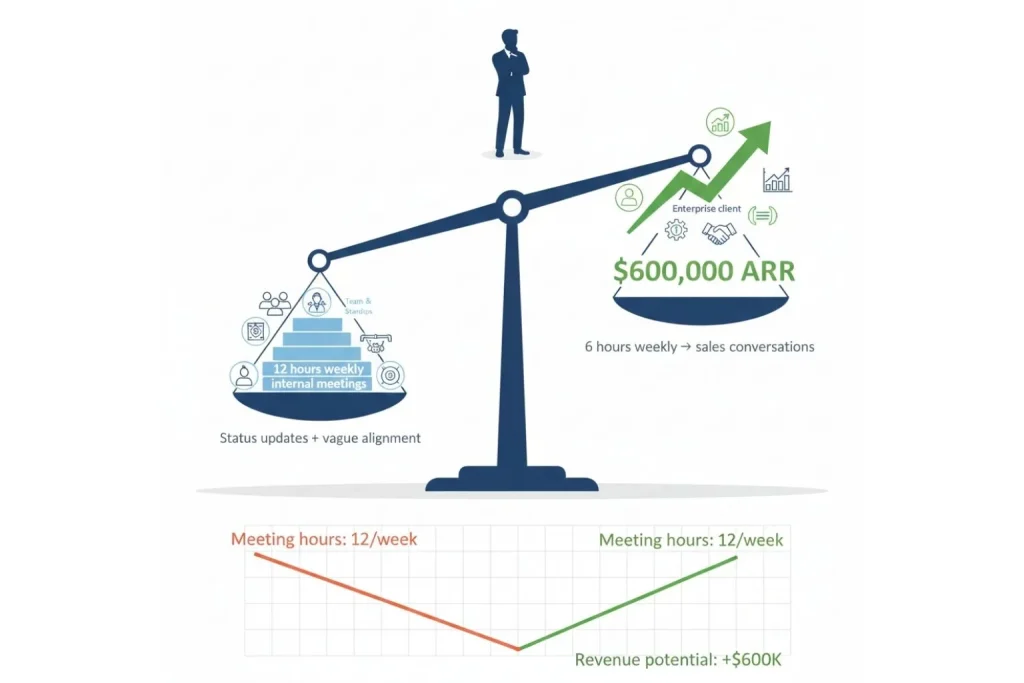
Let’s get specific. You’re a founder with a $2M ARR SaaS business. Your primary growth lever right now is closing enterprise deals. You know from data that every hour you spend in sales conversations increases your monthly close rate by approximately 2%.
You spend 12 hours weekly in internal meetings standups, syncs, planning sessions, retrospectives. If you reallocated just half of those hours 6 hours weekly to enterprise sales conversations, you’d run roughly 6 more prospect calls per week, or 24 per month.
At a 2% incremental close rate improvement per call hour, that’s a 48% improvement in monthly enterprise closes. If your average enterprise deal is $50,000 ARR and you typically close 2 per month, that’s potentially one additional enterprise deal monthly: $50,000 ARR, or $600,000 incremental ARR yearly.
You’re trading $600,000 in potential revenue for internal meetings that mostly produce vague alignment and status updates.
The same math applies to product development. Your engineering team has 6 hours weekly consumed by meetings. If you cut that to 2 hours, you’ve reclaimed 4 engineering hours per person weekly. With a 5-person engineering team, that’s 20 hours weekly equivalent to half a full-time engineer.
Over a year, that’s 1,000 engineering hours (assuming 50 work weeks). At that capacity, your team could ship 2-3 additional major features, which might translate to 15-20% improvement in user retention or conversion rates.
The opportunity cost of meeting culture isn’t just the salary dollars spent sitting in conference rooms. It’s the revenue you’re not generating, the features you’re not shipping, the strategic initiatives you’re not executing because your team’s capacity is consumed by collaboration theater instead of actual value creation.
Meeting debt: Bad meetings spawn follow-ups
The worst part of unproductive meetings isn’t the initial waste it’s the compound effect.
A vague meeting creates confusion. Confusion requires clarification. Clarification happens in another meeting. That meeting is also vague because the original decision wasn’t clear. So you schedule another “quick sync.” Which raises new questions. Which requires another meeting.
This is meeting debt: unclear meetings that generate follow-up meetings to resolve the ambiguity the original meeting created.
The cycle looks like this:
Week 1: Team meeting about Q2 product priorities. Discussion happens, but no clear decision emerges. Outcome: “Let’s explore both options and reconvene.”
Week 2: Follow-up meeting to “finalize decision.” But new information surfaced, and now there’s a third option. Outcome: “Let’s do more research and sync again next week.”
Week 3: Another follow-up. Three people have conflicting understandings of what was previously discussed. You spend 30 minutes just re-establishing context. Outcome: “We need input from engineering before deciding let’s schedule that.”
Week 4: Engineering joins. They point out constraints nobody considered earlier. Back to square one.
One unclear meeting cascaded into four meetings over four weeks, consuming 6+ organizational hours, with no decision reached. Meanwhile, competitors who make decisions faster have already shipped the feature you’re still debating.
Research shows this pattern is common: approximately 50% of meeting attendees schedule follow-up meetings because the original meeting lacked clarity on decisions, ownership, or next steps. That means half your meetings are generating additional meetings just to clean up the mess they created.
Meeting debt compounds exponentially. One bad meeting spawns two follow-ups. Those two spawn four Slack threads. Those four spawn eight “quick questions.” Organizational chaos.
The meeting Audit Framework
You can’t fix what you don’t measure most entrepreneurs have zero visibility into their actual meeting costs because they’ve never systematically tracked them.
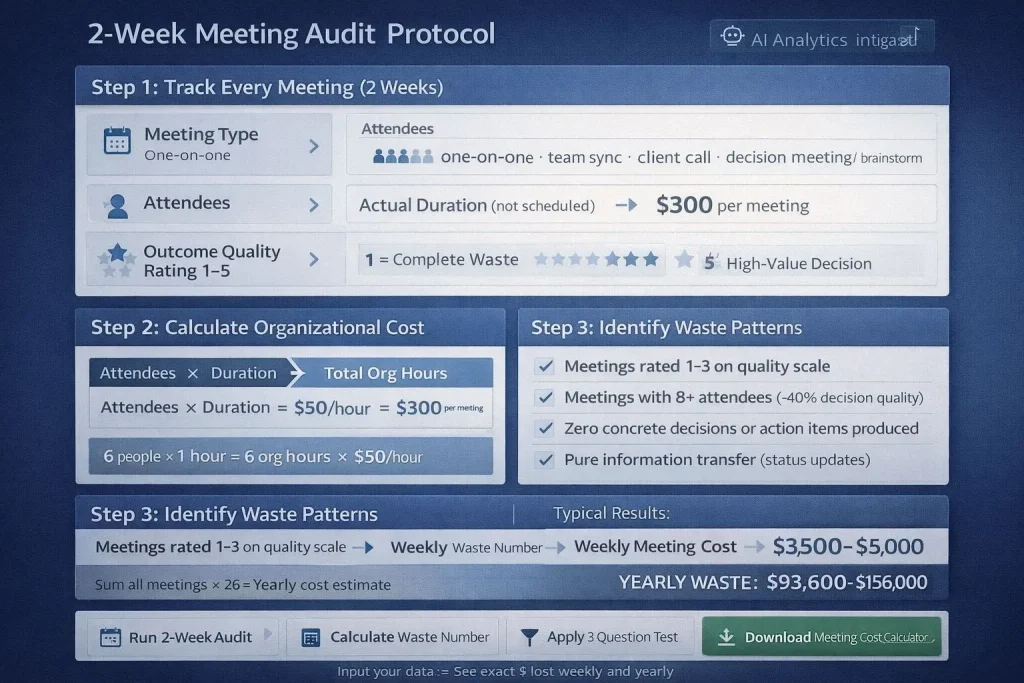
Here’s a two-week audit protocol to diagnose your meeting waste:
Step 1: Track every meeting for two weeks
For each meeting, capture: meeting type (one-on-one, team sync, client call, decision meeting, brainstorm), number of attendees, duration (actual time, not scheduled meetings often run over), and your subjective outcome quality rating on a 1-5 scale where 1 equals complete waste and 5 equals high-value decision.
Step 2: Calculate organizational cost
For each meeting, use this formula: Total hours = (Number of attendees × Duration in hours). Cost = (Total hours × Team average hourly rate).
Example: 6-person meeting, 1 hour long, $50/hour average rate. Total hours: 6 × 1 = 6 hours. Cost: 6 × $50 = $300.
Sum this across all meetings in two weeks, then multiply by 26 to estimate yearly cost.
Step 3: Identify waste patterns
Filter your data: Which meetings rated 1-3 on outcome quality? Which had 8+ attendees? (Research shows 8+ people dramatically reduces decision quality.) Which produced zero concrete decisions or action items? Which were purely information transfer like status updates?
Common findings from this audit: 40-60% of meetings fail the necessity test. Meetings with 8+ people average 2.1 out of 5 on outcome quality. Recurring meetings accumulate “attendee bloat” over time started with 4 people, now 9 people attend “just to stay in the loop.” Status update meetings consume 30-40% of total meeting time.
Step 4 : Calculate your waste
Take all meetings rated 1-3. Sum their organizational cost. That’s your quantified weekly waste.
Typical results: Total weekly meeting cost of $3,000-$5,000. Waste (meetings rated 1-3): $1,800-$3,000, representing a 60% waste rate. Yearly waste: $93,600-$156,000.
That number should hurt. It’s supposed to that’s real money your business is burning on unproductive collaboration.
Real dollar impact examples
Let’s make this tangible with three real scenarios:
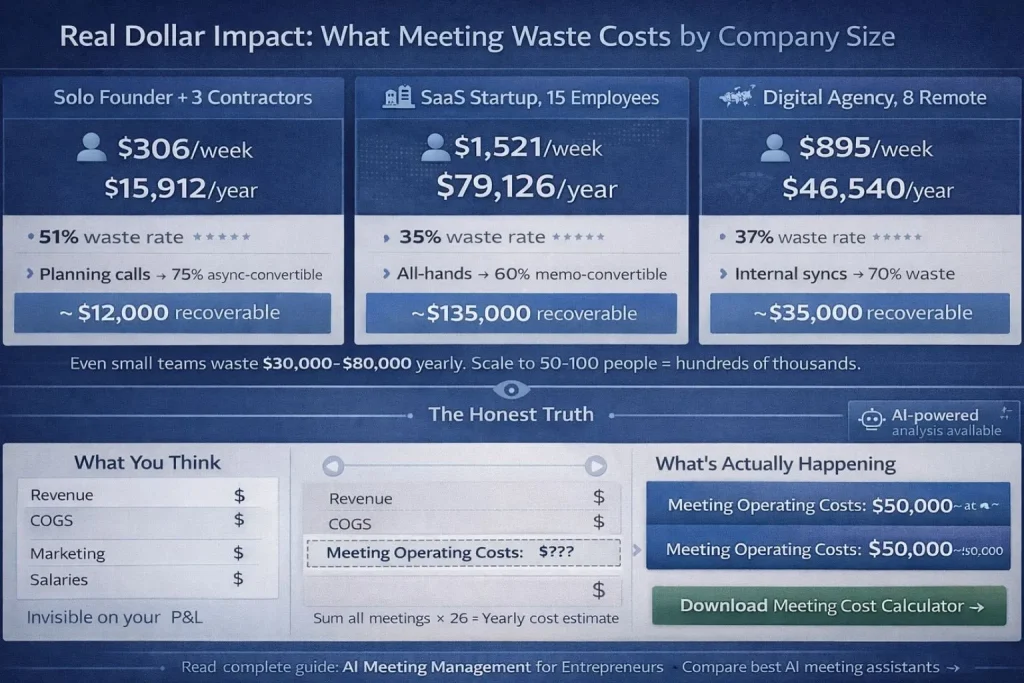
Scenario A: Solo Founder + 3 Contractors
Meeting structure: Weekly planning call with 4 people × 60 minutes = 4 hours. Three individual check-ins: 3 × 2 people × 30 minutes = 3 hours. Client calls: 2 × 2 people × 45 minutes = 3 hours.
Weekly total: 10 hours organizational time. Average rate: $60/hour. Weekly cost: $600. Yearly cost: $31,200.
Waste analysis after audit: Weekly planning call is mostly status updates that could be async—75% waste. Check-ins often lack clear agenda 50% waste. Client calls are generally productive 20% waste.
Waste calculation: Planning: 4 hours × 75% × $60 = $180. Check-ins: 3 hours × 50% × $60 = $90. Client calls: 3 hours × 20% × $60 = $36.
Weekly waste: $306 (51% waste rate). Yearly waste: $15,912.
Action: Cut planning call to 25-minute decision-only session. Move check-ins to async Loom unless decisions needed. Yearly savings: approximately $12,000 in reclaimed capacity.
Scenario B: SaaS Startup, 15 Employees
Meeting structure: Monday all-hands with 15 people × 60 minutes = 15 hours. Daily standups with 10 people × 15 minutes × 5 days = 12.5 hours. Product syncs with 7 people × 90 minutes × 2 per week = 21 hours. Engineering syncs with 6 people × 60 minutes × 2 per week = 12 hours. Leadership meetings with 4 people × 2 hours × 1 per week = 8 hours. One-on-ones: 7 sessions × 2 people × 45 minutes = 10.5 hours.
Weekly total: 79 organizational hours. Average rate: $55/hour. Weekly cost: $4,345. Yearly cost: $226,075.
Waste analysis: All-hands is 60% information that could be a memo. Standups have 40% unnecessary attendance. Product syncs include 30% wandering discussions. Engineering syncs are 25% convertible to async. Leadership meetings are relatively efficient at 20% waste. One-on-ones are generally valuable at 15% waste.
Conservative waste estimate: 35% overall. Yearly waste: $79,126.
Action: Implement decision-first meeting system. Expected 60% meeting reduction. Yearly savings: approximately $135,000 in reclaimed organizational capacity, equivalent to 2.5 full-time hires.
Scenario C : Digital Agency, 8 Remote Team Members
Meeting structure: Client calls at 6 per week × 3 people × 60 minutes = 18 hours. Internal syncs with 8 people × 45 minutes × 2 per week = 12 hours. Creative reviews with 5 people × 90 minutes × 2 per week = 15 hours. One-on-ones: 4 sessions × 2 people × 30 minutes = 4 hours.
Weekly total: 49 organizational hours. Average rate: $50/hour. Weekly cost: $2,450. Yearly cost: $127,400.
Waste analysis: Client calls are 15% waste (necessary, mostly productive). Internal syncs are 70% waste (poor structure, no decisions). Creative reviews are 40% waste (too many spectators). One-on-ones are 20% waste (often lack agenda).
Waste calculation: Client calls: 18 × 15% × $50 = $135. Internal syncs: 12 × 70% × $50 = $420. Creative reviews: 15 × 40% × $50 = $300. One-on-ones: 4 × 20% × $50 = $40.
Weekly waste: $895 (37% waste rate). Yearly waste: $46,540.
Action: Eliminate internal syncs, replace with async updates. Reduce creative review attendees to decision-makers only. Add structure to one-on-ones. Yearly savings: approximately $35,000.
Notice the pattern: even “small” meeting cultures generate $30,000-$80,000 yearly in quantifiable waste for small teams. Scale that to 50-100 person companies, and you’re talking hundreds of thousands in wasted organizational capacity.
First steps to recovery
The point of quantifying meeting costs isn’t to eliminate all meetings it’s to ensure every meeting justifies its organizational expense.
Here’s your starting point:
Action 1: Run the two-week audit.
Using the framework described earlier. Don’t skip this. you need real data on your actual meeting culture, not assumptions. Track every meeting for two weeks. Rate quality. Calculate costs. Identify waste.
Action 2: Calculate your meeting waste number.
Sum the organizational cost of all meetings rated 1-3. That’s your Weekly waste. multiply by 52 for yearly waste. write that number down. put it somewhere visible. This is what your current meeting culture costs.
Action 3: Apply the 3-Question necessity Test to every recurring meeting on your calendar.
For each recurring meeting, ask: Does this meeting require a collective decision that can’t be made asynchronously? Are all attendees essential decision-makers or critical contributors? Can we make this decision in 25 minutes or less?
If the answer to any question is “no,” the meeting needs to be canceled, restructured, or converted to async communication.
Expected outcome: 40-60% of recurring meetings fail this test. Those meetings should be eliminated or fundamentally redesigned.
Action 4: Download the Meeting Cost Calculator.
I’ve built a simple spreadsheet that automates the organizational cost calculation. Input your meeting data, and it shows you exactly what each meeting costs weekly and yearly. It also highlights which meetings are generating the most waste based on your quality ratings.
Download Meeting Cost Calculator
This calculator makes the invisible visible. Once you see “$47,000 yearly” next to your Monday standup, cutting or redesigning that meeting becomes a no-brainer business decision.
Unproductive meetings aren’t a time management problem they’re a business economics problem.
When you calculate the true cost organizational dollars, decision bandwidth depletion, maker schedule destruction, compound opportunity cost, and meeting debt the numbers become impossible to ignore.
Most entrepreneurs would never approve a $50,000-$150,000 annual line item called “Meeting Operating Costs” without demanding clear ROI. But that’s exactly what’s happening in your business right now, hiding in plain sight on everyone’s calendars.
The first step to recovery isn’t buying an AI meeting tool or reading another productivity framework. It’s measuring what you’re actually spending and having the honesty to confront the waste.
Run the audit. Calculate your Meeting Waste Number. Then decide whether your current meeting culture is worth that price tag.
If the answer is no and for most businesses it will be you need a systematic approach to fix meetings at the root: a decision-first meeting system that ensures every meeting justifies its organizational cost by producing clear decisions with accountable next steps.
Calculate your meeting waste now: Download Meeting Cost Calculator
Ready to explore AI solutions? Compare the best AI meeting assistants to automate your documentation and reclaim 4-6 hours weekly.