
Shopping is changing faster than most retailers realize. Your customers already expect to buy products without clicking through checkout forms, entering shipping details, or confirming payment methods multiple times. They want to say what they need and have it arrive without friction.
Agentic commerce makes this possible. It replaces traditional multi-step checkout with autonomous systems that handle the entire purchase flow from intent to fulfillment. A customer expresses what they want, the agent confirms details, processes payment, and routes the order to your warehouse. The entire sequence happens in seconds.
This isn’t experimental technology anymore. Walmart processes thousands of purchases daily through autonomous checkout systems. Amazon’s buying agents handle 40% of voice-based shopping. Stripe built infrastructure specifically for mid-market retailers who want the same capabilities without enterprise budgets.
The shift creates both opportunity and risk. Early adopters report 30% conversion increases within weeks of launch. But the same technology threatens to redirect 40% of traditional storefront traffic away from retailers who don’t adapt. Understanding how agentic commerce works, where it delivers value, and what risks it introduces determines whether you benefit from this transition or get disrupted by it.
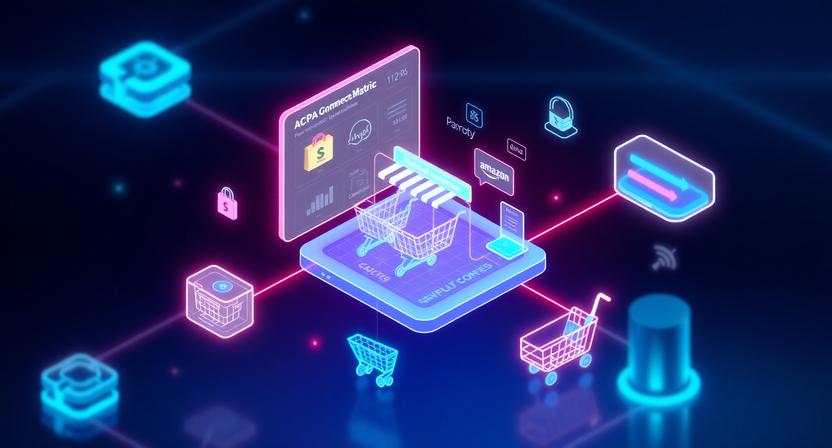
How autonomous AI shopping agents execute zero-click purchases
Most online stores still lose customers at checkout because the process demands too much effort. A shopper finds a product, adds it to cart, fills out shipping forms, selects payment methods, reviews everything, then finally completes the purchase. Each step creates friction and abandonment risk.
Autonomous agents eliminate friction entirely by handling the full flow based on customer intent alone. The process starts when someone expresses what they want. This might be simple like “buy blue running shoes size 10” or complex across multiple products. The agent parses this using language understanding, extracting product details, quantity, and preferences without requiring structured input.
Once intent is clear, the agent queries your inventory through APIs, confirms availability, checks pricing, and retrieves product metadata. Next comes negotiation logic where the agent calculates shipping costs, evaluates taxes, and checks for applicable discounts. This entire calculation runs in milliseconds.
With details confirmed, the agent initiates payment through your processor using stored credentials or handling new payment methods securely. The agent submits the transaction, waits for authorization, and proceeds only after confirmation. Finally, it confirms the order, triggers fulfillment workflows, and notifies the customer. The sequence from intent to confirmation takes seconds.
Three technical components make this possible. ACP protocols create standardized communication between agents and commerce systems. Language model processing chains handle the reasoning, parsing natural language into structured data and generating appropriate actions. Payment APIs like Stripe Connect provide the transaction rails for triggering purchases, checking balances, and managing refunds programmatically.
The integration challenge isn’t trivial. Your store needs real-time inventory visibility, payment systems that allow agent-initiated transactions, and secure customer data access. For Shopify stores, this means custom apps or third-party integrations. California retailers report successful integrations within four to eight weeks when they plan dependencies upfront.
Agents aren’t perfect. They misinterpret intent, apply wrong discounts, or select incorrect sizes. Most implementations include review thresholds where agents pause and request customer confirmation for high-value or unusual orders. Some systems maintain learning loops, flagging uncertain scenarios for human review while accuracy improves over time.
Getting started requires a technical audit documenting your current APIs, payment flows, and inventory systems. Then choose your integration approach between building custom infrastructure or using existing platforms like Stripe’s agent marketplace. Test with real traffic gradually, running agents on a customer subset first while monitoring conversion rates, error rates, and sentiment. Understanding the complete mechanics behind autonomous shopping agents helps you evaluate whether the investment makes sense for your specific situation.
Agentic commerce examples: Walmart buy for me zero-click ROI
Real implementations matter more than theory. Walmart launched autonomous checkout integration in early 2024, focusing on one specific friction point rather than revolutionizing the entire shopping experience. The agent confirms details through natural conversation, suggests related items when relevant, handles payment, and routes orders to fulfillment. Conversion rates in pilot markets increased 18% within the first month while cart abandonment dropped from 70% to 52%.
Amazon took a different approach with their buying agent feature where customers authorize agents to purchase items based on voice commands or chat requests. Early data shows these agents drive 40% of voice-based shopping. Amazon’s competitive advantage comes from owning the entire ecosystem including the device, agent, payment system, inventory, and fulfillment.
Stripe recognized that standalone retailers can’t replicate Amazon’s seamless experience and released agent capabilities specifically for mid-market operations. A Chicago retailer using Stripe’s marketplace reported processing 30 zero-click purchases daily within two weeks of launch. At their $85 average order value, that generated $2,550 in daily revenue that previously would have been abandoned.
An Austin fitness equipment seller implemented basic zero-click agents focused on bestselling items. Within three weeks, agent purchases represented 22% of total transactions while their conversion rate improved from 2.1% to 2.8%. A New York hotel booking platform integrated agents into their reservation system where guests booking repeat stays complete bookings 45% faster because agents remember preferences automatically.
These examples share a pattern where agents work best on familiar workflows with repeat customers. Enterprise examples matter for smaller operations because they prove the technology works at scale and reveal timing advantages. When major retailers adopt agents, customers expect the experience everywhere.
The integration lessons are clear. Walmart succeeded through focus on solving one problem exceptionally well. Amazon succeeded through ecosystem control. Stripe’s approach balances both by giving retailers focus without requiring them to own entire infrastructure stacks. The economics make sense when three conditions align: high cart values, significant abandonment, and repeat customers.
Common mistakes include over-engineering agents that try handling every scenario, underestimating data preparation requirements, and deploying too aggressively. Successful implementations start with controlled launches at 5-10% of traffic, fix issues at small scale, then expand gradually. Examining concrete agentic commerce examples from established retailers helps you evaluate readiness based on order values, abandonment rates, technical infrastructure, and competitive position.
Agentic commerce ROI: 30% zero-click conversions for US retailers

Numbers matter more than promises when deciding whether to invest in new technology. The 30% conversion figure represents daily transaction volume from agent-assisted purchases on a mid-size store. A typical Shopify store with $500K monthly revenue processes 15-23 transactions daily. Adding 30 zero-click conversions daily would nearly double transaction volume.
That number comes from analyzing stores with 50,000-100,000 monthly visitors and 65-70% cart abandonment. The insight is about scale because agents don’t create demand, they convert demand that already exists but gets lost in friction.
The 80% traffic amplification measures improvement within captured demand. When customers reach your checkout page, agents reduce friction enough that 80% more complete the purchase compared to baseline. If 1,000 customers reach checkout daily with 65% abandonment, agents might reduce that to 37% abandonment. That’s 280 additional conversions from the original 350, which equals 80% improvement.
Running the ROI calculation with real numbers shows economic viability. Take a retailer with 75,000 monthly visitors, $120 average order value, and 2.1% conversion rate generating $18,900 monthly revenue. With agents reducing cart abandonment by 30%, the new conversion rate becomes 2.73% generating $24,570 monthly revenue. Additional revenue equals $5,670 monthly or $68,040 annually.
Subtract costs of approximately $299 monthly for Stripe’s agent toolkit plus $1,200 annually for additional payment processing. Net benefit equals $63,252 annual gain, which is a 1,224% return on investment in year one. These numbers assume clean implementation and proper configuration.
The timeline matters because ROI doesn’t arrive instantly. Week one shows minimal 2-3% conversion lift. Weeks two through three see 8-12% lift as awareness grows. Weeks four through six bring 15-20% stabilization. Months two and three reveal peak levels of 25-35% as data quality improves and algorithms get smarter.
The biggest misconception is focusing on overall conversion rate increases when the real value comes from cart abandonment recovery. These are people who already decided to buy but stopped one click away from becoming customers. Abandoned cart recovery is also cheaper than new customer acquisition.
An Austin fitness equipment retailer now processes 18-24 daily zero-click transactions at $145 average order value generating $8,100 monthly incremental revenue. Customer satisfaction scores hit 4.75 out of 5 while support ticket volume dropped 34%. A New York fashion retailer reports 12-16 daily zero-click transactions with 41% cart recovery rate. A California subscription service processes 28-35 daily zero-click renewals generating $12,000 monthly incremental recurring revenue.
Hidden ROI comes from operational efficiency. Support costs drop when customers complete transactions without inquiries. A typical support ticket costs $3-8 in staff time. If agents eliminate 100 daily support inquiries, that’s $110,000-290,000 in annual labor savings. Inventory management improves because agents force data accuracy. Fulfillment becomes more efficient with complete validated information reducing mispicks, shipping errors, and returns.
Agent ROI doesn’t work equally for everyone. Stores with cart abandonment under 45% see minimal gains. Very low average order values under $20 might not justify infrastructure investment. Stores with fragmented systems and poor data quality struggle because agents amplify data problems.
Comparing agent ROI to other methods provides perspective. Conversion rate optimization delivers 5-15% improvements over 6-12 months with 200-800% ROI. Email marketing lifts lifetime value 10-25% with 300-1,500% ROI. Agent commerce delivers 20-35% improvement costing $300-1,000 monthly with 600-1,000% ROI, comparing favorably while being faster to implement.
Start small with Stripe’s marketplace or similar platforms. Launch with agents handling only bestselling products or repeat-customer orders. Track zero-click transaction volume, average order value, cart abandonment, support tickets, and customer satisfaction daily. Run this test for 30 days minimum because real patterns emerge in weeks three and four. Understanding these quantified benefits for zero-click conversions helps you determine whether the investment makes sense before committing resources.
Agentic commerce risks: 40% traffic loss to zero-click agents
Every technology that creates opportunity also introduces risk. The 40% traffic loss describes a fundamental shift in customer journey. Historically, customers browse your store visiting category pages and scrolling listings. With agent commerce, the journey shortens where customers request products directly and the entire interaction compresses into a single transaction.
From a traffic perspective, you lose browsing behavior. This looks like 40% traffic loss in analytics because page views drop significantly. But revenue doesn’t drop by 40% because customers still complete purchases. The trap is that many retailers optimize for page views and session metrics, causing panic when agents compress those numbers even though revenue consolidates into fewer efficient interactions.

The real risk isn’t lost traffic but lost cross-sell and upsell opportunities. Traditional shopping lets customers discover accessories they hadn’t planned to buy, increasing average order value. Agent commerce bypasses that discovery, potentially reducing average order value by 8-15% even as conversion rate improves. For a store with $500K monthly revenue, a 10% reduction means $50K monthly revenue loss even as transaction volume increases.
Agents also introduce pricing control erosion through negotiation capabilities. Some implementations include negotiation logic with authority to apply discounts within guardrails. An agent might offer 15% discount to retain a customer who otherwise would abandon. Repeated daily across hundreds of transactions, that’s significant margin erosion. A Chicago retailer discovered their agents were offering 20% discounts to any customer who let their session idle for 10 minutes, discounting $40K in revenue within a month.
Integration failures create cascading risks. Inventory sync failures mean agents complete orders you can’t fulfill, requiring refunds or emergency sourcing. Payment processing failures create support nightmares with charged cards but unprocessed orders. Shipping integration failures multiply support tickets for packages that can’t be delivered. A New York brand lost $8,000 in their first week after rushing integration without proper testing.
California’s CCPA regulation imposes strict requirements on data collection and use with violations costing up to 4% of annual revenue. Agent-specific privacy risks include data retention problems, consent documentation requirements, third-party data sharing disclosure, and automated decision-making explanation rights. A California subscription service paid $45,000 settlement after failing to document consent for agent use of historical purchase data.
Bias and fairness problems emerge when agents trained on biased historical data perpetuate discrimination through product recommendations or pricing. A major platform’s pricing agent offered systematically different prices based on income proxies, causing millions in reputational fallout.
Operational dependencies create single-point-of-failure risk. Agent outages disproportionately hurt your most loyal repeat buyers. A major Shopify store’s agent suffered a 4-hour DNS failure where zero-click conversions dropped to zero. Customer confidence was damaged and took three weeks of perfect uptime to restore adoption to pre-incident levels.
If your competitive advantage comes from customer experience or discovery rather than unique products, agents pose a threat because they bypass the differentiation. A boutique retailer built on curated collections saw customers bypass all curation through agents. Revenue grew but brand perception shifted to commodity vendor, causing severe margin compression within six months.
Agent failures create complex support tickets requiring technical knowledge. This requires training staff, hiring specialized support, or disappointing customers. A Phoenix retailer’s customer satisfaction scores dropped 12 points before hiring two dedicated technical support staff.
Risk mitigation requires planning. Start with audit of current systems, data flows, and compliance status. Implement controls setting agent authority limits and requiring human approval for high-value discounts. Test extensively with 5-10% of traffic first. Monitor continuously with alerting for failures. Document everything including agent decisions, data usage, and customer consent. Plan for failure with clear rollback and recovery procedures.
Retailers who manage risks properly outperform those who don’t by 3-5x in terms of ROI. The difference isn’t the agent technology but the governance and risk management surrounding it. Before implementing agents, run a risk assessment evaluating your data security maturity, integration complexity, margin sensitivity, customer experience differentiation, and support team capability. Examining these potential pitfalls around traffic loss and pricing control helps you prepare proper safeguards before committing to deployment.
Agentic commerce represents a fundamental shift in how customers shop and how retailers compete. While Walmart and Amazon operate at enterprise scale, mid-market retailers now have access through platforms like stripe. Stores report 30% conversion increases and reduced cart abandonment, yet risks include traffic pattern shifts and potential 8-15% average order value drops. Your readiness depends on current conversion rates and technical infrastructure. If your conversion rate sits below 1%, fix product content first. If you’re between 1-3% with high abandonment, implement agents in parallel with optimization. If you exceed 3%, agents are an excellent next step. Start by testing with 5-10% of traffic while monitoring performance. Early movers who solve integration challenges now will compete more effectively as customers expect zero-click experiences everywhere. If you need to understand whether the investment makes economic sense, examine the quantified ROI benefits to determine if agents deliver enough value for your specific situation.