
Entrepreneurs waste dozens of hours weekly on repetitive tasks that intelligent AI systems now handle automatically. The transformation happens across three distinct AI-driven levels that compound exponentially when combined correctly. AI automation eliminates operational friction while smart algorithms optimize your daily choices and predictive AI models anticipate bottlenecks before they materialize. Understanding this comprehensive approach to AI-powered time management reveals why some founders reclaim 15+ hours weekly while others see minimal gains despite using similar AI tools.
How AI transforms time management : The 3-level framework.
Most entrepreneurs believe they have a time problem when they actually have a management problem. You probably think working 60 hours weekly is necessary to keep your business afloat. The data tells a different story.
Recent studies tracking thousands of startup founders reveal something surprising: the most productive entrepreneurs work fewer hours than their struggling counterparts. The difference isn’t talent or funding but rather how systematically they leverage modern AI tools to eliminate friction from their daily operations.
The transformation happens across three distinct AI-driven levels that compound exponentially when combined. Each level builds on the previous one to create productivity gains that seem impossible until you experience them firsthand. This framework forms the foundation of effective AI time management for entrepreneurs, enabling systematic recovery of hours lost to operational overhead.
Level 1 : AI Automation of repetitive tasks
The first level focuses on eliminating activities that consume time without requiring human judgment. Email management, meeting scheduling, and report generation fall squarely in this category.
Consider your inbox for a moment. How many messages actually need your personal attention versus those that follow predictable patterns? Requests for meetings, confirmations of receipt, technical questions you’ve answered five times already, and standard follow-ups represent a large portion of inbox volume for most founders.
AI-powered smart filters now categorize incoming messages by genuine urgency rather than chronological order. AI-powered suggested responses generate contextually appropriate replies you can approve in three seconds instead of composing for three minutes. On a typical day with 80 emails, this AI automation saves 45 to 60 minutes of pure typing time.
AI meeting transcription illustrates automation at its finest. You used to spend 45 minutes after each hour-long meeting writing structured notes. Modern AI-powered transcription tools capture conversations, identify speakers, extract decisions, and list action items without manual intervention. Your role shrinks to 10 minutes of review and refinement. Across five weekly meetings, that’s nearly **3 hours** reclaimed.
A well-known company reduced time spent on expense reports by up to 75% through AI automation. Tasks that previously required significant time monthly now take a fraction of that. Multiply these small AI gains across dozens of processes and the cumulative impact becomes substantial.
Level 2: AI-Driven decision optimization.
The second level addresses the invisible drain of constant micro-decisions. Every morning you face dozens of choices that consume cognitive energy before you’ve produced anything tangible. What should I tackle first? Which meeting slot should I propose? How much time should I allocate to this project?
This decision fatigue erodes your capacity for strategic thinking. By the time you reach important work, your mental bandwidth has already diminished significantly.
Intelligent AI scheduling systems resolve these dilemmas by analyzing your constraints and priorities automatically. Your calendar organizes itself based on peak productivity windows, existing commitments, and task dependencies. Motion, for example, is reported to save significant coordination time according to independent research. For an entrepreneur spending 15 hours weekly on schedule management, that can represent 3+ hours recovered.
The AI system doesn’t just save minutes. It preserves the mental energy you’d otherwise spend juggling variables and second-guessing choices. This cognitive preservation often matters more than the time savings.
AI-powered priority scoring transforms another exhausting daily ritual. Instead of relying on intuition or whoever screams loudest, you get objective evaluation across multiple dimensions. Business value, technical feasibility, and velocity to results each receive systematic assessment. The AI-calculated weighted score reveals priorities your gut feeling would miss.
Asana and ClickUp both offer sophisticated AI scoring that evaluates new tasks automatically once you define your criteria. No more 30-minute morning sessions debating what deserves attention today.
Level 3: Predictive AI Analytics and intervention.
The third level moves beyond reactive optimization into proactive problem prevention. AI systems monitor patterns to detect issues before they become crises.
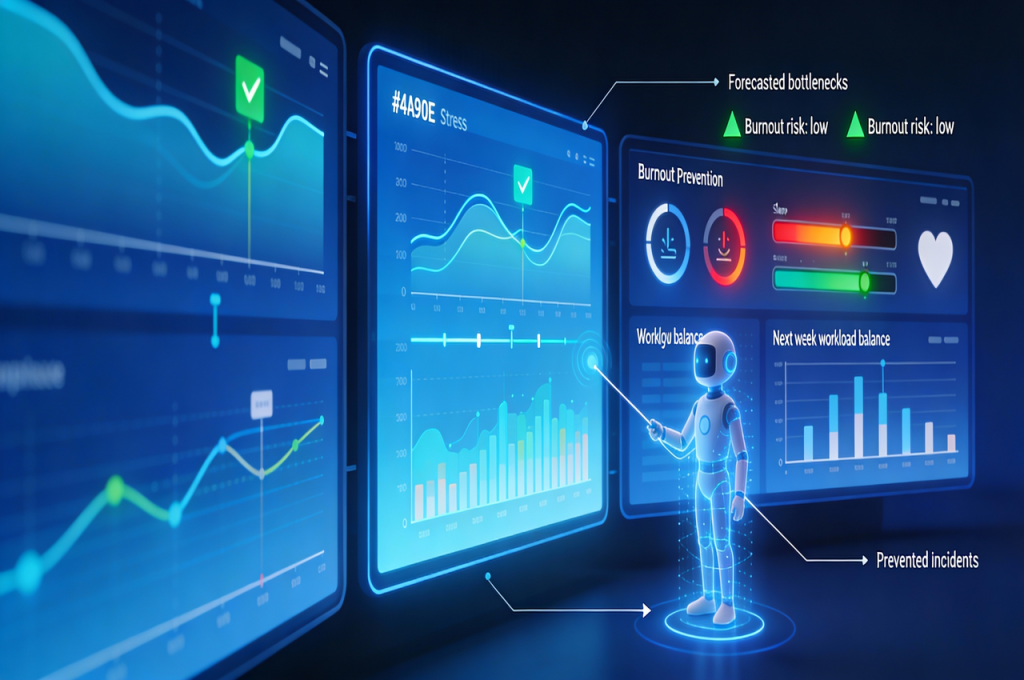
A project consistently consuming more time than estimated triggers early AI warning alerts. A team member accumulating excessive hours without corresponding output receives a rebalancing recommendation before burnout occurs. A client showing disengagement signals gets flagged for proactive outreach.
This AI anticipation fundamentally changes your operational posture. Instead of firefighting emergencies, you intervene when problems are small and manageable. The time saved fighting fires compounds with the stress reduction from fewer catastrophes.
AI-powered behavioral analytics identify concerning trends in your own work patterns. Gradual increase in working hours, progressive decrease in breaks, accumulation of evening work session these patterns often precede burnout by weeks or months. Gentle AI alerts prompt course correction before health consequences materialize.
The strategic coach Dan Sullivan teaches entrepreneurs about three day types: focus days for high-value work, buffer days for administrative tasks, and free days completely off. Predictive AI systems can automatically classify and balance these day types, ensuring you maintain sustainable rhythms rather than drifting into unsustainable patterns.
The Compounding AI effect.
These three AI levels create exponential returns when combined properly. AI automation frees several hours weekly. AI decision optimization adds more hours. Predictive AI intervention prevents crises that would have consumed additional hours monthly.
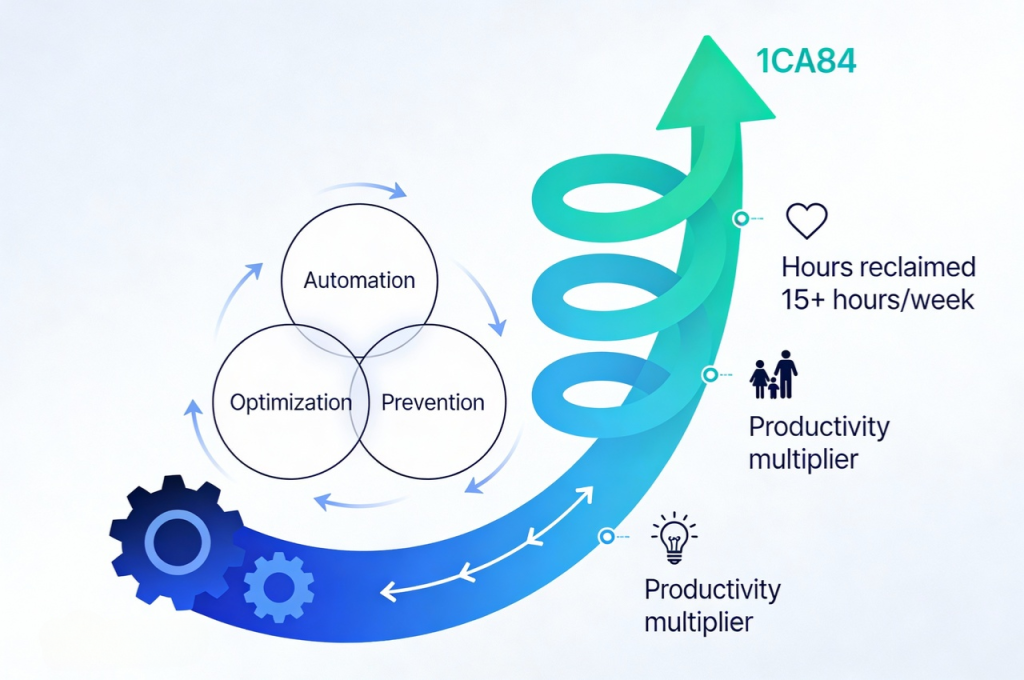
But the real magic happens in the interaction between AI levels. The time saved through AI automation gets protected by AI decision optimization, which allocates it to high-value activities. Predictive AI analytics ensures this optimized schedule remains sustainable long-term rather than creating a new form of burnout.
Entrepreneurs often report 10+ hours recovered weekly after 90 days of systematic implementation. That represents nearly 700 hours annually or the equivalent of 4 full months of working days.
The gains extend beyond raw hours into quality of work and quality of life. Reduced decision fatigue improves strategic thinking. Fewer crises decrease stress. AI-protected focus time enables deeper creative work. Better boundaries improve relationships outside work.
Measuring the impact of AI time management
Several metrics reveal whether the AI transformation is actually happening or just feeling productive without substance. Time gained per task category provides the most direct measure. Track how long specific processes required before and after AI implementation. Email management, meeting coordination, report generation, research, and administrative work should all show measurable reduction.
Quality of output matters as much as speed. Many users report notable improvements in quality alongside time savings. The combination of efficiency and effectiveness drives real business results rather than just appearing busy.
Error rates typically decrease when AI systems handle routine tasks. Machines excel at consistency on repetitive activities. Humans struggle with sustained attention on boring work. This quality improvement prevents downstream time waste fixing mistakes.
Capacity expansion reveals itself in what you can now handle with existing resources. Can you manage more clients without hiring? Do you advance more projects simultaneously? Have you eliminated weekend work while maintaining output? These capability shifts demonstrate genuine AI transformation.
Common AI Implementation mistakes
Several predictable errors sabotage these AI transformations. Attempting to automate everything simultaneously creates confusion and dilutes attention. You learn nothing deeply and abandon quickly when facing first obstacles. Progressive domain-by-domain AI implementation produces better sustained results.
Skipping initial measurement prevents quantifying actual impact. You might feel improvement but without baseline data you can’t demonstrate ROI or identify the most effective levers. A simple tracking spreadsheet for one week before starting provides essential reference points.
Using generic AI prompts without personalization produces mediocre outputs requiring extensive revision. The AI assistant can’t intuit your context, tone, or specific constraints. Investing 30 minutes crafting detailed prompts generates directly usable results that save hours weekly.
Neglecting team training limits AI benefits to early adopters and can create frustration within the team. The leverage appears when five people each gain 5 hours rather than one person gaining 10. Schedule 2-hour training sessions sharing discoveries and supporting adoption.
Getting started this week with AI
The path forward requires neither massive investment nor technical expertise. Start by installing an AI tracking tool and letting it capture one full week of activity without changing behavior. This honest baseline reveals where time actually goes versus where you believe it goes.
Identify your two biggest time sinks from that AI data. Email management and meeting overhead rank high for most founders. Research AI tools specifically addressing those pain points. Most offer free trials allowing real-world testing before commitment.
Configure basic AI automation for one domain and measure results for two weeks. Document actual time saved, not just perception. Use this proof point to fuel motivation for expanding to additional areas.
The transformation from 60-hour weeks to 40-hour weeks with equivalent output doesn’t require magic. It requires systematic application of AI tools designed precisely for the challenges you face daily. Those AI tools exist today mature and proven across thousands of implementations.
For a deeper dive into building your complete AI-powered time management system, explore how these three levels integrate with specific tools and workflows tailored to different entrepreneurial contexts.