
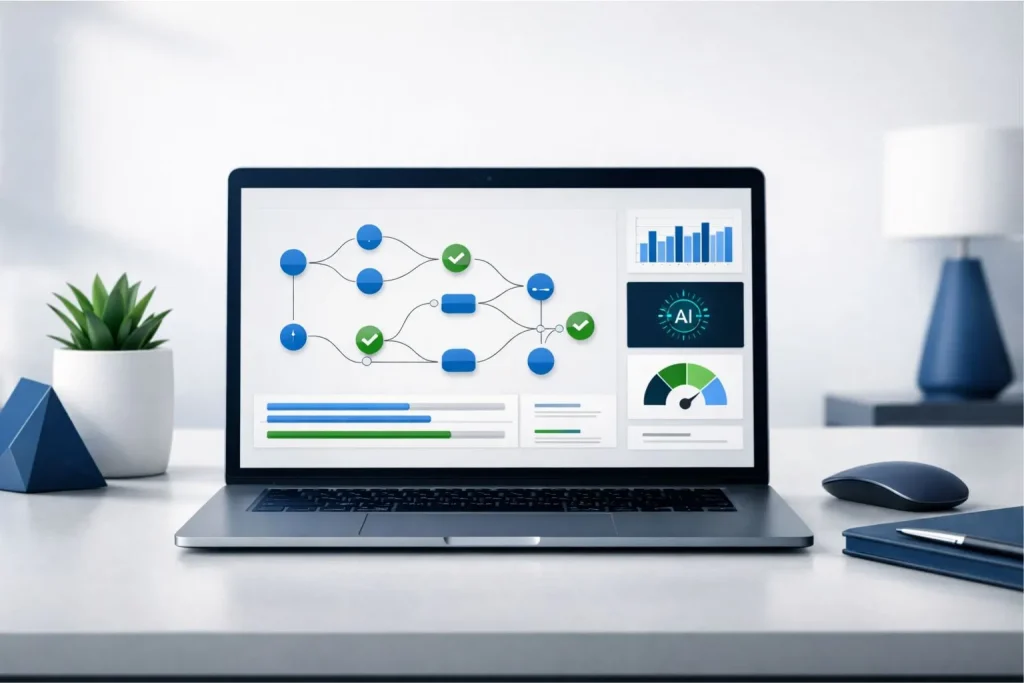
Most small and mid-sized businesses waste 40% of their workday on repetitive tasks that could run themselves. Email follow-ups. Data entry. Customer onboarding. Social media scheduling. The work gets done, but it drains energy, slows growth, and keeps teams stuck in execution mode instead of strategy.
AI-powered business automation changes that equation. It does not just speed things up-it fundamentally shifts how work flows through your business. Tasks that took hours now take minutes. Processes that required constant oversight now run autonomously. Teams that were buried in admin work now focus on high-impact decisions.
This guide breaks down 7 proven AI-powered business automation strategies that multiply productivity across marketing, operations, customer management, and team collaboration. You’ll see which tools matter, how to measure real ROI, and what it takes to prepare your team for a fundamentally different way of working.
Table of Contents
AI-powered automation tools for SMB
The right tools don’t just automate tasks-they make decisions. Traditional automation follows rigid if-this-then-that rules. AI-powered tools analyze patterns, predict outcomes, and adapt behavior based on real-time data.
AI-powered business automation tools analyze patterns, predict outcomes, and adapt behavior based on real-time data giving SMBs capabilities that once required enterprise-level teams.
Zapier and make handle workflow automation across thousands of apps. They connect your CRM to your email platform, your form submissions to your project management system, your e-commerce orders to your fulfillment pipeline. But they’re still rule-based. They execute what you tell them to execute.
According to Zapier’s automation report, businesses using workflow automation save an average of 3.6 hours per week per employee.
AI automation platforms like Relay.app and Bardeen add intelligence. They can read email content and route messages based on intent, not just keywords. They extract structured data from unstructured documents. They prioritize tasks based on urgency signals that change throughout the day.
For marketing specifically, tools like hubspot and Active Campaign now embed AI directly into campaign workflows. They don’t just send emails on a schedule-they analyze engagement patterns and adjust send times, subject lines, and content variations to maximize opens and clicks. Your campaigns improve automatically as they run.
Customer service automation has shifted from basic chat bots to AI agents that handle complex requests. Intercom and Drift use natural language processing to understand customer questions, pull relevant account data, and provide accurate answers without human intervention. When they can’t resolve an issue, they route it to the right team member with full context already attached.
Operations tools like Notion AI and clickup Brain bring intelligence into project management. They can generate project briefs from meeting notes, suggest task dependencies based on historical data, and flag bottlenecks before they cause delays. Your team’s work history becomes a knowledge base that improves coordination.
The pattern across all these tools: they reduce the cognitive load of managing work. You spend less time deciding what to do next and more time doing the work that actually moves your business forward.
For a detailed comparison of the best platforms available, see our AI automation tools guide for small businesses.
How AI-powered business automation transforms your marketing
Marketing automation used to mean scheduled emails and basic segmentation.
Today, AI-powered business automation changes the scale and sophistication of what’s possible – from predictive lead scoring to real-time campaign optimization.
Lead scoring becomes predictive instead of reactive. Traditional systems assign points based on actions-download a guide, visit the pricing page, open three emails. AI models analyze thousands of behavioral signals simultaneously and calculate conversion probability in real time. They identify high-intent prospects before they fill out a form, letting your sales team focus on conversations that matter.
Content personalization shifts from static rules to dynamic adaptation. Instead of “if industry = saas, show case study A,” AI systems analyze individual engagement history, browsing patterns, and firmographic data to assemble unique content experiences for each visitor. Two people from the same company might see completely different messaging based on their roles and interests.
Campaign optimization runs continuously without manual testing. You launch an email campaign with three subject line variations. AI algorithms monitor performance across segments, identify winning patterns, and automatically shift traffic toward higher-performing options. By the end of the campaign, your best-performing variant is reaching 80% of your list.
Social media management becomes strategic instead of operational. Buffer and Hootsuite now use AI to analyze your past posts, identify what drives engagement, and suggest optimal posting times and content formats. They can generate caption variations, recommend hashtags based on reach potential, and flag content that underperforms before you waste budget promoting it.
Nurture sequences adapt to behavior in real time. Someone downloads your guide but doesn’t open the follow-up email. Traditional automation sends email two anyway. AI-powered sequences detect the lack of engagement and switch to a different channel-maybe a linkedin message or a retargeting ad-before returning to email later. The system finds the path of least resistance to conversion.
The benefit isn’t just efficiency-it’s effectiveness. AI finds patterns humans miss. It tests combinations too complex for manual management. It operates 24/7 without fatigue or bias. Your marketing becomes a learning system that improves every day.
Ready to launch your first campaign? Follow our 7-day AI marketing automation framework to get results fast.
Optimize business processes with AI-Powered Automation
Most business processes weren’t designed-they evolved. Someone handled a task one way, it worked, and it became “how we do things.” Over time, these processes accumulate steps that no longer serve their original purpose.
AI-powered business automation brings visibility and intelligence to these processes, identifying inefficiencies that manual analysis consistently misses.
AI process optimization starts with visibility. Tools like Process Street and Tallyfy map your existing workflows and identify inefficiencies. But AI takes it further-it analyzes execution patterns across hundreds of workflow instances and spots bottlenecks, redundant steps, and approval delays that slow everything down.
Document processing is where AI delivers immediate ROI. Invoices, contracts, receipts, purchase orders-every business handles hundreds of documents that require data extraction and routing. Traditional OCR captures text but requires manual verification. AI document processing tools like Rossum and Docsumo understand document structure, validate extracted data against expected formats, and flag anomalies for human review. Your AP team stops typing numbers into spreadsheets and starts managing exceptions.
Approval workflows become intelligent instead of linear. Traditional systems route every request through the same chain of approvals regardless of value or risk. AI workflow tools analyze request characteristics-amount, category, requester history, urgency-and dynamically route each item to the appropriate approver. Low-risk requests auto-approve. High-risk items escalate immediately. Your team stops waiting on approvals that don’t need human judgment.
Inventory and supply chain management shift from reactive to predictive. AI analyzes historical sales data, seasonal trends, supplier lead times, and external factors like weather or economic indicators to forecast demand with higher accuracy than traditional forecasting models. You order stock before you run out, not after customers start complaining.
Meeting scheduling becomes invisible. Tools like Reclaim.ai and Motion analyze your calendar, identify open slots that match meeting requirements, and automatically coordinate with attendees based on priority and flexibility. The back-and-forth of “Does Tuesday at 2 work?” Disappears. Your calendar fills itself with the right meetings at the right times.
The shift here is from manual coordination to autonomous execution. Your team stops managing process logistics and starts focusing on the decisions that actually require human judgment.
Learn how to apply this step by step in our AI business process optimization guide.
AI-Powered business automation for customer relationship management
CRM systems have always promised a complete view of customer relationships. In practice, they became data graveyards-fields no one fills out, notes no one reads, reports no one checks.
AI-powered business automation changes the value equation capturing data automatically, surfacing insights proactively, and predicting customer needs before they’re articulated.
Contact enrichment happens in the background. When a new lead enters your system, AI tools like Clearbit and zoominfo append firmographic data, social profiles, tech stack information, and company signals automatically. Your sales team sees a complete profile without opening linkedin or doing Google searches.
Activity capture becomes passive. Revenue.io and Gong record sales calls, transcribe conversations, extract key moments, and log next steps directly into your CRM. Salesforce Einstein analyzes email exchanges and calendar events to keep opportunity records current without forcing reps to update fields manually. The CRM reflects reality without anyone maintaining it.
Next-best-action recommendations guide customer interactions. AI analyzes customer history, identifies patterns that predict churn or expansion, and suggests specific actions-send a case study, schedule a check-in call, offer a product demo-based on what worked with similar customers. Your team stops guessing what to do next and starts following data-driven playbooks.
Sentiment analysis monitors customer health continuously. AI scans support tickets, email exchanges, product usage logs, and survey responses to detect early warning signs of dissatisfaction. It flags at-risk accounts before renewal time, giving your customer success team time to intervene. You lose fewer customers because you see problems earlier.
Personalized communication scales to thousands of customers. AI writing assistants generate customized email drafts based on customer data, previous interactions, and desired outcomes. Your account managers send thoughtful, personalized messages without spending hours writing them. Quality communication becomes scalable.
The fundamental shift: CRM becomes a tool that helps your team instead of a database they’re forced to maintain. It surfaces the right information at the right time and suggests the right actions based on data patterns that no human could track manually.
How to measure the ROI of your AI-powered business automation
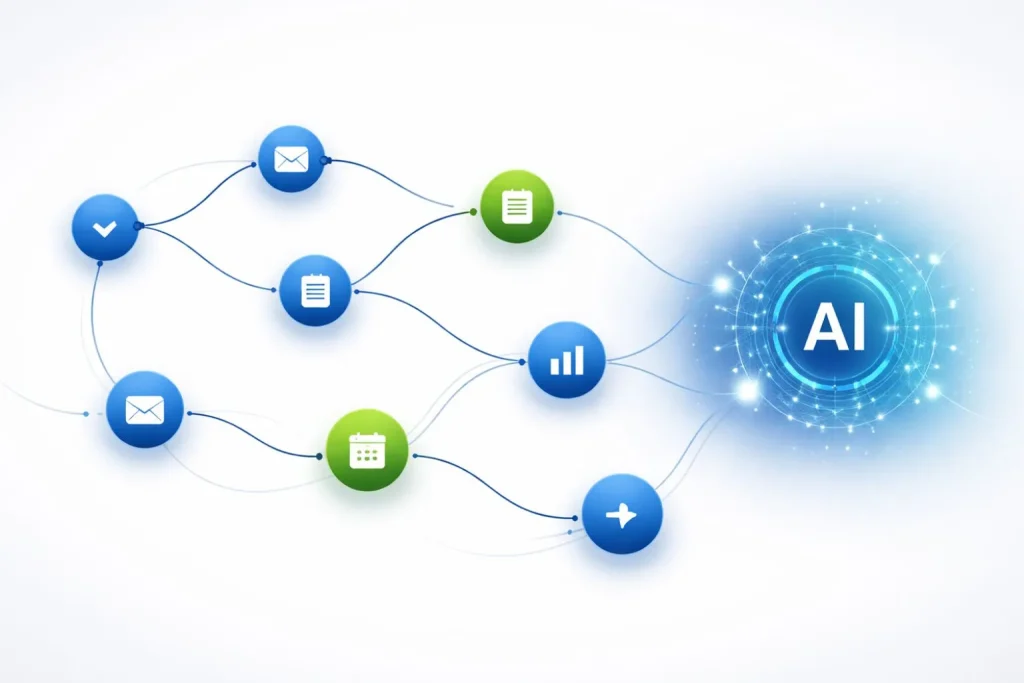
Productivity gains feel good but don’t justify budget unless you can measure them.
AI-powered business automation ROI comes from three sources: time savings, error reduction, and capability expansion each measurable with the right framework.
Time saving sare the most obvious metric but require precise measurement. Track the average time spent on a task before automation and after. If customer onboarding took 45 minutes per customer and now takes 8 minutes, that is 37 minutes saved per customer onboarded. Multiply by the number of customers onboardedper month and the hourly cost of the person doing the work. That is your monthly time savings in dollars.
Error reduction has a harder-to-measure but often larger impact. Manual data entry errors cost businesses an average of 15-25% in rework, customer complaints, and lost opportunities.
A McKinsey Global Institute report confirms that automation can reduce operational costs by up to 30% in the first year.
AI automation eliminates entire categories of errors-typos, duplicate records, missed follow-ups, incorrect routing. Calculate the cost of errors by tracking customer service tickets related to process mistakes before and after automation. The reduction is your error cost savings.
Capability expansion is the multiplier effect. Automation doesn’t just make existing work faster-it makes previously impossible work possible. You couldn’t personally follow up with every trial user based on their specific behavior. AI can. You couldn’t A/B test 50 subject line variations. AI can. You couldn’t monitor every customer account for churn signals. AI can. These new capabilities drive revenue growth that wouldn’t exist without automation.
The ROI formula:
ROI = (Time savings + Error reduction + Revenue from new capabilities − automation costs) / automation costs × 100
If you save $5,000 in time, $3,000 in error costs, generate $10,000 in new revenue, and spend $2,000 on automation tools, your ROI is 800%.
Track these metrics monthly. AI automation compounds—it gets better as it learns from more data. Your ROI in month one might be 200%. By month six, it might be 1,000%. The investment pays back faster over time, not slower.
The mistake most businesses make: they measure implementation effort instead of ongoing impact. AI automation isn’t a project-it’s a capability that improves continuously. Measure it like you’d measure a team member who gets better at their job every month.
The future of work: AI-powered business automation and human collaboration
The question isn’t whether AI will replace jobs.
The real question is how AI-powered business automation will reorganize work around what humans and AI each do best.
Humans excel at ambiguity, creativity, relationship-building, strategic judgment, and ethical reasoning. AI excels at pattern recognition, data processing, consistency, speed, and operating without fatigue. The businesses that win are the ones that deliberately design workflows to leverage both.
Task redesign separates execution from decision-making. Instead of a marketing manager writing emails, scheduling them, tracking opens, and analyzing results, AI handles execution and analysis. The manager focuses on strategy — deciding what offers to test, which segments to prioritize, how to position the product. Their role shifts from operator to strategist.
Augmentation becomes the default mode. Customer service reps don’t answer every question they handle complex issues while AI resolves routine requests. AI surfaces relevant knowledge articles, suggests responses, and drafts replies. The rep reviews, adjusts for tone and context, and approves. The human adds judgment; the AI adds speed.
Learning systems replace static processes. Traditional businesses document processes in manuals that become outdated immediately. AI-augmented businesses treat every workflow as a learning opportunity. The system captures what worked, identifies patterns, and suggests improvements. Your operations manual writes itself based on actual performance data.
Skill evolution accelerates. When automation handles routine work, your team develops higher-level capabilities faster. Junior team members work on strategic projects sooner because the operational burden decreases. Your org chart flattens because fewer people are needed for coordination and more people focus on value creation.
The cultural shift matters more than the technology. Teams need to trust AI recommendations without becoming dependent on them. They need to know when to override the system and when to follow it. They need to view automation as a tool that amplifies their capabilities, not a replacement that threatens their role.
Companies that navigate this transition well don’t just implement tools they rethink how work flows. They ask “What should humans do?” and “What should AI do?” for every process. They design roles around judgment and creativity instead of task completion. They measure team performance by outcomes, not activity.
The future isn’t humans versus AI. It’s humans with AI versus humans without it. The productivity gap between the two grows every month.
According to Harvard Business Review, companies that combine human judgment with AI automation consistently outperform competitors relying on either approach alone.