
Running an e-commerce business is not only about marketing and sales.
From my experience, profitability is often decided behind the scenes: inventory accuracy, supply chain efficiency, and internal automation.
This is where AI becomes a real game changer.
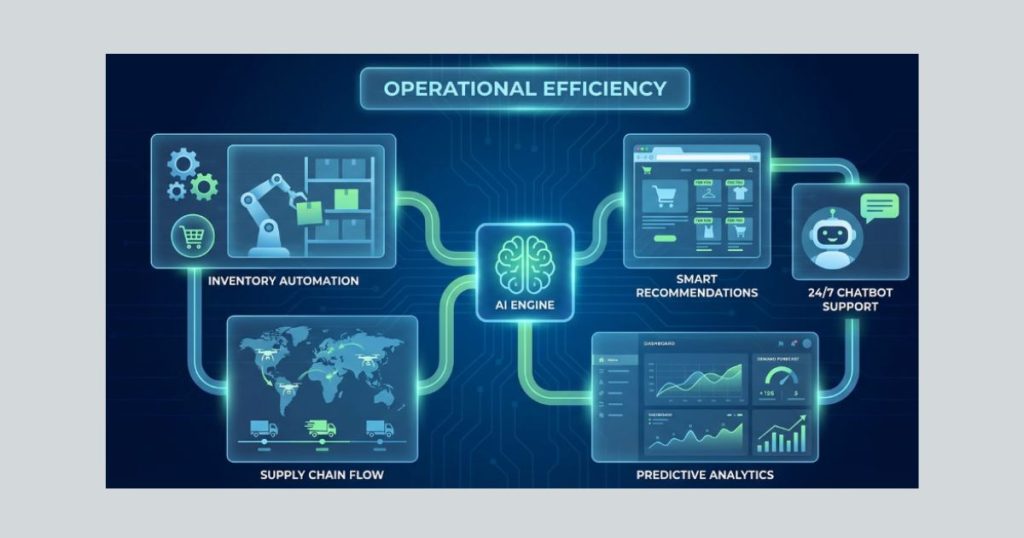
In this article, I explain how I use AI to improve operational efficiency in e-commerce — reducing costs, optimizing inventory, and automating workflows — and why AI inventory management ecommerce is becoming essential for scalable and profitable online businesses.
Why operational efficiency matters in e-commerce?
I quickly learned that growth without control leads to problems:
- Overstocked products that block cash flow
- Stockouts that kill sales and trust
- Manual processes that waste time
- Logistics errors that increase costs
AI helps me move from reactive management to predictive and automated operations.
For any serious e-commerce business, efficiency is not optional — it’s the foundation of profitability.
AI inventory management e-commerce: smarter stock decisions
What AI brings to inventory management
Traditional inventory management relies on past sales and spreadsheets.
AI goes further by analyzing:
- Historical sales data
- Seasonality and trends
- Customer demand patterns
- External signals (promotions, events, market shifts)
This allows me to forecast demand more accurately and avoid costly mistakes.
Key benefits of AI inventory management
| Challenge | Traditional Approach | AI-Powered Approach |
| Demand forecasting | Manual estimates | Predictive analytics |
| Stockouts | Reactive restocking | Anticipation of demand |
| Overstock | Excess inventory | Optimized stock levels |
| Cash flow | Capital blocked | Better liquidity |
With AI inventory management ecommerce, I maintain the right stock, at the right time, in the right place.
Supply chain optimization with AI
From complexity to clarity
Supply chains are complex, especially when selling across multiple channels or regions.
AI helps me:
- Identify bottlenecks
- Optimize supplier selection
- Predict delays
- Reduce transportation costs
Instead of reacting to problems, I can anticipate them.
How AI improves supply chain performance?
| Supply Chain Area | AI Impact |
| Supplier planning | Demand-driven ordering |
| Logistics | Route optimization |
| Delivery time | Predictive ETA |
| Cost control | Data-driven decisions |
This level of visibility is essential when scaling an e-commerce operation.
Automation: saving time and reducing human error
Why i rely on automation?
Manual processes slow everything down:
- Order processing
- Inventory updates
- Customer notifications
- Internal reporting
AI-powered automation allows me to run operations with fewer resources while maintaining accuracy.
What i automate with AI?
| Process | AI Automation Benefit |
| Order fulfillment | Real-time stock sync |
| Inventory updates | Automatic adjustments |
| Reordering | Smart restock triggers |
| Reporting | Real-time insights |
Automation is not about replacing humans — it’s about freeing time for strategic decisions.
The financial impact: cost reduction & profitability
Operational AI directly impacts profitability.
Here’s what I gain:
- Lower storage and logistics costs
- Fewer lost sales due to stockouts
- Reduced labor costs
- Better forecasting = better margins
AI doesn’t just improve operations — it protects cash flow and margins, which is critical in competitive e-commerce markets.
Why AI makes e-commerce scalable?
Scaling without AI means:
- More staff
- More errors
- More complexity
With AI-driven inventory, supply chain optimization, and automation, I can:
- Handle higher volumes
- Expand to new markets
- Maintain operational control
This is why AI is not a luxury — it’s a scalability requirement.
Operational efficiency is one dimension of a much deeper transformation that affects every layer of an online business.
Final thoughts
From my perspective, operational efficiency is the silent driver of e-commerce success.
By adopting:
- AI inventory management ecommerce
- AI-powered supply chain optimization
- Intelligent automation
I turn operations into a competitive advantage rather than a cost center.
For any e-commerce business focused on long-term profitability, AI is no longer optional — it’s operational intelligence.