
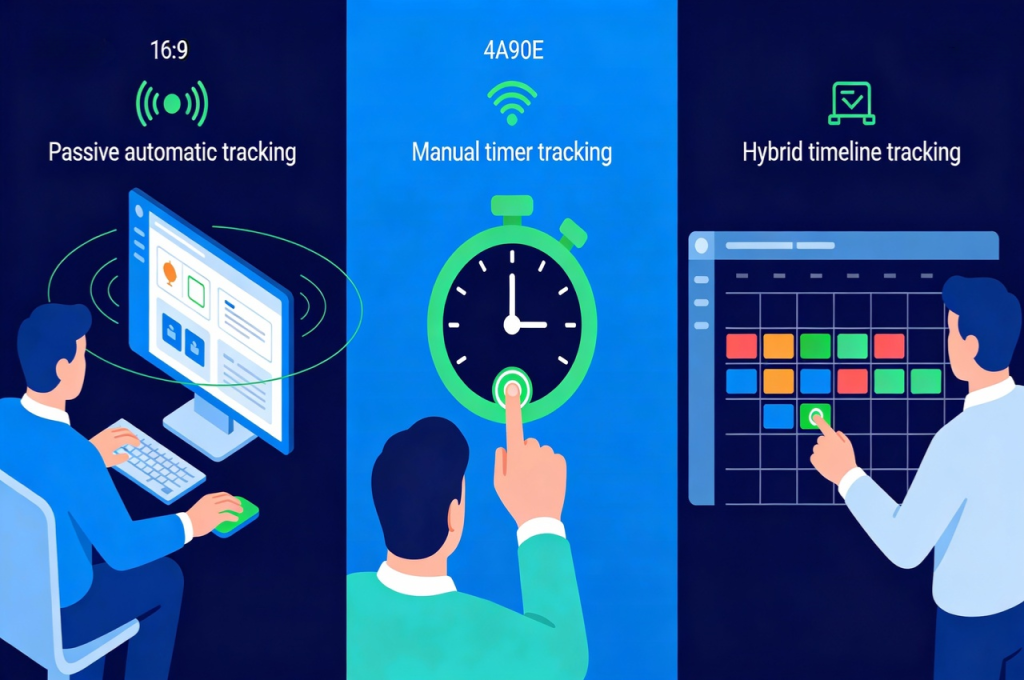
Your perception of time allocation can differ significantly from reality according to multiple studie tracking entrepreneurs objectively. RescueTime captures attention patterns passively while Toggl demands manual timer discipline and Timely reconstructs timelines visually for post-factum assignment. The methodology you choose between passive, automatic, and manual active profoundly impacts both adoption longevity and insight quality. Understanding these fundamental differences alongside integration capabilities and analytics depth helps you select tracking approaches that actually improve your overall AI time management effectiveness rather than adding administrative overhead.
Automated time tracking: RescueTime vs Toggl vs Timely.
Your perception of time allocation can differ significantly from reality according to multiple studies tracking entrepreneurs objectively. You probably believe you spend 3 hours daily on strategic work when actual measurement reveals 90 minutes fragmented across interruptions.
This gap between perception and reality explains why time optimization efforts often fail. You can’t improve what you don’t measure accurately. Manual estimation and memory both prove
unreliable for understanding where hours actually disappear throughout your week. The three AI-powered platforms examined here represent fundamentally different philosophies about tracking methodology. RescueTime captures attention patterns passively while Toggl demands manual timer discipline and Timely reconstructs timelines visually for retrospective assignment. Your choice between these AI approaches profoundly impacts both adoption longevity and insight quality over months of use.
RescueTime: The AI-Powered Passive Attention Guardian.
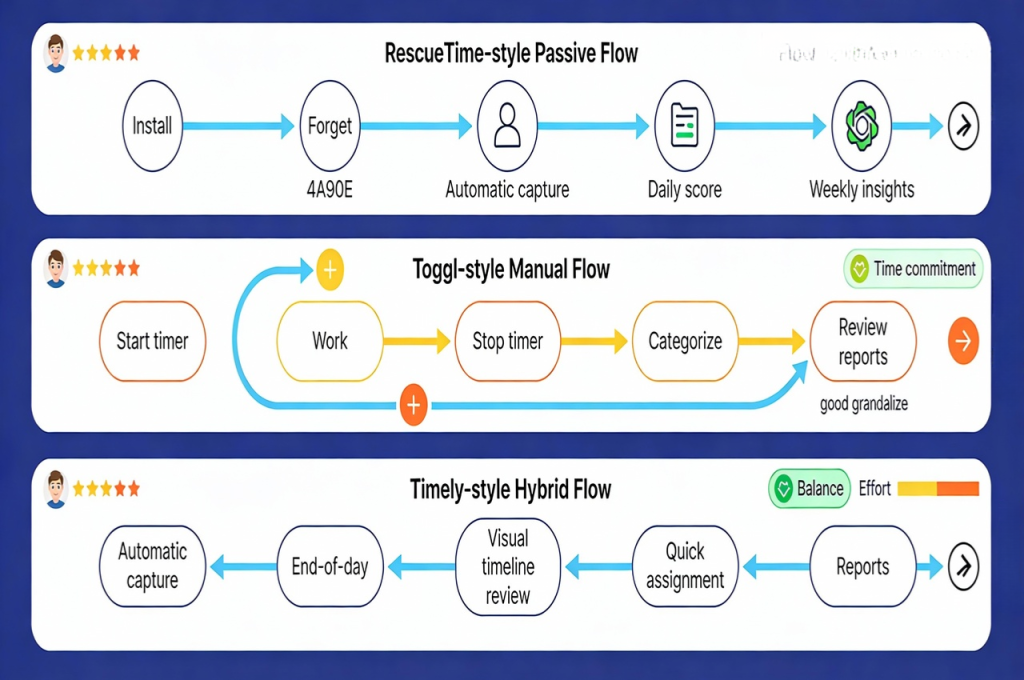
RescueTime operates silently in background, categorizing every application and website you visit according to productivity levels. The AI platform requires virtually no conscious interaction after initial setup, making it ideal for people who hate administrative overhead.
The AI system automatically classifies activities as very productive, productive, neutral, distracting, or very distracting based on default categories and your custom rules. Watching YouTube during work hours gets flagged as distraction while using your project management tool counts as productive time.
The real value emerges in revealing invisible leaks consuming hours weekly. Those five minutes checking social media repeated ten times daily total nearly an hour you never consciously noticed losing. Email that feels like 30 minutes actually absorbed 90 when you count all the brief checks throughout the day.
AI-powered daily productivity scores create natural gamification without forced discipline.
You instinctively work to improve your score, which gently nudges behavior toward better
habits. This psychological mechanism proves more sustainable than willpower-based approaches.
AI focus time features complement awareness by blocking access to distracting sites during designated work sessions. You can’t visit Twitter during your morning deep work block even if temptation strikes. This external AI constraint breaks automatic procrastination habits.
AI-generated detailed reports show productivity trends over time, revealing patterns invisible day to day. Perhaps your Tuesday mornings consistently outperform Friday afternoons.
Maybe post-lunch productivity crashes harder than you realized.
Strengths: – Zero daily effort required – Reveals unconscious time leaks – Natural gamification through scores – Excellent for digital knowledge workers
Limitations:
Physical meetings, phone calls, whiteboard sessions, and paper-based work remain invisible to RescueTime. A consultant splitting time between video conferences and in-person client visits gets incomplete picture.
Pricing: $6 monthly for premium features
Best for: Solo entrepreneurs focused on personal productivity optimization
Toggl Track: AI-enhanced precision for billing.
Toggl Track takes the opposite philosophical approach by prioritizing accuracy over automation. You explicitly start and stop timers for each activity, creating precise record of every work session.
This manual discipline demands more cognitive overhead but delivers superior granularity for client billing and project profitability analysis. You can assign every minute to specific clients, projects, and tasks, then generate automated invoices or internal cost reports.
The ability to categorize work across multiple dimensions simultaneously proves valuable for agencies and consultancies. That 90-minute session gets tagged with client name, project phase, task type, and team member, creating rich dataset for business intelligence.
AI-enhanced integration with 100+ applications allows starting timers directly from Trello,
Asana, or your project tool without interface switching. You click “start timer” and it flows
automatically to Toggl with appropriate project tagging.
AI-powered detailed reports dissect time allocation across every dimension: by client, by project, by task type, by team member for collaborative work. This granularity identifies profitable client relationships versus time sinks with clarity impossible through estimation.
The Pomodoro timer integration structures focused work into 25-minute sessions followed by 5-minute breaks. This technique backed by substantial productivity research prevents cognitive exhaustion while maintaining high output.
Strengths: – Precise billing accuracy – Multi-dimensional categorization – 100+ tool integrations – Detailed profitability analysis
Limitations:
Manual overhead becomes burdensome for people with highly fragmented work patterns.
Forgetting to start timers, switching contexts every few minutes, or working across many
brief tasks makes Toggl frustrating.
Pricing: $10 per user monthly for basic plans
Best for: Consultants billing hourly, agencies managing multiple client accounts
Timely: AI-powered hybrid intelligence approach.
Timely bridges the philosophical gap between fully automatic and fully manual tracking. The
AI platform captures all digital activities automatically, then presents visual timelines you can
assign to projects with quick clicks.
You reconstruct your day retrospectively without managing timers throughout work sessions.
Automatic AI capture ensures nothing gets forgotten while manual assignment maintains
accuracy for client billing. This AI hybrid delivers advantages of both pure approaches.
The AI-powered visual timeline makes pattern recognition intuitive. You immediately spot
blocks of deep concentration, fragmented periods, and time lost in administrative overhead.
Colored segments show application usage and meeting attendance, creating comprehensive
activity map.
Memory AI technology learns from your assignment patterns to suggest categorizations automatically. If you consistently assign morning email time to internal operations, the AI system starts proposing that category for similar future activities. The intelligence improves continuously through use.
AI-powered team features allow managers to understand workload distribution without invasive surveillance. The focus remains on project progress and capacity planning rather than micromanaging individual minutes. This respectful AI approach maintains team morale while providing necessary visibility.
Privacy controls ensure employees feel comfortable using the AI system. Team members can mark certain periods as private, preventing managers from seeing specific activities during those times. This balance between transparency and boundaries proves crucial for adoption.
Strengths: – Automatic capture, manual assignment – Visual pattern recognition – Learning AI suggestions – Respectful team features
Limitations:
The AI platform excels for project-based work requiring accurate time allocation but may feel
like overkill for simpler tracking needs.
Pricing: $8-20 per user monthly depending on features
Best for: Agencies and teams managing multiple projects, designers, writers, consultants
Feature comparison across AI dimensions.
Tracking Methodology.
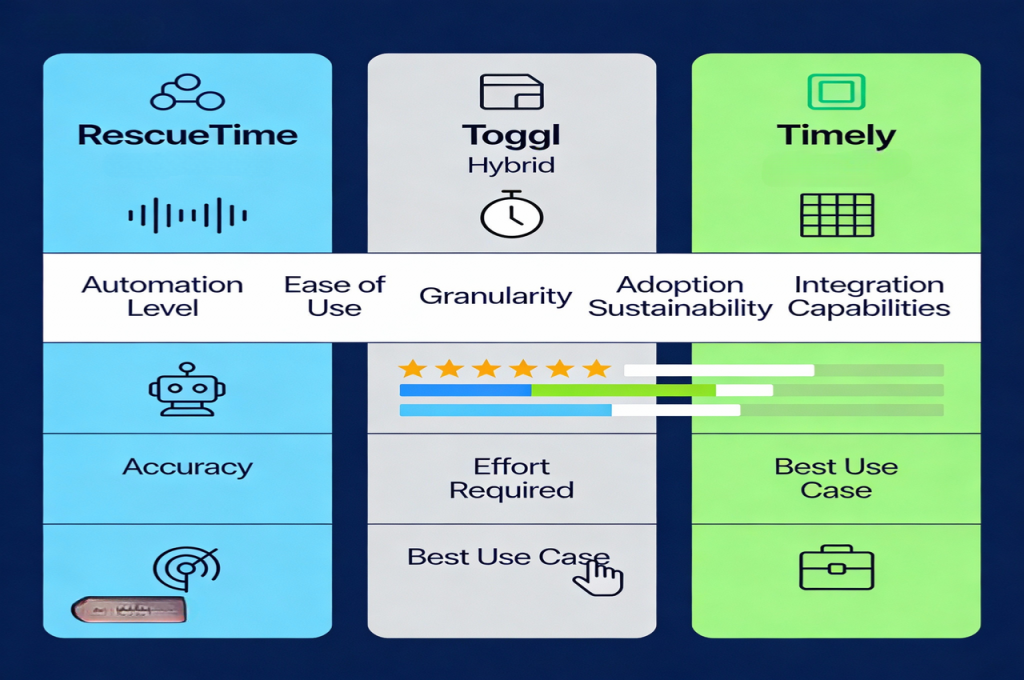
RescueTime’s passive approach requires zero daily discipline but provides less granular project assignment. Toggl’s active timers deliver precision at the cost of constant attention.
Timely’s AI retrospective assignment balances both concerns.
Categorization Flexibility
RescueTime uses broad productivity classifications suitable for personal optimization but insufficient for client billing. Toggl allows unlimited custom hierarchies perfect for complex project structures. Timely supports AI-powered project assignment with reasonable flexibility.
Reporting Depth
RescueTime provides solid productivity analytics but limited business intelligence. Toggl excels at multidimensional reporting across clients, projects, and team members. Timely offers comprehensive AI-powered project profitability analysis.
Integration Ecosystem
Toggl leads with 100+ native connections to project management, CRM, and accounting platforms. RescueTime focuses on productivity tools and website tracking. Timely integrates
with major project management systems.
Mobile Functionality
Toggl offers robust mobile apps with full timer functionality. RescueTime tracks mobile device usage but with less sophistication than desktop. Timely provides mobile timeline viewing and basic AI assignment.
Team Collaboration
RescueTime remains primarily individual-focused tool. Toggl supports team time tracking and reporting from foundation. Timely builds specifically for AI-powered team capacity planning and project management.
Choosing based on your work style.
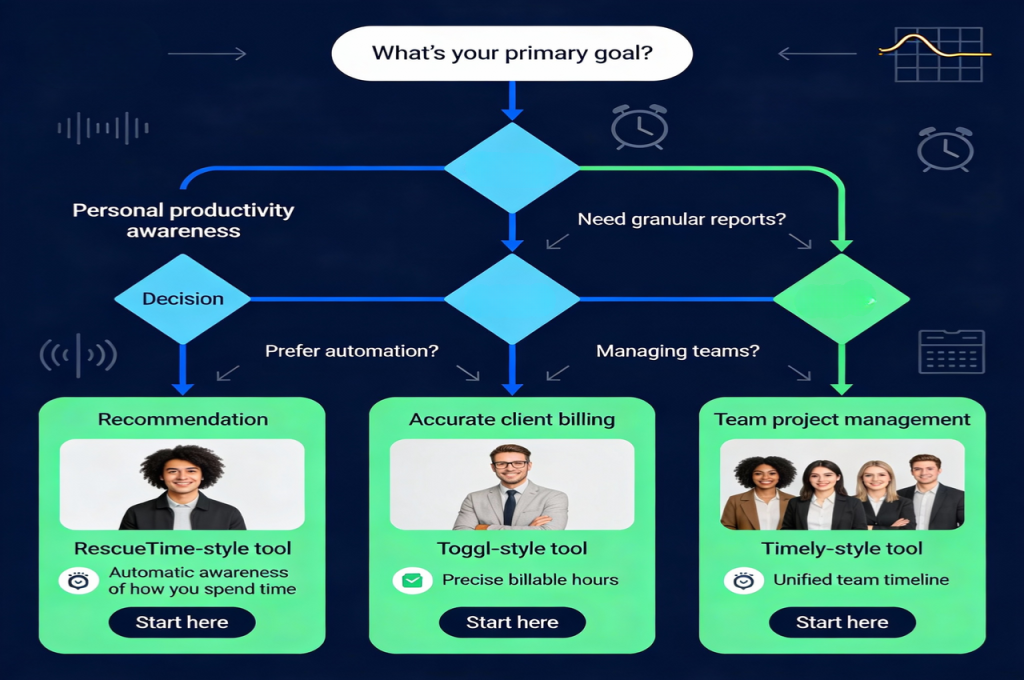
Solo entrepreneurs focused on personal productivity optimization benefit most from RescueTime’s effortless AI tracking and attention management. The passive approach eliminates administrative burden while revealing optimization opportunities.
Consultants and freelancers billing clients hourly require Toggl’s precision and detailed client-project reporting. The manual overhead justifies itself through accurate invoicing and clear profitability visibility.
Agencies and teams managing multiple projects need Timely’s balance of automatic AI capture and flexible assignment. The retrospective AI workflow maintains accuracy without
disrupting creative processes.
The ideal scenario often combines AI tools strategically. RescueTime for personal attention awareness plus Toggl or Timely for billable client work creates comprehensive coverage.
The modest subscription costs justify running multiple specialized AI tools simultaneously.
Getting actionable insights from AI data.
Raw tracking data provides limited value without systematic AI analysis and action. Weekly review sessions comparing time allocation against stated priorities reveal misalignment between intentions and reality.
Calculate your effective hourly rate by dividing revenue by tracked billable hours. This AI metric exposes clients or projects consuming disproportionate time relative to fees charged. Identify your peak productivity windows by correlating tracked focus time with output quality using AI analytics. Perhaps morning hours generate your best strategic thinking while afternoons suit administrative tasks.
Audit meeting time separately to prevent calendar bloat. Track total hours in meetings weekly and categorize by value delivered using AI analytics. Many entrepreneurs discover that a significant portion of meeting time generates minimal return and can be eliminated.
Compare estimated task durations against actual completion times. If you consistently underestimate, apply AI correction factors to future planning. This calibration improves schedule reliability dramatically.
Time tracking is only one component of a broader system. For a complete framework that combines tracking, scheduling, and prioritization, see our guide on AI time management for entrepreneurs. For comprehensive integration of AI time tracking with intelligent scheduling and systematic prioritization, explore how complete productivity systems combine measurement, optimization, and automation to generate compounding efficiency gains across all entrepreneurial activities.