
Acquiring new customers in US ecommerce has become increasingly costly across most categories. For a brand doing $80,000 a month, that acquisition spend disappears the moment a first-time buyer does not return. Ecommerce customer retention AI changes this by automating the follow-up, the loyalty logic, and the offer calculation that most teams handle manually or skip entirely.
The problem is not effort. Most Shopify brands know they should be running win-back sequences, loyalty programs, and personalized offers. The problem is execution at scale. A 2-person team cannot manually segment 15,000 customers, calculate reorder windows, and write individualized offers every week.
AI retention systems handle all of that. They monitor purchase behavior, assign loyalty scores, trigger the right message at the right time, and adjust offer values based on predicted customer value. The result is a repeatable revenue engine that runs without daily management.
This guide covers the 5 core pillars of AI-driven customer retention: behavioral loyalty, Shopify automation stacks, AI-powered repeat sales sequences, loyalty program design, and customer lifetime value measurement. Each section includes concrete examples from US Shopify brands, practical tools, and steps you can act on immediately.
Table of contents
Why ecommerce customer retention AI outperforms acquisition in 2026
US ecommerce brands spent more on customer acquisition in 2024 and 2025 than in any previous period. Meta CPMs rose year-over-year. Google Shopping CPCs climbed across most competitive categories. The brands that maintained profitability were not those that found cheaper traffic. They were those that extracted more revenue from customers they already had.
The acquisition cost problem in US ecommerce

The math is straightforward. A brand spending $60 to acquire a customer who buys once generates $60 in acquisition cost per order. A brand that brings that same customer back 3 times spreads that $60 across 3 orders, reducing cost per order to $20. At scale, this difference determines whether a brand is profitable or not.
Manual retention does not change this math. A 15% discount sent to your entire list rewards customers who would have bought at full price and trains others to wait for the next sale. It also misses customers who are close to churning. The activity creates the appearance of a retention strategy without the precision that makes it profitable.
What AI makes possible that manual retention cannot
Ecommerce customer retention AI does 3 things that manual retention cannot. First, it scores every customer in real time: assigning a predicted purchase probability, a churn risk score, and an estimated lifetime value. These scores update automatically as purchase behavior changes.
Second, it personalizes timing. AI sends messages when a specific customer is statistically likely to buy, not on a fixed calendar schedule. A customer who buys every 45 days receives a reorder prompt on day 40. A customer whose purchase frequency has dropped receives a win-back offer before they disappear entirely.
Third, it matches offer to value. High-LTV customers receive exclusive access, early launches, and tiered rewards. Lower-LTV at-risk customers receive a targeted discount calculated against their predicted margin contribution. No flat offers sent to everyone.
A Dallas, Texas home goods brand on Shopify Plus illustrates this shift. Before implementing AI retention, they sent the same bi-weekly email to all 9,000 customers. After deploying Klaviyo predictive analytics, they segmented their list into 5 behavioral cohorts and ran separate automations for each. Within 4 months, repeat purchase rate increased from 18% to 29%, and revenue from existing customers grew by $14,000 per month without increasing marketing budget.
Key insight: Ecommerce customer retention AI shifts the unit economics of your business by extracting more value from customers you already paid to acquire. The brands winning on retention in 2026 are running more precise systems, not harder ones.
AI customer loyalty ecommerce: how behavioral data builds repeat buyers
AI customer loyalty in ecommerce works differently from traditional points-based programs. Instead of rewarding total spend, AI loyalty systems monitor behavioral signals: what a customer buys, how often, through which channel, at what price point, and after which trigger. The system assigns a loyalty score based on this combination, not just the dollar total. This distinction matters because different customers respond to entirely different rewards, and a points balance cannot capture that.
Moving from points to behavior-based loyalty
Traditional loyalty programs reward volume. A customer earns 1 point per dollar, accumulates to a redemption threshold, and gets a coupon. The program cannot distinguish between a high-frequency low-margin buyer and a low-frequency high-margin buyer. It applies the same logic to both.
AI customer loyalty in ecommerce changes the input. The system monitors 4 behavioral signals: purchase recency, purchase frequency, average order value, and product category affinity. These inputs combine into a loyalty score that updates in real time. A customer who has placed 3 orders in 30 days with increasing cart values scores differently from a customer who placed 3 orders in 6 months with declining ones.
This distinction determines the reward type. A high-frequency buyer who always responds to product launches does not need a discount. Early access to a new collection costs you nothing and reinforces the behavior you want. A mid-tier customer who has not bought in 60 days may respond to a targeted 12% offer on a category they have browsed. The AI matches reward type to behavioral pattern automatically.
How AI segments loyalty automatically
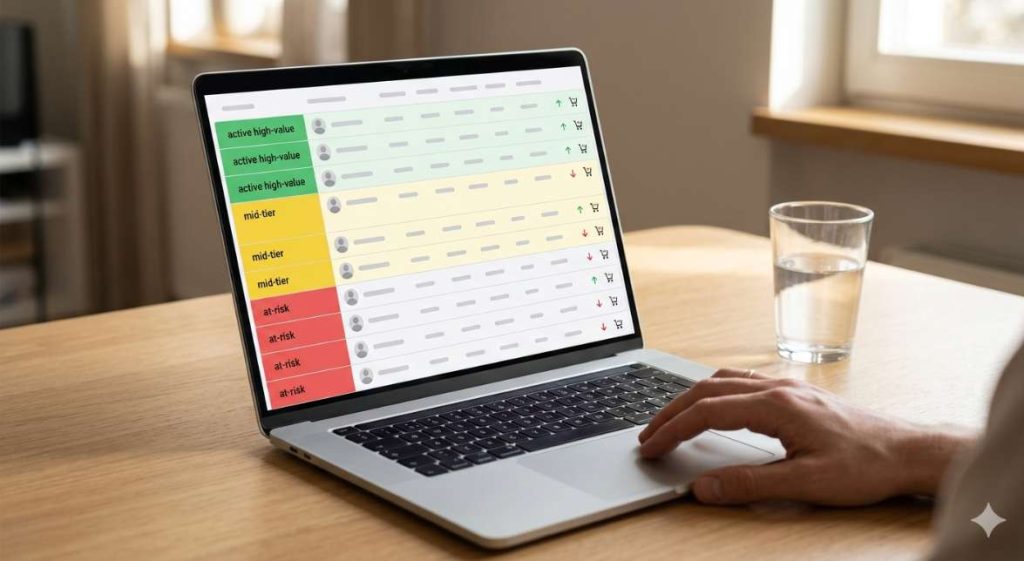
score drops, the system moves them from the active tier to the at-risk segment and triggers a different retention sequence, without any manual list management.
Tools like Klaviyo, Yotpo, and LoyaltyLion segment customers automatically based on the 4 behavioral inputs above. Segments update in real time. When a customer’s recency score drops, meaning they have not bought in longer than their typical cycle, the system moves them from the active retention segment to the at-risk segment and triggers a different automation sequence.
No manual list management is required. You build the segments and the flows once. The AI routes each customer to the correct path based on their current behavioral score, not a static tag you assigned at signup.
A Portland, Oregon pet supply brand used Klaviyo’s predictive analytics to identify their top 15% of customers by predicted lifetime value. They built a VIP tier called Pack Members with 3 exclusive benefits: early access to new products, free shipping on all orders, and a monthly AI-curated bundle recommendation. No flat discounts were offered to this tier. Average order value for Pack Members increased 28% within 3 months, and their repeat purchase rate reached 71%.
Key insight: AI customer loyalty in ecommerce is not about rewarding the most spending. It is about identifying which behavior patterns predict long-term value and reinforcing those patterns with the right incentive at the right time.
Customer retention automation Shopify: building a 3-layer stack
Customer retention automation on Shopify works through the combination of 3 tool layers: email, SMS, and a loyalty platform. Each layer handles a distinct channel. All 3 pull from the same behavioral data your Shopify store generates. When these layers operate together, they create a retention system that reaches any customer through the right channel at the right moment, without manual intervention.
Email automation with Klaviyo
Klaviyo is the standard email layer for Shopify retention because it integrates directly with Shopify’s purchase data, browsing behavior, and customer properties. Its predictive analytics engine calculates expected next order date, predicted LTV, and churn probability for every customer automatically. These predictions power flows: automated sequences that trigger based on behavior rather than calendar dates.
Core flows every Shopify brand should run: a post-purchase welcome series across days 3 through 30, a first-time buyer conversion sequence, a win-back sequence triggered at days 60, 75, and 90 of inactivity, VIP milestone triggers when a customer crosses a spend or order threshold, and replenishment reminders based on product consumption windows.
Setup: connect Klaviyo to Shopify, enable predictive analytics, and build 4 customer segments based on Klaviyo’s predicted LTV quartiles. Route each quartile to a different automation track from the start.
SMS retention with Attentive or Postscript

Attentive and Postscript both integrate with Klaviyo and Shopify to add a SMS channel that runs alongside email. SMS is not a replacement for email. It is a precision channel for time-sensitive messages: flash sales for VIP customers, restock alerts for browsed products, and win-back offers for customers who have not opened an email in 30 days.
SMS retention performs best when messages are under 160 characters, carry a clear offer, and link directly to a product page. A generic SMS pointing to the homepage converts at a fraction of the rate of a product-specific message tied to the customer’s purchase history.
Loyalty platform with LoyaltyLion or Smile.io
LoyaltyLion and Smile.io both integrate with Shopify, Klaviyo, and Attentive. They manage the points balance, tier structure, and reward catalog. Critically, they feed loyalty data back into Klaviyo: your email automations can reference a customer’s tier, point balance, and next reward milestone directly in the message body.
A Nashville, Tennessee home fragrance brand built this 3-layer stack over 10 weeks: Klaviyo in weeks 1 through 3, Postscript SMS added in week 4, LoyaltyLion connected in week 7. By the end of month 3, 34% of their monthly revenue came from repeat buyers, up from 21% before automation.
Key insight: Customer retention automation on Shopify works best as a 3-layer system where email, SMS, and a loyalty platform all share behavioral data and trigger separately based on the same customer signals.
Ecommerce repeat sales AI: the sequences that bring customers back
Ecommerce repeat sales AI works by predicting when a specific customer is statistically ready to buy again and reaching them before they purchase elsewhere. The 3 highest-performing sequences are post-purchase nurture, predictive reorder, and win-back. Each targets a different stage of the customer journey and requires a different message logic to perform well.
Post-purchase sequences (days 3 to 30)
Most brands send one post-purchase message: the order confirmation. The 30 days that follow are where the second purchase is won or lost.
Day 3: Product use and setup email. Practical tips, video tutorials if applicable. No offer yet.
Day 7: Social proof follow-up. Reviews from buyers of the same product. Soft prompt to explore a related category.
Day 14: Cross-sell offer. AI recommends the most likely next product based on the first purchase. Keep the offer mild: 5% to 10% for first-time buyers, no discount for high-LTV segments.
Day 30: Engagement check. If no second purchase, send a targeted prompt with a category recommendation. If they have bought again, move them into the active repeat buyer segment and end the sequence.
Win-back and churn prevention sequences
A customer who last purchased 75 days ago and has not opened the last 4 emails is at high churn risk. Ecommerce repeat sales AI identifies this automatically and routes the customer into a win-back sequence.
Win-back messages should be direct: acknowledge the gap, show what is new, and include a meaningful offer. Calculate the offer based on predicted LTV. High-LTV churning customers justify a 15% to 20% offer. Low-LTV at-risk customers receive a smaller offer or are removed from active spend. Not every win-back is worth the margin cost.
Predictive reorder triggers
Consumable products like supplements, skincare, pet food, and cleaning supplies have predictable consumption windows. A customer who buys a 60-day supply of collagen peptides should receive a reorder prompt on day 52, not day 60. By day 60, they may have already ordered from a competitor.
Klaviyo’s predictive analytics calculates expected next order date for each customer based on their individual purchase history, not the product’s generic consumption window. A customer who double-orders every 45 days receives a prompt at day 40. This personalization increases reorder conversion significantly versus fixed-date reminders.
A Boston, Massachusetts skincare brand used predictive reorder triggers calibrated to their 60-day moisturizer cycle. The reorder prompt arrived on day 52, with the next replenishment item selected automatically by AI based on browsing history. This single automation generated $18,000 per month in additional repeat revenue within 90 days of launch.
Key insight: Ecommerce repeat sales AI is most effective when it targets the moment of repurchase intent: a behaviorally predicted window when a specific customer is ready to buy, not a fixed date on a campaign calendar.
AI loyalty program ecommerce: design principles that protect margins
An AI loyalty program in ecommerce must solve 2 problems simultaneously: increasing repeat purchase frequency and protecting gross margin. Most loyalty programs solve the first while slowly eroding the second. A flat 10% discount for all members rewards customers who would have bought at full price, trains others to wait for promotions, and applies the same offer to a $200 LTV customer and a $2,000 LTV customer with no distinction between them.
Tiered loyalty structures and VIP tiers
A tiered AI loyalty program separates customers into 3 to 4 levels based on behavioral score, not just total spend. A practical structure for a US Shopify brand:
Tier 1 (Entry): Standard points, basic perks such as free shipping above $75.
Tier 2 (Regular): Faster point accrual, early access to new collections, exclusive product bundles.
Tier 3 (VIP): Concierge experience, exclusive events, no-minimum free shipping, priority support queue.
Tier 4 (Elite, optional): Reserved for the top 1% to 2% by LTV. Personal outreach and invitation-only product launches.
Tier upgrades should happen automatically based on behavioral thresholds: 4 orders in 6 months or $500 in spend within 90 days. No manual assignment required.
Earned vs. expected discounts

The most important distinction in loyalty program design is between earned discounts and expected discounts.
An expected discount is one the customer waits for. If you send a 15% coupon every November, your customers learn to delay their October purchase. You have trained them to hold off rather than act. This pattern is common in brands that run the same promotional calendar year after year, often without realizing the behavior they have created.
An earned discount is unlocked by behavior. A customer who completes their 5th purchase earns a reward. A customer who refers 3 friends earns a tier upgrade. A customer who reaches a spend milestone earns early access to a product launch. These rewards reinforce the behavior you want and are not perceived as standard promotions.
AI loyalty systems automate the earned discount calculation. When a customer crosses a behavioral threshold, the system calculates the appropriate reward, issues it automatically, and sends a personalized message explaining exactly what they earned and why.
Dynamic discount rules based on customer LTV
High-LTV customers do not need discounts to buy again. Offering them a 20% coupon wastes margin. Low-LTV customers at churn risk may need a meaningful offer to return. The AI calculates the appropriate offer level based on 3 inputs: predicted lifetime value, purchase probability in the next 30 days, and the product margin floor.
A Chicago, Illinois apparel brand rebuilt their loyalty program around this logic. They removed flat 10%-off coupons for all members and replaced them with behavioral rewards: early access for VIP customers, bundle upgrades for mid-tier customers, and targeted 12% offers only for customers at churn risk. Monthly discount spend dropped by $4,200, retention rates held steady, and revenue from loyal customers grew 11%.
Key insight: An AI loyalty program in ecommerce protects margins by treating discount offers as a last resort, not a default. The system uses behavioral data to determine which customers need a price incentive and which respond better to access and experience.
Customer lifetime value ecommerce AI: how to measure and grow it
Customer lifetime value ecommerce AI is the metric that connects every retention decision to a financial outcome. Without LTV data, retention spend is guesswork. With it, every automation, loyalty reward, and win-back offer can be calibrated against a measurable expected return. For a Shopify brand managing thousands of customers, LTV-based retention is the difference between spending on the right people and spending uniformly across all of them.
What customer lifetime value means for ecommerce SMBs
LTV measures the total net revenue a customer is expected to generate over their relationship with your brand. It is not the same as total historical spend. It accounts for discount redemptions, return rates, support costs, and margin by product category.
The practical question for a Shopify brand is this: over the next 12 months, how much profit will this specific customer generate? A customer with a predicted 12-month LTV of $420 justifies a $60 win-back offer. A customer with a predicted LTV of $80 does not. Making this calculation for 15,000 customers weekly requires AI, not a spreadsheet.
How AI predicts LTV from purchase signals
AI predicts LTV by combining 4 purchase signals: order frequency, average order value, product category margins, and recency trend. Recency trend asks whether the customer is buying more or less over time. A customer with 3 orders in 3 months and increasing cart values has a rising LTV. A customer with the same order count but declining values and longer gaps between purchases does not.
Tools like Lifetimely, built specifically for Shopify, and Triple Whale compute predicted LTV at the customer and segment level. They also calculate LTV by acquisition channel: you can see that customers acquired via email generate significantly more lifetime value than those acquired via paid social and allocate your acquisition budget toward channels that produce the most valuable customers over time.
Using LTV tiers to prioritize retention spend

Once LTV predictions are in place, the strategic move is to build retention spend tiers around LTV quartiles.
Once LTV predictions are in place, the strategic move is to build retention spend tiers around LTV quartiles.
Top quartile (highest predicted LTV): High-touch retention. VIP loyalty tier, personal outreach, exclusive experiences, no-discount offers. This segment typically drives a disproportionate share of total revenue in US SMB brands.
Second quartile: Standard retention automation. Regular email flows, SMS reminders, mid-tier loyalty rewards. Focus on increasing order frequency.
Third quartile: Light automation. Basic post-purchase sequences and win-back if inactive. Minimal discount exposure.
Fourth quartile (lowest predicted LTV): Minimal spend. Standard email only. Remove from active retention budget if no purchase in 90 days.
A San Francisco, California health supplements brand used Lifetimely to map LTV tiers across 12,000 customers. Their analysis showed that the top 8% of customers generated 41% of total revenue. They shifted 60% of their retention budget to this segment and added a dedicated VIP flow, personal check-in emails, and an invitation-only subscription program. Revenue from this segment increased 19% in 6 months without any increase in total marketing spend.
Key insight: Customer lifetime value ecommerce AI is most actionable when used to determine where not to spend. Protecting and expanding high-LTV segments is more profitable than trying to upgrade customers who will never generate significant returns.
What you should take away from this
Ecommerce customer retention AI is not one tool or one campaign. It is a connected system where behavioral data feeds loyalty logic, loyalty logic drives automation sequences, and automation sequences are calibrated to customer lifetime value. When these elements work together, the result is a revenue engine that generates repeat sales without daily management.
Three steps to build this system:
1. Measure first. Connect Lifetimely or Triple Whale to your Shopify store and run a LTV analysis on your existing customer base. Identify your top quartile and your churn-risk segment before building any automation. Every retention decision that follows becomes sharper with this data in place.
2. Build the automation stack. Deploy Klaviyo for email, add SMS via Attentive or Postscript, and connect a loyalty platform such as LoyaltyLion or Smile.io. Start with post-purchase sequences and predictive reorder triggers. These generate the fastest measurable return.
3. Design loyalty around behavior, not discounts. Audit your current discount strategy. Replace flat offers with tiered, earned rewards for high-LTV customers. Reserve price incentives for churn-risk segments where the margin calculation justifies the spend.
To go deeper on specific retention systems covered in this guide:
- AI email and SMS automations for customer retention
- Predictive customer analytics and loyalty offers
- AI customer service as a sales and retention channel
- Dynamic discounting and margin protection for Shopify brands
Start with your LTV data. Every retention decision that follows is easier when you know which customers are worth retaining and exactly how much each one is worth to your business.