

Most entrepreneurs do not have a productivity problem. They have a structure problem.
They use AI tools every day – and still feel scattered. They produce content – but inconsistently. They work hard, but the results do not compound.
The missing piece is almost always the same: a clear AI productivity framework that connects strategy, tools, and execution into one repeatable system.
An AI productivity framework is not a list of tools. It is not a prompt library. It is a four-layer structure that tells you exactly what to do, in what order, with what tools – every single week.
If you are wondering why so many entrepreneurs stay stuck even after adopting AI tools, the answer is almost always the same – and it has nothing to do with the tools themselves. You can read more about why most entrepreneurs struggle before building a framework, before moving forward with this guide.
This article walks you through that framework, step by step. By the end, you will have a working model you can apply to your business starting today.
Table of Contents
Why every entrepreneur needs an AI productivity framework first

Before choosing a single tool, before writing a single prompt – you need an AI productivity framework.
Here is why. AI is an amplifier. It takes what you give it and scales it. If you give it a clear process, it scales efficiency. If you give it confusion, it scales confusion.
This is the chaos to system AI shift that separates entrepreneurs who get consistent results from those who stay stuck in a cycle of tool-switching and random output.
The cost of skipping the framework
When there is no AI productivity framework in place, three things happen predictably.
First, decisions multiply. Every task becomes a question: which tool should I use? What prompt works best here? Where do I save this output? These micro-decisions accumulate and drain your focus before the real work even begins.
Second, output becomes inconsistent. Some weeks you publish three pieces of content. Other weeks, nothing. Not because you lacked ideas – but because you had no structure to execute against.
Third, progress stalls. Without a framework, every month feels like starting over. There is no compounding. No momentum. Just effort without direction.
What changes when the framework exists
An AI productivity framework removes the daily decision fatigue. You know exactly what to do when you sit down to work. You know which tool handles which task. You know what the output looks like before you start.
That clarity is not a luxury. It is the foundation of everything that comes after.
The 4-step AI productivity framework explained
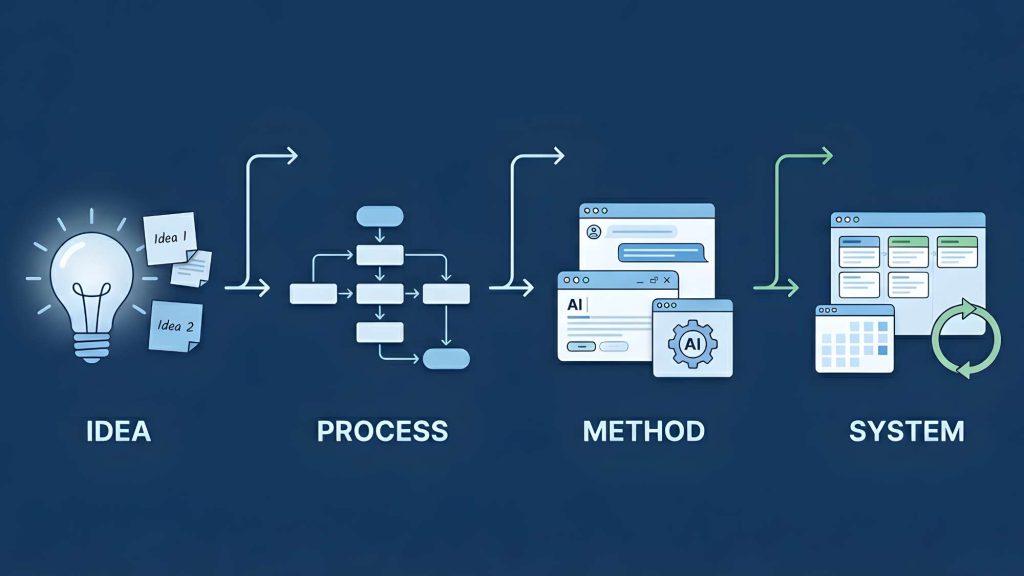
This AI productivity framework is built around four layers. Each layer builds on the previous one. Together, they form a complete productivity system for entrepreneurs that AI can run inside of – reliably, every week.
Step 1 – Idea: Define the outcome before you start
Every productive work session begins with one clear question: What is the one thing that needs to exist by the end of this session?
Not a vague goal. A specific output. One article. One email sequence. One social post series. One client proposal.
The AI productivity framework starts here because AI cannot define your goals for you. It can help you execute them. But the direction must come from you.
In practice: Before opening any tool, write one sentence – “By the end of this session, I will have [specific output] for [specific audience].” That sentence becomes your anchor for every decision that follows.
Step 2 – Process: Map the steps from zero to done
Once the outcome is defined, the next step in the AI productivity framework is to map the process. A process is simply the sequence of steps that moves you from blank page to finished output.
For a blog article, the process might look like this:
| Step | Action | Time |
|---|---|---|
| 1 | Keyword + angle confirmation | 10 min |
| 2 | Outline creation | 15 min |
| 3 | AI-assisted first draft | 30 min |
| 4 | Human review + voice edit | 20 min |
| 5 | SEO check + internal links | 10 min |
| 6 | Format + publish | 15 min |
This process does not change from week to week. It is fixed. Predictable. Repeatable. That stability is what makes the AI productivity framework work at scale.
Step 3 – Method: Assign the right tool to each step
Now that the process is mapped, each step gets a tool. This is the only point in the AI productivity framework where tool selection happens – and it happens inside the process, not before it.
The method layer answers one question per step: What is the most efficient way to complete this step?
Some steps need AI assistance. Some do not. A research step might use a search tool or Perplexity. A drafting step might use ChatGPT or Claude. A scheduling step might use Buffer or Later. A review step might need nothing but your own judgment.
Matching method to step prevents the most common framework failure: using AI where human thinking is needed, or doing manually what AI could handle in seconds.
Step 4 – System: Lock it in and repeat it
The final layer of the AI productivity framework is the one most entrepreneurs skip. A system is a process with a schedule attached.
A process you run once is an experiment. A process you run every Monday at 9am – that is a system.
Locking in the system means three things: setting a fixed time for the workflow, documenting it so anyone (or any AI) can follow it, and committing to running it for a minimum of four weeks before evaluating.
This is what transforms the AI productivity framework from a concept into a real engine for your business.
How to apply the AI productivity framework to your real work

Understanding the AI productivity framework is one thing. Applying it is another. Here is what implementation looks like in practice – with a real scenario.
A real example: content creation for a solo entrepreneur
Sarah runs a one-person consulting business in Atlanta. She wants to publish one long-form article and four social posts every week. Before adopting an AI productivity workflow, her process was reactive – she wrote when she felt inspired, which meant she published maybe twice a month.
After applying the AI productivity framework, her week looks like this:
Monday – 60 minutes:
- Step 1 (Idea): Confirm this week’s topic from her monthly content list
- Step 2 (Process): Build the article outline in Notion
- Step 3 (Method): Use ChatGPT to generate a first draft from the outline
- Step 4 (System): Save draft in Notion under “In Review”
Wednesday – 45 minutes:
- Human review, voice edit, SEO check
- Add internal links
- Schedule for Thursday publication
Friday – 30 minutes:
- Repurpose article into 4 social posts using AI
- Schedule on Buffer for the following week
Total time: under three hours per week. Output: one article + four posts, every week, without fail.
The AI productivity framework did not make Sarah faster at each task. It made her consistent, which is infinitely more valuable.
The one adjustment most people need to make
When entrepreneurs first apply the AI productivity framework, they tend to over-engineer Step 2 (the process). They add too many steps, too many review layers, too many approval points.
The rule is simple: if a step does not directly contribute to the final output, remove it. Start lean. Add complexity only when the simple version is already running smoothly.
Seeing a framework applied to a real weekly schedule makes this much easier to understand. If you want to see a full weekly AI workflow in action, that article walks through a complete example you can adapt to your own rhythm.
Build your system once – then let AI scale it
The power of the AI productivity framework is not in any single session. It is in what happens after four weeks of consistent execution.
When the same workflow runs every week, something shifts. Decisions disappear. Habits form. Output compounds. And the entrepreneur workflow system you built starts to feel effortless – not because the work got easier, but because the structure absorbed the cognitive load.
From solo system to scalable operation
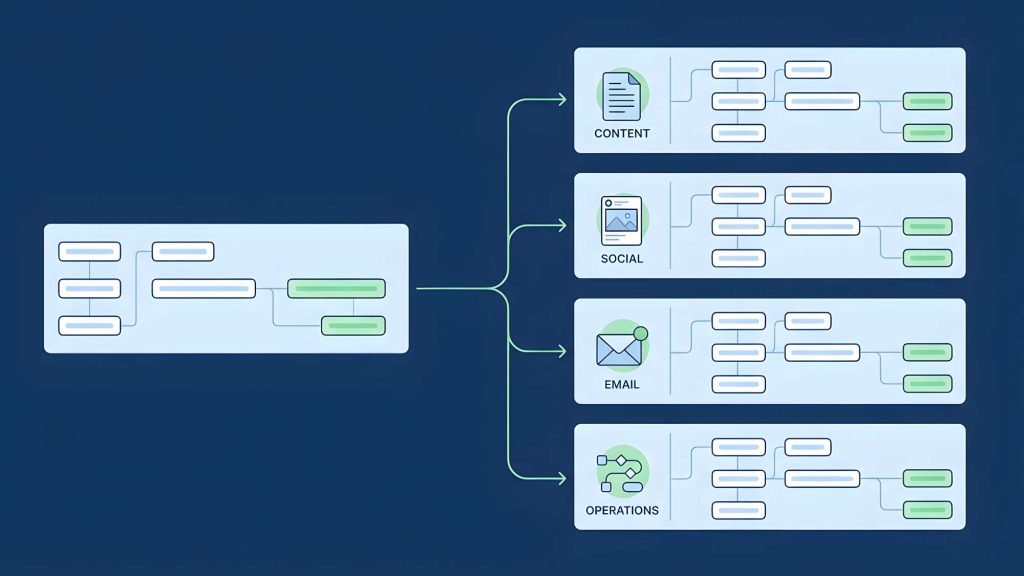
Once the AI productivity framework is running reliably for one content type, it can be duplicated for another. The same four-step logic – Idea, Process, Method, System – applies to email marketing, social media, client proposals, or internal documentation.
Each new system you build follows the same structure. You are not starting from scratch. You are applying a proven model to a new domain.
James, a freelance marketing strategist in Seattle, built his first AI productivity framework around blog content. Six months later, he had applied the same model to his LinkedIn strategy, his client onboarding emails, and his monthly reporting. Same framework. Three new systems. One methodology.
The compounding effect of a documented system
A documented system does one more thing that most entrepreneurs underestimate: it makes delegation possible.
When your AI productivity framework is written down – with steps, tools, timing, and expected outputs – anyone can follow it. A virtual assistant. A new team member. Even a more advanced AI agent.
You build it once. You document it clearly. Then you step back and let it run.
FAQ
What is an AI productivity framework exactly?
An AI productivity framework is a four-layer structure – Idea, Process, Method, System – that connects your goals to your tools through a repeatable workflow. It tells you what to do, in what order, with what resources, every time you sit down to work. Unlike a tool stack or a prompt library, a framework gives AI a clear process to execute inside, which is what makes the results consistent.
How long does it take to build an AI productivity framework?
The initial design takes about 30 to 60 minutes for one workflow. You define the output, map the steps, assign the tools, and set the schedule. The first two weeks are about running it and identifying friction points. By week four, most entrepreneurs report that the AI productivity framework feels natural and requires almost no active decision-making.
The real shift
An AI productivity framework is the structure that makes everything else work.
Without it, tools are distractions. Effort is scattered. Output is inconsistent. With it, AI becomes a reliable engine – one that runs the same process, every week, without requiring you to reinvent the wheel each time.
The four steps are simple: define the Idea, map the Process, assign the Method, lock in the System.
Start with one workflow. Run it for four weeks. Then build the next one on top of it.
That is how the AI productivity framework becomes the foundation of a business that compounds – quietly, consistently, and without burnout.