

Fifteen hours weekly equals 780 hours annually or nearly 100 full working days reclaimed through systematic AI integration. Week one audits your current time allocation revealing invisible leaks while week two implements two quick wins generating immediate motivation. Weeks three and four expand automation scope then optimize configurations based on behavioral data collected. This progressive approach prevents overwhelming deployment while building momentum through measurable victories. Following this structured methodology connects individual tactics into a coherent productivity transformation system that compounds gains across multiple domains rather than creating isolated improvements.
4-Week Action plan: From 60 to 40 hours with same output.
Most entrepreneurs waste significant time on coordination overhead, administrative friction, and operational busywork that intelligent AI systems now handle automatically. The transformation from 60-hour weeks to 40-hour weeks with equivalent output doesn’t require magic.
It requires methodical application of proven AI tools across a structured timeline that builds momentum through quick wins while establishing sustainable habits. This progressive four-week AI framework prevents overwhelming deployment while generating measurable victories that fuel continued adoption..
Each week focuses on specific domains with clear metrics documenting gains before expanding scope to additional areas. This systematic approach is designed to integrate seamlessly into a complete AI time management for entrepreneurs system, combining automation, prioritization, and tracking for maximum impact.
Week 1: Establishing your baseline with AI.
The first week dedicates itself entirely to honest measurement of current reality. You can’t optimize what you don’t measure, and most entrepreneurs radically misperceive where time actually disappears.
Install RescueTime or Toggl Track on Monday morning and let it capture a complete work week without changing any behaviors. This unvarnished AI baseline reveals true patterns rather than idealized versions you imagine.
Don’t try to be more productive during measurement week. Work exactly as you normally would, including all the distractions, procrastination, and inefficiencies. The goal is photographic accuracy of your starting point.
By Friday evening, export your AI tracking data and identify the **10-15 processes** consuming most time. Email management, meeting coordination, report creation, information research, and administrative tasks typically dominate for most founders.
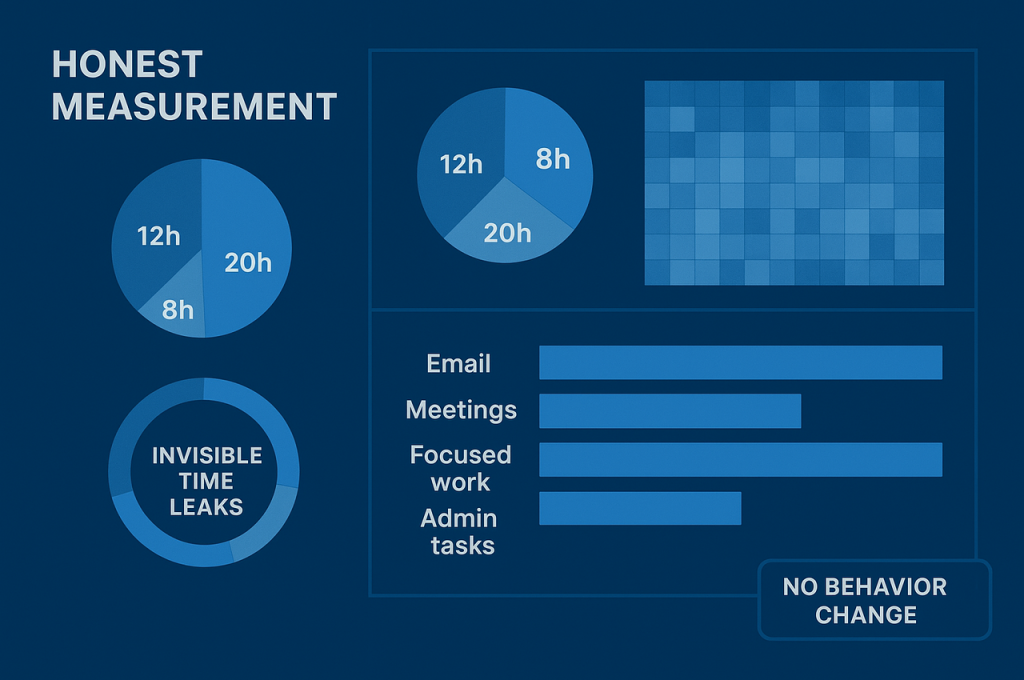
Quantify average time spent per category with brutal honesty. If email actually consumed **12 hours** this week, write down 12 hours—not the 6 hours you wish it took. These precise numbers become reference points proving ROI later.
Create a simple spreadsheet documenting baseline metrics: total work hours, distribution across major categories, time in meetings versus focused work, and percentage of time on strategic versus operational activities.
Select your two initial targets based on combination of time consumed and emotional pain. Perhaps email management drains 10 hours weekly and frustrates you constantly. Maybe meeting overhead wastes **8 hours** and leaves you exhausted.
Week 2: Implementing AI quick wins.
The second week launches tactical AI implementation on your two chosen domains. Start with AI email automation since this affects multiple daily touchpoints and generates noticeable relief quickly.
Configure AI-powered smart filters creating three priority buckets. **Urgent** requires action within 24 hours. **Important** needs thoughtful response but not immediately. **Informational** can be batch-processed once daily.
Modern AI email clients learn from your behavior patterns automatically, improving categorization accuracy weekly. Initially you’ll need to manually correct some classifications, but the AI system adapts surprisingly fast.
Enable AI-powered suggested responses for common message types. Meeting requests, confirmations of receipt, status updates, and standard questions all follow predictable patterns. The AI system generates contextually appropriate replies you can approve in seconds.
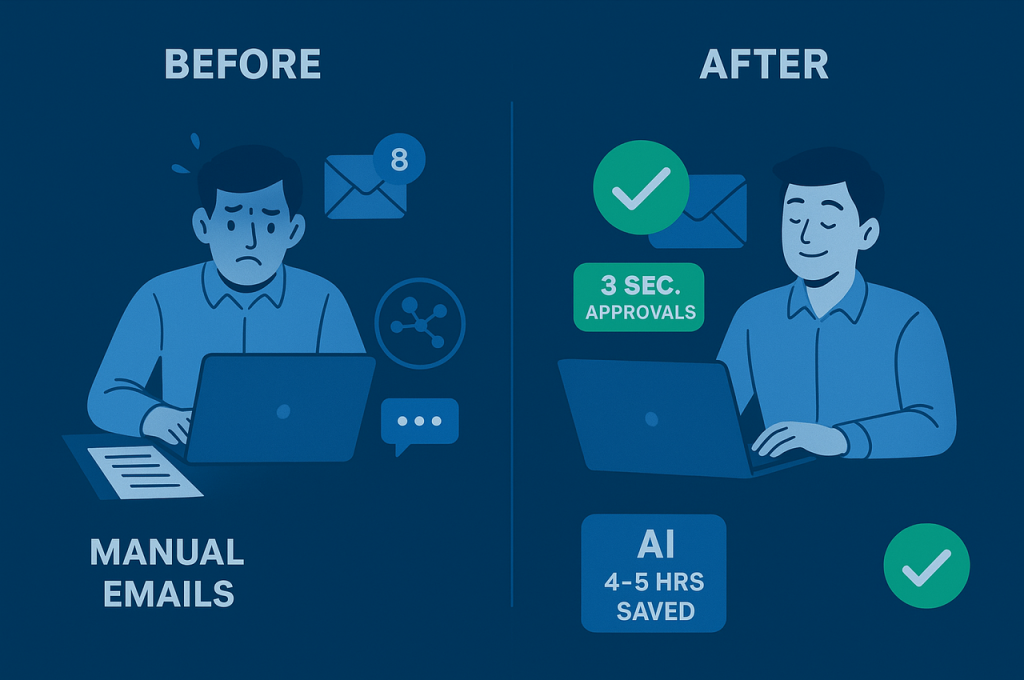
Measure time saved rigorously by tracking email processing duration this week versus last week’s baseline. According to user reports, most entrepreneurs discover significant reduction immediately even before full optimization.
For meeting automation, implement AI transcription and summarization using Otter or Fireflies. Join one AI tool to your video conferences and let it capture everything automatically. After meetings you’ll receive transcripts with speaker identification, action items extracted, and summary generated.
Review the first few AI transcripts to verify accuracy, then start relying on them instead of manual documentation. This frees complete attention during conversations, improving engagement and meeting quality.
Calculate time recovered by comparing previous post-meeting documentation burden against current AI review time. The typical **45-minute** writing session can shrink to **10-minute** verification. Across five weekly meetings, that’s nearly **3 hours reclaimed**.
Document your results in the tracking spreadsheet. You should see measurable reduction in both email and meeting time already. These early wins prove the approach works.
Week 3: Expanding AI automation scope.
The third week broadens AI implementation to three additional high-impact areas now that you’ve proven the concept works. Confidence from week two victories enables tackling slightly more complex automation.
Information research represents low-hanging fruit for most knowledge workers. How often do you spend **20 minutes** hunting for a document, regulatory detail, or competitive intelligence? Those searches repeated dozens of times monthly add up to substantial time.
Implement AI-powered research assistants that find, synthesize, and cite sources automatically. These AI tools can significantly reduce research time according to user reports while often improving quality through more comprehensive source coverage.
Practice using AI research assistants for real work questions throughout the week. Track three metrics: total searches performed, time saved per search, and quality of results compared to manual research.
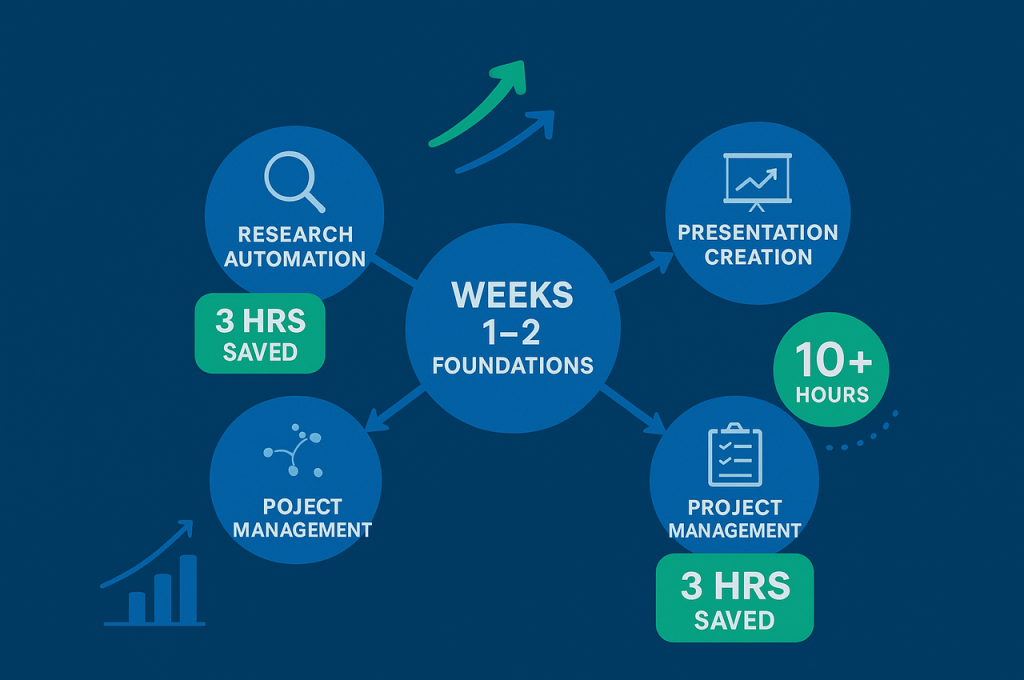
Presentation creation consumes disproportionate time for many entrepreneurs. Structure development, visual design, and formatting can easily absorb **2 hours** for a standard deck. Specialized AI tools now generate complete first drafts in **10 minutes** from brief outlines.
Test AI presentation automation on one real upcoming deck rather than hypothetical example. Provide detailed brief with key messages, target audience, and desired structure. Review the AI-generated draft and calculate time saved. The typical 2-hour project can shrink to **30 minutes** of refinement.
Project management and team coordination represents the third domain for week three. Automate status updates, progress reporting, and bottleneck detection using your existing project management platform’s AI intelligence features.
Configure automatic AI-powered weekly progress summaries that compile from task completion data rather than requiring manual report writing. Set up AI alerts when projects deviate from timeline or budget parameters.
If managing a team, dedicate one **2-hour session** to training on the new AI systems. Adoption multiplies benefits when everyone uses the AI tools. Share your week two results to demonstrate concrete gains.
Week 4: AI optimization and comprehensive measurement
The fourth week focuses on refinement and comprehensive impact assessment. You’ve now implemented AI automation across five domains and accumulated three weeks of comparative data.
Compile your complete metrics showing time allocation before and after across all categories. Calculate total hours saved weekly and annualize to reveal the full magnitude. Most disciplined implementers report reaching up to **10-15 hours** of weekly savings by this point.
Identify friction points that still slow workflows despite AI automation. Perhaps email suggestions need better prompts. Maybe meeting transcription accuracy suffers with background noise. Possibly research queries return irrelevant results.
Dedicate time to optimizing these rough edges. Refine AI email filter rules based on misclassifications. Improve meeting audio setup for better AI transcription quality. Craft more specific research queries.
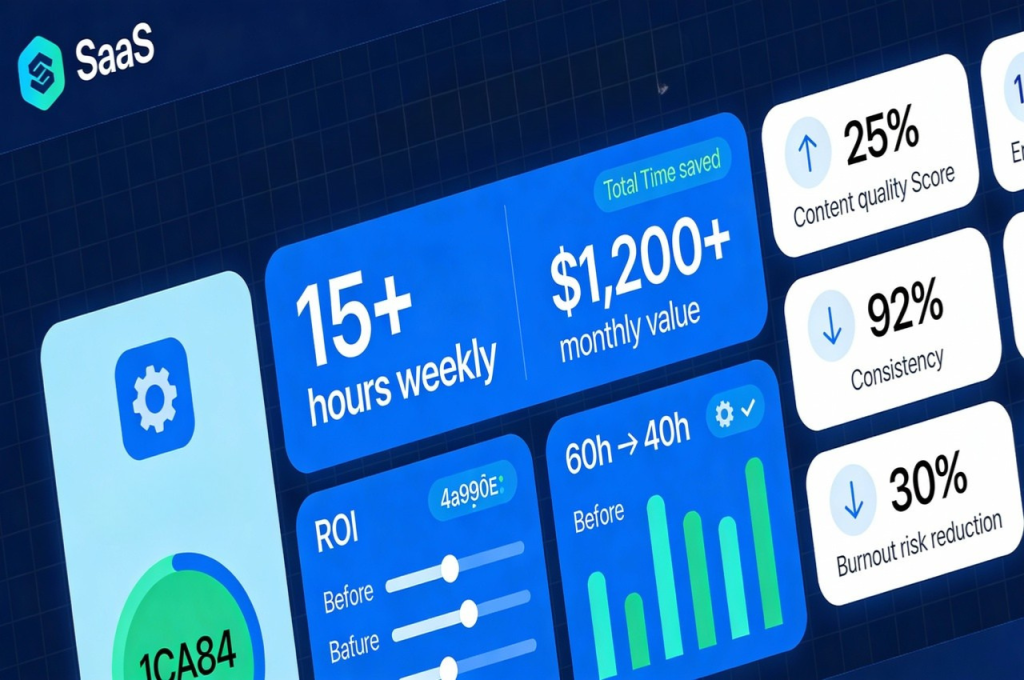
Calculate financial ROI using your actual or target hourly rate. An entrepreneur saving 12 hours weekly can generate substantial recovered capacity monthly. Subtract AI tool costs typically under $50 monthly for net gain.
Document your optimized AI processes in simple wiki or shared document. This knowledge capture ensures you don’t forget configurations during future troubleshooting.
Plan your expansion roadmap for months two and three. Which additional domains warrant AI automation next? What advanced features of existing AI tools remain unexplored?
Real entrepreneur case studies with AI
Sarah runs an e-commerce business that was consuming 65 hours weekly. She implemented this exact four-week AI plan starting with email and meeting automation.
Week one baseline revealed **15 hours weekly** in email and **12 hours** in meetings. By week four she’d reduced email to **6 hours** and meetings to **8 hours**, reclaiming **13 hours** for growth initiatives.
Her revenue remained stable during AI implementation, then showed notable improvement in the following quarter because she finally had time for marketing experiments she’d postponed for months.
Marc consults independently and struggled with maintaining five client accounts simultaneously. His baseline showed **20 hours weekly** on client communication and coordination.
After implementing AI email automation, AI meeting transcription, and automated reporting, his coordination time dropped to **9 hours weekly**. The recovered **11 hours weekly** enabled accepting a sixth client without weekend work.
Julie leads a small marketing agency where she and three team members were drowning in operational overhead. Team AI implementation during weeks three and four multiplied individual gains.
Collectively they recovered **32 hours weekly** across four people through coordinated AI automation adoption. This capacity expansion eliminated the need to hire a fifth person for six months.
Common obstacles and AI solutions
Time investment paradox, strikes most people during week two. You’re spending time learning new AI tools rather than doing billable work. Push through this dip because the learning investment pays perpetual dividends.
Technical difficulties, discourage some implementers who aren’t naturally tech-savvy. Most modern AI tools offer excellent documentation and support. Invest **30 minutes** reading setup guides rather than fumbling through trial and error.
Team resistance, emerges when introducing AI changes affecting others. Frame AI automation as enabling rather than replacing human judgment. Share your personal gains demonstrating concrete benefits.
Tool overwhelm, happens when exploring dozens of options simultaneously. Stick with the specific AI tools recommended for each domain rather than researching alternatives endlessly.
Maintenance neglect, causes AI systems to degrade over time without periodic review. Schedule monthly **30-minute sessions** reviewing AI automation performance and adjusting rules.
Measuring long-term AI sustainability
The true test arrives in months three and six when initial enthusiasm fades. Are the new AI habits sustainable or will you gradually revert to old patterns?
Track adherence to AI automated workflows weekly. Are you still using AI email filters or manually triaging again? Do AI meeting transcripts get reviewed or ignored?
Monitor AI tool engagement through usage statistics. Declining usage signals either poor tool fit or inadequate integration into workflows.
Evaluate whether recovered time gets invested wisely or simply filled with new busywork. The goal is strategic capacity not just different ways to stay busy.
Revisit your baseline metrics quarterly, comparing current state to original measurements. You should see sustained improvement or continued optimization, not regression toward old patterns.
Your next steps
Start this week by implementing the week one baseline measurement. Choose your tracking tool, commit to one full week of honest data collection, and identify your two biggest time sinks.
The transformation begins with measurement, accelerates through quick wins, and compounds through systematic expansion. Each week builds on the previous one, creating momentum that carries you toward sustainable productivity gains.
Document your progress, celebrate your wins, and adjust your approach based on real-world results. The AI tools exist today your decision to begin determines when you’ll reclaim those hours.