

Your schedule is full, your team is moving, and you’re putting in serious hours every week. But at the end of the quarter, you look up and ask the question every founder dreads: “What did we actually accomplish?”
The calendar was packed. The effort was real. But the outcomes the ones that were supposed to move your business forward are barely further along than they were twelve weeks ago.
This is the busy-but-not-growing trap. You’re not losing hours to bad meetings. You’re losing entire quarters to misaligned priorities spending your best energy on work that feels productive but doesn’t compound toward your actual goals. Research shows that 67% of US entrepreneurs don’t conduct quarterly planning, and 80% can’t name their top 3 business priorities this quarter. Without a quarterly goal setting system, you default to urgency over importance, every single week.
This guide introduces a complete AI strategic planning framework built on three pillars: a 12-week OKR system that translates goals into explicit priority allocation, capacity planning for entrepreneurs that prevents overcommitment before it starts, and quarterly reviews that make each planning cycle sharper than the last. Unlike generic OKR tutorials, this isn’t about writing better goals. It’s about using AI-powered strategic planning to treat your quarterly priorities as strategic capital and investing them with the same intentionality you’d bring to any high-stakes business decision.
Let’s start by understanding why the problem isn’t your effort it’s your strategic priority allocation.
Table of Contents
Why most strategic planning fails: The busy-but-not-growing trap entrepreneurs face
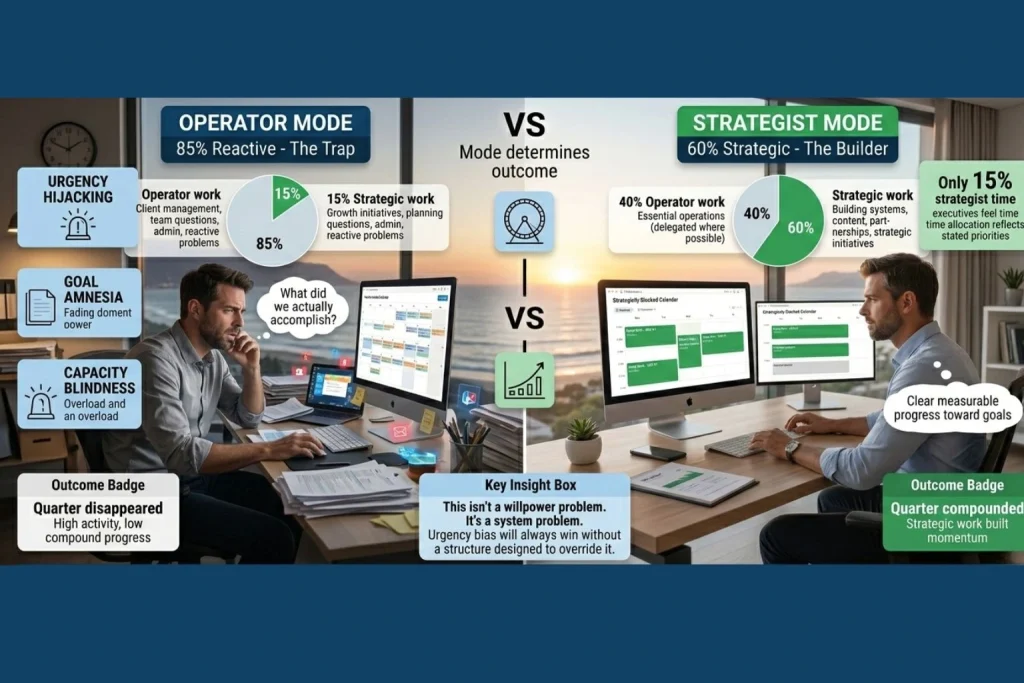
Why strategic planning fails: Operator mode vs strategist mode
Every entrepreneur operates in two distinct modes and the tension between them is the root cause of most quarterly planning failures.
Operator mode is where most founders live. You solve today’s problems, answer the urgent email, handle the client escalation, jump on the unexpected team issue. Operator mode keeps everything from falling apart. It’s necessary, reactive, and relentless. And it has an almost gravitational pull because every operator problem creates immediate discomfort if ignored.
Strategist mode is where growth happens. You step back from the day-to-day to decide what this quarter should build toward, which priorities deserve your best hours, and which work should be cut, delegated, or deferred. Strategist mode creates the conditions for compound progress. And it almost never feels urgent which means it almost always gets sacrificed.
The brutal math: most US entrepreneurs spend less than 15% of their week in genuine strategist mode. The remaining 85% is consumed by operator work client management, team questions, admin, reactive problem-solving. They’re not lazy. They’re trapped in a mode that rewards activity over alignment.
The first step toward breaking this pattern isn’t a better to-do list. It’s recognizing which mode you’re operating in and deliberately protecting time for the one that actually builds your business.
How poor quarterly planning makes entire quarters disappear
Here’s a scenario that plays out across thousands of US businesses every single quarter:
A founder sets ambitious goals in January. They’re motivated, the goals are written down, and for the first two weeks, they’re making real progress. Then February arrives. A key client needs extra attention. A team member has an issue. A new opportunity appears that feels too good to ignore. Week by week, the strategic work gets pushed to “next week” until next week becomes next quarter.
By March, the founder has worked 60-hour weeks and accomplished almost everything except the goals they set in January. They’ve been extraordinarily busy. They’ve moved the needle on almost nothing that matters.
The research is stark: a study from the Harvard Business Review found that only 15% of executives feel their time allocation actually reflects their stated priorities. The gap between what founders say matters and where their hours actually go is the most expensive problem in entrepreneurship and it compounds every quarter it goes unaddressed.
This isn’t a willpower problem. It’s a system problem. And the urgency bias the cognitive tendency to prioritize what feels immediate over what’s genuinely important will always win without a structure designed to override it.
What strategic misalignment really costs your business
When founders think about wasted time, they tend to think in hours an unproductive meeting here, an unnecessary call there. But the real cost of strategic misalignment isn’t measured in hours. It’s measured in quarters.
Consider what one misaligned quarter actually costs:
One quarter of working on the wrong priorities = 12 weeks of intense effort that produces no compound return. Your competitors who did align their quarters around the right goals are now 12 weeks ahead on content, audience, product, or revenue. Four misaligned quarters a full year doesn’t just cost you 12 months. It sets your trajectory back 18 months or more, because the compounding effects you didn’t build in year one are now unavailable in year two.
The strategic misalignment cost isn’t the wasted energy. It’s the compounding you didn’t capture the audience that didn’t grow, the content that didn’t rank, the system that didn’t get built. Every quarter you operate without clear priority alignment is a quarter where your business runs in place while it could have been building.
That’s the real number. And it’s the number that should make quarterly planning non-negotiable.
Three priority traps that kill quarterly goal setting
Before any planning system can work, you need to recognize the specific patterns that derail priority alignment. There are three that appear in nearly every founder’s quarter, regardless of industry or business size.
Pattern 1 Urgency Hijacking. Urgent tasks are psychologically louder than important ones. An unanswered email creates discomfort. Not working on your content strategy this week creates no discomfort at all until six months later when you realize nothing has compounded. Urgency hijacking is what happens when reactive work consistently displaces strategic work, week after week, until the quarter is gone.
Pattern 2 Goal Amnesia. Most founders set quarterly goals with genuine intention. By week four, those goals are buried in a Notion doc they haven’t opened. Without a visible, active tracking system, goals become aspirations nice to have in theory, irrelevant in practice. Goal amnesia is how ambitious plans disappear without anyone making a conscious decision to abandon them.
Pattern 3 Capacity Blindness. Setting three ambitious objectives without calculating whether you have the hours to achieve them isn’t optimism it’s a setup for failure. Capacity blindness is the most common form of quarterly overcommitment, and it’s almost entirely preventable with a simple calculation most founders never run.
No AI tool fixes these patterns on its own. They require a deliberate framework one that addresses alignment, tracking, and capacity before the quarter begins.
→Strategic Time Management for Entrepreneurs: How AI Turns Busy Schedules into Real Business Growth
How does AI turn quarterly goals into strategic priorities?
Why 12-Week cycles beat annual planning
Annual planning fails for a simple reason: twelve months is too far away for your brain to treat as real. When a deadline is a year out, the urgency that drives action never materializes. Goals stay abstract. Priorities drift. By Q3, the annual plan is a historical document with no connection to daily work.
Twelve-week cycles work because they sit in the psychological sweet spot long enough to achieve outcomes that actually matter, short enough to stay urgent throughout. When your planning horizon is 12 weeks, week one is already 8% of the way through. There’s no time to ease in, no runway to coast.
The structural math also works in your favor: four 12-week cycles per year means four clear moments to recalibrate, course-correct, and sharpen your priorities based on what you learned. Annual planners have one. Quarterly planners have four. That’s four times the feedback loops, four times the opportunities to compound on what’s working and cut what isn’t.
Research supports this: teams operating on quarterly planning cycles achieve goal completion rates approximately 3 times higher than those using annual frameworks. The shorter horizon creates the urgency that makes strategic work feel as immediate as operational work.
OKR framework 101 priority allocation edition
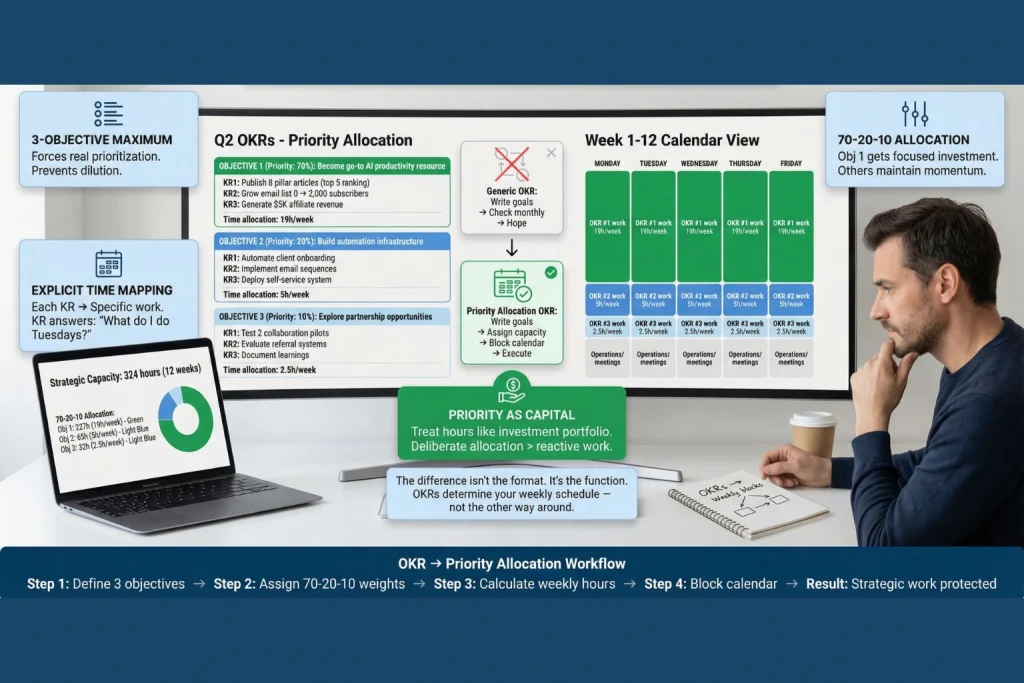
OKR stands for Objectives and Key Results a goal-setting methodology developed at Intel and scaled to global prominence at Google. The standard explanation covers how to write them. What most guides skip is how to use them as a priority allocation tool.
Here’s the distinction that matters:
Generic OKR approach: Write an inspiring Objective. Attach three measurable Key Results. Check progress monthly. Adjust as needed.
Priority allocation approach: Write an inspiring Objective. Attach three Key Results that define exactly which work deserves your strategic hours. Assign explicit capacity weight. Let the OKR structure determine your weekly schedule not the other way around.
The difference isn’t the format. It’s the function. When OKRs are treated as priority allocation tools, every Key Result answers not just “what will I measure?” but “what will I actually do with my Tuesdays?”
A concrete US example for a content entrepreneur:
Objective: Become the go-to AI productivity resource for US solopreneurs.
- KR1: Publish 8 pillar articles that rank top 5 for target keywords by end of quarter
- KR2: Grow email list from 0 to 2,000 subscribers via one lead magnet
- KR3: Generate $5K in affiliate revenue from content-driven organic traffic
Each Key Result implies a specific type of strategic work. KR1 requires 3–4 hours of focused writing per article plus keyword research. KR2 requires building a lead magnet and distribution system. KR3 requires affiliate content strategy and placement. Together, they create a clear picture of where the quarter’s strategic hours need to go before a single week begins.
The 3-objective maximum isn’t a limitation it’s the mechanism. More than 3 objectives means none of them receives the focused investment required to compound.
AI-Assisted OKR creation from vague goal to clear priority map
This is where AI fundamentally changes the planning process not by replacing your strategic thinking, but by accelerating the translation from fuzzy intention to structured plan.
The old way: a founder spends 2–3 hours in a planning session staring at a blank doc, cycling through ideas, writing and rewriting objectives that never quite feel right. They end the session with a plan that’s either too vague to act on or too detailed to remember.
The AI-assisted way: a 25-minute session with a clear prompt structure that produces a draft plan you can react to and refine.
Start with this prompt: “I’m a [role] building [type of business]. My main business priority for Q[X] is [one sentence]. Help me create 3 OKRs each with 1 Objective and 3 Key Results framed as priority allocation. Each KR should be specific, measurable, and achievable in 12 weeks. Also suggest a 70-20-10 capacity weight across the three objectives.”
The AI output gives you a structured starting point. Your job is to react: does this reflect your actual priorities? Are the KRs ambitious but realistic? Does the capacity weighting match where you believe your highest leverage is?
This iterative reaction human judgment refining AI structure produces better plans faster than either approach alone. Use Claude or ChatGPT for the drafting; use Notion AI to connect your OKRs to your existing project notes; use Tability or Coda to track KR progress through the quarter.
Goal alignment test: Validate your quarterly plan before you start
Before finalizing any quarterly plan, run every OKR through three alignment questions. If any answer is “no,” revise before the quarter starts not after week six.
Question 1: If I achieve these three Key Results, am I meaningfully closer to my annual business goal? If the honest answer is “not really,” the OKRs are measuring the wrong things. Busy work can produce impressive-looking KRs with zero strategic impact.
Question 2: Do these Key Results require hard choices stopping or deprioritizing something I’m currently doing? Real priorities create real tradeoffs. If you can add three new OKRs without cutting anything, they’re additions to your workload, not strategic priorities. A quarterly plan that requires no sacrifice isn’t a strategic plan it’s a wishlist.
Question 3: Can I achieve these KRs with my actual available capacity this quarter not in an ideal world, but in the real one? This question leads directly to the next section. Until you’ve calculated your net strategic capacity, you cannot honestly answer it.
→AI-Assisted OKRs: How to Set Quarterly Goals That Actually Stick
With clear OKRs defined and aligned, the next challenge is ensuring your plan is actually achievable and AI makes this calculation faster than you’d expect.
How does AI Capacity planning stop quarterly overcommitment?
Why founders overcommit every quarter
Planning optimism bias is well-documented in behavioral economics and it hits entrepreneurs harder than most. When you plan, you’re imagining a smooth version of the future: full energy, no unexpected client escalations, no team issues, no life events. That version of the future never arrives.
The US hustle culture amplifies this bias. The cultural narrative that ambitious people find a way to get it all done makes overcommitment feel virtuous. If the plan doesn’t feel like a stretch, you’re not trying hard enough.
The result: research shows that 70% of quarterly goals fail not because of poor strategy but because of overcommitment. Founders set targets that would require 20% more hours than they actually have, then spend the quarter wondering why they’re falling behind despite working constantly.
The hidden capacity drains are the culprit. Client calls, team check-ins, email and Slack, admin and operations, unplanned requests these typically consume 35–45% of a founder’s available hours before a single strategic task gets touched. Most founders plan as if these drains don’t exist. Capacity planning makes them visible, quantifiable, and manageable.
The 12-Week capacity formula
Run this calculation before committing to any quarterly plan:
Step 1 Gross capacity: Weekly available hours × 12 weeks. Example: 45 hours/week × 12 = 540 gross hours
Step 2 Subtract capacity drains: Estimate your weekly drain total meetings, communication, admin, reactive work. A conservative starting estimate for most founders is 40%. Example: 540 × 40% = 216 hours lost
Step 3 Net strategic capacity: The hours actually available for OKR work. Example: 540 – 216 = 324 net strategic hours
Step 4 Apply the 70-20-10 rule:
- OKR #1 gets 70% → 227 hours
- OKR #2 gets 20% → 65 hours
- OKR #3 gets 10% → 32 hours
Now look at each OKR and ask: “Is what I’m trying to achieve actually doable in that many hours?”
For most founders running this calculation for the first time, the answer reveals a significant overcommitment. That’s not a failure that’s the calculation working. It’s the difference between discovering the problem in week one versus week eight.
The 12-Week Capacity Planning Calculator (download below) automates this calculation and generates a visual quarterly hour budget across your three OKRs.
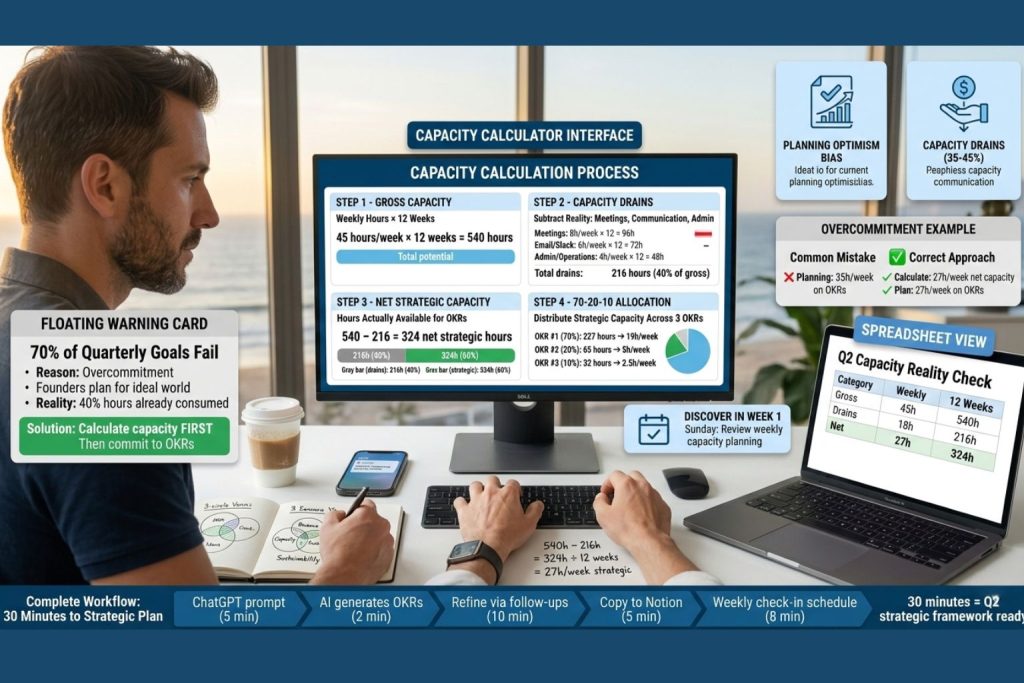
The 70-20-10 priority allocation rule
The instinct to split effort equally across three objectives is understandable it feels balanced, fair, and comprehensive. It’s also reliably ineffective.
When each of three objectives gets 33% of your strategic time, none of them receives the concentrated investment needed to build momentum. You make incremental progress everywhere and breakthrough progress nowhere. It’s the quarterly equivalent of multitasking high activity, low compound return.
The 70-20-10 split creates a deliberate hierarchy:
- 70% to OKR #1 forces the question: what is genuinely my highest-leverage priority this quarter? That answer shapes everything else.
- 20% to OKR #2 keeps a meaningful secondary objective alive without cannibalizing the primary focus.
- 10% to OKR #3 maintains a third initiative at a sustainable pace exploratory, not intensive.
This allocation also changes how you protect your calendar. If OKR #1 gets 70% of 324 hours = 227 hours over 12 weeks, that’s approximately 19 hours per week of focused strategic work on your top priority. Make that a non-negotiable weekly budget, and you have a concrete measure of whether your week served your priorities or didn’t.
AI as your capacity planner ; practical workflow
Once you have your net capacity number, AI accelerates the planning conversation in ways that would take hours manually:
Feasibility check prompt: “I have [X] net strategic hours this quarter. My top OKR is [paste]. It receives 70% of capacity = [Y] hours over 12 weeks. Is this objective and its three KRs achievable in [Y] hours? Break down estimated time per KR and flag anything unrealistic.”
Weekly budget prompt: “Based on [Y] hours for OKR #1 over 12 weeks, create a week-by-week hour budget with monthly milestones. Weeks 1–4 focus on [phase 1], weeks 5–8 on [phase 2], weeks 9–12 on [phase 3].”
The output isn’t a final schedule it’s a realistic blueprint that you adjust based on your actual knowledge of the work involved. The AI accelerates the calculation; you apply the judgment.
→The AI Capacity Planning Framework for 12-Week Business Cycles
With a capacity-validated plan in place, the system is complete except for the piece most founders skip entirely: the quarterly review that closes the loop and makes next quarter smarter.
How do AI-Powered quarterly reviews improve your planning?
Why most quarterly reviews never happen
Only 33% of US entrepreneurs conduct formal quarterly reviews. The reasons are predictable: when a quarter goes badly, the last thing you want to do is analyze exactly how badly it went. When it goes well, forward momentum feels more valuable than looking back. In either case, the new quarter starts before the old one is properly closed.
The cost of this avoidance compounds. Every quarter you don’t review is a quarter whose lessons don’t inform the next one. The capacity miscalculations repeat. The misaligned priorities return with slightly different labels. The same patterns that derailed Q2 quietly derail Q3 because no one stopped to name them.
A quarterly review isn’t a performance judgment. It’s a calibration session a structured opportunity to ask: what did we learn, and how does it change what we do next?
The 90-Minute quarterly review framework: Step-by-Step process
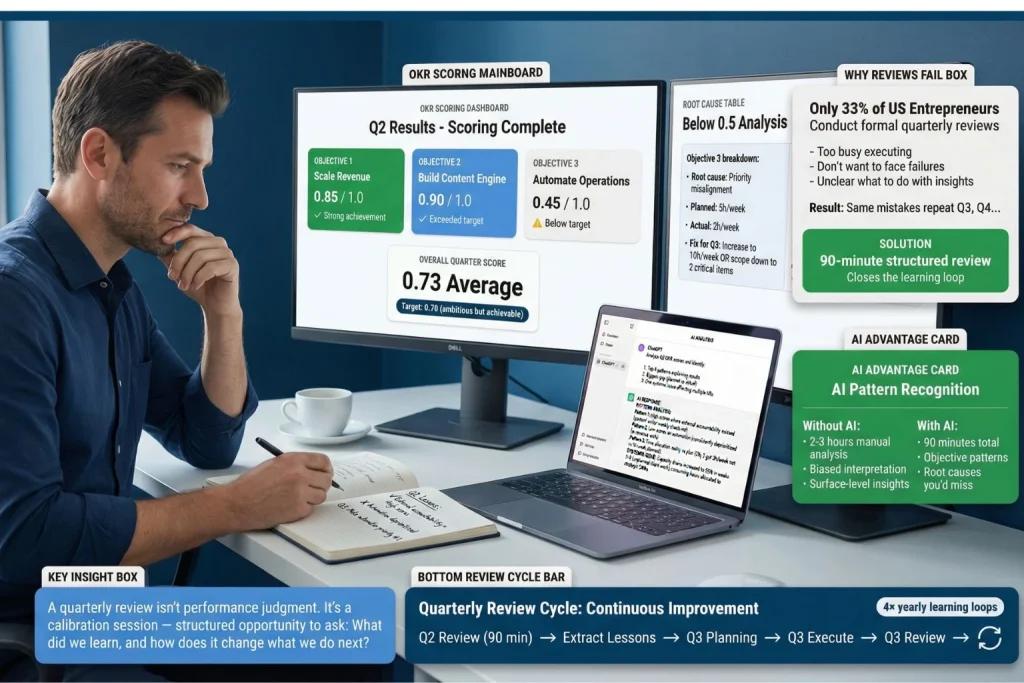
Block 1 / OKR Scoring (0–20 min)
Score every Key Result from 0.0 to 1.0. The target is 0.7 ambitious but achievable. Score against what you committed to at the start of the quarter, not a revised version you quietly adjusted mid-way through. If you planned 8 articles and published 3, that’s a 0.37.
Honesty here is the entire value of the exercise. A generous scoring system produces comfortable feelings and zero learning.
Block 2 / AI Pattern analysis (20–40 min)
Paste your OKRs and scores into Claude or ChatGPT with this prompt:
“Here are my Q[X] OKRs and scores: [paste]. Identify: (1) the top 3 patterns explaining why certain KRs were hit and others weren’t, (2) which Objective showed the biggest gap between planned and actual, and (3) one systemic issue not a one-off event that likely affected multiple KRs.”
AI is remarkably good at identifying structural patterns across results that you’re too close to see clearly. It will often surface a connection you hadn’t consciously made three missed KRs that all required the same type of deep focused work your calendar consistently failed to protect.
Block 3 / Root Cause Analysis (40–60 min)
For every KR below 0.5, identify the structural root cause:
- Capacity overcommitment → resize the KR next quarter
- Priority misalignment → adjust 70-20-10 allocation
- Strategic implementation gap → break KR into monthly milestones before committing
- External factors → build a 10–15% buffer into next quarter’s capacity
“I got busy” is not a root cause. “My drain rate increased from 40% to 62% in weeks 5–8 due to two unplanned client onboardings, which consumed the hours allocated to OKR #1” is a root cause. The specificity is what makes the fix possible.
Block 4 / Q+1 OKR Draft (60–80 min)
Use this prompt to draft next quarter’s plan:
“Based on these Q[X] results and root causes: [paste]. Help me draft 3 OKRs for Q[X+1] that build on what worked, fix the structural issues identified, and are sized for a founder with [X] net strategic hours per quarter.”
One rule: Q+1 OKRs must directly reflect what you learned in Blocks 1–3. If the review showed that OKR #2 consistently lost hours to OKR #1, and you’re replanning Q+1 with the same two objectives at equal weight you haven’t used the review. The output should change something.
Block 5 / Capacity Validation (80–90 min)
Run the Q+1 draft through the capacity formula. Does the plan fit inside your net strategic hours honestly? If not, resize now. Five minutes of adjustment before the quarter starts saves six weeks of frustration mid-quarter.
The course correction decision matrix
For every KR that scored below 0.5, apply this matrix to determine the Q+1 adjustment:
| Root Cause | Q+1 Action |
| Capacity overcommitment | Reduce KR scope to match real available hours |
| Priority misalignment | Replace KR with one better aligned to top objective |
| Strategic implementation gap | Break KR into monthly milestones before committing |
| External factors | Maintain KR, add 15% time buffer |
The cause matters more than the score. A 0.4 caused by a genuine external disruption calls for a different response than a 0.4 caused by consistently deprioritizing the work. Treating them the same produces the wrong fix.
→Quarterly OKR Review & Course Correction with AI: A 90-Minute Framework
The system that compounds
Most entrepreneurs don’t fall short of their goals because they lack ambition or effort. They fall short because they operate without a system that connects their priorities to their time quarter after quarter, at the scale where compounding actually happens.
This framework gives you that system:
Section 1 diagnoses the real problem not time scarcity, but priority misalignment at the quarterly level.
Section 2 provides the OKR structure that turns vague goals into explicit priority allocation, with AI accelerating the drafting process from hours to minutes.
Section 3 adds the capacity formula that prevents overcommitment before it starts replacing optimism bias with arithmetic.
Section 4 closes the loop with a quarterly review that makes each planning cycle measurably smarter than the last.
The compound effect of running this system consistently isn’t a better quarter. It’s a business that builds with precision where each 12-week cycle adds to the last, and strategic progress becomes the default output of your work rather than a fortunate accident.
The founders who build the most aren’t the ones who work the hardest. They’re the ones who invest their quarters most deliberately.