
Automation feels like freedom until you realize you’ve lost control.
Most SMB founders automate to save time, reduce errors, and scale faster. The logic makes sense: delegate repetitive tasks to AI, focus on high-value work, and grow without adding headcount. But somewhere between the first workflow and the tenth, something breaks. A lead gets the wrong email. A task disappears. A decision gets made without anyone noticing.
The problem isn’t the automation. It’s the absence of governance.
Governance sounds corporate, bureaucratic, heavy. But in the context of AI automation for small businesses, it’s the opposite. Governance is the system that keeps you in control while you scale. It’s the difference between automation that amplifies your business and automation that creates invisible risk.
This article explains what AI automation governance really means for SMBs, why it matters, and how to build lightweight control systems that protect your business without slowing you down.
Table of Contents
why automation without governance fails
Automation without governance doesn’t fail loudly. It fails slowly, invisibly, in ways you don’t notice until the damage is done.
loss of ownership
When you automate a process, you transfer responsibility from a person to a system. If no one owns that system, no one monitors it, adjusts it, or fixes it when context changes.
A marketing agency in Chicago automated their client reporting process. The system pulled data from three platforms, generated a PDF, and emailed it to clients every Monday. It worked for six months. Then one platform changed its API. The reports started showing incomplete data. Clients noticed before the agency did. Two clients asked if the agency was still paying attention.
The issue wasn’t technical. It was ownership. No one was assigned to monitor the automation. The team assumed “automated” meant “handled.” It didn’t.
Without clear ownership, automations become orphaned systems. They run until they break, and you only discover the problem when someone complains or revenue drops.
invisible decision drift
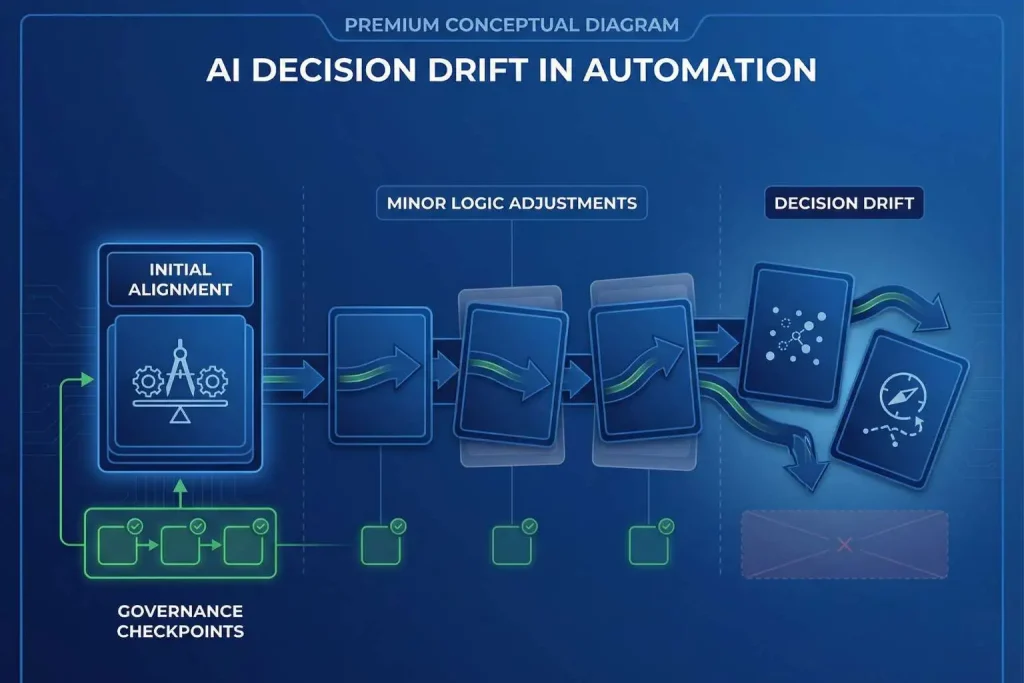
Automations make decisions. Small ones, usually. Send this email, assign this task, update this field, flag this lead. Each decision follows rules you defined at some point. But business context changes. Customer behavior shifts. Priorities evolve. The rules don’t.
A SaaS founder in Austin automated lead scoring using engagement signals. High engagement meant “hot lead.” Low engagement meant “nurture later.” Six months in, the founder realized the system was deprioritizing enterprise leads because enterprise buyers engage differently than solo buyers. The automation was still running the old logic. The founder had moved on, assuming it was working.
This is decision drift. The automation keeps deciding based on outdated assumptions. You don’t notice until you audit, and most founders don’t audit until something breaks visibly.
The cost isn’t just missed opportunities. It’s the false confidence that comes from thinking the system is working when it’s actually degrading.
what AI automation governance really means
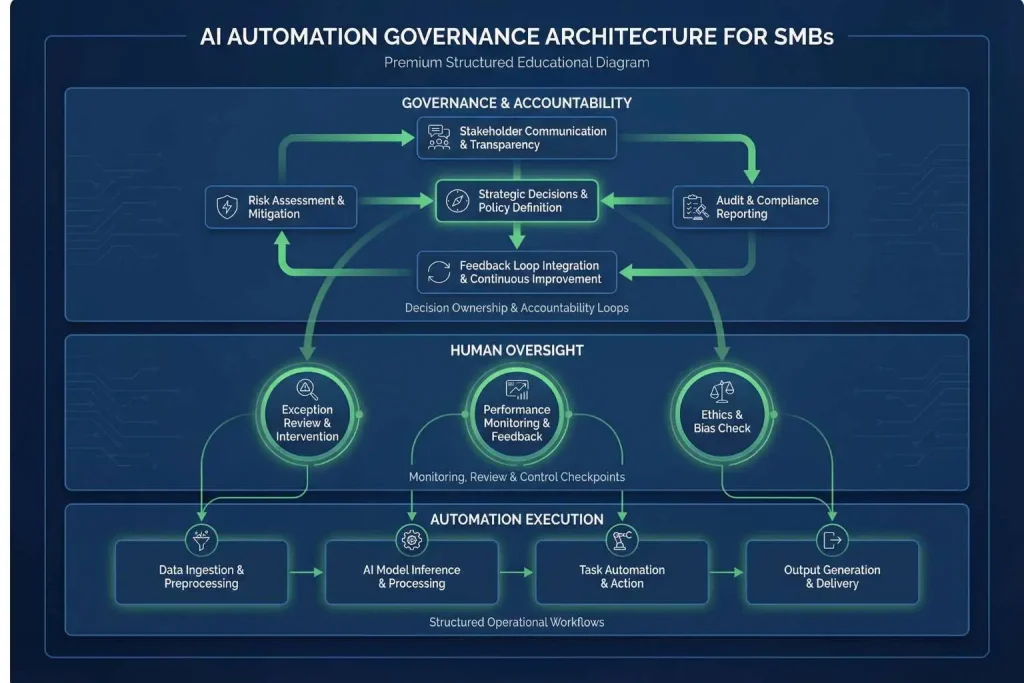
Governance isn’t about adding layers of approval or slowing things down. It’s about maintaining clarity, ownership, and control over the systems running your business.
decision ownership
Every automation makes decisions. Governance assigns a human owner to those decisions. Not to execute them manually, but to monitor outcomes, adjust rules, and intervene when necessary.
For a customer support automation, the owner isn’t the person answering tickets. It’s the person responsible for ensuring the automation handles the right tickets in the right way. That person reviews flagged cases, adjusts routing logic, and decides when to pause the system.
Ownership creates accountability. Without it, automations run unsupervised, and when they fail, no one is responsible for catching it early.
The owner doesn’t need to be technical. They need to understand the business outcome the automation is supposed to deliver and have the authority to change it when it doesn’t.
accountability loops
An accountability loop is a checkpoint that forces review. It’s not bureaucracy. It’s clarity.
For high-stakes automations, like lead assignment or customer-facing communication, accountability loops might include approval steps. A senior team member reviews outputs before they go live. For low-stakes automations, like task updates or internal notifications, the loop might just be a weekly review log.
A real estate agency in Miami automated appointment scheduling. They added a simple accountability loop: every Friday, the operations lead reviewed missed appointments and cancellations. If patterns emerged, the lead adjusted the booking rules. This 15-minute review caught three issues in the first two months, including a timezone bug that was costing the agency client meetings.
Accountability loops don’t slow you down. They prevent slow failures from compounding. The key is making the loop proportional to the risk. High-stakes decisions get heavier loops. Low-stakes decisions get lighter ones.
human-in-the-loop models that work
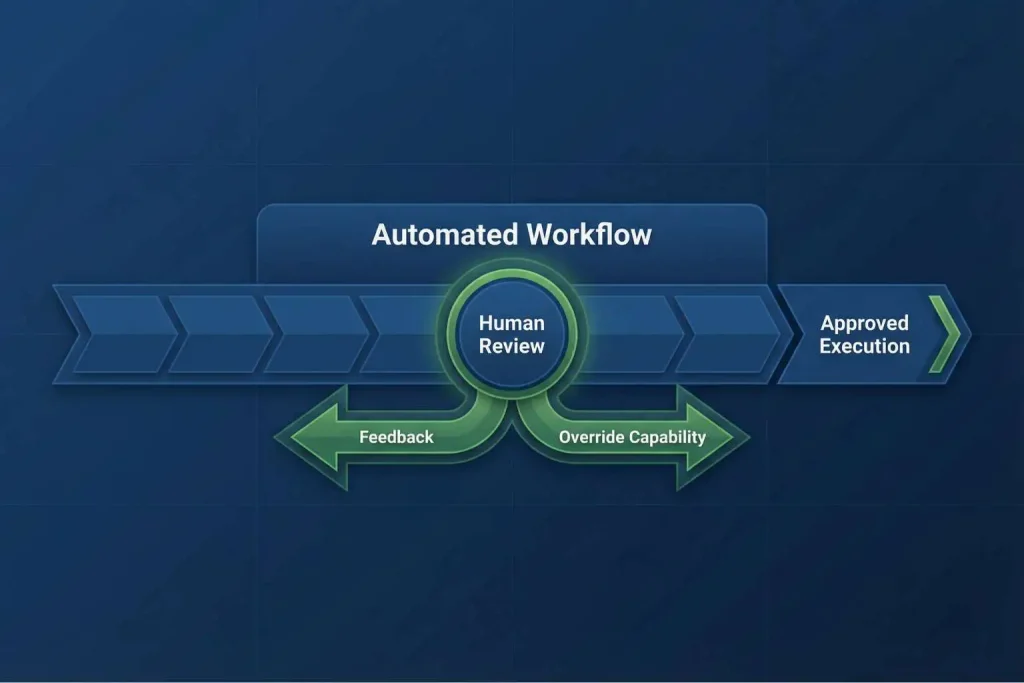
Human-in-the-loop doesn’t mean manual work. It means strategic human checkpoints in automated flows.
approval-based systems
For decisions with meaningful consequences, approval-based systems give you control without killing efficiency.
A consulting firm in Seattle automated contract generation. Clients filled out a form, and the system generated a draft contract using templates and conditional logic. Instead of sending the contract directly, the system routed it to a partner for review. The partner could approve, adjust, or reject. Most contracts went through unchanged. But twice in the first month, the partner caught edge cases the automation couldn’t handle: unusual pricing structures and non-standard deliverables that would have created fulfillment problems later.
Approval-based systems work when the approval step is fast and the consequences of error are high. They don’t work when approval becomes a bottleneck or when approvers stop reviewing carefully because most outputs are fine.
The system has to be designed so that approving is easier than rejecting. If rejection requires more work than manual creation, people will approve everything to avoid the friction.
monitoring and override rules
For lower-stakes automations, monitoring and override rules give you visibility without requiring constant intervention.
A SaaS company in Denver automated customer onboarding emails. The system sent a sequence based on user behavior. The founder didn’t approve every email, but the system logged all sends and flagged anomalies: emails sent to the wrong segment, unusually high unsubscribe rates, or sequences triggered by unexpected events.
The founder reviewed the log once a week. Most weeks, nothing needed attention. But when something did, the founder could pause the automation, investigate, and adjust the rules before the issue scaled.
Monitoring and override rules create visibility. They let you stay in control without micromanaging. The system runs autonomously most of the time, but you have a clear view of what it’s doing and the ability to intervene when necessary.
The rule here is simple: automate execution, but never automate oversight.
governance for SMBs, not enterprises
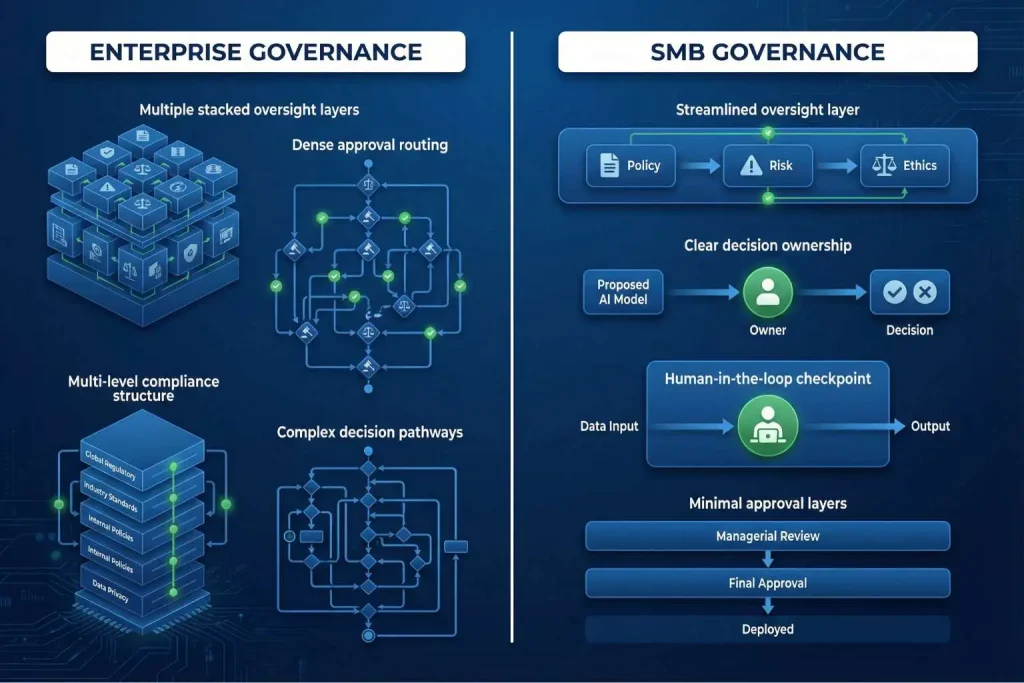
Enterprise governance frameworks don’t work for small businesses. They’re too heavy, too slow, and too expensive to maintain.
SMB governance is different. It’s lightweight, practical, and built around real constraints: limited time, small teams, and fast-changing priorities.
lightweight control models
Lightweight governance means minimal structure with maximum clarity.
For an SMB running five automations, governance might look like this: each automation has one owner, owners review their automations weekly or biweekly, high-stakes automations include approval checkpoints, low-stakes automations log activity for spot-check reviews, and the founder reviews the full automation stack once a quarter.
This isn’t bureaucracy. It’s intentional oversight. It takes less than an hour a week and prevents failures that cost far more time to fix.
A solo founder in Portland automated invoice reminders and client follow-ups. Governance was simple: once a month, the founder reviewed sent emails and adjusted templates based on client feedback. No tools, no dashboards, just intentional review. It worked because it matched the scale of the operation.
The goal isn’t to build a governance system that handles every edge case. It’s to build one that catches the failures that matter before they become expensive.
what not to over-engineer
Governance fails when it becomes a project instead of a practice.
You don’t need approval chains for every automation. You don’t need formal documentation for every rule change. You don’t need oversight meetings or governance committees.
You need clarity on who owns what, regular review rhythms, and the ability to pause or adjust automations quickly when needed.
Over-engineering governance creates friction. It makes people avoid automation because the overhead feels heavier than the benefit. Right-sized governance creates confidence. It lets you automate more because you know you’ll catch problems early.
The test is simple: if your governance system takes more time than the automation saves, you’ve over-engineered it.
connecting governance to the decision framework
Governance doesn’t exist in isolation. It’s the execution layer for the decisions you make about what to automate and how.
from rules to execution
The decision framework helps you determine what to automate, when to automate, and what level of control to maintain. Governance translates those decisions into systems.
If the decision framework tells you a process is high-risk and requires human oversight, governance defines what that oversight looks like: approval steps, review logs, or monitoring thresholds.
If the framework says a process is low-risk and fully automatable, governance still assigns an owner and a review cadence. Even low-risk automations need someone responsible for ensuring they keep working as intended.
Governance without a decision framework is reactive. You build oversight after something breaks. A decision framework makes governance proactive. You design control into the system from the start.
internal links to pillar and traffic magnet
Before building governance systems, you need clarity on which automations to build and why. The AI automation decision framework walks through the strategic decisions that come before governance: how to evaluate what to automate, when automation makes sense, and when it doesn’t.
If you’re unsure whether your current automations are creating risk, start with when not to automate with AI. It identifies common failure patterns and helps you recognize where governance gaps might exist.
Governance isn’t the first step. It’s the system that protects the decisions you’ve already made.
what governance gives you
Governance doesn’t slow you down. It protects your ability to scale.
With governance, you can automate confidently, knowing you’ll catch issues before they compound. You can delegate decisions to systems without losing control. You can scale operations without adding constant manual oversight.
Without governance, automation becomes a liability. Systems drift. Decisions go unmonitored. Small failures accumulate into big problems.
The difference between automation that works and automation that fails quietly is governance. Build it early, keep it lightweight, and treat it as a core part of your automation strategy, not an afterthought.