
Emily’s Austin Shopify store burns $20,000 monthly on unproven AI pilots while Jake’s Chicago operation faces $5,000 GPU bills without clear payback periods. Infrastructure, data preparation, and talent costs compound without ROI decision frameworks ranking projects by payback horizon. Cost breakdown templates and investment calculators help mid-size US retailers allocate resources strategically. Understanding cost governance supports sustainable AI adoption.
The cost structure: what you’re actually paying for
When you say “AI costs too much,” what exactly are you paying for?

Software licensing is obvious. A recommendation engine platform might charge $500-2,000 monthly based on transaction volume. An inventory forecasting tool might be $1,000-3,000 monthly.
What you don’t see: data preparation. Before any AI runs, your data must be clean. Product descriptions need standardization. Inventory records need validation. Customer data needs deduplication. If you have 10,000 products and your data is messy, hiring someone to clean that data costs $8,000-15,000. If you do it internally, it’s still 100-150 hours of your team’s time, costing $5,000-10,000 in opportunity cost.
Integration costs hide too. Your AI needs to connect to your systems. If you have five integration points and each requires custom development, that’s $10,000-25,000.
Personnel time costs accumulate. Someone needs to select the AI platform. Someone needs to oversee implementation. Someone needs to monitor performance. If you allocate one person at 30% capacity for six months, that’s $15,000-20,000 in salary cost.
Training costs appear during launch. Your team needs to learn the system. External training might cost $2,000-5,000. Internal training (someone training the team) costs time.
Ongoing maintenance recurs monthly. The AI needs monitoring. Performance degrades, so periodic retraining is necessary. Budget 10-15% of annual implementation cost for annual maintenance.
A typical mid-size AI implementation:
| Cost Category | Amount |
|---|---|
| Software (annual) | $15,000 |
| Data preparation (one-time) | $12,000 |
| Integration (one-time) | $18,000 |
| Personnel time (annual) | $25,000 |
| Training (one-time) | $3,000 |
| Maintenance (annual) | $5,000 |
| Total Year 1 | $78,000 |
| Total Years 2+ | $23,000/year |
This is realistic. Not cheap, but not prohibitive either.
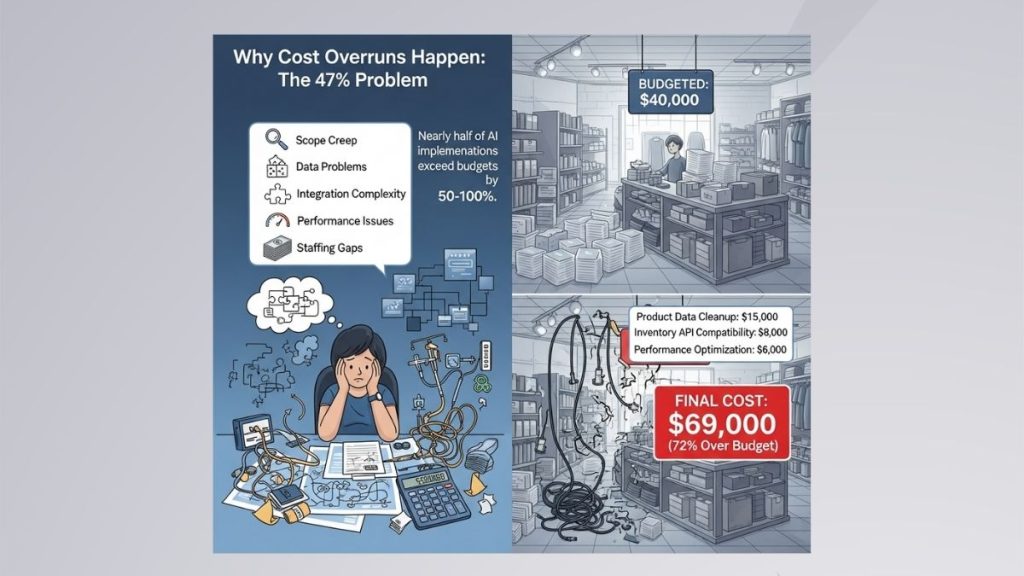
Why cost overruns happen: the 47% problem
Nearly half of AI implementations exceed budgets by 50-100%.
Scope creep is the primary culprit. You start implementing recommendation AI. Mid-project, someone says “while we’re at it, let’s add dynamic pricing.” Suddenly your scope doubled but your timeline didn’t.
Data problems multiply costs. You thought your data was 80% ready. It’s actually 40% ready. Cleaning the remaining 60% takes twice as long as anticipated.
Integration complexity emerges. You assumed your inventory API would work with the AI. Testing reveals incompatibilities. You need a middleware layer. That wasn’t budgeted.
Performance issues require rework. You implement the AI. It works but slowly. Optimizing performance requires engineering time you didn’t budget.
Staffing gaps force outsourcing. You planned internal implementation. Your team gets pulled onto other projects. You hire contractors at 2x internal staff rates.
Austin retailer example: Budgeted $40,000 for a recommendation engine. Discovered mid-project that product data required $15,000 in cleanup. Inventory API compatibility issues required $8,000 in middleware development. Performance optimization added $6,000. Final cost: $69,000. That’s a 72% overrun.
The cost estimation framework: getting it right
Estimating AI costs requires breaking the project into components and estimating each.
Software component: Research platforms, get pricing, budget accordingly. Most scale based on transaction volume or data size. Get a quote for your specific scale.
Data preparation component: Audit your current data quality. How many product records need enhancement? How many customer records have issues? Estimate the time to fix each category. Multiply by your hourly cost.
Integration component: List every system your AI needs to connect to. For each connection, estimate: simple API integration (12-20 hours dev time, $2,000-3,500), middleware development (40-60 hours, $6,000-10,000), or major rework (100+ hours, $15,000+).
Personnel component: List the people involved and how much time they’ll spend. Be realistic about actual time allocation.
Training component: How much time will your team spend learning? How much external training do you need?
Ongoing maintenance: Allocate 10-15% of implementation cost annually.
Add it all up. That’s your realistic budget.
Miami retailer example: Running this framework for a pricing optimization project revealed true cost was $52,000 (initial estimate: $35,000). They made an informed decision based on ROI. They proceeded and hit budget because they’d estimated correctly.
Setting ROI thresholds: when AI makes economic sense
Not every AI project makes economic sense. You need decision thresholds.
For cost-reduction initiatives (inventory forecasting, supply chain optimization), the ROI calculation is straightforward. If current inventory carrying cost is $100,000 annually and AI reduces that by 12%, that’s $12,000 annual benefit. If implementation cost is $20,000, you break even in 1.67 years. That’s reasonable.
If AI reduces carrying cost by 3%, that’s $3,000 annual benefit. Breaking even in 6+ years is poor ROI. Don’t do it.
For revenue-increasing initiatives (recommendations, dynamic pricing), the math is similar but more uncertain. If current conversion rate is 2% with 100,000 monthly visitors and $100 average order value, that’s $200,000 monthly revenue.
If AI increases conversion to 2.3%, that’s $230,000 revenue. Additional profit (40% margin): $12,000 monthly or $144,000 annually. Implementation cost of $40,000 breaks even in 3.3 months. Excellent ROI.
Your threshold should be: Don’t implement unless ROI payback is under two years for cost-reduction projects, under one year for revenue projects. This seems harsh, but it forces honest evaluation.
Comparative ROI: AI versus other investments
Before committing to AI, compare ROI to alternative investments.
Conversion rate optimization (CRO) consulting: $15,000-40,000, 4-6 months, achieves 5-15% conversion lift. ROI: 100-400% over two years. Payback: 8-18 months.
Email marketing platform & strategy: $5,000-15,000 annually, achieves 10-25% customer lifetime value lift. ROI: 200-600%. Payback: 3-8 months.
Recommendation AI: $40,000-80,000 implementation, $15,000-25,000 annually, achieves 8-15% conversion lift. ROI: 150-400%. Payback: 6-14 months.
Inventory AI: $30,000-60,000 implementation, $10,000-15,000 annually, achieves 5-15% inventory cost reduction. ROI: 50-150%. Payback: 12-24 months.
AI compares well to alternatives when properly implemented. The choice depends on your specific situation: low conversion rate? CRO or recommendation AI. Weak email performance? Email platform. Expensive inventory? Inventory AI.
Cost control: avoiding overruns
You prevent cost overruns through disciplined project management.
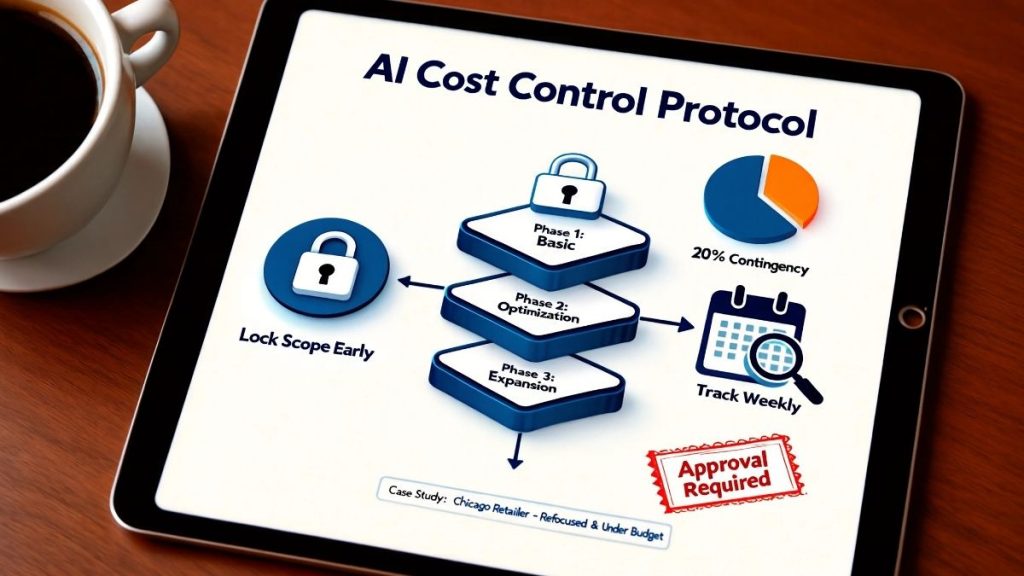
Lock scope early. Decide what the AI will and won’t do. Any scope changes require formal approval and budget adjustment. This prevents “while we’re at it” additions.
Break implementation into phases. Phase one: basic implementation. Phase two: optimization. Phase three: expansion. Gate by success metrics.
Allocate contingency. Most AI projects encounter surprises. Budget an extra 15-20%.
Track costs weekly. Don’t wait until month-end to discover overruns. Weekly tracking catches problems immediately.
Require approval for overages. This creates a forcing function for correcting course.
Chicago retailer example: Implemented strict cost controls. When their recommendation engine project hit 60% of budget with only 50% of work complete, they paused to reassess. They discovered scope had drifted (over-engineering features). They refocused on core functionality. They completed on time and under budget.
Staffing decisions: build versus buy
A major cost variable is staffing. Do you hire staff internally or external consultants?
Internal hiring: Upfront costs (salary, benefits, productivity ramp). Long-term, cheaper per project.
External consulting: Higher per-hour cost but temporary. You pay only for work done. Short-term, cheaper.
If you’re doing one AI project, hire consultants ($40,000-80,000 total).
If you’re planning multiple AI projects, hire a data scientist ($100,000-130,000 annually). First project costs $150,000 (salary + implementation). Second project costs only $50,000 additional salary. By project three, you’ve broken even compared to external consultants.
Measuring actual ROI: avoiding inflated claims
After implementing AI, measure actual ROI honestly.
Set baseline metrics before implementation. Measure identical metrics after. Account for external factors. Run statistical tests. A 2% conversion increase might be random noise.
California retailer example: Claimed 30% conversion lift from recommendation engine. Investigation showed they’d also changed homepage layout, launched new email campaign, and ran a sale. Isolating just the recommendation engine impact, the real lift was 7%.
Honest measurement prevents crediting AI for improvements it didn’t create.
The investment decision framework
Here’s your framework for deciding whether to implement an AI initiative:
- Calculate implementation cost (software, data, integration, personnel, training)
- Estimate annual benefit (revenue increase or cost reduction)
- Calculate payback period (cost divided by annual benefit)
- Apply your threshold (one year for revenue, two years for cost projects)
- If payback exceeds threshold, don’t do it unless circumstances are unusual
- During implementation, track costs weekly and measure results honestly
Your current AI projects: running the framework retroactively
If you already have AI projects running, apply the framework retroactively.
What was actual implementation cost? What’s actual annual benefit? What’s actual payback period? Is it worse than expected? Why? If payback is poor, should you continue, pivot, or kill? Make deliberate choice, not default. If payback is good, what did you do right? Replicate for future projects.
The bottom line
AI cost management isn’t about preventing AI adoption. It’s about ensuring AI you do adopt generates real business value.
Retailers who manage costs properly implement AI faster, spend less, and achieve better results.
For comprehensive guidance on establishing cost governance, setting approval workflows, and sequencing AI projects for maximum ROI, explore our detailed [guide on building AI governance frameworks for e-commerce retailers].