
Your marketing team of 3 people competes against companies with marketing departments of 30. They have specialists for email, social media, paid ads, content, and analytics. You have one person wearing all those hats, plus answering customer calls.
Traditional advice says “hire more people” or “do less marketing.” AI marketing automation for small businesses says something different: make your 3-person team perform like a 15-person team in the channels that matter most.
This isn’t about replacing human creativity with robots. This is about automating the repetitive execution so your team focuses on strategy, creative work, and high-value customer interactions. The email sequence that nurtures 100 leads? Automated. The social posts scheduled across 4 platforms? Automated. The follow-up when someone abandons their cart? Automated.
Small businesses using AI marketing automation for small businesses see 30-50% more qualified leads without increasing headcount, respond to prospects in minutes instead of hours, and scale campaigns to thousands of contacts while maintaining personalization that feels one-to-one.
The playbook below shows you what to automate (and what not to), which tools deliver ROI for businesses with $300K-$2M revenue, and how to launch your first automated campaign in 7 days not 6 months.
If you haven’t automated your business operations yet, start with our business automation foundations guide first. But if operations are handled and you’re ready to automate growth, this playbook is your starting point.
Table of Contents
What is AI marketing automation? (Clear US-focused definition)
AI marketing automation for small businesses uses artificial intelligence to execute, optimize, and personalize your marketing campaigns across multiple channels with minimal manual effort.
Here’s what it means in practice:
When someone downloads your lead magnet at 11 PM, AI automation AI marketing automation for small businesses immediately sends a welcome email, adds them to your CRM with proper tags based on which resource they downloaded, triggers a 5-email nurture sequence customized to their industry, and notifies your sales team if they’re a hot lead-all before you wake up.
When you publish a blog post, AI automation creates 6 social media posts with different angles, schedules them across LinkedIn, Twitter, and Facebook at optimal times for each platform, monitors engagement, and re-promotes top performers automatically.
When a prospect visits your pricing page three times but doesn’t convert, AI automation scores their intent, triggers a personalized email addressing common objections, and suggests the best next action based on similar customer behaviors.
What marketing automation is NOT:
It’s not sending generic blast emails to your entire list. It’s not posting the same content to every social platform. It’s not replacing strategy with algorithms. And it’s definitely not “set it and forget it”-it’s “set it and optimize it.”
The Four types of AI ;arketing qutomation for small businesses
Email marketing Automation: Triggered sequences, behavioral segmentation, send-time optimization, A/B testing at scale.
Social media Automation: Content scheduling, engagement monitoring, comment responses, performance-based re-promotion.
Lead nurturing Automation: Scoring, segmentation, personalized content delivery, sales handoff triggers.
Campaign analytics Automation: Performance tracking, attribution modeling, report generation, optimization recommendations.
Most successful AI marketing automation for small businesses strategies integrate all four working together automatically.
Core benefits of AI marketing automation for small businesses
AI marketing automation for small businesses is about growth, not just efficiency. Marketing automation benefits manifest differently than operations automation.
Lead generation at scale (The primary benefit)
Traditional marketing means manually reaching out to 10-20 prospects weekly. AI marketing automation for small businesses changes this nurturing 1,000+ leads simultaneously with personalized content.
According to HubSpot’s Marketing Report, businesses using marketing automation generate 451% more qualified leads than those relying on manual outreach.
Real numbers from marketing SMBs:
A B2B software company (8 employees, $800K revenue) implemented email automation and social scheduling. Lead generation increased from 45 to 67 monthly qualified leads (+49%) without adding marketing staff. Cost per lead dropped from $89 to $52 (42% reduction).
A local service business (12 employees, $1.1M revenue) automated their follow-up sequences for quote requests. Conversion rate from quote to customer increased from 18% to 29% (+11 percentage points) because automated follow-ups happened consistently within 2 hours instead of “when someone remembered.”
At an average customer value of $3,200, those 11 additional percentage points meant $112,000 additional annual revenue from the same number of leads.
Personalization at scale :The competitive advantage
Your competitors send the same email to everyone. AI marketing automation for small businesses lets you send different emails based on industry, company size, previous interactions, and behavior signals automatically.
Case example: An e-commerce business selling to both B2B and B2C customers created separate automation workflows. B2B buyers received case studies, volume pricing, and partnership opportunities. B2C buyers received lifestyle content, user reviews, and limited-time offers. Same product, different messaging, fully automated. Result: Email conversion rate increased from 2.1% to 3.8% (81% improvement).
Response speed:The deal closer
Research shows 78% of customers buy from the company that responds first. Manual follow-up means 4-24 hour delays. AI marketing automation for small businesses means 2-minute response times.
A real estate agency automated their inquiry responses. Average response time dropped from 4.5 hours to 8 minutes. Lead-to-appointment conversion increased from 18% to 28% — that meant $127,500 additional annual revenue.
Marketing team productivity :The efficiency multiplier.
AI marketing automation for small businesses doesn’t just improve results — it frees your team to focus on strategic work instead of repetitive tasks..
Time savings from automation:
- Email campaign setup: 6 hours weekly → 1.5 hours (75% reduction)
- Social media posting: 8 hours weekly → 2 hours (75% reduction)
- Lead follow-up: 10 hours weekly → 2 hours (80% reduction)
- Report generation: 4 hours weekly → 0.5 hours (87% reduction)
That’s 25.5 hours saved weekly for a typical small marketing team. At a loaded cost of $45/hour, that’s $59,670 annually in time value. More importantly, those hours redirect to content creation, strategy development, and customer relationship building activities that actually grow revenue.
Consistency and brand experience
Every prospect receives the same quality of follow-up. Every customer gets welcomed properly. Every abandoned cart triggers a recovery sequence. AI marketing automation for small businesses ensures your brand promise gets delivered consistently, not just when someone remembers.
Ready to see these results in your business? Download our free Marketing Automation ROI Calculator to estimate your potential savings and revenue growth. Get your custom projection in 5 minutes.
Essential AI marketing automation tools for small businesses
The AI marketing automation for small businesses landscape includes hundreds of tools but most small businesses need only 2-3 platforms maximum to cover email, social, and analytics.
All-in-one marketing platforms
HubSpot marketing hub ($45-$800/month)
- Best for: Businesses where marketing drives growth
- Includes: Email automation, social scheduling, landing pages, forms, CRM, analytics
- Typical ROI: 400-800% first year for businesses fully leveraging the platform
- Setup time: 20-30 hours
- Skill level: Beginner-friendly
When to choose: You’re replacing 3+ separate tools (email platform, CRM, social scheduler, analytics) and need everything integrated.
When to skip: You only need email automation without CRM, or you’re happy with best-of-breed specialized tools.
Email marketing Automation specialists
ActiveCampaign ($29-$150/month for 1,000 contacts)
- Best for: Email-first businesses, e-commerce
- Includes: Advanced automation, predictive sending, behavioral segmentation, CRM
- Typical ROI: 350-700% for businesses where email drives significant revenue
- Setup time: 8-12 hours
Active Campaign’s benchmark data shows businesses using predictive sending see 25% higher open rates on average.
Mailchimp ($13-$350/month)
- Best for: Beginners, simple automation needs
- Includes: Basic automation, templates, simple analytics
- Typical ROI: 200-400% for straightforward use cases
When to choose: Email is your primary customer communication channel and you need sophisticated automation beyond basic workflows.
Social media automation platforms
Buffer ($6-$120/month)
- Best for: Simple scheduling across platforms
- Includes: Post scheduling, basic analytics, team collaboration
- Setup time: 2-4 hours
Hootsuite ($49-$739/month)
- Best for: Teams managing multiple client accounts
- Includes: Advanced scheduling, social listening, detailed analytics
- Setup time: 6-10 hours
Marketing analytics & attribution
Google analytics 4 (Free) + Google data studio (Free)
- Best for: Everyone (it’s free and powerful)
- Includes: Website analytics, conversion tracking, custom dashboards, automated reports
When to add paid analytics: You’re spending $5K+/month on marketing and need sophisticated attribution modeling. Most SMBs don’t need this yet.
Quick Marketing tools comparison
| Platform | Best For | Monthly Cost | Setup Time | Channels Covered | Skill Level |
|---|---|---|---|---|---|
| HubSpot | All-in-one solution | $45-$800 | 20-30 hrs | Email, Social, CRM, Analytics | Beginner |
| ActiveCampaign | Email-first businesses | $29-$150 | 8-12 hrs | Email, CRM, SMS | Beginner |
| Mailchimp | Simple automation | $13-$350 | 4-6 hrs | Email, Basic Social | Beginner |
| Buffer | Social scheduling | $6-$120 | 2-4 hrs | Social Media only | Beginner |
| Hootsuite | Advanced social | $49-$739 | 6-10 hrs | Social Media, Listening | Intermediate |
Selection Framework: Start with email automation (highest ROI). Add social automation if you’re posting 5+ times weekly. Add all-in-one platform if you’re replacing 3+ separate tools.
For detailed setup guides, see our social media automation guide.
Not sure which tool is right for your business? Take our 2-minute Tool Selector Quiz and get a personalized recommendation based on your budget, team size, and marketing goals.
Complete AI marketing automation framework for small businesses
Successful AI marketing automation for small businesses follows a clear framework. Here’s what to automate, in order.
Phase 1: Email automation (Start here)
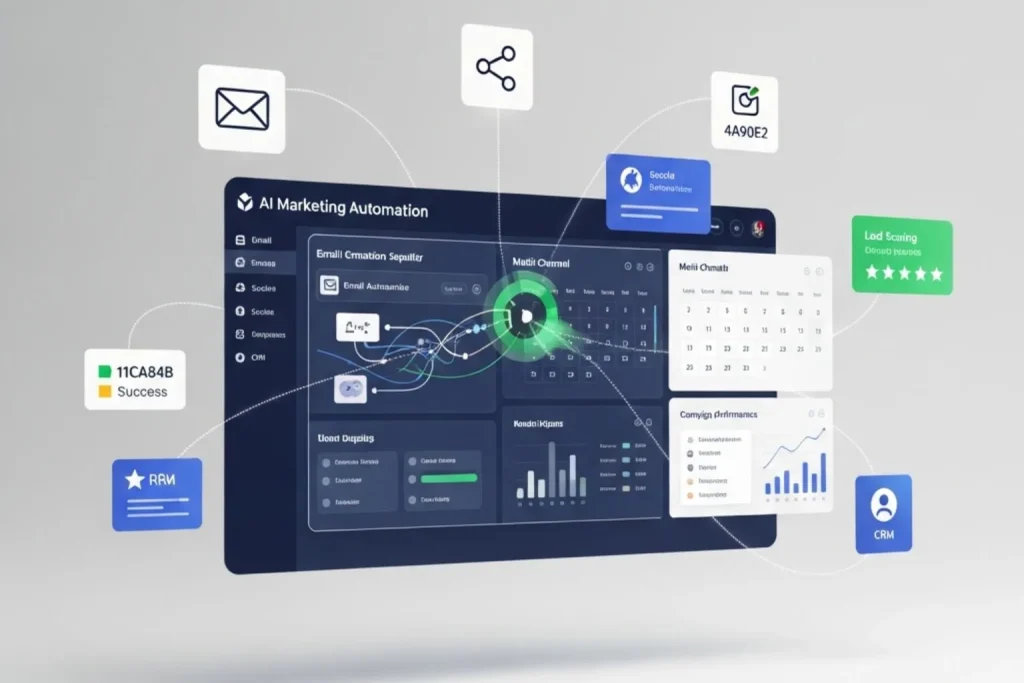
Email delivers the highest ROI of any marketing channel for most small businesses. This is why Phase 1 of any AI marketing automation for small businesses strategy should start with email..
Essential email automations:
Welcome sequence (3-5 emails over 1-2 weeks)
- Triggered by: Newsletter signup, lead magnet download, account creation
- Purpose: Introduce your business, set expectations, deliver initial value
- Result: 40-60% open rates, 5-10% click rates (much higher than regular campaigns)
Lead nurture sequence (5-10 emails over 4-8 weeks)
- Triggered by: Specific lead magnet downloads, demo requests, pricing page visits
- Purpose: Educate prospects, address objections, move toward purchase
- Result: 3-8% conversion rate to sales-qualified lead
Abandoned cart recovery (E-commerce) (2-3 emails over 3-7 days)
- Triggered by: Cart abandonment without purchase
- Purpose: Remind, address concerns, provide incentive
- Result: 10-15% cart recovery rate (industry average)
Re-engagement campaign (3-4 emails over 2-3 weeks)
- Triggered by: 60-90 days of inactivity
- Purpose: Re-activate dormant subscribers before removing them
- Result: 5-12% reactivation rate
Customer onboarding (varies by product)
- Triggered by: Purchase or signup
- Purpose: Ensure successful product adoption, reduce churn
- Result: 15-30% reduction in early churn
For complete email automation setup, see our email marketing automation guide.
Phase 2: Social media automation
In any AI marketing automation for small businesses strategy, social distribution should be automated while engagement stays human.
What to automate:
- Content scheduling (batch-create monthly. schedule at optimal times) .
- Content amplification (auto-share blog posts, repurpose top content) .
- Performance monitoring (track engagement, generate weekly reports)
What NOT to automate:
- Direct responses to comments and DMs
- Real-time engagement (industry news, trending topics, community conversations)
- Relationship building (networking, partnerships, influencer outreach)
Phase 3: Lead generation & nurturing
Lead scoring: Automatically assign points based on behaviors. Trigger sales notifications when leads hit score thresholds.
Behavioral triggers: Automatically notify sales when leads meet qualification criteria. Provide sales with complete activity history.
Phase 4: Campaign analytics & optimization
Automated reporting:
- Weekly performance dashboards delivered to your inbox
- Month-over-month comparison reports
- Channel-specific performance summaries
Attribution tracking
- Automatically tag campaign sources
- Track full customer journey from first touch to conversion
- Identify which channels drive highest-value customers
Optimization alerts
- Notification when campaign performance drops below thresholds
- Alerts for unusually high unsubscribe rates
- Warnings when email deliverability declines
How to Launch your first AI marketing automation campaign 7-day framework
This 7-day framework is designed specifically for AI marketing automation for small businesses with limited time and resources.
The fastest path to results: launch one complete automated campaign in 7 days.
The 7-Day Launch plan overview
- Day 1: Campaign strategy & goal setting
- Day 2: Choose and configure your tools
- Day 3-4: Build email automation sequences
- Day 5-6: Set up social media amplification
- Day 7: Launch, monitor, and optimize
This isn’t a perfect, enterprise-grade campaign. This is a functional, lead-generating campaign that runs while you sleep and improves your results immediately.
Why 7 days works for small businesses: You don’t have 6 months to plan the perfect campaign. You need results this quarter. A good campaign running today beats a perfect campaign launching never. You’ll optimize based on real data, not assumptions.
For the complete day-by-day implementation guide, see our 7-day campaign launch guide.
Measuring AI marketing automation ROI for small businesses
AI marketing automation for small businesses ROI differs from operations automation — you’re measuring revenue impact, not just cost savings.
Primary metrics to track
Lead generation metrics:
- Leads generated (month-over-month growth)
- Cost per lead (should decrease with automation)
- Lead quality score (are automated leads converting?)
Conversion metrics:
- Lead-to-opportunity conversion rate
- Opportunity-to-customer conversion rate
- Time from lead to customer (should decrease)
Revenue metrics:
- Marketing-influenced revenue
- Customer acquisition cost (CAC)
- Return on ad spend (ROAS)
Efficiency metrics:
- Marketing team time saved (hours per week)
- Campaign setup time (before vs. after automation)
- Report generation time
Sample ROI Calculation: Marketing Agency
Background: 12-person marketing agency managing 30 client accounts.
This case study shows how AI marketing automation for small businesses delivers measurable returns within the first year.
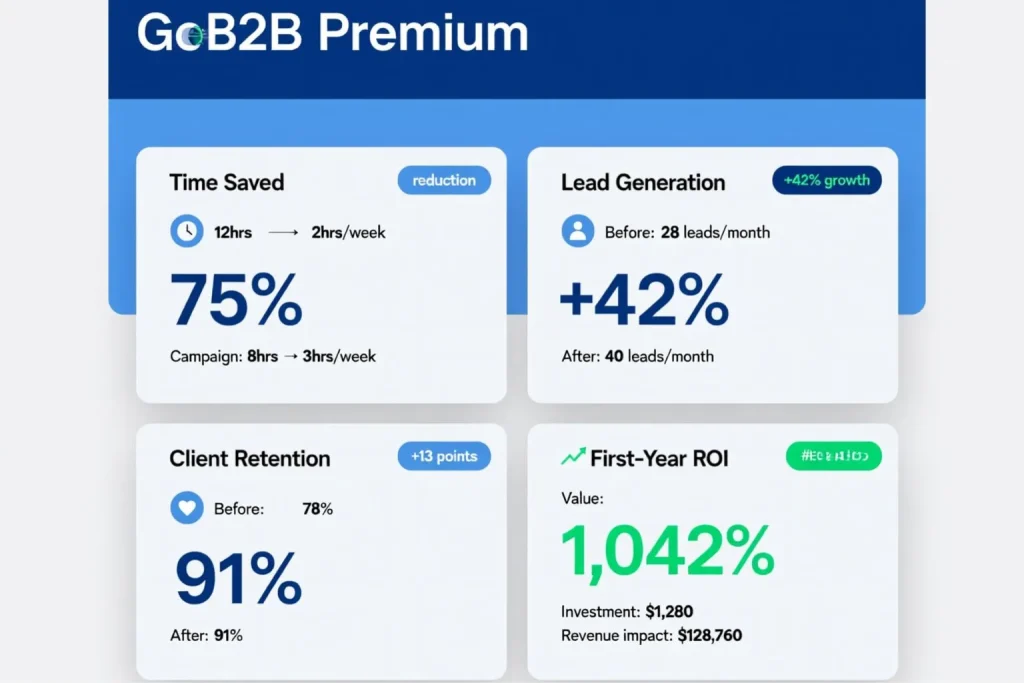
Results after 6 months:
- Client reporting time: 12 hours/week → 2 hours/week
- Campaign management: 8 hours/week → 3 hours/week
- Lead generation for own agency: +42% (from 28 to 40 monthly qualified leads)
- Client retention: 78% → 91% (better reporting built trust)
ROI calculation:
- Investment: $9,600 annually (HubSpot) + $1,680 setup = $11,280
- Time savings: 15 hours/week × $42 loaded rate × 52 weeks = $32,760
- Revenue impact: 4 additional clients retained × $2,000/month = $96,000
- Total ROI: 1,042% first year
Conservative ROI (time savings only): Still 190% first year
For the complete ROI measurement framework, see our AI automation ROI guide.
Common AI marketing automation mistakes for small businesses to avoid
Mistake 1: Automating Before Understanding Your Customer Journey The problem: You build automation workflows before mapping how customers actually move through your funnel. The fix: Map your customer journey on paper first. Identify key decision points at each stage. Then automate messages that address those specific needs.
Mistake 2: Over-Automating and Losing the Human Touch The problem: You automate everything including responses to complex questions. Customers feel like they’re talking to robots. The fix: Automate distribution and routine follow-ups. Keep responses to specific questions and relationship building human.
Mistake 3: Set-and-Forget Mentality The problem: You build automation once and never revisit it. Performance degrades as customer behaviors change. The fix: Schedule monthly automation reviews. Check open rates, click rates, and conversion metrics. Update messaging based on performance data.
Mistake 4: Ignoring Mobile Experience The problem: 60-70% of emails are opened on mobile devices. Your automated emails look great on desktop but terrible on phones. The fix: Test every automated email on mobile before activating. Use responsive templates. Keep subject lines under 50 characters.
Mistake 5: Automating Without Segmentation The problem: You send the same automated sequence to everyone regardless of their industry, company size, or interests. The fix: Segment your audience by relevant criteria. Create industry-specific sequences. Personalize messaging based on behavior and attributes.
Getting started with AI marketing automation for small businesses
Week 1: Foundation
Day 1-2: Map your current customer journey from first touch to purchase. Identify the 3 most frequent paths customers take.
Day 3-4: Choose one marketing channel to automate first (usually email for highest ROI). Select your platform based on your budget and needs.
Day 5-7: Set up your chosen tool. Connect integrations. Build one simple automation (welcome sequence or lead nurture).
Deliverable: One automated email sequence running.
Week 2-4: Expansion
Week 2: Add 2-3 more email automations (abandoned cart, re-engagement, onboarding).
Week 3: Add social media scheduling automation. Build 2 weeks of content in advance.
Week 4: Set up basic analytics and reporting. Track lead generation and conversion metrics.
Deliverable: Multi-channel automation generating and nurturing leads.
Month 2-3: Optimization
Review performance data monthly. Identify what’s working and what’s not. A/B test subject lines, messaging, and timing. Expand successful automations. Eliminate or improve underperforming ones.
For the complete 7-day quick-start implementation, see our 7-day campaign launch guide.
Final thoughts: AI marketing automation for small businesses as growth enginee
AI marketing automation for small businesses isn’t a replacement for marketing strategy it’s an amplifier. A bad marketing strategy automated is still a bad strategy just executed faster at larger scale.
But a good marketing strategy combined with intelligent AI marketing automation for small businesses becomes a growth engine. You nurture hundreds of leads simultaneously while your team focuses on closing deals. You maintain consistent brand presence across channels while your team creates strategic content. You respond to prospects in minutes while your team builds relationships with high-value accounts
The small businesses winning with AI marketing automation for small businesses:
- Start with one channel (usually email) and do it well before adding others
- Maintain human touch in direct interactions while automating distribution
- Optimize continuously based on performance data, not assumptions
- View automation as an ongoing competitive advantage, not a one-time project
- Measure success by lead generation and revenue impact, not just time saved
You have the framework. You have the tools. You have the implementation roadmap. The question isn’t whether to automate your marketing it’s whether you can afford not to while competitors already are.
Launch your first automated campaign this week. Start with our 7-day implementation guide, measure results after 30 days, and expand from there. In 90 days, you’ll wonder how you ever managed marketing manually.
To take your AI marketing automation for small businesses further, explore our specialized guides:
- Email Marketing Automation Guide: Sequence templates, ready-to-use workflows, and advanced segmentation strategies.
- Social Media Automation Strategy: Content planning, recommended tools, and automated engagement tactics.
- 7-Day Implementation Plan: Daily checklists, campaign templates, and step-by-step setup guides.
- Business Automation Foundations: Ensure your core business operations are ready for scaling.